
checkskin.ai
AI-powered skin analysis for everyone. Get insights in under
Introduction
In the procurement of custom precision parts, enterprises often face a dilemma: pay a premium for excessively tight tolerances or endure high defect rates and project delays due to insufficient precision. Data indicates that misconceptions around IT7-grade tolerance requirements can lead to disputes over 40-60% of accepted quantities and defect rates exceeding 8%. The root cause frequently lies in a misalignment of understanding regarding precision capability between buyer and supplier. Traditional supplier audits often fail to quantify the true level of CNC machining precision standards control, resulting in selection errors and cost overruns.
This article deconstructs a data-driven framework for CNC manufacturer selection and precision capability evaluation. It aims to equip readers with a scientific understanding of machining tolerances, enabling effective CNC machining cost control and avoidance of overpriced CNC machining while ensuring quality. The following five core questions will guide a thorough supplier capability assessment.
Why ISO Certificates Alone Cannot Guarantee Dimensional Consistency in CNC Machined Parts?
While foundational, ISO certifications like ISO 9001 attest to a quality management system, not a direct guarantee of machining precision. Many sourcing disappointments with certified suppliers stem from three gaps: missing data on statistical process capability (Cp/Cpk), inadequate measurement systems, and divergent interpretations of a machining tolerance guide. A certificate confirms the existence of procedures but not their effective execution for precision.
The key is quantifying sustained capability. A genuine precision machining assessment moves beyond paperwork to examine long-term Statistical Process Control (SPC) data. This data reveals whether a supplier's processes are statistically capable of consistently holding specified tolerances, or if they rely on sorting good parts from bad. Without this evidence, an ISO certificate is merely a promise, not proof of CNC machining precision standards mastery.
How to See Past the Brochure: Assessing a CNC Shop's True Precision Capability
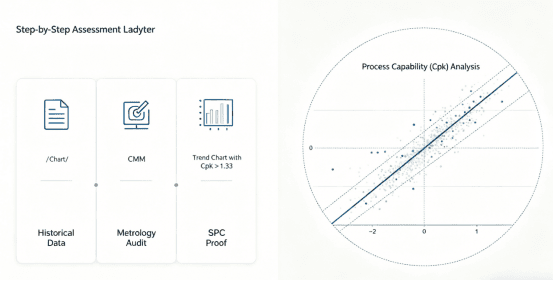
Evaluating real capability requires a structured, evidence-based approach. The first step in how to assess CNC machining precision is to request historical process capability reports for part features similar to yours (e.g., deep holes, thin walls). Generic test coupons are insufficient. Second, scrutinize their metrology: are Coordinate Measuring Machines (CMMs) and optical comparators regularly calibrated? Is there documentation of Measurement System Analysis (MSA) to ensure reliable data? The third and most critical step is auditing SPC control charts for key processes. This verifies if a claimed ±0.025mm tolerance is backed by a Cpk ≥ 1.33 over time, proving stability.
A Three-Step Verification Framework
This systematic framework moves beyond marketing claims to deliver a data-driven precision machining assessment. It methodically verifies a supplier's capability through historical data, metrology rigor, and statistical proof.
l Request Feature-Specific Historical Data
Generic test coupons are insufficient. The first step is to demand historical process capability reports for part features identical or similar to yours, such as deep holes or thin walls.
l Scrutinize Measurement System Integrity
Next, audit their metrology foundation. Verify that equipment like CMMs is regularly calibrated and that a documented Measurement System Analysis (MSA) is in place to guarantee data reliability.
Audit SPC Charts for Proof of Stability
The most critical step is auditing SPC control charts for key processes. This verifies if a claimed ±0.025mm tolerance is statistically backed by a Cpk ≥ 1.33 over time, proving stability. For instance, LS Manufacturing successfully addressed a medical client's complex housing issue. By integrating 5-axis machining with real-time monitoring, they reduced dimensional variation to within 0.012mm, slashing the scrap rate from 12% to 0.8%. This exemplifies the tangible value of partnering with a provider of true tight tolerance CNC machining services, where precision is proven, not just promised.
Which Common Design Over-Specifications Silently Inflate Costs?
Unnecessary cost is often designed in before a tool ever touches metal. A primary driver of overpriced CNC machining is tolerance over-specification. Common pitfalls include applying IT7-grade tolerances to non-functional surfaces, over-dimensioning with excessive datum references that create tolerance stack-ups, and ignoring material properties (like aluminum's thermal expansion) during design. The antidote is a function-based tolerance strategy.
The High Cost of Tolerance Over-Specification
Unnecessarily tight tolerances are a primary source of overpriced CNC machining. This common design mistake directly increases manufacturing complexity, inspection time, and scrap rates, contradicting core principles of smart, cost-effective design.
l Common Design Pitfalls
A primary driver of overpriced CNC machining is applying tight tolerances like IT7-grade to non-functional surfaces. Another is over-dimensioning with excessive datums, creating cumulative tolerance stack-up errors.
l The Overlooked Factor
Ignoring material properties, such as aluminum's thermal expansion during machining and measurement, further jeopardizes precision and inflates cost by demanding unrealistic process control.
Implementing a Function-Based Strategy
The solution is a pragmatic machining tolerance guide. A function-based strategy applies tight tolerances onlyto critical mating or functional surfaces. For all other features, default to general tolerances per standards like ISO 2768-m. This right-tolerance philosophy is central to effective CNC machining cost control. A case study involving an aerospace bracket showed that by relaxing non-critical tolerances and optimizing standard, machining time dropped by 30% and costs by 35%, with no impact on performance. This disciplined approach to avoid overpriced CNC machining starts with intelligent design.
3-Axis vs. 5-Axis CNC: How to Choose the Most Cost-Effective Option for Your Tolerance Requirements?
The choice between 3-axis and 5-axis CNC machining significantly impacts both precision and cost. For parts with prismatic geometries, 3-axis machining is often the most economical. However, for complex components with features on multiple planes, 3-axis machining requires multiple setups. Each new fixture introduces potential error accumulation, challenging the hold of tight positional tolerances.
In contrast, 5-axis machining allows for near-net-shape finishing in a single setup, inherently providing superior geometric accuracy and surface consistency for complex contours. While its hourly machine rate is higher, the total cost for intricate parts can be lower due to eliminated setup time, reduced fixture costs, and fewer secondary operations. A thorough precision machining assessment for CNC machining cost control must evaluate total part cost, not just hourly rates. For parts demanding strict compound angle tolerances, 5-axis machining often delivers higher quality at a competitive total price. To quickly gauge which technology is optimal for a specific design, utilizing a sophisticated online CNC machining services platform that provides instant DFM analysis and comparative quotes can be an invaluable first step.
Beyond the Machine: The Soft Quality Pillars of an Excellent CNC Supplier
Machines are tools; the true differentiator lies in the supplier's operational ethos. The first pillar is proactive Design for Manufacturability (DFM) feedback. Can the supplier's quote include constructive suggestions to simplify geometry or adjust tolerances for cost reduction without compromising function? Second is an ingrained quality culture, evidenced by rigorous First Article Inspection (FAIR) reports and in-process checks, not just final inspection.
Third is the depth of certification. Beyond baseline ISO 9001, industry-specific standards like IATF 16949 (automotive), AS9100D (aerospace), and ISO 13485 (medical) demonstrate a commitment to stringent sector-specific protocols. A supplier like LS Manufacturing, which holds IATF 16949 and ISO 13485 certifications, signals a systemic dedication to the extreme rigor required by automotive and medical clients. These soft pillars—expert DFM, ingrained quality processes, and specialized certifications—are fundamental for consistent output and are critical factors in a comprehensive CNC manufacturer selection process, ensuring the supplier's system supports the advertised CNC machining precision standards.
Conclusion
Selecting the right CNC machining partner is a systems engineering challenge, far beyond unit price comparison. By implementing a data-centric evaluation framework—from digging into real process capability data and optimizing designs to avoid over-tolerancing, to understanding the cost implications of different technologies and holistically judging quality management systems—businesses can resolve the false trade-off between cost and quality. This approach optimizes the supply chain and reduces total cost of ownership.
Do not let vague high-precision promises become a source of project risk. Before initiating your next critical parts project, systematically review potential partners using the checklist above. Seek a partner that provides transparent data and expert DFM analysis as a standard practice.
H2:Author Biography
This article was contributed by a precision manufacturing consultant with over 15 years of experience, specializing in manufacturing supply chain optimization and zero-defect quality system implementation. The consultant has assisted numerous European manufacturing firms in selecting and qualifying precision component suppliers in the Asia-Pacific region.
FAQs
Q1: How can we quickly judge if the tolerance requirements in a CNC quote are reasonable?
A1: Conduct a functional analysis. Differentiate between assembly/functional surfaces and non-functional ones. For non-functional surfaces, ask the supplier if more lenient standards (e.g., ISO 2768-m) can be applied. Applying tight tolerances only to critical features often immediately reveals significant cost-saving opportunities.
Q2: When evaluating a supplier, what key quality documents should we look for besides Cpk values?
A2: Request the Measurement System Analysis (MSA) report to ensure measurement reliability, and the First Article Inspection Report (FAIR) to understand their initial quality control process. Material Test Certificates (MTCs) for raw materials also reflect their supply chain control level.
Q3: For low-volume prototype parts, how can we control costs related to tolerances?
A3: Clearly communicate the prototype's purpose (functional validation vs. aesthetic model). For non-critical dimensions, consider agreeing in writing to use best effort or standard tolerances. Prioritize suppliers that offer tiered pricing and clearly distinguish between standard and high-precision machining costs.
Q4: How does material selection affect the final tolerances and cost of CNC parts?
A4: A material's machinability, heat treatment state, and coefficient of thermal expansion directly impact achievable precision and stability. For example, maintaining the same tolerance in stainless steel is more costly than in aluminum due to greater cutting difficulty and tendency for elastic deformation. Early communication with your supplier on material options is crucial for total cost control.
Q5: What should be the next step if we are unsatisfied with our current supplier's precision?
A5: First, jointly analyze the Non-Conformance Report (NCR) to pinpoint whether it's a design, process, or measurement issue. Request a capability study for the specific problematic process. If issues persist, consider third-party inspection for arbitration or initiate a backup supplier audit process using the systematic assessment checklist from this article.

Your Products Change Rapidly, Does Your Documentation Keep Up?
Modern software products evolve at an incredible pace. New features are released frequently, APIs change, infrastructure is updated, and bugs are resolved continuously. Development teams have adopted faster release cycles to keep up with customer expectations and market demands.
Documentation, however, often struggles to keep pace.
As products evolve, documentation can quickly become outdated, creating a disconnect between what users read and how the software actually works. This phenomenon, commonly known as documentation drift, is a growing challenge for software teams of all sizes.
When documentation falls behind product changes, it affects more than just user experience. It impacts onboarding, support operations, developer productivity, security processes, and compliance efforts.
As development cycles accelerate, relying on manual documentation updates becomes increasingly difficult to sustain, which is why documentation automation is becoming a critical part of modern software development workflows.
The Real Impact of Documentation Drift
Many organizations view documentation as a secondary task compared to product development. Unfortunately, the cost of outdated documentation often becomes visible only after problems begin to appear.
User Frustration and Increased Support Requests
Users depend on documentation to learn features, configure integrations, troubleshoot issues, and understand workflows.
When documentation no longer reflects the actual product, users may encounter:
● inaccurate setup instructions
● outdated feature descriptions
● broken workflows
● missing information
Instead of helping customers succeed, documentation becomes a source of confusion.This often leads to increased support tickets and unnecessary pressure on customer success teams.
Slower Internal Onboarding
Documentation is equally important for internal teams.
New developers frequently rely on documentation to understand:
● application architecture
● deployment procedures
● engineering workflows
● development environments
When information is outdated or incomplete, onboarding slows significantly.
New team members become dependent on senior engineers for answers, creating interruptions and reducing overall team efficiency.As organizations grow, this challenge becomes even more difficult to manage.
Security and Compliance Challenges
For many businesses, documentation is not simply a convenience. It is a requirement.
Security, compliance, and governance teams often need accurate documentation covering:
● system architecture
● software dependencies
● infrastructure changes
● security controls
When documentation does not match the current state of the software, compliance efforts become more complex and operational risk increases.
Documentation Platforms Helping Teams Stay Current
Several modern platforms are helping organizations improve documentation management. Each focuses on different aspects of the documentation lifecycle.
Mintlify
Mintlify is widely recognized for its modern design and developer-focused experience. The platform combines visually appealing documentation with AI-assisted content creation, helping teams maintain polished external documentation while reducing writing effort.
It is particularly popular among startups and developer-first companies that want professional-looking public documentation.
Swimm
Swimm focuses on keeping documentation closely connected to the codebase. Its approach helps engineering teams maintain stronger alignment between technical documentation and actual implementation.
Common use cases include:
● developer onboarding
● code explanations
● internal knowledge sharing
● engineering documentation
For teams focused on internal technical workflows, Swimm provides valuable code-context integration.
ReadMe
ReadMe is widely used by API-driven organizations. The platform specializes in creating structured developer portals and API documentation while enhancing the developer experience through interactive features.
Its strengths include:
● API reference documentation
● developer portals
● documentation organization
● AI-enhanced content workflows
This makes it particularly useful for products that rely heavily on developer adoption.
Dromeas
Unlike platforms that focus on a single documentation layer, Dromeas takes a broader automation-first approach. By connecting directly to GitHub repositories, Dromeas automatically generates, deploys, and maintains multiple documentation types, including:
● end-user documentation
● developer documentation
● security documentation
● compliance-ready documentation
Documentation remains synchronized with software releases, helping teams eliminate documentation drift without depending on continuous manual updates. In addition, Dromeas respects existing branding requirements, ensuring documentation remains consistent with the company's visual identity and user experience.
The platform also structures documentation in a format that works effectively with modern AI systems and large language models, making documentation easier to discover, index, and consume.For organizations seeking a scalable documentation solution, Dromeas provides a comprehensive automation-driven approach.
What Makes Dromeas Different?
Many documentation platforms focus primarily on design, API references, or developer documentation.
Dromeas approaches the challenge from a broader perspective by automating the complete documentation lifecycle.
After connecting to a GitHub repository, Dromeas analyzes:
● source code
● architecture
● dependencies
● existing documentation
Using this information, it generates and continuously maintains documentation as the product evolves.
This includes:
● end-user documentation
● onboarding guides
● developer references
● architecture documentation
Rather than requiring teams to manually update content after every release, Dromeas keeps documentation synchronized automatically.
This significantly reduces maintenance overhead while improving documentation accuracy across the organization.
How Dromeas Automates Documentation
The platform follows a structured workflow designed to keep documentation aligned with product development.
1. Repository Connection and Analysis
The process begins by connecting a GitHub repository.
Dromeas analyzes:
● project structure
● source code
● architecture
● existing documentation
This allows the platform to understand how the product operates rather than relying solely on manually written content.
2. Documentation Planning
Before generating content, the system identifies:
● missing documentation
● outdated sections
● opportunities for improvement
● documentation requirements for different audiences
This planning stage helps ensure that documentation remains useful, organized, and comprehensive.
3. Automatic Generation and Deployment
Once the analysis is complete, documentation is generated and deployed automatically.
Generated content may include:
User Documentation
● onboarding guides
● tutorials
● FAQs
● troubleshooting resources
Developer Documentation
● architecture overviews
● setup instructions
● implementation references
● API documentation
Security and Compliance Documentation
● software bills of materials (SBOMs)
● dependency tracking
● audit-ready records
Because deployment is automated, documentation becomes available immediately while remaining aligned with software releases.
Documentation That Evolves Alongside Your Product
Traditional documentation workflows depend heavily on manual effort.
As software changes, documentation updates are often delayed or forgotten entirely.
Dromeas transforms documentation into a living system.
When product changes occur:
● documentation updates automatically
● documentation can be deployed automatically
● releases remain synchronized with documentation
● branding remains consistent
This reduces one of the largest maintenance burdens faced by modern development teams.Instead of constantly catching up, documentation evolves alongside the software itself.
Why This Matters for Modern Software Teams
Software complexity continues to increase.Development teams release updates faster than ever, making traditional documentation practices increasingly difficult to maintain.
Organizations that automate documentation gain several important advantages:
● reduced maintenance overhead
● faster developer onboarding
● fewer support tickets
● stronger compliance readiness
● more accurate product information
As software delivery accelerates, documentation systems must scale at the same pace.Automation makes this possible.
Final Thoughts
As products evolve faster and release cycles continue to shorten, documentation can no longer be treated as a separate manual task.
Outdated documentation creates friction for users, slows onboarding, increases support costs, and introduces compliance challenges. While platforms such as Mintlify, Swimm, and ReadMe help address specific parts of the documentation lifecycle, Dromeas offers a more comprehensive approach through end-to-end automation.
By automatically generating, deploying, and maintaining documentation directly from software repositories, Dromeas helps organizations keep documentation aligned with product changes. Its ability to respect branding requirements while providing documentation in an LLM-friendly format further strengthens its value for modern software teams.
For companies looking to eliminate documentation drift and maintain accurate documentation at scale, Dromeas provides a sustainable path forward.
Ensuring originality is essential in academic, educational, and professional writing. With the rise of AI-assisted writing tools, plagiarism detection and content authenticity have become more important than ever. Students, teachers, and writers need reliable ways to verify that their work is original and credible.
Reilaa offers a solution that combines the power of a Turnitin Similarity Checker with advanced AI Checker capabilities. By integrating these features, Reilaa helps users ensure content originality, maintain academic integrity, and avoid potential plagiarism or AI-generated content concerns.
Why Originality Matters in Writing
Original content reflects credibility and professionalism. Plagiarism or overly AI-generated content can result in academic penalties, reputational damage, or even legal issues.
A Turnitin Similarity Checker identifies sections of content that match existing sources, providing a similarity percentage and detailed references. An AI Checker evaluates whether content is AI-generated, helping maintain transparency and authenticity.
Using both tools together ensures that content is not only free from plagiarism but also genuinely human-written when required.
How Reilaa Works as a Turnitin Similarity Checker
Reilaa allows users to upload documents or paste text for analysis. Its AI-driven system scans the content against a comprehensive database of academic papers, publications, and online sources.
The Turnitin Similarity Checker generates a detailed report that includes:
Similarity Percentage: Highlights the amount of content that matches other sources.
Highlighted Matches: Clearly shows sections that require citation or revision.
Source References: Provides links to original sources to ensure proper attribution.
Students, teachers, and writers can quickly identify potential plagiarism and take corrective action before submission or publication.
How Reilaa Supports AI Detection
With the rise of AI-generated content, it is increasingly important to distinguish human-written work from AI-assisted writing. Reilaa’s AI Checker evaluates content to detect AI-generated patterns while preserving original ideas.
This feature is particularly useful for:
Educators: Ensuring assignments are genuinely student-generated.
Writers: Maintaining authenticity and credibility in professional content.
Students: Learning to balance AI assistance with original writing.
By combining plagiarism and AI detection, Reilaa ensures complete content verification.
Benefits for Students
Students face strict academic standards and need tools that verify both originality and authenticity. Reilaa provides:
Turnitin Similarity Checker: Quickly identify copied sections in essays or reports.
AI Checker: Detect AI-generated content to maintain academic integrity.
Detailed Reports: Understand which areas need revision or proper citation.
Time Savings: Quickly correct content before submission, reducing stress and effort.
Reilaa empowers students to submit original and credible assignments confidently.
How Reilaa Helps Teachers
Teachers often need to check multiple assignments for plagiarism and authenticity. Reilaa’s dual-check system allows educators to:
Generate Turnitin Reports: Identify similarities with academic papers, articles, or online content.
Detect AI-Generated Text: Ensure that student submissions reflect their own work.
Provide Constructive Feedback: Highlight areas requiring revision or proper citation.
This streamlines the evaluation process and supports academic integrity efficiently.
Benefits for Writers and Professionals
Independent writers, bloggers, and content creators need to maintain originality and authenticity. Duplicate content or AI-generated text without disclosure can harm credibility and SEO performance.
Reilaa offers writers:
Turnitin Similarity Checker: Detect content that may be inadvertently copied from other sources.
AI Checker: Verify that content is human-written or properly disclosed when AI is used.
Detailed Insights: Understand and address similarity and AI-generated sections before publication.
This ensures professional, trustworthy, and plagiarism-free content.
Key Features of Reilaa
Reilaa is a versatile tool that combines plagiarism detection with AI content evaluation. Its main features include:
Turnitin Similarity Checker: Provides similarity percentages, highlighted matches, and source references.
AI Checker: Detects AI-generated content and identifies patterns.
User-Friendly Interface: Easy upload or text paste for instant analysis.
Supports Multiple Formats: Works with Word, PDF, and plain text files.
Reliable Database: Scans a large collection of academic papers, articles, and online sources.
These features make Reilaa a comprehensive solution for students, teachers, and writers.
Why Reilaa Is the Best Option
Many plagiarism or AI detection tools are limited, inaccurate, or require paid subscriptions. Reilaa combines both Turnitin Similarity Checker and AI Checker functionality in one platform.
It delivers accurate results, detailed reports, and actionable insights without compromising accessibility or ease of use. Compared to other tools, Reilaa provides comprehensive verification for academic, professional, and creative writing.
How to Use Reilaa Effectively
Access Reilaa and select the Turnitin Similarity Checker or AI Checker.
Upload your document or paste the text.
Run the analysis and wait for the report.
Review highlighted matches or AI-generated sections.
Revise content as needed to ensure originality and authenticity.
This simple workflow allows students, teachers, and writers to maintain high-quality content efficiently.
Final Thoughts
Maintaining originality and authenticity is critical in today’s academic and professional environments. Access to Turnitin reports and AI detection tools is essential for students, educators, and content creators.
Reilaa provides a combined solution with its Turnitin Similarity Checker and AI Checker, offering detailed reports, actionable insights, and reliable results. It helps students submit plagiarism-free work, teachers ensure academic integrity, and writers maintain professional credibility.
For anyone seeking an accessible, reliable, and comprehensive content verification tool, Reilaa is the ultimate solution for detecting both plagiarism and AI-generated text.
Artificial intelligence has transformed the way we write. Students rely on AI to draft assignments, teachers use it to create lesson materials, and writers turn to it for content creation at scale. Despite the speed and efficiency AI provides, raw AI generated text often lacks natural flow, tone variation, and human-like readability. This is where an effective AI Humanizer becomes indispensable.
Ryne AI has positioned itself as the Best AI Humanizer in the market. It goes beyond simple rewriting by enhancing clarity, improving sentence flow, and ensuring that AI output reads naturally. With Ryne AI, users can produce content that feels genuinely human while still leveraging the power of AI.
Why AI Generated Text Feels Robotic
AI writing tools focus on grammar, logic, and speed. While this produces accurate content, it often comes at the cost of style and nuance. AI generated sentences can feel repetitive, overly formal, or disconnected, which can reduce engagement and credibility.
For students, robotic AI output can make assignments appear artificial or detached. Teachers may struggle to make AI-generated teaching materials accessible and engaging. Writers face the challenge of producing content that resonates with audiences without sounding generic.
Ryne AI addresses these challenges by acting as a robust AI Humanizer, turning machine-like drafts into text that reads naturally and connects with readers.
How Ryne AI Works as an AI Humanizer
Unlike basic paraphrasing tools, Ryne AI analyzes sentence structure, context, and intent to improve the overall quality of AI text. It focuses on:
Sentence variation: Adjusting length and flow to match human writing patterns.
Tone balancing: Ensuring consistent style across paragraphs.
Natural phrasing: Rewriting awkward or mechanical sentences for readability.
Meaning preservation: Keeping the original ideas intact while improving expression.
By combining these elements, Ryne AI transforms AI-generated drafts into polished content that feels human and professional.
Why Ryne AI Is Considered the Best AI Humanizer
Many tools marketed as AI humanizers focus solely on word replacement. This approach often leaves sentences awkward or confusing, and the overall tone can still feel robotic.
Ryne AI stands out because it enhances not just vocabulary, but the structure, rhythm, and clarity of AI content. It ensures ideas transition smoothly, paragraphs remain coherent, and sentences flow naturally. This comprehensive approach is why Ryne AI is widely regarded as the Best AI Humanizer in its class.
How Ryne AI Helps Students
Students frequently use AI to generate ideas, summaries, and draft essays. However, AI output alone can be rigid and impersonal, which may impact readability and grades.
Ryne AI helps students transform AI drafts into content that sounds authentic. It improves flow, removes repetitive patterns, and ensures the writing reflects the student’s voice. This allows students to submit assignments that are clear, polished, and credible.
Additionally, Ryne AI saves time by reducing the need for manual editing, allowing students to focus on research, analysis, and learning.
How Ryne AI Supports Teachers
Teachers use AI to create lesson plans, study guides, quizzes, and instructional content. While AI can generate material quickly, it often lacks clarity and engagement for students.
Ryne AI refines these drafts into materials that are easier to read and understand. It ensures explanations are natural, logical, and approachable for learners. Teachers can quickly produce professional quality resources without spending hours rewriting AI drafts manually.
This makes Ryne AI a valuable tool for educators who want to maintain high standards in teaching while saving time.
How Ryne AI Benefits Writers
Writers, especially those producing blogs, articles, or marketing content, need material that feels authentic and engaging. AI generated text can provide speed but often results in content that lacks personality or nuance.
Ryne AI acts as a final humanizing layer for writers. It transforms AI drafts into content with natural tone, sentence variation, and engaging flow. Writers can maintain their own voice while benefiting from the efficiency of AI.
Whether producing long-form articles, short web copy, or professional documents, Ryne AI ensures that the writing is polished, human-like, and audience-ready.
Ryne AI for SEO and Online Content
Search engines favor content that provides value and readability for users. Robotic or formulaic AI content can reduce engagement and hurt performance.
Ryne AI improves readability, flow, and sentence structure, making content more enjoyable for readers. Keywords are integrated naturally, supporting SEO objectives without making content feel forced.
By humanizing AI text, Ryne AI helps content perform better online, balancing search engine optimization with high-quality, reader-friendly writing.
Ryne AI vs Other AI Humanizer Tools
Many competing AI humanizers rely only on superficial word substitution. This approach often produces awkward phrasing and inconsistent tone.
Ryne AI distinguishes itself by focusing on context, sentence structure, tone, and clarity. It preserves the meaning of AI drafts while ensuring the writing reads naturally and professionally. Compared to other tools, Ryne AI consistently produces human-like, polished, and engaging content.
Its combination of quality enhancement, readability improvement, and usability makes it the clear choice for students, teachers, and writers seeking the Best AI Humanizer.
Why Ryne AI Is the Best Long-Term Solution
Ryne AI is easy to use, works with different types of content, and delivers reliable results without requiring advanced writing skills.
Students gain clarity in their assignments, teachers can create high-quality instructional materials efficiently, and writers can produce professional, engaging content consistently. Its advanced humanization capabilities make Ryne AI a long-term solution for anyone who relies on AI writing tools.
Final Thoughts
AI has revolutionized content creation, but raw AI output often lacks the human touch needed for clarity, engagement, and credibility. Choosing the right AI Humanizer is crucial.
Ryne AI refines AI generated text into natural, readable, and authentic writing. Its sophisticated approach makes it the Best AI Humanizer, helping students, teachers, and writers create content that is professional, polished, and human-like.
For anyone looking to combine the speed of AI with the nuance of human writing, Ryne AI is a trusted and reliable solution.
Artificial intelligence has become a regular part of writing for students, teachers, and professional writers. AI tools help generate ideas, drafts, and complete pieces of content in a short amount of time. However, AI generated text often sounds mechanical and lacks the natural tone of human writing. This is why tools designed to humanize AI content are becoming increasingly important. A reliable Free AI Humanizer allows users to refine AI generated text so it reads clearly, naturally, and authentically.
Humaniser is built to solve this exact problem. It transforms AI written content into smooth, human sounding writing while preserving meaning and intent. By focusing on clarity, tone, and structure, Humaniser has earned its reputation as the Best AI Humanizer for users who want professional quality results without complexity.
Why AI Generated Content Needs Humanization
AI writing tools are designed to be efficient and accurate, but they often rely on predictable patterns. This leads to repetitive sentence structures, uniform tone, and phrasing that feels unnatural to readers. Even when the information is correct, the writing may feel distant or robotic.
Humanization improves the way content sounds and feels. It introduces natural variation, improves sentence rhythm, and makes ideas flow more smoothly. A good AI humanizer ensures that content connects with readers on a human level rather than sounding like automated output.
Humaniser addresses these issues by refining AI generated text into writing that feels natural, clear, and easy to understand.
What Makes Humaniser a Free AI Humanizer
Many humanization tools place important features behind paywalls or require sign ups before use. Humaniser stands out by offering a Free AI Humanizer that delivers meaningful results without unnecessary barriers.
Users can paste their content into Humaniser and receive refined output that is ready for use. The free access focuses on real improvements such as better flow, improved tone, and removal of robotic phrasing. This makes Humaniser accessible to students, educators, and writers who need quality without extra cost.
How Humaniser Works as an AI Humanizer
Humaniser works by analyzing the structure and meaning of the text rather than simply replacing words. It looks at how sentences are constructed, how ideas connect, and how tone is maintained throughout the content.
The tool improves writing by adjusting sentence length, refining transitions, and removing unnatural phrasing. This process ensures that the final output sounds like it was written by a person rather than generated by a machine.
By focusing on context and readability, Humaniser delivers consistent results across different types of content.
How Humaniser Helps Students
Students often rely on AI tools for brainstorming, drafting essays, or summarizing information. While AI can help save time, submitting content that sounds artificial can affect clarity and confidence.
Humaniser helps students turn AI drafts into natural writing that reflects their own voice. It improves sentence structure and flow while keeping ideas intact. This allows students to submit assignments that are clear, readable, and more engaging.
Using a Free AI Humanizer also reduces the time students spend manually editing AI generated text, allowing them to focus more on learning and understanding the subject matter.
How Humaniser Supports Teachers
Teachers use AI tools to create lesson plans, worksheets, quizzes, and educational explanations. However, teaching materials must be clear and approachable to be effective.
Humaniser refines AI generated educational content so it reads naturally and communicates ideas more clearly. It helps teachers create content that feels personal and easy for students to understand.
By using Humaniser, teachers can quickly improve the quality of AI assisted materials without spending additional time rewriting drafts.
How Writers Benefit from Humaniser
Writers often use AI tools to speed up content creation, especially for blogs, articles, and professional writing. The challenge is ensuring that the final output does not feel generic or automated.
Humaniser acts as a final editing step for writers. It transforms AI drafts into polished content with natural tone and flow. This helps writers maintain credibility and reader trust while working efficiently.
Whether writing informational articles or creative content, writers can rely on Humaniser to deliver consistent and natural results.
Free AI Humanizer for SEO and Online Content
Search engines favor content that provides a good user experience. Writing that sounds robotic often leads to low engagement and shorter reading time.
Humaniser improves readability and flow, making content easier and more enjoyable to read. This encourages users to stay on the page longer and engage with the content. By naturally integrating keywords, it supports SEO goals without making content sound forced.
A Free AI Humanizer like Humaniser allows content creators to maintain quality while scaling their work efficiently.
Why Humaniser Is the Best AI Humanizer Compared to Other Tools
Many tools labeled as AI humanizers rely on simple paraphrasing techniques. These tools often replace words without improving clarity or sentence flow, which can lead to awkward results.
Humaniser takes a more advanced approach by focusing on meaning and structure. It refines content in a way that feels intentional and human. Compared to similar tools, Humaniser delivers more consistent tone, better readability, and clearer expression.
Its combination of quality output and free access positions Humaniser as the Best AI Humanizer for users who want dependable results without complexity.
Final Thoughts
AI writing tools have changed the way content is created, but their output often lacks a human touch. A reliable AI humanizer is essential for making AI generated content sound natural and engaging.
Humaniser offers a powerful Free AI Humanizer that improves tone, structure, and clarity while preserving original meaning. It helps students submit better assignments, supports teachers in creating effective learning materials, and enables writers to produce professional quality content efficiently.
By combining accessibility with strong writing refinement, Humaniser stands out as the Best AI Humanizer for anyone who wants AI assisted writing to feel truly human.
AI powered writing tools are now widely used for creating blogs, academic content, marketing copy, and business documents. They help users save time and produce content at scale. However, a common issue remains. Much AI generated content is easily recognized as machine written. This has increased the demand for an effective AI Humanizer that can refine AI text and help bypass AI detection in a natural and responsible way.
StarWriter AI is designed to meet this need. By improving tone, structure, and readability, it transforms AI generated drafts into human sounding content that feels authentic and engaging.
Why AI Generated Content Is Often Detected
AI writing tools rely on structured language models. These models are trained to produce grammatically correct and logically sound text, but they often follow predictable patterns. These patterns include repetitive sentence structures, consistent phrasing, and a uniform tone.
AI detection systems analyze these characteristics to identify machine generated content. When writing lacks natural variation and human nuance, it becomes easier to flag. This can create problems for users who need their content to appear original, credible, and trustworthy.
An advanced AI Humanizer helps address this challenge by rewriting content in a way that reflects real human writing behavior.
What Is an AI Humanizer
An AI Humanizer is a tool that refines AI generated text so it sounds natural and human. Unlike basic paraphrasing tools, an AI Humanizer focuses on meaning, flow, and tone rather than simple word replacement.
StarWriter AI analyzes the context of the content and rewrites it with natural sentence variation, smoother transitions, and balanced language. The goal is not to disguise content but to improve its quality so it reads as if it were written by a person.
This approach allows users to benefit from AI efficiency while maintaining human level writing quality.
How StarWriter AI Helps Bypass AI Detection
To bypass AI detection naturally, content must align with human writing patterns. StarWriter AI achieves this by removing common signals that detection tools look for.
The AI Humanizer improves content by:
Reducing repetitive phrasing
Varying sentence length and structure
Enhancing transitions between ideas
Balancing tone across paragraphs
These refinements help content feel organic and readable. Instead of trying to manipulate detection systems, StarWriter AI focuses on improving clarity and flow. When content reads naturally, it is less likely to trigger detection tools.
The Role of an AI Humanizer in Content Quality
Beyond detection concerns, an AI Humanizer plays a crucial role in content quality. Human sounding writing is easier to read, more engaging, and more persuasive.
StarWriter AI ensures that AI assisted content connects with readers by improving sentence rhythm and word choice. This is especially important for content that aims to inform, persuade, or build trust.
Humanized content also reduces the need for extensive manual editing, saving time and effort.
Bypass AI Detection for SEO and Online Publishing
Search engines prioritize content that delivers value to users. AI generated content that feels robotic often results in lower engagement, higher bounce rates, and weaker performance.
Using an AI Humanizer like StarWriter AI helps create content that readers enjoy. Humanized writing encourages longer page visits and better interaction, which are positive signals for search engines.
By allowing keywords to appear naturally within the text, StarWriter AI supports SEO goals without making content sound forced or repetitive.
Use Cases for StarWriter AI Humanizer
Blog and Website Content
Writers often use AI tools for drafting articles. StarWriter AI refines these drafts into polished content that is ready for publication and enjoyable to read.
Academic and Educational Writing
Students and educators use AI for research and drafting. The AI Humanizer helps ensure clarity, originality, and a natural academic tone.
Marketing and Sales Copy
Marketing content must feel personal and persuasive. StarWriter AI helps emails, landing pages, and advertisements sound conversational rather than automated.
Business and Professional Documents
Professional writing requires clarity and credibility. StarWriter AI ensures AI assisted reports, proposals, and internal documents sound human and well structured.
AI Humanizer vs Basic Rewriting Tools
Traditional rewriting tools often rely on synonym replacement. This approach can lead to awkward phrasing and unnatural sentences.
StarWriter AI takes a deeper approach by focusing on context and meaning. It rewrites content in a way that preserves intent while improving readability and tone.
This difference makes StarWriter AI a more reliable AI Humanizer for users who need consistent, high quality results.
Why Choose StarWriter AI as Your AI Humanizer
StarWriter AI combines advanced language understanding with ease of use. Users do not need editing experience to produce professional quality content.
Key benefits include:
Natural human sounding output
Fast and efficient content refinement
Works across multiple content formats
Improves clarity without altering meaning
These strengths make StarWriter AI a practical solution for individuals and teams who depend on AI writing tools.
Final Thoughts
AI writing tools offer speed and efficiency, but their content often lacks a human touch. An effective AI Humanizer is essential for creating writing that feels natural, credible, and engaging.
StarWriter AI helps users bypass AI detection naturally by improving tone, structure, and flow. Whether you are working on SEO content, academic writing, marketing copy, or professional documents, it ensures your AI assisted content connects with real readers.
As AI continues to shape content creation, tools like StarWriter AI play an important role in maintaining authenticity and trust in written communication.
Comment