
Forage AI
Your AI-powered data extraction and automation partner
Data-driven organizations recognize that consistent access to clean and compliant social media data can differentiate them from industry followers. While most companies understand the potential of social media intelligence, few have mastered the operational framework to acquire and benefit from it.
Wondering why? The struggle isn’t simply the lack of technical or legal expertise; it’s architectural. In simpler terms, for a successful data project, enterprises need systems that deliver high-quality and reliable data, ensure compliance, and adjust to changing data needs. This requires moving beyond basic scraping techniques to robust data acquisition strategies. This is where things get messy.
Understanding the Core Challenges: Scale and Compliance
Building a small prototype is fine; however, deploying the data project into the real world with real data extraction challenges is not always a smooth journey. For social media data projects specifically, scale and compliance are the two key criteria we need to consider to ensure success. The challenge of scale means building a system that delivers consistent, reliable data flows—not just one-time data grabs. It’s about designing for:
High-Frequency Data Collection: Extracting data every hour, not every day, to ensure data freshness. This can be a key factor when real-time data extraction is important.
Multiple Platforms compatibility: Each major platform (LinkedIn, Twitter, Reddit, Facebook, etc.) has unique technical structures and anti-bot measures. A one-size-fits-all approach will fail.
Data Processing: Transforming raw, unstructured data from these different sources into a clean, structured, and analyzable format.
Without a system in place, data pipelines break, insights become stale, and the value of the initiative declines. Your data project will become a liability and fail to fulfill its intended purpose.
The Imperative of Legal Compliance
For social media data extraction projects, operating within strict legal boundaries is non-negotiable. With so much personal and private data involved, this isn’t just about avoiding blocks and scraping respectfully; it’s about mitigating serious legal risk. A compliant approach is built on:
Respecting Platform Terms of Service: Each platform has its own rules governing automated access and privacy policies. While the legal landscape for scraping public data is complex (e.g., the hiQ v. LinkedIn case), following the basic rules is a critical first step.
Adhering to Data Privacy Laws: Regulations like GDPR and CCPA apply even to publicly available data. This mandates principles such as data minimization (only collecting what is necessary) and having a lawful basis for collecting and processing data.
Ethical Data Handling: This involves transparency about data collection and ensuring you’re not infringing on individual data privacy.
Ignoring these aspects exposes the organization to potential legal action, financial penalties, and reputational damage.
Find the Right Social Data for Your Strategy
Not all social data delivers the same value. The right choice depends entirely on your business objectives. Targeting the wrong source leads to wasted resources and missed insights. This guide will help you align your strategy with the data that actually drives results.
1. Types of Data Available
Social media is a treasure trove of publicly accessible and valuable data for business analysis:
Data TypeBest ForHow to use itProfessional & Firmographic DataB2B Sales, RecruitingMap org charts, track employee movement, and identify growing companies. Ideal for feeding into CRM systems.Public Conversations DataBrand Sentiment, Market ResearchConduct sentiment analysis, track emerging trends, and manage brand reputation. Reveals the public perception.Engagement DataCampaign Analysis, Content StrategyMeasure campaign ROI, identify influential creators, and refine your content strategy based on what truly resonates.
2. Platform-Specific Considerations
Each type of online platform requires a different technical and legal approach:
Professional Networking Platforms: Highly protective with strict policies for automated extraction. Extracting data at scale can require advanced proxy management, fingerprint rotation, and human-like request patterns to stay sustainable and compliant.
Social Media Platforms: While many offer official APIs, enterprise-scale use can be costly and restrictive. With custom data extraction, you can extract only what you need, at the scale you require. Ensure you respect rate limits and accessibility rules.
Community Forums & Discussion Boards: Rich sources for niche insights and public sentiment, but decentralized structures and varying moderation rules make extraction inconsistent. Success requires adaptable parsing systems and clear adherence to community standards.
3. Legal and Ethical Guidelines
It’s best to always consult a lawyer before embarking on a social media data extraction project. However, the core rule is simple: Ensure you are following the general rules and regulations for data extraction. These include, but are not limited to:
Following the best practices: Remain respectful to the websites you’re scraping. Follow robot.txt guidelines and websites’ ToS.
Personal data: Most laws and regulations have specific guidelines for scraping personal data, even if it is publicly available. It’s best to consult your lawyer first.
Data minimization: Scrape only what is needed, do not store unnecessary data, and allow users to control how and when their data is used.
The 5-Step Enterprise Framework for Implementation
Turning theory into practice requires a clear roadmap. Follow these steps to implement a scalable and compliant strategy.
Step 1: Define Your Objective
Before writing a single line of code, answer this: What specific business problem will this data resolve? Vague goals yield vague results. Instead of “track social sentiment,” aim for “track sentiment shifts toward Product X among tech professionals on Twitter and Reddit within 24 hours of a feature launch.” This precision dictates your entire approach.
Step 2: Map Your Data Requirements
With your objective clear, specify exactly what you need:
Sources: Which specific platforms, subreddits, or forums?
Data Points: Do you need post text, engagement metrics, author bio, timestamps?
Cadence: Do you need real-time streaming data or daily/weekly batches?
Compliance Boundaries: Document GDPR/CCPA alignment and platform ToS adherence
This blueprint prevents scope creep and ensures every data point serves a purpose.
Step 3: Choose Your Path: Build vs. Buy
This is the critical build-versus-buy decision—a choice that will define your project’s cost, timeline, and ultimate success.
Build Internally: This means staffing and managing a dedicated team for scraping, anti-detection engineering, and legal compliance. It’s a costly, ongoing arms race that diverts resources from your core business.
Partner Strategically: Leverage experts like Forage AI who provide accurate, compliant, and hassle-free custom data. Achieve operational data flows in weeks, not months, with predictable costs.
Unless you are building a data product, we recommend working with a partner. Companies like Forage AI manage your entire data pipeline so you can focus on generating insights. Most enterprises find partnering with expert data providers reduces time-to-insight while minimizing the operational and compliance risk that come with managing extraction internally.
Step 4: Validate with Focused Proof of Concept (PoC)
Test before scaling. A 30-day PoC should validate:
Data Quality: Accuracy, completeness, and structure
Compliance: Adherence to your legal framework
Integration: Seamless flow into your CRM/BI tools
Reliability: Uptime and consistency during testing
Step 5: Integrate and Operationalize
Define how you will consume the data. Eg:
Feed CRM systems for sales intelligence and lead scoring
Connect to BI tools for market trend analysis
Power real-time alerts for risk management
Automate talent pipelines for recruitment
Structure your implementation to show quick wins within 90 days.
Social media data extraction Applications That Drive ROI
When executed well, a compliant, large-scale social media data project becomes a competitive advantage:
Talent Intelligence & Recruitment: Enterprises can analyze millions of professional profiles to identify emerging skills, career movements, and hiring opportunities. By leveraging such insights, organizations have reduced recruiting costs while simultaneously improving candidate quality and fit.
Market Research & Consumer Insights: Replace lagging surveys with real-time sentiment tracking from targeted forums and groups.
Sales Intelligence & Lead Generation: Mapping org structures and identifying prospects through hiring trends and tech adoption signals can lead to significantly higher close rates than cold outreach.
Risk & Crisis Management: Spot emerging brand threats or PR crises in real-time across platforms.
How Forage AI Delivers Enterprise-Grade Data Extraction
At Forage AI, we help companies bypass the complexity of building and maintaining data infrastructure. Our platform is designed for leaders who need reliable, compliant social media data without the technical overhead.
What We Offer:
Custom Pipelines: Tailored delivery of the exact fields, formats, and frequency you need. Save costs and get what you need.
Managed Data Extraction: We help you with end-to-end data extraction from planning to delivery and maintenance.
Compliance Built-in: GDPR, CCPA, and platform terms of service are baked into our processes. We keep you away from legal compliance hassles.
Scalable Infrastructure: Quickly scale from hundreds to millions of data points. With automated proxy management and adaptive anti-blocking tactics, scale as you wish.
Frequently Asked Questions (FAQ)
What’s the difference between using an API and a web scraper?
Official APIs provide hassle-free access to data, but they often come with strict usage limits and high costs at scale. In contrast, web scraping enables the collection of more flexible and customized datasets, but it must be carefully designed to ensure sustainability, compliance with legal regulations, and adherence to platform terms of service.
How does Forage AI avoid getting blocked by platforms?
By following the best practices to extract data and using anti-ban technologies, Forage AI avoids getting blocked.
What do I need to get started with a data extraction project?
Define your business objective. From there, Forage AI helps identify the right data sources, fields, and delivery formats to integrate seamlessly into your workflows.

Stop wasting budget on bad data. The right business data provider is a force multiplier, turning information into revenue and competitive advantage. The wrong one is a source of constant cost and risk. According to Gartner, high-quality data can drive a 70% increase in revenue opportunities.
This guide is your framework for choosing a business data provider that transforms data from a tactical tool into a strategic asset, empowering your growth.
Thanks for reading! Subscribe for free to receive new posts and support my work.
What Are Business Data Providers and Why Do You Need Them?
Business data providers are companies that collect, verify, and distribute structured information about companies, contacts, and market dynamics. They source and organize market data so you don’t have to build custom scrapers or worry about legal pitfalls.
The Modern B2B Data Landscape
Today's b2b database providers go far beyond simple contact lists. The best vendors offer:
Firmographic Data: Company size, industry, location, revenue, and organizational structure
Technographics: Technology stack, software usage, and digital infrastructure
Buyer Intent Signals: Real-time interest indicators
Change Alerts: Personnel moves, funding rounds, M&A events
Compliance Benchmarks: Global privacy and security standards
DIY Extraction: Why It Fails at Scale
Resource Drain: Custom web scraping demands significant engineering overhead and lacks accountability
Compliance Hazards: GDPR and CCPA violations can result in fines up to 4% of global revenue
Scaling Limits: Custom solutions break when moving from hundreds to thousands of sources
Quality Gaps: Maintaining accuracy across millions of data points is nearly impossible without dedicated infrastructure
Professional data vendors solve these challenges through dedicated infrastructure, compliance frameworks, and quality assurance processes that would cost millions to replicate in-house.
How Quality Data Drives Revenue
For Sales Teams: Shorter Cycles and Larger Deals
Accurate, enriched data empowers reps to:
Personalize outreach for higher response rates
Prioritize hot prospects via better lead scoring and segmentation
Result: Higher win rates, faster deals, and less wasted effort on research.
For Marketing Teams: Higher Conversion and Lower Cost
Quality lists mean:
Hyper-targeted campaigns reaching the right audience
Elimination of invalid or unqualified contacts for a lower cost per lead
Result: More conversions, lower spending wasted, and clear campaign ROI.
For Executive Leadership: Confident Strategic Decisions
Accurate data enables leaders to:
Size markets reliably, model risk, and spot competitive trends
Build forecasts and allocate resources based on verifiable reality
Result: Lowered risk and smarter, faster pivots.
Making the Business Case
When assessing providers, frame the choice as a strategic ROI decision, not a cost center. The real question is: “What is the return on empowering every team with high-fidelity intelligence?” The risks of inaction—whether wasted salaries or strategic missteps—almost always outweigh the price of doing it right.
How to Choose the Right Business Data Provider?
Selecting the right data extraction company requires evaluating seven critical factors that directly impact your success. Use this framework to compare vendors objectively.
Data Freshness and Verification Standards
Look for providers that refresh data within 24-48 hours with multi-source verification. Avoid vendors with quarterly updates or manual processes that leave you with outdated contact information.
Global Compliance and Security Infrastructure
Ensure your provider demonstrates GDPR, CCPA compliance with SOC 2 certification. Compliance failures can result in fines up to 4% of global revenue.
API Quality and Integration Capabilities
Prioritize API-first providers with native CRM integrations and real-time sync capabilities. Avoid vendors requiring months of custom development for basic connections.
Data Source Transparency and Provenance
Choose providers that clearly document their data sources and collection methods. Be wary of vendors with vague data provenance claims.
Pricing Model and Scalability
Select transparent, scalable pricing that grows with your business. Avoid opaque pricing or expensive per-seat licensing that restricts team access.
Customer Success and Support Infrastructure
Evaluate response SLAs, support channels, and success resources. Quality support determines whether challenges become minor bumps or major roadblocks.
Data Depth and Enrichment Capabilities
Beyond basic contacts, look for comprehensive intelligence, including firmographics, technographics, intent signals, and change monitoring for effective personalization.
Use a structured evaluation checklist to compare options side-by-side and ensure you don't overlook critical requirements.
A structured evaluation checklist—like this one from Forage AI—helps you compare options side-by-side.
The 5 Best Business Data Providers in 2025
Below are the leading players, each excelling in different segments. All have been rated highly in recent analyst reports and user reviews.
1. ZoomInfo – Enterprise Data Leader
Strengths: ZoomInfo offers detailed company data and contact information, which helps teams find and connect with decision-makers. With 321 million professional profiles and information about 104 million companies worldwide, it's the go-to choice for large enterprises.
Ideal For: Enterprises prioritizing massive scale.
Pricing: Enterprise contracts, starting at $15K+/yr.
Key Features: Advanced intent signals, robust CRM integrations, frequent updates.
2. Apollo Io– Mid-Market Value Platform
Strengths: Strong balance of features and affordability with robust prospecting tools and a large B2B leads database.
Ideal For: Mid-market companies seeking comprehensive sales intelligence
Pricing: Starts at $49/user/month (free tier available).
Key Features: Sales sequences, conversation intelligence, and lead scoring.
3. Cognism – Compliance & European Precision
Strengths: Standout GDPR/CCPA coverage, highly accurate mobile and regional data.
Ideal For: Organizations operating (or expanding) in EMEA.
Pricing: Custom/usage-based, varies by coverage.
Key Features: “Diamond Data” verification, mobile number accuracy, compliance frameworks
4. Bright Data – Custom Web Data Infrastructure
Strengths: Bright Data provides the underlying proxy and scraping infrastructure for building completely custom data pipelines.
Ideal For: Data ops teams with tooling expertise, advanced custom use cases.
Pricing: By volume/requests; pay-per-use flexibility.
Key Features: Proxy networks, browser emulation, data collection APIs.
5. Forage AI – Next-Gen, Unlimited Access Model
Strengths: Extreme data freshness with real-time updates, unlimited user access, API-first design, and multi-layer enrichment. Backed by real customer reviews and growing industry adoption.
Ideal For: Organizations needing fresh, accurate company data without traditional licensing constraints or the need for in-house data engineering. Ideal for both data ops leaders who need scalable automation and product leaders who need reliable data for analytics and demos.
Pricing: Flexible pricing model without any seat-based constraints.
Key Features: Automated change monitoring, real-time triggers, custom delivery formats, and documented compliance.
Forage AI represents the evolution of business data providers, combining enterprise-grade infrastructure with startup agility. Their unlimited access model eliminates the internal competition for data credits that plagues traditional vendors
Next Steps: Transform Your Data Strategy
The data provider you choose today will either accelerate your growth or become a bottleneck that limits your potential. The companies that will dominate their markets in 2025 will treat data as a strategic asset, not just another tool. They will equip sales teams with precise intelligence, run marketing campaigns that hit their targets, and enable leadership to make confident decisions based on accurate information.
If you're ready to unlock this competitive advantage, start your evaluation process today. The data providers listed above represent the best in the industry, each offering unique strengths to meet different organizational needs.
For companies seeking the ultimate combination of real-time accuracy, unlimited access, and custom extraction capabilities, explore these AI solutions to eliminate the traditional constraints that limit growth. Your next breakthrough is hiding in the data you don't have access to yet.
The question isn't whether you need better business data; it's how quickly you can implement it before your competitors do.
Are you ready to see what quality business data can do for your organization? The transformation starts with a single decision: choosing a provider that supports your ambitions rather than limiting them.
Every IDP (Intelligent Document Processing) vendor demos their software with perfect documents. But your real documents aren’t perfect. It is thousands of scanned papers with complex structures, diagrams, and handwritten notes. Contracts in multiple languages. Forms that are half-typed, half-written. Most solutions that look great in demos fail when they meet the documents.
This comparison will save you approximately 3 weeks of vendor evaluation time by answering:
Which top 10 IDP solutions effectively handle large-scale, complex, unstructured documents with impressive accuracy rates
Scalability questions – actual processing capabilities and volume limits
Critical features vendors don’t mention until deep in sales discussions
TLDR: Best IDP Solutions for 2025
For enterprises needing comprehensive data extraction:
Forage AI – Fully managed IDP services processing millions of documents with over 99% accuracy, built for large-scale custom enterprise projects
UiPath IXP – Platform solution integrated with RPA ecosystem, 93% accuracy
ABBYY Vantage – Low-code/no-code platform with pre-built models with strong OCR capabilities
Microsoft Azure AI – Cloud-native API, trains models with samples, Azure ecosystem integration
Hyperscience – Up to 99% accuracy through a proprietary model architecture called Hypercell
AWS IDP – Developer APIs using Textract/Comprehend, require technical orchestration
Google Document AI – Cloud API with template-free GenAI extraction, minimal training needed
Rossum – Template-free approach using LLM for transactional documents
Docsumo – SMB-focused template-based solution with over 95% accuracy
Docparser – No-code tool with point-and-click setup, basic OCR for simple documents
For enterprises processing millions of complex documents: Forage AI offers the optimal managed service combining the highest accuracy (99%+), massive scale capabilities, with flexible and rapid custom model deployment.
Intelligent Document Processing in 2025
Intelligent Document Processing isn’t just about OCR. Traditional OCR converts images to text—that’s it. Modern IDP solutions understand context, extract relationships, and transform unstructured chaos into queryable intelligence.
Think of the difference this way: OCR reads a contract and gives you text. IDP understands it’s a contract, identifies parties, extracts key terms, flags unusual clauses, and connects it to your existing vendor database. One gives you characters; the other gives you intelligence.
Agentic AI takes it a step further by autonomously validating documents, detecting anomalies, and adapting to new document types. For example, Forage AI’s Unstructured Document Extraction Agent achieves over 5 times the processing speed without requiring manual configuration.
The transformation happens through layered AI. Vision models identify document structure. Language models understand meaning. Knowledge graphs connect entities.
The Reality of Document Processing
Document processing fails when solutions can’t handle real-world complexity. Supplier invoices arrive with mixed languages and handwritten notes. Contracts combine typed text with manual annotations. Medical forms mix printed fields with the doctor’s handwriting. Financial reports span hundreds of pages with nested tables and footnotes.
The real challenges enterprises face daily:
Mixed document quality (scanned, photographed, faxed, digital)
Varying formats within the same document type
Multi-language processing requirements
Integration with existing data workflows
Maintaining accuracy at scale
It is important to understand your project requirements, challenges, and pick the solution that works best.
Your Evaluation Framework for IDP Solutions
Accuracy – Error rates on your actual complex, multi-format documents
Scale – Volume handling without performance degradation
Speed – Processing time from document ingestion to usable data
Flexibility – Ability to handle new document types without retraining
Support – Technical expertise and optimization assistance
1. Forage AI – The Obvious Enterprise Choice
What Makes It Different
Forage AI operates as a fully managed service for data collection, delivering clean, structured data rather than requiring you to manage extraction tools.
Their advanced data extraction approach, based on LLM and agentic AI with human-in-loop, doesn’t just extract—they understand, validate, and enrich information across documents and web sources, delivering perfect data without any hassles.
Key Capabilities
Full-service data partner – Takes complete ownership of end-to-end pipeline from ingestion through quality assurance to integration
Over 99% accuracy guarantee – Delivers ready-to-use “perfect data” through a hands-off service, eliminating manual extraction and verification
Enterprise-scale processing – Handles thousands of documents simultaneously without degradation, from handwritten medical forms to complex financial statements
Custom-built solutions – Tailored pipelines for large-scale, complex projects with deep domain expertise for challenges standard platforms can’t solve
Unified intelligence – Combines document and web data in single workflows—extracting contracts while pulling vendor information, compliance updates, and market insights
Seamless integration – Maintains custom pipelines, ensures system compatibility, and provides flexible delivery formats so you focus on analysis, not infrastructure
Expandable data sources – Serves as your single partner for all data needs, incorporating various inputs to deliver comprehensive, enriched datasets managed in one place
Technical Architecture
Retrieval-Augmented Generation (RAG) – Enables contextual understanding of documents
Agentic AI – Provides real-time adaptation to new document types as they’re encountered
LLM-agnostic framework – Offers flexibility to evolve with advancing AI technology
Rapid custom model training – Completes within hours rather than days or weeks
Comprehensive technology stack – Includes AI agents, custom deep learning models, OCR, HDR, and advanced LLMs
Human-In-Loop strategy – Expert oversight ensures accuracy and quality control
Clean client experience – Users receive validated data in their preferred format without dealing with underlying technical complexity
Best Suited For
Mid to large enterprises processing complex, varied data sources at scale that need a single partner for all data needs.
Particularly valuable for financial documents, legal contracts, and regulatory filings where context and enrichment matter as much as raw extraction.
Ideal for organizations that want to eliminate the overhead of managing extraction technology and focus resources on strategic data use.
2. UiPath IXP – The Automation Platform
UiPath IXP integrates intelligent document processing directly into the broader UiPath automation ecosystem. The platform transforms unstructured content into structured, actionable data that feeds directly into automated workflows.
Key Capabilities
The inference-first approach eliminates upfront training requirements. The system processes documents immediately and learns from user corrections over time.
UiPath combines multiple models, including their proprietary DocPath for classification and extraction, plus CommPath for communications mining.
Integration happens through the UiPath Studio visual designer, where document processing becomes drag-and-drop activities within larger workflows.
The Document Understanding framework includes specialized activities for classification, extraction, validation, and human review when needed.
The platform achieves 93% accuracy on standard documents out of the box, improving through continuous learning.
Best Suited For
UiPath brings document processing into its broader automation ecosystem. The inference-first approach means no initial training for unstructured documents—the system learns from corrections. If you’re already using UiPath for RPA, adding IXP creates seamless workflows. Best for organizations already invested in UiPath’s ecosystem.
3. ABBYY Vantage – The OCR Veteran
ABBYY Vantage represents the evolution of decades of OCR expertise into a modern low-code/no-code IDP platform. The solution provides over 150 pre-trained document skills and industry-specific documents. Vantage transforms document-centric processes by combining proven OCR technology with modern AI capabilities.
Key Capabilities
Vantage operates on a skill-based architecture. Each skill represents trained models for specific document types or extraction tasks. Users combine these skills through a visual designer to create complete document processing workflows.
The platform’s Content IQ technology analyzes document structure, identifies data relationships, and applies business rules for validation.
The no-code approach allows business users to design extraction workflows without programming.
Point-and-click interfaces define extraction zones, set validation rules, and configure output formats.
For complex requirements, the platform supports custom skill development using transfer learning from existing models.
Best Suited For
The platform processes structured and semi-structured documents with industry-leading accuracy, particularly for printed text. Best suited when document formats are relatively consistent and pre-built models match your requirements. Particularly strong for companies needing proven technology with support and established vendor relationships.
4. Microsoft Azure AI Document Intelligence
Azure AI Document Intelligence (formerly Form Recognizer) provides cloud-native document processing capabilities integrated with Microsoft’s broader AI and cloud ecosystem. The service extracts text, key-value pairs, tables, and structures from documents using pre-built models or custom training.
Key Capabilities
The service operates through REST APIs and SDKs, making it accessible to developers across platforms.
Pre-built models handle common documents immediately—invoices, receipts, IDs, business cards.
Custom models train with as few as five sample documents using the Studio interface or programmatically through APIs.
Layout API analyzes document structure without training, extracting text, tables, selection marks, and document hierarchy.
The Read API handles printed and handwritten text extraction across multiple languages.
Best Suited For
Perfect for development teams building custom applications that need embedded document processing. Works best when you need flexible APIs rather than complete platforms, allowing precise control over the extraction pipeline.
5. Hyperscience
Hyperscience specializes in high-accuracy document processing through its proprietary Hypercell architecture and human-in-the-loop (HITL) workflows. The platform excels at handling structured forms, semi-structured documents, and notably, handwritten text with up to 99% accuracy.
Key Capabilities
The Hypercell architecture breaks documents into small processing units, applying specialized models to each cell for maximum accuracy.
Machine learning models handle initial extraction, flagging low-confidence results for human review.
The HITL interface presents uncertain fields to human validators, who correct errors and simultaneously train the system.
Configuration happens through a visual flow designer where users define document types, extraction fields, and validation rules.
The platform includes pre-built flows for common documents but emphasizes customization for organization-specific requirements.
Smart routing automatically directs documents to appropriate workflows based on classification.
Best Suited For
Best suited for processing documents with significant handwritten content or when regulatory compliance is required.
6. AWS – Intelligent Document Processing
AWS IDP combines multiple services—Amazon Textract, Comprehend, Augmented AI (A2I), and Bedrock—to create comprehensive document processing pipelines. Rather than a single product, AWS provides building blocks that developers assemble into custom solutions.
Key Capabilities
Amazon Textract forms the foundation, extracting text, forms, and tables from documents.
Textract’s AnalyzeDocument API identifies key-value pairs and table structures without training.
For specialized documents, custom queries extract specific information using natural language questions.
Amazon Comprehend adds intelligence through entity recognition, sentiment analysis, and custom classification.
Bedrock introduces generative AI capabilities for summarization and intelligent extraction.
A2I provides human review workflows when confidence thresholds aren’t met.
Best Suited For
Ideal for organizations with strong technical teams comfortable building custom solutions. Best when requirements don’t fit pre-packaged platforms or when you need specific AWS service integration.
7. Google Document AI
Google Document AI delivers enterprise document understanding through the Google Cloud Platform. The service combines computer vision and natural language processing to extract, classify, and enrich document data.
Key Capabilities
The platform operates through processors—specialized models for different document types or tasks.
General processors handle any document without training, extracting text, entities, and sentiment.
Specialized processors target specific documents like invoices, receipts, or contracts with pre-trained understanding.
Custom Document Extractor, powered by generative AI, learns from just a few examples. Users provide sample documents and highlight fields of interest.
The system generalizes from these examples, handling variations without explicit rules.
This eliminates the template-per-layout problem plaguing traditional solutions.
Best Suited For
Optimal for development teams and businesses within the Google Cloud ecosystem that are building custom applications and need flexible, API-driven document processing with minimal training.
8. Rossum
Purpose-built for transactional documents. Their deep learning eliminates manual template configuration, and the system understands document structure automatically.
Key Capabilities
Rossum’s cognitive intelligence learns document layouts without templates or rules. Upload a document, and the system immediately identifies and extracts relevant fields.
The AI understands common transactional document concepts—line items, totals, tax calculations, and applies this knowledge to new formats automatically.
The platform includes built-in validation using both AI and business rules. Automatic three-way matching compares extracted data against purchase orders and receipts.
Confidence scoring highlights fields requiring review, presenting them through an optimized validation interface that minimizes cognitive load.
Best Suited For
Ideal when transactional document processing is your primary need.
9. Docsumo
Docsumo provides accessible, intelligent document processing tailored for small and medium businesses. The platform offers pre-built APIs for common industry documents while maintaining flexibility for custom requirements.
Key Capabilities
Users start by selecting document types from Docsumo’s library or creating custom types.
The platform provides pre-trained models for different documents and forms.
For custom documents, the interface guides users through defining extraction fields and validation rules.
Template-based extraction provides control and predictability.
Users define extraction zones, data types, and validation rules through a visual editor.
The platform suggests field locations based on uploaded samples, accelerating configuration. Post-processing rules handle calculations, transformations, and data enrichment.
Best Suited For
Ideal for small and medium-sized businesses that process moderate volumes of industry-standard documents.
10. Docparser
Docparser offers straightforward, no-code document data extraction for businesses needing basic parsing capabilities. The platform focuses on simplicity over advanced features, providing reliable extraction for structured documents through an intuitive interface.
Key Capabilities
Setup follows a guided three-step process: import documents, create parsing rules, and export data.
The visual rule builder uses point-and-click selection to identify extraction zones.
Users highlight areas on sample documents, and Docparser creates rules to extract corresponding data from similar documents.
Zonal OCR technology reliably extracts text from consistent locations.
The platform handles PDFs, scanned images, and even email attachments automatically.
Parsing rules include basic transformations, removing characters, splitting text, and formatting dates, sufficient for most simple extraction needs.
Best Suited For
Perfect for small businesses or departments with basic document parsing needs. Best for structured documents with consistent layouts. Ideal when simplicity and ease of use outweigh advanced features. Not suitable for complex documents, high volumes, or scenarios requiring intelligent understanding.
Direct Comparison of Top IDP Solutions
FeatureForage AIUiPathABBYYOthersAccuracy (Complex Docs)~99%+~93%~90%~80-95%Document Volume Capacity (Scale)Very highly scalableScalable, but depends on the setup.Highly scalableVariesCustom Model Fully custom and purpose-built with in-house industry-specific librariesPlatform-basedTemplate-basedVariesWeb + Document DataYesNoNoNoHandwritten TextYesLimitedYesVariesMulti-language SupportYesYesYesLimitedUnstructured DocumentsExcellentGoodModerateLimited
Decision Framework
If you process millions of complex documents frequently → Forage AI
If you need the best IDP solution with custom datasets → Forage AI
If accuracy on unstructured data is critical → Forage AI or Hyperscience
If you need web + document extraction combined → Forage AI
If you’re already using UiPath RPA → UiPath IXP
If you only process simple standard documents → Rossum or ABBYY
If you need a no-code configuration → Docparser
If you’re AWS-native with dev resources → AWS IDP
Running Effective POCs
The best way to evaluate these solutions? Run a proof of concept with your actual documents.
Here’s what works:
Start with your messiest data. Every vendor demos their solution with perfect documents.
Test documents with complex structures, poor scans, mixed languages, handwritten sections, and complex tables and diagrams. This reveals true capabilities immediately.
Include edge cases from day one. That invoice with over 200 line items. The contract with nested tables. The form combines printed and handwritten text. If a solution can’t handle these, you’ll discover it during the POC, not after implementation.
Test at realistic volumes. Processing 100 documents differs vastly from processing 10,000. Performance degradation, error rates, and processing speeds change at scale. Run tests that mirror your production environment.
Making Your Decision
Choosing an Intelligent Document Processing solution shapes your data collection strategy for years ahead.
The right platform depends on your specific requirements:
Enterprises handling complex, high-volume documents that require highly accurate data with integrated web intelligence and minimal in-house effort choose Forage AI
Existing UiPath automation infrastructure might favor UiPath IXP
Standard document focus suggests Rossum or ABBYY
Development resources and AWS commitment indicate AWS IDP
Consider capabilities beyond basic extraction. Modern enterprises require solutions that can understand context, handle variety, and scale reliably. For instance, Forage AI’s integration of AI agents, an autonomous system designed to handle complex, end-to-end document processing workflows with minimal human intervention, can be a key solution. A platform that processes documents in seconds, rather than several minutes to hours, fundamentally changes operational possibilities.
The market is shifting toward unified platforms combining document and web intelligence. Organizations implementing comprehensive IDP solutions like Forage AI report competitive advantages through faster decision-making and improved data quality.
Next Step: Start with a focused POC using your most challenging documents. Test with real complexity, not sanitized samples. Most vendors offer pilot programs; use them to validate capabilities against your specific needs.
Need Expert Guidance? Our team at Forage AI has helped hundreds of enterprises navigate through these processes. We’re happy to help with your specific data collection requirements.
Every second, new products, reviews, and price changes flood platforms like Amazon, Walmart, and eBay. For e-commerce businesses, this constant flow isn’t just noise—it’s a goldmine of opportunity. Capturing and organizing this product data allows you to track competitor pricing, spot market trends, and make smarter business decisions.
But how do you actually extract this valuable data at scale that makes sense for your business?
Many businesses start with the official marketplace APIs. These offer structured access to product catalogs but often come with limitations: restricted access, limited datasets, and strict usage quotas. Increasingly, as businesses grow, they are turning to AI-powered automated product data scraping that is custom-designed for their data pipeline. This advanced approach captures datasets that perfectly fit the business requirements and adapts seamlessly to platform changes without constant manual adjustments.
In this article, we will explore the differences between API-based and intelligent data extraction for Amazon, Walmart, and eBay, and explain why your choice is critical for your competitive strategy.
What Are Marketplace APIs?
If your business is starting to explore e-commerce data extraction, you’ll find marketplace APIs particularly interesting. Marketplaces and e-commerce platforms provide APIs primarily for developers, sellers, and affiliates. These APIs expose specific parts of their product catalogs in structured formats like JSON or XML. APIs are excellent for precise, authorized tasks, such as managing your own inventory or building simple affiliate links. However, their limitations become clear when you need deep competitive intelligence and market analysis.
Examples:
Amazon Product Advertising API – For affiliates to retrieve ASINs, prices, and availability.
Walmart Open API – For approved partners to access product listings and stock data.
eBay Developer API – Rich listing and seller data for developers building tools.
Pros of Marketplace APIs:
Official and supported by the marketplace.
Provides structured, clean data outputs.
Relatively easy to integrate into applications.
Cons:
Stricter usage quotas limit the amount of data you can collect.
Limited data types are included, frequently excluding reviews, promotions, or detailed seller tactics.
May not reflect real-time site changes immediately.
APIs are useful for specific, sanctioned tasks, but they fall short for comprehensive competitive intelligence and market analysis.
What Is Custom Product Data Extraction?
Unlike APIs, which only provide the data that marketplaces choose to share, custom e-commerce scrapers dynamically collect product details directly from website pages. Modern AI-powered scrapers significantly improve upon outdated methods that often fail due to website updates, ensuring a continuous data flow without the need for constant manual intervention.
Modern AI-powered systems can:
Parse unstructured website content in real time.
Adapt automatically when website layouts or anti-bot defenses change.
Normalize diverse product information into highly structured e-commerce datasets.
Apply Natural Language Processing (NLP) to analyze reviews and customer sentiment.
The main advantage is the reliability and scalability of the data: automated extractors, free from API limitations, can capture the entire competitive landscape, including intricate price shifts and promotional patterns, while ensuring accuracy and deliverability.
Now let’s find out which method is right for you.
Amazon: APIs vs Custom Extraction
Amazon is the giant of e-commerce, but its vast catalog, complex product relationships, and extensive review ecosystem present unique challenges for data collection.
Amazon API
Provides product titles, ASINs, prices, and basic availability.
Typically excludes detailed reviews, sentiment analysis from ratings, or historical pricing data.
Restricted to affiliates and subject to strict request limits.
Custom Data Extraction
Comprehensive Data Capture: Collects all desired product details, including complete Amazon review datasets for deeper analysis.
Real-time Monitoring: Continuously tracks price history, discounts, and seller performance, enabling immediate response to market shifts.
Granular Insight: Accurately distinguishes between sponsored and organic listings, providing clearer competitive intelligence.
Example: A fashion retailer building a fashion database of best-selling apparel on Amazon illustrates this perfectly. They need to go beyond the API to include customer reviews for sentiment analysis, which helps identify key features (e.g., fabric quality, sizing accuracy) that customers value most. This depth of insight is unavailable through standard APIs.
Walmart: APIs vs Custom Extraction
Walmart is expanding its online marketplace rapidly in the U.S., particularly in groceries, apparel, and consumer goods.
Walmart API
Provides structured data for approved developers.
Useful for basic catalog synchronization and inventory tracking.
Offers limited category access and generally lacks customer reviews or insights into pricing trends.
AI-powered Custom Scraping
Captures dynamic pricing changes across various regions and product categories.
Extracts comprehensive review datasets for sentiment and trend analysis.
Identifies promotional cycles, such as seasonal discounts or flash sales.
Example: A CPG (Consumer Packaged Goods) brand monitoring retail stats across Walmart’s grocery section can build a custom data extraction solution to track pricing changes by zip code, enabling localized promotion strategies that standard APIs simply cannot support.
eBay: APIs vs Custom Extraction
Unlike Amazon and Walmart, eBay’s unique blend of auction-style and fixed-price listings adds another layer of complexity to data extraction.
eBay API
Offers strong structured access to product listings and seller profiles.
Well-suited for developers creating bidding or inventory management applications.
Typically does not capture dynamic bid activity or intricate auction closing strategies.
Next-Gen Custom Scrapers
Track auction bids and “Buy-It-Now” prices in real time.
Monitor seller reputation, shipping policies, and promotional tactics.
Capture detailed marketplace data for in-depth competitive analysis.
Example: An electronics reseller leverages custom extraction to monitor auction dynamics for high-demand items. This allows them to identify when bids spike and adjust their own listing prices and availability, providing insights that the API cannot.
Beyond APIs: Why Custom Data Extraction Wins
While APIs are valuable tools, they are not designed for the depth of competitive intelligence businesses need today. Smarter scraping pipelines provide businesses with a distinct advantage:
Comprehensive Datasets: Access any dataset, including reviews, pricing history, availability, and promotions.
Normalized E-commerce Databases: Clean, deduplicated data consistent across all marketplaces.
Competitive Pricing Intelligence: Detecting competitor price drops or flash discounts instantly.
Retail Trend Spotting: Building specialized fashion datasets or tracking emerging product categories.
Scalable Pipelines: Processing millions of records without hitting restrictive API limits.
Think of it this way: APIs give you a slice of the picture. Custom data extaction give you the whole canvas.
Building a Workflow: From Data to Insights
Collecting data is just the first step. Here’s how to transform raw extracted data into actionable business value:
Extract: Use APIs or AI-powered data scrapers to capture raw e-commerce data.
Normalize: Standardize product titles, SKUs, sizes, and attributes across different platforms.
Validate: Remove duplicates, fill in missing fields, and run checks for data anomalies.
Store: Push the cleaned data into a centralized e-commerce database or data warehouse.
Integrate: Feed the data into your existing BI dashboards, ERP systems, or pricing engines.
Analyze: Create reports on competitive pricing, product performance, and customer sentiment.
Act: Adjust pricing strategies, launch targeted campaigns, or optimize products based on these insights.
Data-driven companies often partner with experts like Forage AI to streamline e-commerce data extraction, allowing their teams to focus on generating actionable insights without the burden of managing changing webpage layouts, ensuring data quality, preventing bans, or maintaining pipelines. Simply get the precise data you need, in the format and on the schedule you want.
Level up your business with data insights
Fashion & Apparel: Build comprehensive multi-platform fashion databases for precise market and trend forecasting.
Electronics: Track fast-changing SKUs and identify emerging products quickly and maximize your profits.
CPG & Grocery: Monitor regional stock levels and retail stats across major platforms like Walmart. Explore new markets and introduce new products.
B2B & Wholesale: Manage e-commerce supply system by analyzing seller data and market opportunities.
Across industries, the value is clear: richer e-commerce data means faster decisions and sharper strategies.
Ready to unlock complete pricing, review, and trend data? Talk to our experts
Finance teams are drowning in paperwork. While you’re manually typing invoice data into spreadsheets, automation handles the same work in minutes with 90% fewer errors.
41% of CFOs report that less than a quarter of their processes are automated, despite 98% saying they’ve invested in automation technologies (McKinsey). Every hour spent on data entry is an hour not spent on the strategic work that actually drives business growth.
You’re stuck between staying with familiar manual processes or diving into intelligent document processing technology. This guide cuts through the confusion and shows you exactly how to make the right choice for your team.
What is Financial Data Automation?
Financial automation eliminates manual data entry by extracting information directly from documents. Instead of teams manually typing invoice numbers into spreadsheets, software reads documents and feeds clean data straight into your accounting systems.
Financial data automation covers the repetitive tasks that eat up your team’s time:
Processing invoices and purchase orders.
Extracting data from financial data statements.
Monitoring regulatory filings.
Handling expense reports.
The technology scans documents, understands their structure, and feeds clean data directly into your existing systems. Modern solutions handle everything from simple receipts to complex SEC filings.
The real value? Your team stops doing data entry and starts doing strategic work that actually moves the business forward. This shift represents a fundamental digital finance transformation that modern organizations cannot afford to ignore.
Challenges of Financial Data Processing
Finance teams face mounting pressure from multiple directions that make manual processing increasingly unsustainable.
Scaling Impossibility – Traditional financial data solutions hit hard limits when businesses grow. Adding more people doesn’t solve the fundamental inefficiency—it just makes coordination harder and increases error potential.
Error-Prone Manual Work – Studies show manual data entry errors occur in 1-5% of entries. For financial teams processing thousands of documents, this translates to hundreds of mistakes monthly that require costly correction and verification.
Compliance Complexity – Regulatory requirements multiply yearly while audit expectations intensify. Manual processes struggle to maintain consistent documentation trails and fail to catch compliance issues before they become problems.
These challenges highlight why financial data automation has become essential rather than optional. Organizations that solve these problems gain significant competitive advantages over those still struggling with manual approaches.
From Manual to AI-Powered: Your Processing Options
You’ve got three main approaches, each with distinct advantages and limitations.
Manual Processing
This is where most teams start. Print documents, type data into Excel, and hope for the best.
While this works for small volumes, it creates significant bottlenecks as you scale.
The approach looks cheaper upfront but creates ongoing labor costs. Businesses like IBM eliminated 35,000 human hours annually through automation.
Basic OCR Software
OCR represents your first step into automation.
These tools scan documents and convert them to text, handling standardized forms effectively.
However, they break when formats change and struggle with complex layouts. While OCR improves speed significantly, accuracy remains variable, and integration capabilities are limited.
Intelligent Document Processing (IDP)
Modern IDP uses AI to actually understand documents.
These systems adapt to different formats and learn from variations.
They handle complex financial data statements, regulatory filings with footnotes, and invoices from different vendors.
Most importantly, automation scales effortlessly—processing 1,000 invoices takes the same time as processing one, while maintaining consistent quality, whether it’s the first document or the thousandth.
The key insight? Automation doesn’t eliminate humans. It frees them up for strategic work that actually moves the business forward. Most organizations hit break-even within 6-12 months, making the transition from manual processing both financially and operationally compelling.
Advanced Intelligent Document Processing for Financial Documents
Modern IDP goes beyond basic text extraction with sophisticated AI capabilities that understand context and relationships.
Contextual Understanding – Advanced systems interpret complex regulatory filings and cross-reference data across multiple documents using natural language processing. They maintain accuracy even when document formats change.
Autonomous Processing – AI agents handle multi-step workflows automatically—analyzing documents, validating data, routing approvals, and generating reports. Processing time drops from days to hours.
Automated Entity Matching – Modern financial data solutions identify when “Goldman Sachs Group Inc.” and “Goldman Sachs” refer to the same entity, ensuring data consistency across your financial database.
Real-Time Enrichment – Systems automatically pull current market data, regulatory status, and related news to provide complete context alongside extracted financial figures.
These capabilities eliminate manual cross-referencing and data validation, delivering fewer errors, faster processing, and more reliable insights for decision-making.
How to Choose Advanced Financial Data Extraction Services
Don’t get lost in vendor feature lists. Focus on what actually matters for your situation.
Start with Your Documents – What do you process most? Simple invoices or complex SEC filings? Some solutions excel with standard forms but choke on complex layouts. Know your document types before you start shopping.
Accuracy Requirements – Basic expense processing might tolerate occasional errors. Regulatory compliance? You need near-perfect accuracy. Look for solutions demonstrating 95%+ accuracy on your specific document types.
Integration Reality Check – How well does it play with your existing accounting software and ERP systems? Strong API availability enables custom integrations that actually work.
Volume and Scalability – Consider both current processing needs and future growth. Some solutions handle thousands of documents efficiently while others break down at scale.
Security and Compliance – Financial documents contain sensitive data. Verify encryption standards, data residency options, and regulatory compliance certifications relevant to your industry.
Key Questions for Vendors:
What’s your error rate for documents like ours?
Accuracy varies significantly by document type and complexity.
How do you handle complex financial statements with footnotes and cross-references?
This reveals their AI sophistication level.
What’s the real implementation timeline from contract to production?
Get specific dates, not vague estimates.
What ongoing support do you provide post-implementation?
Understand maintenance, updates, and troubleshooting availability.
Can you process our actual documents during evaluation?
Live testing reveals more than demos with sample data.
How do you handle document variations and format changes?
This tests adaptability for real-world scenarios.
What’s your uptime track record and disaster recovery plan?
Critical for business continuity planning.
How do pricing models scale with our document volume?
Understand cost implications as usage grows.
What training and change management support do you offer?
User adoption often determines project success.
Can you provide references from similar organizations in our industry?
Peer validation reduces implementation risk.
Choose a partner who understands both the technical requirements and business context of financial data processing. Forage AI has processed over 100,000+ PDFs with proven expertise in complex document challenges. We specialize in the irregular structures and custom requirements that break generic solutions.
Ready to Transform Your Finance Operations?
The technology is proven, the ROI is clear, and the competitive advantage is significant. While manual financial data processing holds teams back from strategic work that drives business growth, automation delivers measurable results within months.
Our team designs custom financial data solutions that fit your unique requirements rather than forcing you to adapt to generic software. Whether you need basic invoice processing or complex data extraction, we scale with your organization’s growth.
Ready to see exactly how automation works with your documents? Talk to our automation experts for a free assessment using your actual financial data documents.
Every day, the real estate industry generates 2.5 billion data points from property transactions, market activities, and construction projects. Yet most businesses struggle to access, organize, and leverage this information effectively.
Whether you’re a commercial real estate investor hunting for undervalued properties, a construction company seeking qualified leads, or a PropTech startup building the next breakthrough application, your success depends on one critical factor: access to comprehensive, accurate real estate data.
With this guide, we’re here to help! Here are some of the topics we will cover today to help you access real estate data:
Types of real estate data available (property, market, commercial, construction)
Top use cases (investment, lead gen, valuation, AI training)
Best data providers (public sources, commercial platforms, scraping tools
How AI is transforming the industry
What is Real Estate Data?
Real estate data encompasses all information related to properties, markets, transactions, and industry activities. Think of it as the digital footprint of every building, land parcel, and market transaction happening around us.
Real estate data refers to any structured or unstructured data related to the buying, selling, renting, development, and management of real estate properties. It includes a wide range of data points such as:
Property listings
Transaction history
Ownership records
Mortgage data
Construction permits
Building specs
Geospatial data (zoning, elevation, flood zones)
Demographic insights
Market trends and comps
Rental yield and occupancy rates
This data flows from multiple sources: government records, MLS systems, property management platforms, construction departments, and increasingly, satellite imagery and IoT sensors.
Real Estate Data Use Cases
Real estate data isn’t just for brokers anymore. It drives growth across multiple sectors and businesses.
1. Commercial Real Estate (CRE) Intelligence
Investors and developers use data to assess market potential, compare rental yields, and identify high-opportunity locations. CRE professionals use commercial real estate databases to analyze:
Vacancy rates
Lease comps
Foot traffic and heatmaps
Tenant mix
This can help them make better investment decisions.
2. PropTech & AI Startups
Proptech companies rely on real estate data scraping and ML/LLM pipelines to fuel valuation engines, personalized recommendations, or chatbots. For example:
AI-powered virtual agents for property discovery
Predictive price estimators
Automated due diligence using document extraction
There are so many businesses, like property listing websites, built on web-scraped real estate data.
3. Construction and Development
Construction companies and urban planners use construction industry leads, zoning data, and permit history to understand the demand and requirements of buyers to plan future builds and identify demand gaps.
4. Banking, Lending, and Insurance
Mortgage lenders analyze property price trends, credit risk profiles, and LTV ratios, while insurers use structural and historical data to assess premiums.
5. Government and Urban Planners
Authorities use real estate datasets to manage infrastructure, predict housing needs, and improve land use zoning with real estate data analytics.
Real estate data has literally endless use cases. If you’re not leveraging this opportunity, you are missing out. However, even when companies plan to use real estate data, they are clueless about how to obtain it.
Where to Get Real Estate Data: Providers and Datasets
Sources of real estate data varies by property type, geographic region, and intended use case. Here are the main sources:
Data Sources – Where raw real estate data originates
Public Records – County assessor offices, HUD, municipal zoning departments, tax databases, and building permit systems
Listing Data – MLS databases, regional listing services, and major property platforms (e.g., Zillow, Realtor.com, LoopNet)
Construction & Development Records – Permit databases, zoning maps, contractor filings, and project pipelines (e.g., Dodge Data, BuildFax, ConstructConnect)
2. Data Providers – Organizations that collect, clean, enrich, and deliver real estate data:
Provider TypeKey PlayersSpecializationBest ForCommercial AggregatorsCoreLogic, ATTOM, CoStar, REISMarket analytics, transaction historyInvestment analysis, market researchListing PlatformsMLS, Zillow, LoopNet, Realtor.comActive listings, market trendsLead generation, competitive intelligenceConstruction SpecialistsDodge Data, BuildFax, ConstructConnectProject pipelines, contractor dataConstruction leads, project trackingCustom Data SolutionsForage.ai, DataSeer, PropertyRadarTailored datasets, multi-source integration, AI-ready formatsAI development, specialized analytics
Note- Building your own scraping pipeline is time-consuming, expensive, and prone to compliance risks.
A custom data partner like Forage AI handles the entire process — from sourcing and cleaning to normalizing and enriching — so you get real-time, multi-source datasets tailored to your exact use case. We ensure accuracy through multi-point validation, deliver data in AI-ready formats, and integrate directly into your workflows. The result? Faster insights, better decisions, and zero headaches.
AI in Real Estate: Why Data Quality Matters
From predictive pricing to AI-powered tenant screening, artificial intelligence is reshaping real estate decision-making. But these AI models are only as good as the data they learn from. Incomplete, outdated, or poorly structured datasets lead to inaccurate predictions, wasted resources, and missed opportunities.
That’s why understanding what makes a real estate dataset valuable is essential — whether you’re building a machine learning model, training a Large Language Model (LLM), or running advanced analytics.
What Makes a Real Estate Dataset Valuable
High-impact AI outcomes in real estate depend on datasets with these characteristics:
Granularity – Data at the parcel, block, or ZIP-code level for precision insights.
Historical Depth – Time-series data capturing years of transactions, market trends, and valuations.
Multi-Source Integration – Blending property,
zoning, construction, crime, and amenities data into one unified dataset.
Textual + Visual Inputs – Rich descriptions, images, and floorplans for training both LLMs and computer vision models.
Common Data Formats for AI Applications
To feed AI models efficiently, real estate data often needs to be delivered in:
CSV/JSON – For structured numerical and text-based data.
Shapefiles / GeoJSON – For geospatial mapping and analysis.
Parsed PDFs/HTML – Extracted from listings, legal documents, or permits via OCR/NLP tools.
AI-Powered Real Estate Insights
With AI development, generating insights from real estate data is even easier. Here are a few ways in which companies are using AI-powered real estate data to generate insights. Here’s how:
Property Description Generation
Real estate firms are using AI-powered tools to craft engaging, SEO-friendly listing copy in minutes.Market Summary & Reporting
AI platforms are transforming raw real estate data—such as listings, pricing, and construction activity—into quick executive summaries and regional insights, dramatically reducing manual research hours. MarketWatchSmart Real Estate Agents (Chatbots & Virtual Assistants)
AI-driven chatbots are reshaping client engagement by handling lead qualification, appointment scheduling, property recommendations, and 24/7 customer support. One chatbot implementation boosted lead response efficiency and scaled round-the-clock engagement. tringlabs.aiDocument Extraction & Analysis
AI systems are increasingly used to parse complex real estate documents—like leases and contracts—extracting structured information automatically and improving due diligence accuracy.Predictive Modeling
By fine-tuning on historical pricing, economic indicators, and transaction data, AI tools can forecast property values, rental ROI, and neighborhood trends—shaping more informed investment strategies.
Real Estate Data Challenges & How Forage AI Solves Them
In today’s market, data is one of the most valuable assets in real estate — but only if it’s accurate, accessible, and actionable. The challenge? Most property, market, and construction data is scattered across dozens of incompatible systems, often locked in outdated formats or updated far too slowly to guide real-time decisions. For developers, investors, brokers, and PropTech innovators, this creates costly blind spots, delays, and missed opportunities.
Here’s how Forage AI transforms these challenges into competitive advantages:
Data Fragmentation & Inconsistency
Public records, MLS feeds, permits, and zoning documents exist in dozens of different formats across siloed portals, making comprehensive data integration nearly impossible.
Our custom scraping pipelines and intelligent data normalization layers integrate these fragmented sources into unified, enriched datasets — ready for immediate analysis or AI training — cutting data prep time by up to 90%.Inaccurate & Stale Market Data
Traditional AVMs and marketplace estimates can be outdated or wildly inaccurate, especially for off-market properties or unique assets, leading to poor investment decisions.
We aggregate multiple public and private data sources with continuous real-time updates, delivering insights significantly more accurate than static vendor feeds.Unstructured Legal & Zoning Documents
Critical details are often buried in lease agreements, permit PDFs, and zoning overlays — data that remains inaccessible without labor-intensive processing.
Our advanced NLP models and OCR technology convert unstructured documents into structured, searchable data, enabling instant entity extraction, clause summarization, and automated workflows.AI Training Data Bottlenecks
Training effective LLMs on real estate data requires massive, diverse, and consistently labeled datasets — something that’s usually prohibitively expensive and time-consuming.
We deliver production-ready AI training corpora, pre-labeled and optimized for LLM fine-tuning, complete with structured property data, geospatial features, and time-series market trends.
Real Estate Data FAQs
Where can I get high-quality real estate data?
You can source real estate data from public databases, listing platforms (like Zillow, Redfin), or premium providers such as ATTOM, CoreLogic, and Forage AI. For enterprise-scale needs, Forage AI builds custom pipelines tailored to your use case.
What is the best way to use real estate data in AI applications?
Use real estate data for property price prediction, tenant scoring, or property descriptions. Forage AI can help extract data that you need and integrate with your data pipeline. We can also build LLM-based tools for chatbots, analytics, and insights.
How can LLMs help in real estate?
LLMs automate document understanding, chat support, property summaries, and decision-making by turning messy real estate data into readable, actionable insights. The foundation for accurate LLM output is clean and accurate data. This is where Forage AI can help.
Can I use scraped real estate data for commercial projects?
Yes, if data is publicly available and your use complies with legal and licensing requirements. Working with a partner like Forage AI ensures compliance, scalability, and quality in every dataset we build or scrape.
What sets Forage AI apart from other providers?
Custom-built data pipelines (not one-size-fits-all APIs)
Support for visual, textual, and structured data
Seamless LLM and GenAI integration
Competitive edge through fast turnaround and deep data enrichment
Data quality assurance like no other
Final Thoughts
Real estate data isn’t just about addresses and price tags anymore—it’s about unlocking patterns, predicting trends, and powering innovation. Whether you’re building the next PropTech app or scaling commercial investments, access to high-quality real estate data—and the ability to apply AI to it—can transform how you work.
With Forage AI, you’re not just buying data. You’re gaining a partner that helps you extract value from real estate data at scale, fuel your AI initiatives, and stay ahead in a competitive landscape.
Need help building your real estate data pipeline or AI model?
👉 Talk to Forage AI experts – Get enterprise-grade real estate data solutions tailored to your use case.
-
1Real estate data becomes much more complicated once it moves beyond its original use case. A dataset collected for property search or market analysis may later be aggregated, enriched, shared, or used for LLM training. That raises important questions about data provenance, accuracy, privacy, licensing, and whether the original permissions actually cover the new use. The technical ability to collect and process data does not automatically answer the legal or ethical question of whether it should be used that way. For real estate data providers, making the origin and permitted uses of datasets clear could become just as important as the quality of the data itself.
-
1Great breakdown, especially the shift toward AI-ready real estate data. From what I’ve seen, the biggest challenge isn’t just collecting data but cleaning and structuring it at scale. Some teams try building pipelines in-house, but it gets messy fast. Providers like HabileData and Hitech BPO seem to be focusing on that side, which is interesting as demand for LLM-ready datasets grows. Curious are most people here building or outsourcing this part?


In 2025, business success will belong to those who move fast, automate smartly, and turn raw information into competitive advantage. Web data is an untapped goldmine—but collecting and making sense of it manually is slow, error-prone, and simply not scalable.
That’s where AI-powered web data extraction comes in. By combining intelligent crawling with machine learning and natural language processing, modern web scraping tools go far beyond basic automation. They extract relevant insights in real-time, categorize unstructured content, and deliver decision-ready data across sectors—from finance and retail to healthcare and logistics.
Let’s explore the top 5 most impactful use cases for AI-powered web data extraction in 2025 and how businesses can leverage them for growth, innovation, and dominance.
1. Real-Time Competitive Price Monitoring in E-Commerce
Online retailers are in a never-ending race to adjust pricing in real time—based on competitor listings, stock levels, seasonality, and consumer behavior.
Use case in action
An AI-powered crawler scans thousands of competitor product pages hourly.
It identifies pricing changes, promotional offers, and bundled deals.
The system then feeds this data into pricing optimization tools or dashboards.
Retailers adjust their prices dynamically to stay competitive while preserving margins.
Why it matters
Manual competitor tracking is slow and outdated by the time you act. With AI-based web extraction, brands can stay one step ahead, anticipate trends, and make pricing decisions based on what’s happening now—not last week.
According to McKinsey, dynamic pricing powered by real-time competitor data can boost e-commerce revenue by up to 8%.
Amazon reportedly changes its prices more than 2.5 million times a day, leveraging real-time competitor tracking to maximize profitability.
2. Investment Intelligence from Financial News and Market Portals
Investors, asset managers, and financial analysts increasingly rely on alternative data to spot opportunities before the market does. AI-powered web data extraction helps them mine this data from a wide range of online sources.
What it does
Extracts real-time updates from financial news sites, blogs, SEC filings, and investor forums.
Detects patterns in M&A announcements, product launches, executive movements, and market sentiment.
Structures this unstructured data into dashboards or feeds for analysis.
Example scenario
In 2023, a quantitative hedge fund used AI-based news scraping to detect early indicators of the Microsoft-Activision acquisition, helping them make a strategic trade days before the mainstream media caught on.
According to Deloitte, early access to alternative data—like CEO statements and niche news—can give hedge funds a 2-4% alpha advantage.
3. Lead Generation Through B2B Firmographic and Intent Data
Sales and marketing teams are always hunting for qualified leads—but traditional databases go stale fast. Web data scraping powered by AI allows businesses to build custom, up-to-date prospect lists using firmographic data pulled directly from websites, job boards, directories, and event listings.
Data points you can capture
Company name, size, location, industry, technology stack
Job openings (to assess hiring intent and company growth)
Recent partnerships, product launches, or office expansions
Social mentions, awards, or funding announcements
Application
A software company wants to sell to retail chains using Shopify. An AI data extraction tool finds all Shopify-based stores that crossed 100K monthly visitors and recently posted job openings in tech. That’s a high-intent list ready for outreach.
Why this works
LinkedIn reports that B2B buyers are 5x more likely to engage when outreach is based on timely business changes like new hires or funding rounds.
One SaaS company using AI-powered lead scraping saw a 3x increase in demo bookings by targeting fast-growing companies with fresh intent signals.
4. Tracking Consumer Sentiment and Product Feedback
The web is full of opinions—on forums, review sites, Reddit threads, and social platforms. But making sense of that chatter is impossible without AI.
AI-powered data extraction can crawl and analyze
Product reviews across Amazon, Trustpilot, and niche forums
Social media sentiment from Twitter, Reddit, or YouTube comments
Blog posts or influencer mentions
Use case
In 2020, Nike used AI-powered sentiment analysis (via tools like Sprinklr and Brandwatch) to track social media conversations and customer reviews. They identified recurring complaints about the fit of their Air Max 2020 sneakers. By correlating this feedback with regional sales data, Nike quickly adjusted sizing recommendations and manufacturing specs, leading to a 15% reduction in returns and improved customer satisfaction.
Key benefit
AI doesn’t just help brands react to feedback—it enables proactive market intelligence. By monitoring industry-wide sentiment, companies can
Refine R&D based on competitor weaknesses (like Samsung’s foldable phone improvements).
Personalize marketing by spotting emerging trends.
Reduce customer churn by addressing pain points faster.
5. Regulatory and Compliance Monitoring at Scale
Industries like healthcare, insurance, fintech, and manufacturing are heavily regulated—and staying compliant means keeping up with hundreds of changing rules, advisories, and updates.
AI-based crawlers can extract and monitor
Government and regulatory portals
Legal journals, policy sites, and compliance documentation
Industry association updates
Example:
A health insurance provider monitors 100+ global health authority websites for new data privacy regulations, fraud advisories, and medical billing updates. The crawler flags relevant changes, classifies them by region, and triggers internal compliance workflows.
What makes this powerful
A 2023 survey by Thomson Reuters found that 59% of compliance professionals struggle to keep up with regulatory changes. AI monitoring tools reduced missed updates by 70% for companies using real-time tracking of legal sources.
Why Choose Forage AI
While traditional scraping scripts can pull HTML from a page, today’s web content is often dynamic, hidden behind JavaScript, or structured inconsistently. On top of that, scale matters—what works for 10 pages won’t work for 10,000 sources updating every hour.
This is where AI-powered solutions stand apart. They combine scalable crawling with
Natural Language Processing (NLP) to extract insights from noisy text.
Computer Vision to handle visual or scanned content.
Contextual understanding that mimics human judgment.
Auto-categorization and data normalization for clean datasets.
Forage AI specializes in building full-stack, enterprise-grade data extraction pipelines—from web to documents to structured outputs. With deep vertical expertise across finance, retail, and healthcare, Forage AI’s solutions are trusted by global teams for large-scale use cases where accuracy, speed, and compliance are critical.
Whether you need to monitor competitor websites, extract real-time sentiment, or build a live lead database, Forage AI ensures the data you receive is relevant, enriched, and ready for action.
Getting Started with Web Data
If your business isn’t leveraging web data, you’re missing more than just information—you’re giving away your strategic edge.
A few tips before you begin
Identify the key business problem first—don’t just scrape for the sake of it.
Ensure ethical and legal compliance (especially for personal data or restricted content).
Think in terms of pipelines—collection, processing, enrichment, and integration.
Prioritize automation that scales with your growth.
Final Thoughts
From pricing wars to predictive investing, from B2B sales to risk compliance—AI-powered web data extraction is transforming how businesses operate. In an era of information overload, the winners will be those who turn noise into actionable intelligence.
Gartner predicts that by 2026, companies leveraging AI for external data monitoring will outperform peers by 30% in decision-making speed and accuracy. The difference isn’t just having data—it’s about having the right data, at the right time, in the right hands.
Ready to turn insights into advantage?
→ Read our guide – Web Data Extraction- Build vs. Buy Decision Guide
→ Talk to our experts to see how AI-driven sentiment tracking can refine your strategy.
Stay ahead—or watch others pull ahead without you.`
According to industry reports, sales teams spend 20% of their workday researching prospects, that’s over 1.5 hours daily per rep just finding basic contact data. Meanwhile, 21 cents of every marketing dollar gets wasted due to poor data quality that doesn’t convert.
The real problem isn’t with finding B2B database providers; it’s finding one that really works when your business grows beyond 50 employees and simple lead lists.
Is your data infrastructure ready for rapid growth? Five warning signs reveal where traditional providers fail—and how Forage AI solves what they can’t.
When Growth Exposes Provider Limitations: Five Critical Scenarios
These scenarios hit successful companies harder than struggling ones. Growth exposes weaknesses in data infrastructure that weren’t visible at smaller scales. We’ve seen companies triple their sales team only to discover their “enterprise-grade” provider can’t handle the volume without massive cost increases.
Each scenario represents a different breaking point where traditional b2b data solutions shift from helpful tools to growth constraints. The companies that recognize these patterns early maintain their competitive edge, while others get stuck fighting their own data systems.
Scenario 1: The Seat-Based Growth Penalty
Your sales team grows fast, but you’ve hit your user limit with your current provider. Adding more seats would double your monthly spend, while marketing can’t access the system because sales maxed out the licenses.
Major providers face this constantly; enterprise plans often start at $15,000+ annually for basic access with limited users and credits. The pricing model penalizes growth at every tier.
Sound familiar? This is the growth penalty that seat-based pricing creates.
What This Means for You: Every new hire becomes a budget decision rather than a growth opportunity. Teams fight over credits while expansion stalls because data access doesn’t scale affordably.
Companies stuck here need unlimited access models where your data provider grows with you instead of constraining you. Whether you’re working with corporate data, industrial data, or service provider information, access shouldn’t be rationed by seat count.
Scenario 2: The Manual Verification Time Drain
Your reps spend the first hour each morning updating contact data, dealing with email bounces, and phone numbers that connect to disconnected voicemails.
You’re paying for “verified” contact data, yet your team manually checks every lead before outreach. Users across major platforms report this problem consistently, and even premium B2B leads database providers deliver questionable accuracy when you dig into the details.
Here’s what companies don’t realize: most providers verify data in quarterly batches, not in real-time. By the time you get an “updated” contact, the person may have already changed roles. Some B2B intent data providers compound this problem by adding unverified behavioral signals to already questionable corporate data.
The Hidden Cost: According to industry reports, administrative tasks consume almost 6 hours weekly per rep, with manual verification making up a significant portion. That’s nearly a full workday each week spent on data cleanup instead of actual selling.
What This Means for You: Reps waste prime calling hours on data cleanup instead of actual selling. Campaign performance drops while sales velocity slows because half your prospects can’t be reached when it matters.
This scenario demands continuous verification, not quarterly updates. Your provider should catch role changes, email updates, and phone number switches within days, not months.
Modern companies need real-time change monitoring that alerts you to data updates as they happen, not batch processing that leaves you working with stale information for months.
Scenario 3: The Global Expansion Data Gap
You’re expanding into European or Asian markets where your current provider excels in North America but struggles internationally. Coverage drops significantly outside the US, while local market insights are nonexistent.
User reviews consistently highlight this limitation. One G2 review states: “Probably ZoomInfo’s usage and its targeting markets are more prominent in North America, its data accuracy in Europe and APAC regions still needs revision and improvement.” This becomes your expansion strategy roadblock because your business leads database works perfectly in New York, but fails completely in Frankfurt or Singapore.
The Real Cost: Poor data coverage means missing entire customer segments since you can’t target what you can’t see. Market entry becomes more expensive and time-consuming when you’re operating without reliable local intelligence.
What This Means for You: International growth becomes guesswork while local competitors with better market database access outmaneuver you. Expansion timelines stretch because you’re flying blind.
Global companies need providers with true international coverage, not just US-centric data with scattered international contacts. Your market database should reflect actual global market dynamics.
Scenario 4: The Integration Bottleneck Crisis
Your data lives in silos where sales uses one system, marketing uses another, and customer success has its own database. Nothing syncs properly.
Every campaign requires manual data exports and imports, while information gets stale between systems. Duplicates multiply across platforms, and integration projects become complex and expensive.
The Real Cost: Integration projects require significant resources, while data inconsistency creates customer experience problems. Teams make decisions using different versions of reality.
What This Means for You: Operational efficiency suffers, customer experience fragments, and technology investments don’t deliver expected returns because systems can’t communicate.
Manufacturing companies feel this pain intensely since production data needs to sync with sales forecasts. Industrial data requirements demand real-time coordination across multiple departments.
Modern b2b database providers should offer API-first architecture where your data flows seamlessly between all business systems without custom development.
The most effective solutions provide custom data extraction that adapts to your existing infrastructure rather than forcing you to rebuild your systems around their limitations.
Scenario 5: The “Accurate” Data Deception
Your provider claims 95% accuracy, yet contacts bounce regularly while people left companies months ago. Job titles don’t match LinkedIn profiles, and industries get miscategorized.
One Capterra review reflects this common experience: “Quite often, the data is inaccurate. I think the system is not refreshed at regular intervals.” Another G2 user reports: “The accuracy of the data is not 100% accurate as we have been receiving some of the dead leads.”
You’re paying premium prices for data that damages your reputation with every bad email.
The Real Cost: Brand reputation suffers from repeated outreach to wrong contacts while email deliverability drops, affecting all campaigns. Sales teams lose confidence in the data.
What This Means for You: Marketing campaigns underperform, sales productivity plummets, and customer acquisition costs rise because targeting becomes ineffective.
Real estate companies depend on accurate contact data since one wrong contact with a property owner can kill a deal. Professional services firms face similar reputation risks.
Quality matters more than quantity—you need business data extraction that prioritizes accuracy because database size means nothing if the data is wrong.
These five scenarios show the same pattern: solutions that work well at 20 employees create serious bottlenecks at 100+ employees. The providers that built their systems for simple lead generation struggle when companies need data infrastructure that powers entire go-to-market strategies.
What separates companies that scale smoothly from those that hit growth walls? They recognize these limitations early and switch to systems built for their future needs, not just their current size.
How We Solve What Others Can’t: The Forage AI Difference
Most B2B database providers built their systems 5-10 years ago when businesses needed simple contact lists. We built ours for companies that need data infrastructure to power growth, not limit it.
The difference shows up in three areas where traditional providers consistently fall short.
Real-Time Verification vs. Quarterly Updates
While others update their databases every 90 days, our business data extraction system catches changes within 48 hours. Here’s how:
Smart Collection Layer: AI monitors millions of web sources continuously, flagging potential changes in real-time rather than waiting for scheduled crawls.
Technical Validation: Every data point passes through multiple verification systems before reaching your team. We cross-reference email patterns, phone number formats, and role titles against current company structures.
Human Intelligence Overlay: Industry specialists with decades of experience verify complex changes that automated systems can’t handle, like distinguishing between temporary leave and permanent role changes.
This isn’t just faster—it’s fundamentally different. When a VP of Sales leaves a company, we catch it before your outreach bounces. When a startup gets acquired, we update parent company relationships before you send emails to non-existent domains.
Our web data extraction services provide this comprehensive approach to data accuracy that traditional batch-processing systems simply cannot match.
Unlimited Access vs. Seat-Based Constraints
Your data infrastructure shouldn’t penalize growth. We provide organization-wide access without per-user costs because data insights should flow freely across your teams.
For Sales: Full contact database access without worrying about credit limits or seat restrictions.
For Marketing: Complete campaign targeting without splitting budgets between data access and ad spend.
For Customer Success: Real-time account intelligence without separate licensing negotiations.
For Product Teams: Market intelligence to guide feature development without procurement delays.
When your competitor lands a major client, every relevant team member should know within hours—not just whoever has database access that quarter.
Global Coverage vs. US-Centric Data
True international expansion requires local market intelligence, not American data with scattered overseas contacts.
Our firmographic data API provides global coverage that includes regulatory compliance for European privacy laws, Asian business relationship mapping, and emerging market startup tracking. When you expand to Singapore, Frankfurt, or São Paulo, you get local insights from day one.
“Working with Forage AI on our data infrastructure transformation was excellent. Their team helped us validate our growth assumptions and refine our data strategy through multiple iterations. Their expertise and attention to detail made a significant impact on our decision-making process. We’d recommend Forage AI as a trusted partner for companies outgrowing traditional data solutions.”
— Sales Ops and Systems Manager, OurFamilyWizard
Don’t Let Your Data Infrastructure Hold Back Your Next Growth Phase
If you recognized your situation in two or more of these scenarios, your current provider may be creating invisible barriers to scale. Companies typically see immediate improvements within 30 days of switching to our business data extraction service. The technical migration is straightforward with our firmographic data API that integrates with existing CRM and marketing automation systems without requiring custom development.
Take Action: Evaluate Your Current Setup
Option 1: Quick Provider Assessment
Most companies discover they’re losing 15-20% of potential revenue to data limitations they didn’t know existed. We can run a quick comparison of your current provider’s coverage and accuracy against our database, with no lengthy sales processes or pushy follow-ups.
Option 2: Technical Deep-Dive
Are you ready for a thorough assessment? Our technical team can assess your integration requirements, data quality needs, and scalability challenges. We’ll provide a detailed analysis of what switching would mean for your specific use case.
Option 3: Pilot Program
Test our platform alongside your current provider for 30 days. Compare accuracy, coverage, and integration capabilities side-by-side before making any commitments.
Talk to our data experts to start with whichever option matches your evaluation timeline. The real risk is staying with infrastructure that can’t scale with your growth.
Ever checked a competitor’s pricing and realized you’re charging way too much—or leaving money on the table? In today’s digital marketplace, pricing isn’t just a number—it’s a strategy that can make or break your business.
Did you know that 72% of adults in North America pull out their smartphones to compare prices while shopping in-store? It’s the #1 type of research done on mobile devices. When customers can compare prices instantly, staying competitive means not just setting the right price but knowing exactly when and how to adjust it.
This is where real-time price monitoring through web scraping becomes your secret weapon. Instead of flying blind with outdated information, you gain a comprehensive view of the market landscape, letting you make confident pricing decisions that protect margins while keeping you competitive.
Ready to outpace your competition? Let’s explore how modern e-commerce businesses use web data extraction to optimize pricing, spot market shifts, and inform product strategy—all while avoiding common pitfalls that can derail your efforts.
Why Price Intelligence Matters in Today’s Market
Think about it—pricing affects everything from your conversion rates to how customers perceive your brand. As e-commerce continues to evolve, price transparency works both ways: customers can easily compare options, but data-savvy companies can turn this transparency into an advantage.
The numbers speak volumes: 81% of shoppers research online before buying, with price comparison leading the list of reasons why. When you implement effective price monitoring, you can:
Respond quickly to market changes instead of adjusting prices reactively days later.
Protect your brand value by spotting unauthorized sellers who violate your pricing policies.
Time your promotions strategically by understanding competitive discount patterns.
Make smarter product decisions based on how features and prices align across the market.
Staying blind to price dynamics is like playing poker without seeing your cards—you might win occasionally through luck, but you’ll lose consistently to players with better information. Why guess when you can know?
Now that you understand why price monitoring is essential for your business, let’s look at how this technology has evolved to meet today’s demanding market requirements. The tools available today are light-years ahead of traditional methods—giving you capabilities that were once available only to retail giants.
The Evolution of Data Extraction: Traditional to Modern
Remember the old days of price monitoring? Teams would manually visit competitor websites, copy information into spreadsheets, and analyze it once a week or month. Talk about tedious—and by the time you had insights, they were already outdated!
Then, digital transformation changed everything. As online competition intensified, businesses needed faster, more comprehensive market data. This necessity drove innovations that transformed how we track competitive information:
From manual visits to automated collection from hundreds of sources simultaneously.
From weekly snapshots to near real-time updates as prices change.
From inconsistent formats to structured, analysis-ready data.
From limited local monitoring to global market visibility.
Today’s solutions leverage AI and machine learning to maintain accuracy even as websites constantly change. The scope has expanded too—modern platforms monitor millions of sites, tracking not just products and prices but also regulatory changes, job listings, social profiles, and more.
This evolution means even smaller businesses can now access enterprise-grade market intelligence that was once reserved for retail giants with massive research departments. The playing field has leveled—if you know how to leverage these tools.
So, we’ve established why price intelligence matters and how it’s evolved—but exactly how does modern web scraping transform this raw data into competitive advantage? Let’s pull back the curtain and show you the mechanics behind automated price monitoring that delivers results.
How Web Scraping Powers E-commerce Price Monitoring
Imagine having an army of digital scouts that never sleep, tirelessly scanning every competitor’s website 24/7, instantly alerting you when a price drops or a new promotion launches. That’s web scraping in action—your advantage in the pricing intelligence game.
While your competitors might check a handful of products manually each week, your automated system continuously monitors thousands of products across hundreds of websites, capturing:
Product details (names, categories, specifications).
Pricing information (current price, discounts, historical prices).
Availability and stock status.
Shipping costs and delivery estimates.
Return policies and seller ratings.
Product variants and options.
But here’s where the magic happens: powerful systems don’t just dump raw data in your lap. They transform this firehose of information into clear, actionable insights. You’ll spot pricing trends, competitive threats, and market opportunities that would remain invisible with manual methods.
And yes, this happens ethically—respecting legal standards like GDPR and CCPA by targeting only public data, maintaining reasonable request limits, and following responsible data practices. You get the competitive edge without the compliance headaches.
You’ve seen how web scraping works in theory—but how does this translate into tangible business results? Let’s move from mechanics to meaningful applications by exploring the specific ways companies are using price monitoring to drive growth and outpace competitors.
Core Use Cases of Price Monitoring
Let’s look at how businesses actually use this information to drive results. Rather than just theoretical benefits, these are practical applications that deliver measurable ROI.
Dynamic Pricing for Competitive Advantage
The Problem: Static pricing means you’re either leaving money on the table or pricing yourself out of consideration.
The Solution: Track competitor prices in real time and adjust your own strategically.
Real Impact:
Raise prices when competitors are out of stock or priced higher.
Lower prices selectively when needed to win key customers.
Companies using dynamic pricing report 5-25% revenue increases depending on their market.
Promotional Intelligence & Discount Strategies
The Problem: Your competitor launches a flash sale and steals your customers before you can respond.
The Solution: Monitor promotional activities across competitors to anticipate market shifts.
Real Impact:
Spot a competitor launching back-to-school discounts early? Accelerate your campaign timeline.
Notice certain products frequently discounted? Adjust your inventory and marketing focus.
Promotional intelligence lets you play offense instead of defense in seasonal campaigns.
Brand Compliance & MAP Monitoring
The Problem: Unauthorized sellers undercut your prices, damaging relationships with authorized partners.
The Solution: Automatically detect Minimum Advertised Price (MAP) violations across all channels.
Real Impact:
Identify violations within hours instead of days or weeks.
Protect brand value by maintaining price consistency.
Preserve channel relationships by ensuring all sellers compete fairly.
Stock/Availability Intelligence
The Problem: Missing opportunities when competitors can’t fulfill demand.
The Solution: Track competitor stock levels and availability patterns.
Real Impact:
When a popular product goes out of stock elsewhere, feature yours prominently.
Potentially increase prices when you’re the only seller with inventory.
Forecast demand fluctuations by analyzing competitor inventory patterns.
Catalog Optimization
The Problem: Your product listings lack compelling elements that drive conversions.
The Solution: Analyze how top-performing competitors present similar products.
Real Impact:
Highlight features competitors don’t emphasize.
Address information gaps that create purchase barriers.
Improve conversion rates by optimizing your product presentation.
Targeted Advertising
The Problem: Marketing budget wasted on non-competitive products or ineffective messaging.
The Solution: Focus campaigns on your strongest competitive positions.
Real Impact:
Allocate budget to products where you have a price or availability advantage.
Craft messaging that highlights your competitive strengths.
Increase advertising ROI by targeting your most winnable customers.
These use cases demonstrate the immediate tactical benefits of price monitoring—but the strategic implications go even deeper. By combining price data with other market signals, you can unlock insights that inform your entire product strategy. Let’s explore how price intelligence can transform your approach to product development.
Product Demand Analysis: Beyond Basic Price Tracking
Price monitoring reveals more than just what things cost—it offers a window into market demand and product positioning. By combining price data with other market signals, you gain deeper strategic insights:
Which features command premium prices and which don’t move the needle?
Where are the gaps in competitors’ product lines that you could fill?
How do customers really value different aspects of your products?
For example, if you notice a competitor’s basic model priced at $99 sells out constantly while their feature-rich $199 version sits in stock, that tells you something valuable about what customers in that category actually value. This intelligence helps you develop products that match market demand instead of just your internal assumptions.
Product teams can use this data to make better-informed decisions about:
Which features to prioritize in development
How to bundle products or services
Where to position new offerings in the market
When to refresh or retire existing products
This approach transforms price monitoring from a tactical tool to a strategic asset that influences your entire product lifecycle.
We’ve covered the substantial benefits of price monitoring—from tactical advantages to strategic insights. But before you dive in, you should be aware of the common obstacles that trip up many organizations. Understanding these challenges upfront will help you avoid costly mistakes and implement a solution that delivers reliable results from day one.
Challenges in E-commerce Price Monitoring
Now that you’ve seen the powerful benefits of price monitoring, you’re probably eager to get started. But first, let’s address the obstacles you’ll face. This isn’t as simple as installing a free plugin and watching the data roll in. Here’s what you’ll need to overcome:
Dealing with Constantly Changing Websites
Just got your scraper working perfectly? Wait until next week when your competitor redesigns their site. Retailers update their layouts frequently, breaking basic scrapers overnight. Advanced solutions use AI to automatically adapt to these changes, ensuring your data keeps flowing even when websites transform completely.
Getting Past Anti-Bot Defenses
E-commerce sites are fighting back with sophisticated anti-scraping technologies. CAPTCHAs, IP blocking, and browser fingerprinting can stop amateur scraping attempts cold. Overcoming these barriers requires rotating proxies and advanced browser emulation that legitimate data partners have already mastered.
Matching Products Accurately
Is “Apple iPhone 14 Pro Max 256GB Graphite Unlocked” the same as “iPhone 14 Pro Max 256GB – Graphite (Unlocked)”? To humans, obviously yes. To computers, they’re completely different products. Without sophisticated matching algorithms, you risk comparing entirely different items or missing matching products altogether.
Managing Resource Requirements
That scraper you built might work for 10 products on 3 websites. But what about 10,000 products across 300 sites? Building and maintaining in-house scraping infrastructure at scale demands significant investment in development, servers, and ongoing maintenance as websites evolve.
Navigating Legal Considerations
While collecting public data is generally acceptable, it must be done responsibly. Reckless scraping can violate terms of service or data protection regulations. Professional solutions respect website limitations, observe rate limits, and follow ethical data practices to keep you compliant.
These real-world challenges explain why many organizations—even technically sophisticated ones—often partner with specialized data providers rather than trying to build everything in-house.
Now that you’re aware of both the opportunities and obstacles, it’s time to make a critical decision: should you build your own price monitoring system or partner with a specialized provider? The right choice depends on your specific situation—let’s examine the options.
Building or Buying a Price Monitoring System
When implementing price monitoring, you have three main options:
In-House Development
Pros:
Complete customization to your specific needs.
Direct integration with internal systems.
Full control over data collection and storage.
Cons:
Requires specialized development expertise.
Significant ongoing maintenance as websites change.
High total cost of ownership (often underestimated initially).
This approach makes sense if you have unique requirements that off-the-shelf solutions can’t address and sufficient technical resources to build and maintain a robust system.
Third-Party Solutions from Experienced Web Data Providers
Pros:
Faster implementation with proven technology.
Broader market coverage across thousands of sources.
Ongoing updates and improvements handled for you.
Lower risk of data interruptions or quality issues.
Cons:
Less customization than fully bespoke solutions.
Monthly subscription costs (though often lower than DIY total cost).
For most organizations, partnering with a specialized provider like Forage AI delivers the best balance of quality, cost, and time-to-value. Our solutions offer:
Custom extractions tailored to your specific needs with flexible delivery formats.
1000+ ready-to-use datasets sourced from major e-commerce platforms.
Comprehensive coverage across hundreds of millions of websites.
Enterprise-grade accuracy and reliability.
Hybrid Approach
Many companies take a middle path—using external data feeds while building custom analytics and integration layers internally. This approach combines reliable data collection with tailored analysis capabilities.
The right choice depends on your technical resources, budget, and how central price intelligence is to your competitive strategy. Companies that view pricing as a critical differentiator often justify greater investment in sophisticated monitoring systems.
You’ve evaluated the options and chosen your approach—be it in-house, third-party, or hybrid. But how do you translate that decision into a working system that delivers measurable ROI? Let’s walk through a proven implementation roadmap that will set you up for success.
Implementing Price Monitoring Successfully
Now that you understand the options, how do you actually put price monitoring into practice? A successful implementation typically follows these steps:
1. Build a Cross-Functional Team
Price monitoring impacts multiple departments—bring together people from merchandising, marketing, analytics, and technology to ensure all perspectives are considered. This collaborative approach drives broader adoption and more creative applications of the data.
2. Define Clear Success Metrics
What specific outcomes do you want to achieve? Whether it’s margin improvement, conversion rate increases, or faster competitive response times, establish measurable KPIs aligned with your business objectives.
3. Start With a Focused Pilot
Rather than boiling the ocean, select a high-impact product category for initial monitoring. This targeted approach demonstrates value quickly while refining your processes before wider deployment.
4. Integrate Insights Into Workflows
Price intelligence only creates value when it drives decisions. Connect your data to existing decision processes—whether through dashboards, pricing tools, or regular reporting mechanisms.
5. Expand Methodically
As your pilot demonstrates ROI, systematically extend monitoring to additional product categories, competitors, or markets while maintaining data quality standards.
6. Continuously Improve
Regularly evaluate whether the insights are driving better outcomes and refine your approach based on feedback and evolving business needs.
Organizations that follow this structured approach see faster returns and build sustainable competitive advantages through superior market intelligence.
Conclusion: Price Intelligence as a Competitive Necessity
Price monitoring has evolved from a nice-to-have to a must-have competitive tool. In a world where 81% of consumers research before buying, flying blind on pricing is no longer an option.
The evidence is clear: companies leveraging price intelligence consistently outperform competitors relying on intuition or manual monitoring.
The good news? You don’t need an enterprise budget to implement effective price monitoring. With the right approach, businesses of any size can access insights once reserved for retail giants.
Contact Forage AI to discover how our solutions can give you the competitive edge you need
Businesses handle billions of documents every year, yet employees still spend a significant amount of time just searching for information in them. That’s a major productivity drain—and a missed opportunity to unlock the full value of business data. This is where document annotation, powered by modern Retrieval-Augmented Generation (RAG) systems, turns unstructured documents into searchable, structured insights, helping organizations streamline operations and make smarter decisions.
In this blog, we’ll explore what document annotation is, how it works, and why pairing it with RAG is a game-changer. Whether you’re managing legal files, financial reports, or customer communications, you’ll see how this tech can save time, reduce errors, and extract more value from your data.
What is Document Annotation?
Document annotation involves tagging, labeling, or marking up documents to make them machine-readable. By converting raw, unstructured content into structured data, it enables systems to extract insights efficiently. Think of it as adding a digital layer that allows computers to interpret documents as humans do, identifying key information, relationships, and priorities.
Modern annotation leverages RAG, which combines retrieval mechanisms with generative AI to enhance data recognition and extraction. Unlike manual annotation, RAG-powered systems dynamically pull relevant context from vast datasets, improving accuracy and reducing human effort.
Now that we understand the basics of document annotation and how RAG enhances its capabilities, let’s explore the different types of annotation used across various document formats
Types of Document Annotation
Document annotation encompasses several methods tailored to specific needs:
Text-Based Annotation: Identifies entities like names, dates, or amounts, categorizes text, and extracts key phrases. Ideal for text-heavy documents.
Layout-Based Annotation: Captures document structure, including tables, headers, and formatting. Essential for forms, invoices, and technical documents.
Entity-Based Annotation: Targets specific data types, such as personal details, financial figures, or legal terms, for precise extraction.
Relationship-Based Annotation: Maps connections between data points, like linking a purchase order to specific items and quantities.
Each annotation type comes with its own set of challenges and demands. That’s why it’s essential to consider how annotation is performed—whether manually or through automation.
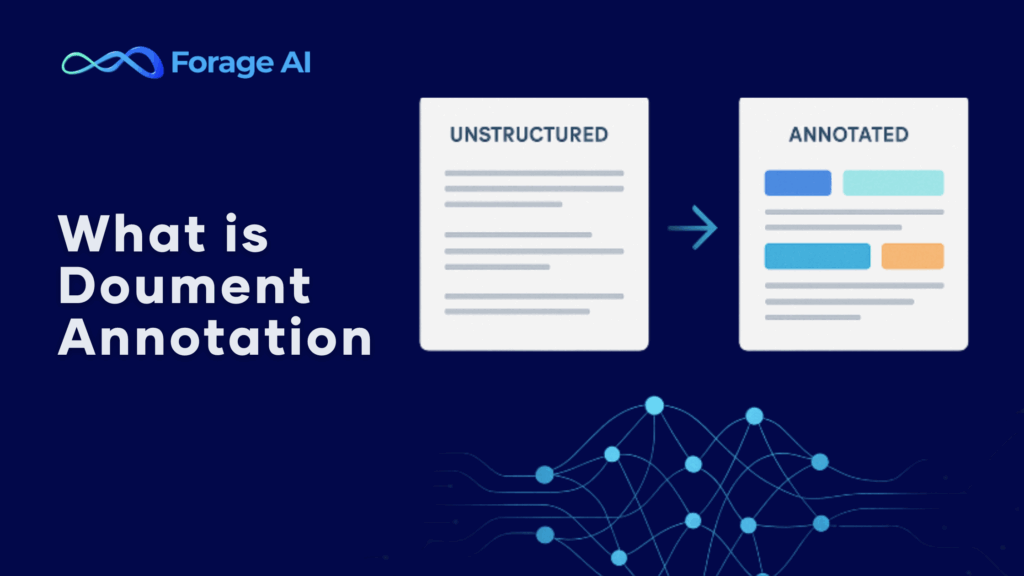
Manual vs. Automated Annotation
Annotation methods range from manual to fully automated. They can serve multiple use cases based on your project requirements.
Manual Annotation: Humans label documents based on guidelines, ensuring high accuracy for complex or novel documents. It’s labor-intensive but reliable. Good for smaller projects.
Semi-Automated Annotation: Combines AI suggestions with human review, creating a feedback loop that refines systems over time.
Fully Automated Annotation: Powered by advanced AI, including RAG, these systems process high volumes with minimal human input, relying on robust training data and quality checks. With advanced technologies, the fully automated annotation process has evolved to ensure high accuracy with contextual understanding.
RAG has revolutionized automation by enabling systems to retrieve relevant information and generate accurate annotations without extensive manual training. Businesses choose approaches based on document complexity, volume, and accuracy needs, often transitioning from manual to automated systems as technology matures.
Understanding how annotation is carried out helps clarify why it’s such a strategic function for businesses today. Let’s look at the broader benefits that document annotation brings to organizations across industries.
Why Document Annotation Matters
Document annotation is a strategic capability with far-reaching benefits, and clean, accurate data is the basis of accurate insights. Here are some of the pain points that document annotation solves:
Operational Efficiency
Reduces processing time by automating data extraction.
Minimizes data entry errors.
Allows employees to focus on high-value tasks such as analysis and more decision-making.
Enables 24/7 document processing without additional staffing.
Enhanced Decision-Making
Transforms static archives into dynamic, searchable knowledge bases.
Uncovers trends and patterns across large document sets.
Provides data-driven insights for informed decisions.
Compliance and Risk Management
Identifies sensitive data for privacy compliance.
Creates audit trails for regulatory reporting.
Ensures consistent handling of regulated information.
Mitigates non-compliance risks through structured data management.
AI and Machine Learning Enablement
Generates high-quality training data for AI models.
Supports continuous improvement through feedback loops.
Enables industry-specific AI solutions.
Lays the foundation for predictive analytics.
With measurable gains in speed, accuracy, and compliance, document annotation is becoming a competitive advantage. Here’s how it’s being used in industries like healthcare, finance, and law.
Industry Applications of Data Annotation
Document annotation delivers tailored benefits across sectors:
Healthcare
Medical Record Analysis: Extracts structured data from patient records for clinical decisions.
Clinical Trial Processing: Standardizes research documents to accelerate drug development.
Regulatory Compliance: Ensures adherence to FDA and other standards.
Financial Services
In finance, annotation helps structure complex information within loan applications, compliance documents, and quarterly reports. It enables faster reviews, better risk assessment, and more efficient data retrieval.
Examples: portfolio statements, tax documents, fund performance reports, and investment-related paperwork.
Legal
Contract Analysis: Identifies key clauses and risks across contracts.
Case Document Review: Accelerates discovery with automated sorting.
Legal Research: Enhances searchability of case law and precedents.
Manufacturing and Supply Chain
Technical Documentation: Organizes specifications and compliance records.
Supplier Processing: Standardizes diverse supplier documents.
Quality Control: Streamlines certification and test result processing.
While document annotation has proven valuable across industries, putting it into practice comes with its own set of challenges.
Challenges and Best Practices
Tackling these challenges requires not just the right strategy but also seamless integration into existing workflows.
Quality Control
Ensuring the accuracy, consistency, and reliability of document annotation through structured processes and checks.
Develop clear, consistent guidelines with examples and edge cases
Ensure annotators follow uniform standards by providing detailed instructions, real-world examples, and handling tricky scenarios up front.
Implement multi-level review and inter-annotator agreement checks
Maintain annotation consistency and accuracy by layering peer reviews, expert validation, and agreement scoring between annotators.
Refine guidelines continuously through feedback loops
Use insights from annotators and model outputs to improve annotation instructions and tools over time.
Customize quality control for complex or domain-specific documents
Adapt QA strategies to handle high-variance formats like legal, medical, or handwritten documents where precision is critical.
Scaling Up
Prioritize high-impact document types.
Use tiered strategies for varying document complexity.
Leverage pre-annotation with RAG models to accelerate review.
Optimize workflows for distributed teams.
Integration
Seamlessly connect with document management systems.
Ensure compatibility with analytics platforms.
Use standardized formats for interoperability.
Develop APIs for enterprise-wide access.
Even with automation technologies like RAG and tools like MCP, the human role can be important for certain use cases. Let’s explore how human-in-the-loop models keep annotation accurate and adaptive and when you should take that direction.
Human-in-the-Loop
Reserve human expertise for complex cases.
Employ active learning for AI to flag uncertain annotations.
Create continuous improvement cycles with human feedback.
Define specialized roles for annotation tasks.
With these building blocks in place, what does the future hold for document annotation?
The Future of Document Annotation
Emerging trends are shaping the future of annotation:
Multimodal Annotation: Combines text, layout, and visual analysis for comprehensive document understanding.
Self-Improving Systems: RAG-driven systems learn from feedback, adapt to new document types, and reduce human effort.
Domain-Specific Models: Tailored annotation for industry-specific needs, enhancing precision.
Ethical Considerations: Balances automation with privacy, security, and bias mitigation, maintaining human oversight.
At Forage AI, we’re not just observing these trends—we’re driving them. Here’s how our RAG-powered annotation solutions deliver real-world impact.
Forage AI: Powering Smarter, RAG-Enabled Annotation Workflows
Forage AI delivers cutting-edge document annotation services powered by RAG, transforming unstructured data into strategic assets.
Services
RAG-Enhanced Annotation: Leverages Retrieval-Augmented Generation (RAG) to pre-select high-relevance context from large unstructured corpora, minimizing noise and increasing annotation accuracy. Our pipelines support custom retrieval logic, domain-specific embedding models, and feedback integration to optimize labeling at scale.
Data Extraction and Analysis: Goes beyond basic entity recognition by combining dense retrieval, LLMs, and domain-specific templates to extract structured data with context-awareness. Supports downstream analytics by preserving document hierarchy, intent, and relationships between fields.
Benefits
Streamlined Data Management: Transforms scattered, unstructured data into well-organized formats (JSON, XML, or tabular), with built-in versioning and schema validation to ensure consistency across datasets.
Informed Decisions: Feeds downstream models or dashboards with structured, high-confidence data—improving decision-making in real-time or batch processing environments.
Operational Efficiency: Automates the most time-consuming parts of data prep—such as document classification, table extraction, and reference matching—using task-specific retrieval models and LLM fine-tuning.
Why Forage AI?
Unlike general-purpose AI solutions, Forage AI builds customized RAG pipelines tailored to your documents, domain, and downstream goals. We don’t just extract data—we enable intelligent workflows with:
Custom retrievers and vector databases tuned for your document types (e.g., portfolios, tax records, insurance claims).
Human-in-the-loop (HITL) tools for error correction and guideline refinement.
High-precision extraction models that combine structured logic with LLM flexibility—ideal for regulated industries where hallucinations are unacceptable.
Seamless integration with your cloud stack (AWS, GCP, Azure) and annotation tools via API or SDK.
This ensures that what you extract is not only accurate but also reliable enough to drive automation, compliance, and strategic insights.
By combining cutting-edge AI with domain expertise, Forage AI positions businesses for long-term success in data management and automation.
Conclusion
Document annotation, supercharged by RAG, is a strategic necessity for modern businesses. It unlocks the value of unstructured data, enabling automation, enhancing decisions, ensuring compliance, and powering AI innovation. As document volumes grow, organizations that adopt advanced annotation will turn information challenges into competitive advantages. Investing in RAG-driven annotation today positions businesses to thrive in a data-driven future.
Comment