
IndieAIs.com
Find the best AI tools built by indie developers.
Quick week two update for anyone following the IndieAIs build.
The numbers: 1,500 visitors, up from 395 at launch 6,000 pageviews, up from 2,500 36 minutes 44 seconds average session, up from 23 minutes 4.07 pages per visit 58% bounce rate, holding steady
The session duration improvement is the signal I am most focused on. People are staying longer and going deeper. The catalog is richer, the community is more active and the platform has more to explore than it did on day one.
What shipped this week:
Compass AI, the main thing. An AI co-founder built directly into IndieAIs with three distinct modes:
Co-Founder for strategy, positioning, branding and document drafting Co-Builder for architecture, code generation and technical decisions General Advisor for open conversation and research at zero credit cost
Each mode has its own system prompt and its own capabilities. The Co-Founder can draft brand guides and pitch deck outlines that open in a dedicated document viewer. The Co-Builder generates code in a proper syntax-highlighted code viewer. The General Advisor never charges credits, it is always free to use.
Compass AI also has persistent memory that compounds across sessions, directory crawling to check your tool's presence across major AI directories and a knowledge transparency layer that shows its reasoning, sources and confidence level for every response.
Full redesign of the Compass AI interface, clean light mode, three-mode switcher, mobile-adaptive layout with proper navigation, document and code viewers.
Stripe integration — Pro plan at $19 per month, Business plan at $49 per month and three one-time credit packs live.
User settings page — username change with 14-day restriction, email change with verification, password creation for Google OAuth users, notification preferences, privacy settings and full GDPR data export.
Platform-wide font improvements, button readability fixes and mobile responsive updates.
What is honest:
Still at $0 MRR. The monetization infrastructure is fully built, plans, credits, Stripe, webhooks. The next milestone is getting builders genuinely using Compass AI enough that the upgrade becomes obvious.
The bounce rate at 58% tells me the traffic mix is still too broad. The right visitors stay for 36 minutes. The wrong ones leave immediately. Tightening distribution targeting is the main focus this week.
One ask:
If you are building an AI tool and you have not listed it on IndieAIs, it takes five minutes and it is free. Every listing makes the directory more useful for every user.
indieais.com Compass AI early access: indieais.com/IndieAIsCompass
More next week.

Most AI "advisors" fail because they try to be everything at once.
When you ask a generic LLM for help with your SaaS, you get a lukewarm soup of marketing fluff and generic code snippets. It’s trying to be your CMO and your Lead Dev in the same breath, and it ends up being mediocre at both.
While building Compass AI, I realized that "context" isn't just about knowing the product, it’s about knowing the mode the builder is in.
The Architecture: Two Buttons, One Basis.
I’m moving away from a single chat interface to a "Tri-Modal" system. On the frontend, it’s just three buttons. On the backend, it’s a modular prompt architecture that swaps the "Specialist" while keeping the "Core Identity."
The Co-Founder (Strategy Mode): This is for the "Surface." It uses the Listing Quality Framework to audit your positioning, find your "Invisible Scars," and suggest distribution channels. It’s brutally honest about why your users are bouncing.
The Co-Builder (Technical Mode): This is for the "Structure." It stops giving marketing advice and starts giving Prompt-Ready architecture. It generates the exact DB schemas and system prompts you need to feed into tools like Claude Code to actually build the fixes.
The General Advisor: For everything in between. The "Basis" prompt that keeps the AI grounded in your specific IndieAIs data without the extra specialist constraints.
Why this matters for Builders
We’ve all been there: you have a great strategy session with an AI, but when you ask it to help you implement it, the code is messy and the context is lost.
By separating the Co-Founder (The Vision) from the Co-Builder (The Execution), Compass can now give you the strategy and then immediately hand you the "Blueprint" to build it.
The "Zero-Defect" goal applies to your code just as much as your copy.
Early access is filling up while I finalize these specialist modes. If you want an AI that knows when to stop talking strategy and start writing architecture, join us here:
👉 https://indieais.com/IndieAIsCompass

-
1
This tri-modal approach is brilliant! The separation between Strategy Mode and Technical Mode is exactly what I've been missing in my workflow.
I'm building MCP CN DevTools (developer tools for Chinese market), and I constantly switch between "what should we build" and "how do we build it" modes. Having the AI explicitly know which mode it's in would save so much context-switching overhead.
The Co-Builder mode generating DB schemas and system prompts is gold. That's the gap between "nice strategy" and "actually shippable code."
Question: How do you handle the handoff between modes? Like when Strategy Mode identifies a positioning issue, can you one-click switch to Co-Builder to generate the actual fix?
This is the future of AI co-founders. 🚀

Generic AI advice is a waste of time because it doesn't know your specific product. That's why I built Compass AI to be "context-aware" by default.
Look at this audit of a test listing. Instead of basic marketing tips, it pulls the actual data—traction, stack, and URL—to give a reality check.
The Problem: Most tools fail because their positioning is a placeholder. If your headline is "TEST," you’re invisible.
The Compass Approach: It scores your listing across 5 key dimensions. It doesn't just say "improve your copy"; it explains exactly why a visitor will bounce based on your current (0/20) clarity score.
The Goal: Moving from "Pre-traction" to "Early Traction" by fixing the friction points that prevent a user from ever clicking your URL.
It’s like having a co-founder who has already read your entire dashboard before you even open your mouth.
How much time are you losing because people don't "get" your tool in the first 3 seconds?
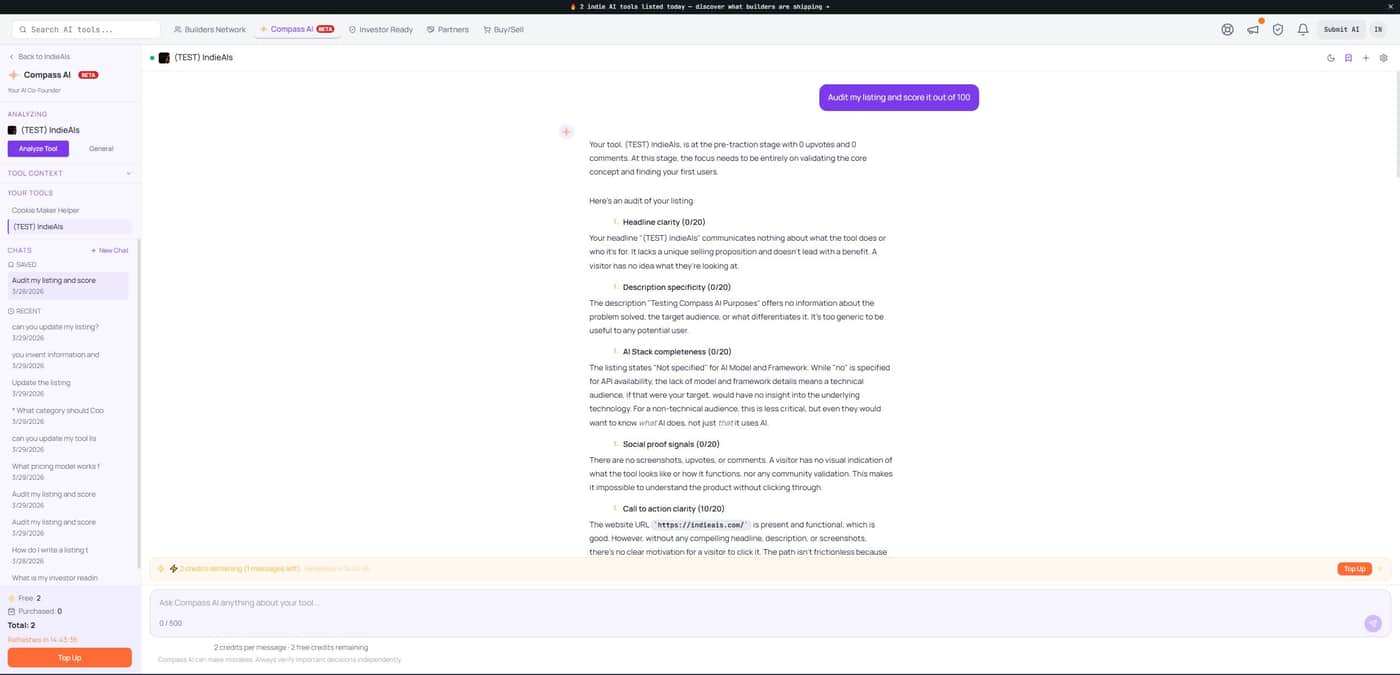
👉 https://indieais.com #buildinpublic #AItools #indiehacker
-
2
This resonates deeply. The "generalist AI advisor" problem is real — when you ask a generic LLM to be your CMO and CTO simultaneously, you get mediocre output on all fronts because it has no accumulated context about your specific product or mode.
What you're building with Compass AI is the right direction. The next layer I'd push on: can that specialized context persist and compound across sessions? The biggest pain I've seen is that even well-prompted AI advisors reset every conversation. You rebuild context from scratch every time.
Building something in this space too (AllyHub — an agent platform where your AI builds reusable skills from every task it runs, so it gets cheaper and smarter over time). The compounding memory problem is the core thing we're solving. Would love to compare notes.
-
2
The context-aware approach is what actually separates useful AI tooling from noise. Most AI advisors are fundamentally pattern-matching on generic startup advice — which is fine for getting started but useless once you have a real product with real positioning decisions to make.
The 5-dimension scoring framing is smart. Having worked on AntigravityAI (an AI tools directory), I've seen firsthand how listing quality and first-impression clarity are the single biggest drop-off points — not the product itself. Visitors don't evaluate tools rationally; they make a gut call in the first scroll and either go deeper or leave. A tool that scores and explains why someone would bounce is genuinely useful feedback.
One thing worth considering: the scoring output is only as good as the context Compass has access to. If a founder has a nuanced ICP or unusual distribution strategy, there's a risk the system anchors on surface-level signals (headline, description) while missing the positioning intent. Would be interesting if there were a way for founders to optionally annotate their listing with target-audience context before the audit runs — so the scores are calibrated against the intended market, not just general SaaS conventions.
Solid build. The before/after audit demo would be compelling proof for distribution.
-
2
This is a clever meta-play — most AI directories just list tools and call it a day, but scoring listings on positioning clarity actually helps founders tighten their messaging. The insight that people bounce because they don't "get" your tool in 3 seconds is painfully true. Would be interesting to see aggregate data over time — like what headline patterns or description structures consistently score highest. That kind of benchmarking data could become a moat for the directory itself.
-
2
"A co-founder who already read your entire dashboard" —
that's the pitch right there. Instantly got it.
The 0/20 clarity score example is brutal in the best way.
Most tools just say "your copy needs work."
Showing the exact score with the reason why someone bounces?
That's actually actionable.
The 3-second rule is what kills most indie products silently.
Nobody tells you they didn't get it — they just leave.
Building something similar in concept —
an AI that gives zero-mercy feedback instead of generic validation.
The hardest part is calibrating "brutal but useful" vs just brutal.
How are you handling false positives?
Like when the AI is harsh on something that's actually decent?
-
2
The context-aware angle is strong. What I keep noticing though is that even when positioning is “correct” on paper, it doesn’t always translate in the first seconds of a visit.
There’s a gap between:
-how founders describe their product
-and how a cold visitor interprets it under time pressure
And that gap is where most of the drop-off seems to happen. So instead of a positioning problem, it often feels more like an interpretation problem.
--Not “is the message right?”
--but “is it understood instantly?”
-
2
The gap between "generic advice" and "this actually applies to my product" is where most feedback tools die. You built the audit that reads the actual data instead of guessing from the headline. That's the difference between critique and guidance.
-
2
Finally—a tool that actually gets my product before I even have to explain it. Feels like having a co-founder who’s read all my docs…minus the awkward Zoom calls.
-
2
This looks interesting
-
2
This is actually really interesting most tools give advice that feels too generic.
The clarity score is a cool idea. How are you calculating it?
-
2
This is super interesting. I'm currently building something small as well and trying to understand how to get first real users.
-
2
that's so cool
-
2
The context-aware angle is strong. What I keep seeing though is that most tools try to fix things after the user has already landed…but the real drop-off happens earlier.
People don’t evaluate products. They scan.
If they can’t instantly map: “what this is”-“is this for me”-“why now” they leave before any scoring or feedback even matters.
Feels like most conversion problems start before optimization even begins.
-
2
The context-aware default is exactly right. I keep running into this with AI in PM work — model gives you polished generic output until you force-feed it your actual constraints. Then it is a completely different tool. The 5-dimension scoring + explaining why a visitor bounces is the right framing. What is the hardest context to get users to actually provide?
-
2
The context-aware default is exactly right. I keep running into this with AI in PM work — model gives you polished generic output until you force-feed it your actual constraints. Then it is a completely different tool. The 5-dimension scoring + explaining why a visitor bounces is the right framing. What is the hardest context to get users to actually provide?
-
2
The "context-aware" angle is the right play - generic AI advice is basically noise at this point. The 5-dimension scoring is interesting but I'd be careful about showing a test listing with 0/20 as the demo. First impression of the tool is "this thing just tells me everything sucks." What if you showed a before/after instead? Listing that scored 6/20, then the same listing after applying Compass feedback scoring 15/20. That tells a story about improvement, not just diagnosis. Also the "co-founder who already read your dashboard" line is strong. I'd lead with that instead of burying it at the end
-
2
good
-
2
Hi
I provide eligible AI businesses access to GCP/AWS credits for the next 24 months to help reduce infrastructure costs.
If this is relevant, happy to share more details.
-
1
This is really interesting! The context-aware approach is exactly what the AI tools space needs right now.
I'm building something similar in the AI developer tools space (MCP CN DevTools - helping Chinese developers deploy MCP servers). One thing I've learned: the gap between "generic AI advice" and "actionable feedback" is all about context.
Your 5-dimension scoring framework is smart. The clarity score especially resonates - most founders don't realize their headline/description is a placeholder until someone points it out with actual data.
Quick question: how are you handling false positives? Like when the AI flags something that's actually decent but just unconventional positioning?
Congrats on the build! 🚀


What Compass AI does with this
Compass AI is built into IndieAIs as an AI co-founder that already knows your tool listing before your first message. It audits your listing across all five of these dimensions and scores you out of 100 with specific fixes ranked by impact.
It does not give generic advice. It gives advice grounded in your actual listing, your specific headline, your specific description, your specific category, your specific screenshots or lack of them, your specific competitive positioning.
It also rewrites your positioning completely if you ask, new headline written, new description written, ready to copy and paste. Names your actual competitors. Identifies your distribution channels. Scores your investor readiness out of 60. Gives you a weekly priority plan calibrated to your exact traction stage.
Everything specific to your tool. Nothing generic.
Early access is open now at indieais.com/IndieAIsCompass
200 credits included for early access builders. Founding member pricing locked for life.
If your listing has never been audited it almost certainly has at least three of these five problems.
IndieAIs indieais.com


We have huge news and we will love your support to share the word starting tomorrow. Please follow us here and on socials to get the latest and greatest update that will help builders.
-
1
Hi
I provide eligible AI businesses access to GCP/AWS credits for the next 24 months to help reduce infrastructure costs.
If this is relevant, happy to share more details.
Hi IH,
Last two days we have been implementing new stuff and testing the platform, there was a break in reading data, now that should be online again. Stay tuned, more coming.
Currently updating and introducing a big feature into IndieAIs.com platform, if you try to login or view the website, you will not be able to since the updates are constant and testing is performed also very actively. Apologies for any inconvenience, we will post when it is active again.
Updates will have new features and new additions to help builders and tools improve.
Building in public means sharing the unglamorous days alongside the exciting ones.
Today was an unglamorous day in the best possible way. No new product category. No viral feature announcement. Just heads down fixing, improving and adding the infrastructure that makes everything else work properly.
Here's everything that shipped.
🔧 Forum Counters Fixed
Upvote counts, comment counts and connect counts on Builders Network posts were not updating correctly. Created database triggers that automatically increment and decrement these counters in real time. The forum now accurately reflects actual engagement on every post.
🔥 Hot Topics Sidebar
Added the Hot Topics tab to the homepage sidebar showing the top 3 most upvoted Builders Network posts at any moment. Previously this only showed on inner pages. Now every visitor sees what the community is engaging with most from the moment they land.
💬 Forum UX Improvements
Comments in the Builders Network now have Reply, Like and Report buttons with threaded replies. Long posts show a Read More option instead of dumping walls of text. Topics have Report buttons. The forum now feels like a proper community space not a basic comment section.
🏅 Badges Redesigned
All four listing badge tiers — Listed, Featured, Sponsored and Premium — have been redesigned as Product Hunt-style SVG pill badges at 250x54px with Light, Neutral and Dark theme variants. The left monogram is now IA in bold. Embed codes are available only to paid tier builders from their dashboard. The badges page shows tier descriptions only — no previews or codes for non-paid listings.
🔔 Full Notifications System
Seven notification triggers are now active across the platform. Forum upvotes, comments and connect requests notify post authors. Tool upvotes and comments notify builders. Follower activity notifies builders of new tools and updates. Every notification marks as read on click, has a delete button and links directly to the relevant page. Mark all read button added.
🚩 Report Buttons Everywhere
Report buttons are now live across tool detail pages, builder profiles, forum topics and comments. Every report goes to the admin dashboard with a full review workflow — pending, reviewed, resolved and dismissed status filters with admin notes per report.
📊 Traction Transparency Board
New page at /traction where builders can opt in to sharing real metrics publicly — weekly active users, MRR, churn rate, uptime and response time. Completely voluntary. Builds trust with users and signals to investors.
🗳️ Feature Voting
New page at /feature-voting where the community can submit and upvote feature requests for any tool on IndieAIs. Status tracking from open to planned to in progress to shipped. Builders get free product research. Users get a voice in what gets built.
⚰️ Tools Archive — The Archive
New page at /archive where builders can voluntarily archive tools they have shut down with a full postmortem — what worked, what killed it, what they learned. The most valuable knowledge in indie building lives in the products that didn't make it. Now there's a home for it.
🔍 Looking For Page
New page at /looking-for with dual tabs — find people (co-founders, collaborators, advisors) and find AI tools (specific requests from the community). Connects builders who need each other directly.
📧 Resend Email Integration
Full email system now live via Resend sending from updates@indieais.com. Newsletter emails, notification emails and promotional emails all live with the IndieAIs IA logo in every template. Admin dashboard has a newsletter tab to select any article and send it to all subscribers in one click.
🍪 CookieYes Integration
Replaced previous cookie solution with CookieYes. Full cookie policy page with CookieYes declaration widget live. All 27 cookies properly categorized across Necessary, Functional, Analytics and Marketing categories.
🗑️ Account Deletion
Builders and users can now fully delete their account and all associated data from their dashboard profile settings. Type DELETE to confirm. Complete data removal in compliance with GDPR.
📢 Platform Updates System
Admin can now send platform-wide update notifications to all users directly from the dashboard. Users see updates in a dropdown in the header — similar to notifications but specifically for platform announcements and feature releases. A full Platform Features page at /platform-features lists every function on IndieAIs from day one with descriptions, icons and version tags.
🗺️ Page Tour System
A help button in the header launches an interactive step-by-step tour of any page — highlighting key elements, explaining buttons, menus, posting sections and features. Tours are live across 15+ pages. New users can now understand the platform without reading a single doc.
That is 14 features shipped in one day alongside a full notification system, email integration and cookie compliance.
IndieAIs is 6 days old.
Still building. More tomorrow.
-
2
impressive shipping velocity for day 6. the notification system especially makes sense. we've found similar engagement patterns with our WordPress AI platform Kintsu.ai. builders need that immediate feedback loop. curious how you're handling discovery with so many AI tools launching daily?
-
2
Shipping 14 features in a day is impressive. Curious how you are deciding what to prioritise at that pace. Are you working from a backlog or just responding to what users are asking for in real time?


IndieAIs just went from 39 to 303 visitors in 10 minutes.
Just spending the day reading builder posts, leaving genuine comments and inviting people to get listed.
Community is the only distribution that matters early.
Still building. indieais.com 🚀
-
2
GJ man! Tried to sign-up using the form (not google oauth), did not get a verification email - not sure if its just me, worth checking out!
-
1
“I’m curious:
Do founders actually think about their professional reputation as a strategic asset, or is that something people only worry about later?” Perceptaadvisory.com


One of the most common things I hear from people in the indie builder community is some version of this:
"I know exactly what I need. I've looked everywhere. It doesn't exist yet."
And on the other side I hear builders saying:
"I want to build something people actually want. I just don't know what that is."
These two people need to find each other.
That's why we just added Request an AI Tool to IndieAIs.
Here's how it works:
If you're a user who can't find the AI tool you need — submit a request. Describe the problem you're trying to solve, what you've already tried and why nothing has worked. Be specific. The more specific you are the more useful it is to the builders reading it.
If you're a builder looking for your next idea — browse the requests. Real people describing real problems they'd pay to have solved. No guesswork. No market research documents. Just someone saying plainly: "I need this and it doesn't exist."
Why this matters more than it sounds
Most product ideas come from one of three places:
The founder's own pain — which produces the best products but is limited to one person's experience.
Market research — which produces generic insights that ten other people are already building toward.
Community signal — which is what this is. Real people in a community of builders and users saying openly what they need.
The Request feature turns IndieAIs into a two-way platform. Not just a place where builders broadcast what they've built. A place where the people who need things built can speak directly to the people who build them.
The first request sets the tone
Right now the requests board is empty.
That means the first person to submit a request gets seen by every builder who visits IndieAIs from this moment forward. If your request is specific, genuine and well-articulated it becomes the template for every request that follows.
If you're a user with a genuine unmet need — this is your moment. If you're a builder looking for signal on what to build next — bookmark the requests page and check it weekly.
One ask from me
If you're reading this and you have a genuine problem that no AI tool has solved properly — submit it. Don't worry about whether it's technically feasible. Don't filter yourself. Just describe the problem honestly.
The right builder might be reading this thread right now.
👉 Submit or browse requests at https://indieais.com/request-ai
-
2
This is a really interesting direction — especially the idea of capturing real demand instead of guessing.
One thing I’ve been noticing is that a lot of builders don’t actually struggle with building, but with deciding what’s worth building in the first place.
Curious — are most of the requests you're seeing very specific problems, or still quite broad?
-
2
This comment was deleted 6 months ago


Comment