
NotiLens
Alerts when your business silently breaks.
Six hours.
That's how long our payment webhook was silently failing before a user messaged us.
We were running a creator marketplace and payments had been failing for hours. No error in the logs. No crash. No alert. Just a customer asking why their payment wasn't going through.
We had error monitoring, uptime checks, the usual stack. None of it caught this.
Because the server was up. The endpoint was responding. Everything looked fine.
The webhook was just quietly dropping events into a void.
That night we started building what we wished existed - something that watches for silence, not just noise.
Not "did it crash?" but "did it actually do anything?"
Six months of using it internally, catching failures before users did, we decided to productize it.
That's NotiLens.
Three failures it's caught since we started dogfooding:
Cron job ran at 3am. Exited successfully. Processed 0 records. Database connection had silently timed out. Found out via NotiLens at 3:04am - not from support tickets at 9am.
AI agent looped 14 times in 6 minutes. No output. API credits burning. NotiLens detected the loop pattern and fired before the bill did.
Signup flow dropped to zero for 4 hours on a Tuesday afternoon. Not a server issue - a misconfigured Cloudflare rule. Revenue just stopped. NotiLens caught the silence in 20 minutes.
None of those threw an error.
Early users are catching things too:
A solo founder running an AI agent pipeline catching loops before users complained
An agency owner fixing a broken Zapier node before their client ever knew
A backend engineer catching a skipped ETL step at 2am before anyone noticed
None of those threw an error either.
What we're building toward:
The monitoring layer for the parts of your backend that don't crash - they just quietly stop working.
Currently live. Looking for founders who've been here before to try it and tell me where it breaks.

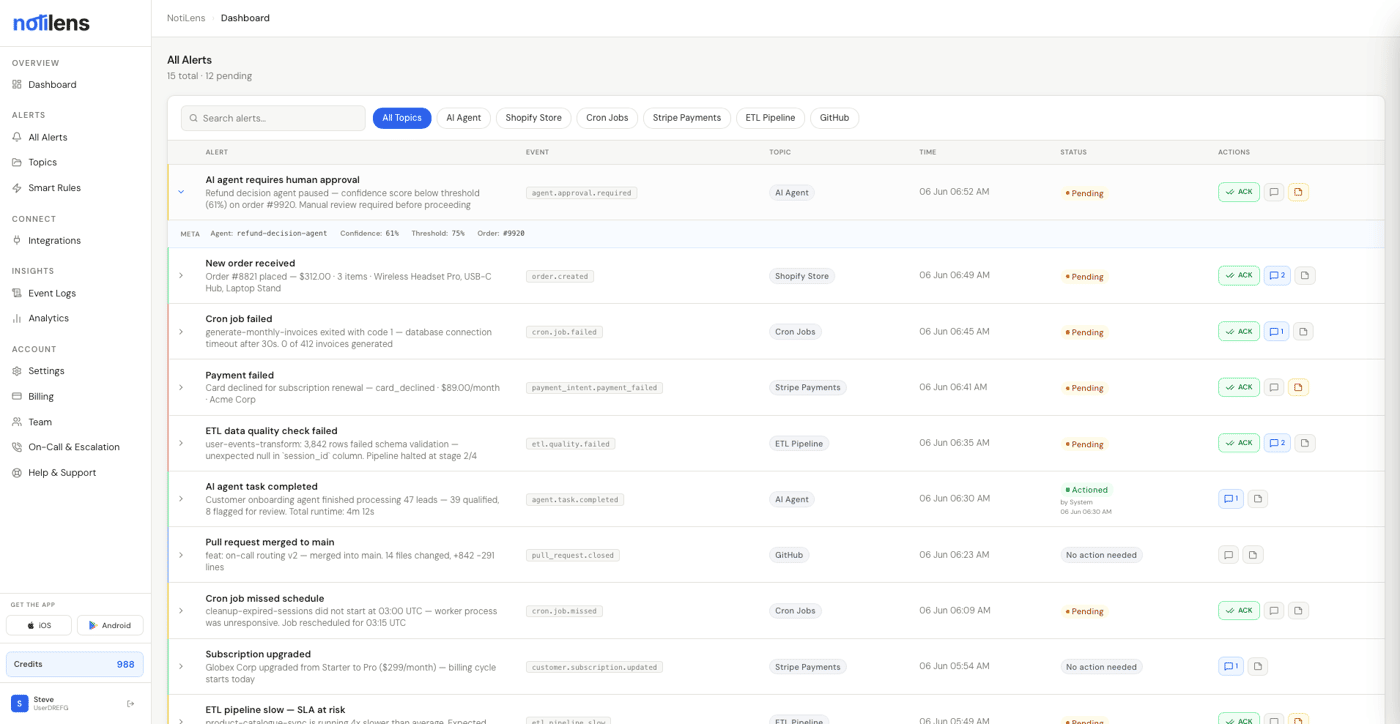
We built NotiLens originally for our own product - CollabZap. Small team, no DevOps, no one watching dashboards. We were flying blind and didn't know it until a customer told us something was broken.
That pain turned into a product other teams started using. After processing 100K+ business events across all products monitored on NotiLens, we have data on what actually breaks in production for small teams.
2,000+ problems caught. Here's the breakdown:
1. Silent failures - 40%
No error. No crash. Just stopped working. Payment not captured. User not activated. Server looked completely fine.
Logs are clean. Uptime monitor is green. But somewhere in the middle, a process quietly died.
2. Cron jobs that quietly died - 25%
Job stopped running at 3am. Nobody knew. Customer noticed their report hadn't updated in 2 days. Job had been running - just processing 0 records.
Scheduled jobs are invisible by default. They either run or they don't, and most setups have no way of knowing which.
3. AI agent flows that silently broke - 20%
Agent triggered. Tool called. Response never came back. No exception, no timeout. Just stuck mid-flow - task never completed, nobody knew.
As more products wire AI agents into core workflows, this one is going to get worse.
4. Metric drift - 15%
Not a crash. Just a slow bleed. Processing time creeping up a little each day. Nobody noticed until it was 3x slower than last week.
Drift looks like normal variance day to day. You need a baseline to know when something has genuinely shifted.
## What Solo Founders and Small Teams Miss
"Server is up" is not the same as "product is working."
Your uptime monitor checks one thing. Everything that happens after jobs running, flows completing, events processing, metrics staying stable is invisible to it.
Worth setting up early:
- Heartbeat on every cron job - if it doesn't check in on schedule, something's wrong. Don't wait for a customer to notice.
- Confirm events end to end - don't just log that something arrived, confirm it was actually processed.
- Baseline your key metrics - know what normal looks like so drift is visible before it becomes a problem.
- Alert on silence - if a flow that runs 50 times a day suddenly runs 0, that's a signal. Silence is data.
Most of these cost nothing to set up. The cost is not having them when something quietly breaks at 2am.
What breaks in your production that you only find out about later?
One of our own products - Collabzap, a creative collaboration marketplace - was growing, but we had a problem most founders don't talk about openly:
We had no reliable way to know what was happening inside our product unless something broke loudly.
Server downtime? Found out when users complained. Disk space hitting 100%? Silent failures, no warning. New signups? We'd manually check the dashboard and hope we hadn't missed a window to reach out. OpenAI token usage quietly creeping up? We found out too late.
The worst one: payments had been failing for 6 hours. Silence had no signal.
We built NotiLens to fix this - first for ourselves, then as a product.
Here's what we configured across Collabzap:
New user signup → instant alert to founder
No signup in 24 hours → silence alert (this was the big one)
Signup spike → anomaly detection
Server uptime + disk space threshold
OpenAI token usage monitoring
Payment flow tracking + broken flow detection
The silence alert was the one that changed how we operated. Instead of manually checking and assuming no news was good news, we now get a ping when nothing happens for too long.
The payment setup was the other eye-opener. We weren't just tracking whether payments fired - we were detecting broken flows: cases where a user starts checkout but the payment webhook never arrives. No error. No alert. Just a conversion that quietly disappeared. NotiLens catches that gap and flags it before it becomes a pattern.
The team no longer watches dashboards constantly.. Alerts fire first, then we dig into logs or APM tools if something needs attention. NotiLens isn't a replacement for those tools - it's what tells you when to open them.
We're now opening NotiLens to early users - 3 months free in exchange for honest feedback. If you're a founder running a product where silent failures are a real risk (Stripe webhooks going quiet, signups dropping off, AI costs creeping up), happy to have you try it.
Drop a comment. Would love to hear how you're currently handling this or if you've just been manually checking dashboards like we were.
Most monitoring tools are built to detect failures that produce errors.
But in real systems, the bigger issue is often what doesn’t happen.
No new signups for hours
No payments coming in
Background jobs stuck silently
AI agents looping without completing tasks
Everything looks healthy — servers are up, logs are clean, dashboards are green — yet the business itself is not moving.
These issues usually go unnoticed because there are no errors to trigger alerts.
NotiLens focuses on this gap by monitoring real business signals and alerting when expected activity drops or stops, helping teams detect issues that traditional monitoring tools miss.
Would love to hear how others currently track “missing activity” or silent failures in their systems.
Comment