
Scheffer Krantechnik
Scheffer Krantechnik GmbH
Moving heavy materials is not only about lifting and transporting a load. The load must also remain stable throughout the movement.
When a heavy object swings, rotates, tilts, or moves unexpectedly, it can create safety risks, damage equipment, and make accurate positioning difficult.
This is why load stabilization is an important concept in industrial material handling.
Load stabilization refers to the methods used to reduce unwanted movement of a suspended or transported load and keep it under controlled conditions during lifting, movement, positioning, and placement.
Why Load Stability Matters
A suspended load behaves differently from an object sitting on the ground.
When a load is lifted, gravity acts through its center of mass. If the load is accelerated, stopped, or moved sideways, it can begin to swing.
For example, imagine a heavy object hanging from a lifting point:
Crane | | [O] / \ / \ LOAD
If the crane suddenly accelerates, the load may move in the opposite direction before gradually settling.
This movement is commonly known as load swing.
The heavier the load and the longer the suspension distance, the more important controlled movement becomes.
What Causes Load Swing?
Several factors can cause unwanted movement.
Sudden Acceleration
If a crane starts moving too quickly, the suspended load can swing.
The same problem can occur when the crane stops suddenly.
A simplified sequence looks like this:
Stationary | v Acceleration | v Load begins swinging | v Oscillation | v Load stabilizes
Smooth acceleration and deceleration can reduce this effect.
Sudden Direction Changes
Changing direction while transporting a suspended load can introduce additional forces.
For example, moving forward and then immediately moving sideways can cause the load to rotate or swing.
This becomes more difficult when the load has an irregular shape or an uneven center of gravity.
Wind and Environmental Forces
Outdoor handling systems can also be affected by wind.
Large surfaces can behave like sails, creating lateral forces on the load.
Environmental conditions therefore need to be considered when designing and operating outdoor lifting equipment.
Uneven Load Distribution
A load does not always have its center of gravity exactly below the lifting point.
If the weight is distributed unevenly, the load can tilt after being lifted.
This can make positioning more difficult and may require additional stabilization methods.
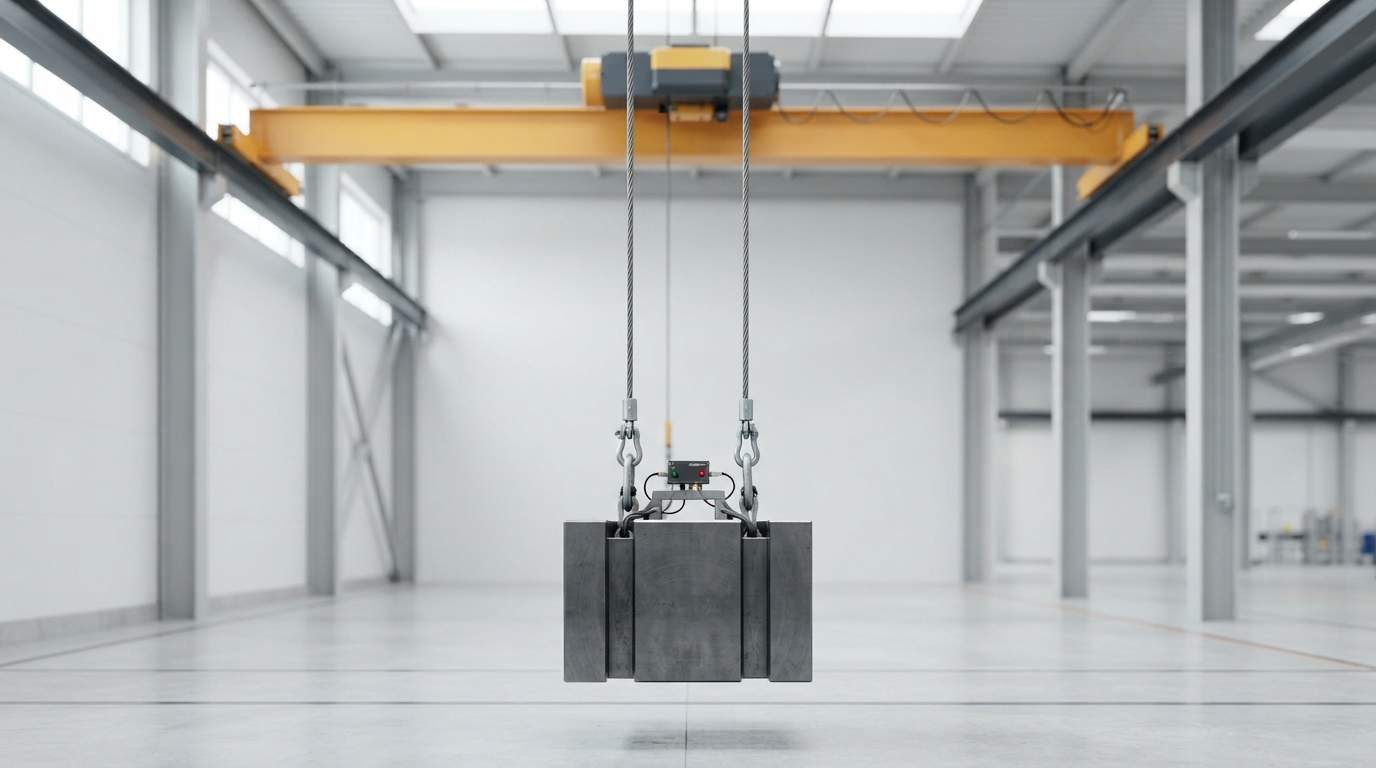
Understanding the Center of Gravity
The center of gravity is an important concept in lifting operations.
It is the point where the weight of an object can be considered to act.
Consider a symmetrical object:
+------------------+ | | | X | | Center of | | Gravity | | | +------------------+
If the lifting point is positioned appropriately above the center of gravity, the load can remain relatively balanced.
If the lifting point is far from the center of gravity, the load may tilt.
This is why lifting equipment must be selected according to the geometry and weight distribution of the material.
Cable Length and Swing Behavior
The suspension length can influence how a load behaves.
A simplified suspended-load system can be compared to a pendulum.
Support | | | O / \ / \ LOAD
A longer suspension distance can produce slower but larger swinging motion.
A shorter suspension distance generally changes the dynamic behavior of the system.
Engineers therefore consider suspension geometry when designing lifting systems and control strategies.
Mechanical Methods of Stabilization
Some stabilization methods rely primarily on mechanical components.
Examples include:
Guide systems
Stabilizing cables
Mechanical restraints
Rigid lifting frames
Special lifting attachments
Guide rails
The correct approach depends on the type of load and movement required.
A mechanical guide can be useful when a load must follow a defined path rather than freely swinging.
Active Load Stabilization
Modern automated equipment can also use active control methods.
Instead of relying only on mechanical components, sensors and controllers can monitor movement and adjust the machine's behavior.
A simplified concept looks like this:
Sensor | v Movement detected | v Controller | v Calculate response | v Motor/Drive | v Load movement | +------> Sensor
This creates a feedback loop.
The system continuously receives information and adjusts its movement accordingly.
Sensors Used for Stabilization
Different sensors can provide information about load position and movement.
Depending on the application, a system may use:
Position sensors
Encoders
Proximity sensors
Distance sensors
Angle sensors
Cameras
Inertial measurement sensors
The choice depends on the required accuracy, environmental conditions, operating speed, and system architecture.
Control Systems and Feedback
A control system can use sensor information to determine whether a load is moving as expected.
For example:
IF swing_detected THEN reduce_acceleration adjust_motion END
This is only a simplified representation.
Real industrial control systems may use mathematical models, feedback controllers, motion profiles, and safety logic.
The key principle is that the machine should respond to actual conditions rather than relying entirely on predefined timing.
Smooth Motion Profiles
One practical way to reduce unwanted movement is to control acceleration and deceleration.
Instead of:
0 → 100% speed
the system can gradually increase speed:
0 → 25% → 50% → 75% → 100%
The same principle can be applied when stopping.
A controlled motion profile reduces sudden changes in force and can improve positioning accuracy.
Load Positioning
Stabilization becomes particularly important near the destination.
A load may need to be positioned accurately above:
A production line
A storage location
A vehicle
A processing station
A container
Another piece of equipment
Even small movements can become significant when the required positioning tolerance is tight.
A useful sequence is:
Transport | v Slow down | v Check position | v Fine positioning | v Confirm stable condition | v Release load
Stabilization During Automated Operations
Automation adds another layer of complexity.
A human operator can visually observe a load and make continuous adjustments.
An automated system needs sensors and control logic to obtain equivalent information.
For example, an automated sequence might include:
Detect the load.
Confirm the lifting device is engaged.
Begin movement at controlled speed.
Monitor position.
Detect unexpected movement.
Adjust the motion profile if required.
Slow down near the destination.
Confirm final position.
Release the load.
Each step can have its own conditions and fault responses.
What Happens When Something Goes Wrong?
A good stabilization system must also consider abnormal conditions.
Possible problems include:
Sensor failure
Unexpected load movement
Communication loss
Motor fault
Obstruction
Incorrect load position
Emergency stop activation
The system should have predefined responses for these conditions.
For example:
Normal operation | v Abnormal condition detected | v Stop or controlled response | v Notify operator | v Investigate condition | v Reset or maintenance
The correct response depends on the hazard and system design.
Safety Should Come Before Speed
Increasing movement speed can improve productivity, but speed should not be considered independently from stability.
A system that moves quickly but creates excessive load movement may require additional time for positioning.
In some applications, a controlled slower movement can produce better overall performance because the load reaches its destination more predictably.
The objective is therefore not simply maximum speed.
The objective is controlled and repeatable movement.
Load Stabilization and Maintenance
Stabilization equipment also requires maintenance.
Components that should be inspected may include:
Cables
Connections
Lifting attachments
Sensors
Mechanical guides
Motors
Brakes
Control components
Wear or damage can change how a system behaves.
Regular inspection helps identify problems before they affect normal operation.
How Engineers Approach Load Stabilization
There is no single stabilization method that works for every application.
Engineers typically consider:
Load Characteristics
What is the weight, shape, size, and center of gravity?
Movement
How far does the load need to travel?
Speed
How quickly must the material be moved?
Accuracy
How precisely must the load be positioned?
Environment
Is the equipment operating indoors, outdoors, in heat, dust, moisture, or other demanding conditions?
Automation Level
Will an operator control the equipment, or will the movement be automated?
Safety Requirements
What hazards exist, and what protective measures are required?
These factors influence the mechanical and control architecture of the system.
A Simple Example
Consider an automated system that moves a heavy component from one processing station to another.
The operation could be divided into five stages:
1. Pick up ↓ 2. Stabilize ↓ 3. Transport ↓ 4. Position ↓ 5. Release
During transportation, sensors monitor the system.
If excessive movement is detected, the controller can modify the motion or initiate the appropriate safety response.
Before releasing the load, the system can verify that the destination and load position meet predefined conditions.
This approach makes the process more predictable and repeatable.
The Role of Software in Modern Handling Systems
Software increasingly connects mechanical equipment with monitoring and control systems.
A modern installation may record:
Movement cycles
Fault events
Sensor states
Operating times
Maintenance information
Equipment status
This information can help engineers understand how equipment behaves over time.
It can also support troubleshooting and maintenance planning.
However, software should complement proper mechanical design and safety engineering rather than replace them.
Conclusion
Load stabilization is an important part of industrial material handling because suspended and transported materials can move unpredictably when acceleration, deceleration, direction changes, or external forces are introduced.
Effective stabilization can involve mechanical guides, suitable lifting equipment, controlled motion profiles, sensors, feedback systems, and appropriate safety controls.
The correct solution depends on the material, movement requirements, environment, accuracy, and level of automation.
By treating stability as a fundamental part of system design rather than an afterthought, engineers can create material handling processes that are more controlled, predictable, and suitable for their intended application.

Comment