Why We Built AI for Godot's 5% Instead of Unity's 51%
Every VC we talked to asked the same question: why build for Godot when Unity owns half the market?
Here's the honest answer, 15 months and 5 billion LLM tokens later.
## The obvious bet was Unity
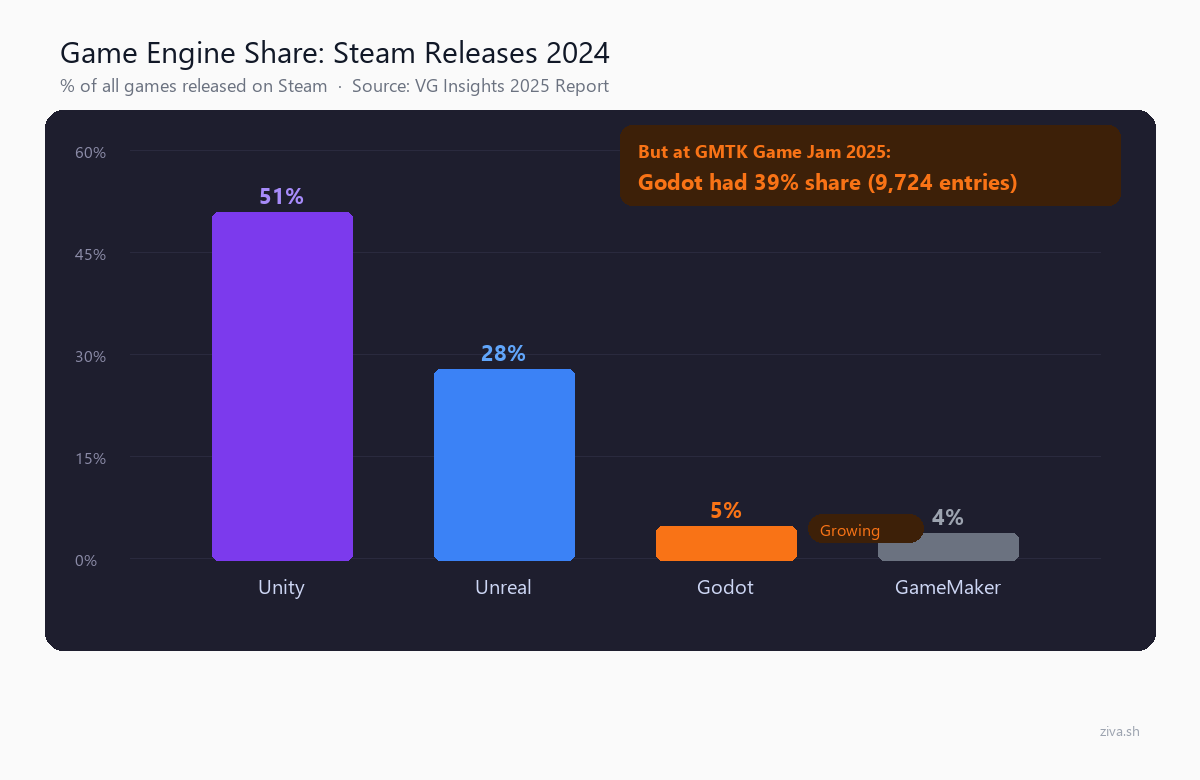
The numbers look brutal on paper. On Steam in 2024, Unity powered 51% of all game releases. Unreal had 28%. Godot? Five percent.
If you're building AI tooling for game developers, the rational move is to go where the developers are. We did the opposite.
## What the top-line numbers don't show
Godot is the only small engine growing. At the GMTK Game Jam 2025 (9,724 entries, the largest on itch.io), Godot held 39% share. At Steam Next Fest in February 2026, Godot demos hit 9%, up from nearly zero a few years ago.
The growth curve matters more than the snapshot. Here's what else we noticed:
- **No real competition.** Unity and Unreal have dozens of AI copilot tools fighting over the same users. Godot had zero when we started.
- **Passionate community.** Godot developers are vocal, loyal, and actively looking for tools. Our early users became evangelists without us asking.
- **Open source tailwind.** After Unity's pricing fiasco in 2023, developers moved to Godot in waves. That migration hasn't stopped.
- **Smaller surface area.** GDScript is one language. Godot's API is well-documented and consistent. This made our AI significantly more accurate than competitors building for Unity's sprawling C#/shader/DOTS ecosystem.
## What 5 billion tokens taught us
We've processed over 5 billion LLM tokens for Ziva users since launch. Here's where those tokens actually go:
- **42% code generation** - Writing GDScript from natural language descriptions
- **27% debugging** - Reading error logs and screenshots to diagnose issues
- **18% scene/level building** - Generating 2D tilemaps and scene structures
- **13% asset work** - Creating and importing sprites, textures, and game assets
The surprise was debugging. We built Ziva as a code generation tool. Users turned it into a debugging assistant. The feature where Ziva automatically reads your debugger output and suggests fixes? That came from watching users paste error messages into the chat over and over.
## The niche advantage is real
Building for a smaller market forced three decisions that turned out to be strengths:
**1. Deep integration over broad compatibility.** We built 50+ integrations with Godot's internals. Ziva reads your scene tree, understands your tilemap, knows your node hierarchy. A general-purpose AI can't do this because it has to support everything.
**2. Pricing that fits indie budgets.** Our Hobby tier is free ($3/month in AI credits). Most game AI tools start at $30+/month because they're targeting Unity studios. Our most popular paid plan is $20/month.
**3. Community-driven development.** With a focused user base, feedback loops are tight. Users tell us what to build next, and we ship it in days, not quarters.
## The counterargument (and why it's wrong)
"But the market is too small to build a real business."
Maybe. But consider: Godot's market share is growing 50-80% year over year in some segments. The AI in game development market is projected to hit $58 billion by 2035. Even a small slice of a fast-growing niche inside a massive market is a real business.
And here's the thing nobody talks about: in a niche market, your cost of acquisition drops to almost nothing. We spend very little on paid marketing. Most of our growth comes from the Godot community itself.
## What I'd tell founders considering a niche play
1. **Pick a market with momentum, not just size.** A growing 5% beats a stagnant 50%.
2. **Build deep, not wide.** The tool that understands one ecosystem perfectly beats the one that sort of works with everything.
3. **Let users reshape your product.** Our best feature (auto-debugging) wasn't in the original plan.
4. **Ignore the TAM slide.** VCs want big numbers. Your first 1,000 passionate users matter more than a theoretical addressable market.
If you're building something and wondering whether the market is "big enough" - the market doesn't need to be big. It needs to be growing, underserved, and full of people who care.
Happy to answer questions about building for niche markets, AI tooling for game dev, or anything else.
[ziva.sh](https://ziva.sh)
Artificial Intelligence
on September 17, 2026