Turned Our Prototype Into a Product and Growing to
$5k/mo
Hello! What's your background, and what are you working on?
Hi, we're Ryan Mickle and Ian Hunter, and we're the founders of Founderkit. Previously, Ryan started Yardsale, which also launched FOBO (local P2P marketplaces), which was part of Y Combinator in Summer 2011. Ian was CTO / Cofounder of Zaarly, another local P2P marketplace and we directly competed with each other.
A rare opportunity happened upon us in which we both were available and in search of our next projects, so we started working together about a year and a half ago. Our focus was to (1) bootstrap multiple products funded by consulting, (2) validate or scuttle ideas quickly, and (3) double down on projects which garnered interest from the community.
Founderkit is a community of thousands of Y Combinator (YC) and VC-backed startup founders. It offers reviews on startup tools and features deals and credits from over a dozen noteworthy services for startups. In the two months since launch, Founderkit has reached over 50,000 founders, with reviews written by thousands of YC and venture-backed entrepreneurs. The site is currently generating $5,000 monthly recurring revenue.
What motivated you guys to get started with Founderkit?
The inspiration for Founderkit was the continual asking and re-asking of the same questions by startup founders — everything from what bank, to transactional email API, to what help desk service to use. With so many new services popping up every month, it's hard to stay up to date on what is best for your business. Too many founders get stuck, or make mistakes, costing thousands of dollars or requiring months of work to correct.
Even within YC, founders would ask the same questions of each other and of alumni. The responses were often very thoughtful, but took time to parse and were occasionally loaded with bias. After discussing this problem, we both realized how much we loved the idea of building something for the startup founder community.
At the time, we still needed to balance consulting, since both of us only had a couple months worth of runway, but Founderkit aligned with our personal interests and felt like a project worth investing in.
What went into building the initial product?
The first version of Founderkit was actually just a spreadsheet which we shared with other founders within YC. We reached out individually to our network and got back a list of services per category, which we just added to the master list. I remember us glancing at the spreadsheet with only contributions from about 10 founders and immediately finding new tools we wanted to try out, which would save us time building products. It was clear that this data would be invaluable to other founders, and we had a duty to find a scaleable way to share it.
After the results from the spreadsheet seemed compelling, we decided to spend about two weeks building the first version of the product, which we called Hackerstack. We'd then share with YC friends, to see if they found it useful. If YC founders thought it was helpful, there was a good chance a wider community of startup founders would as well.
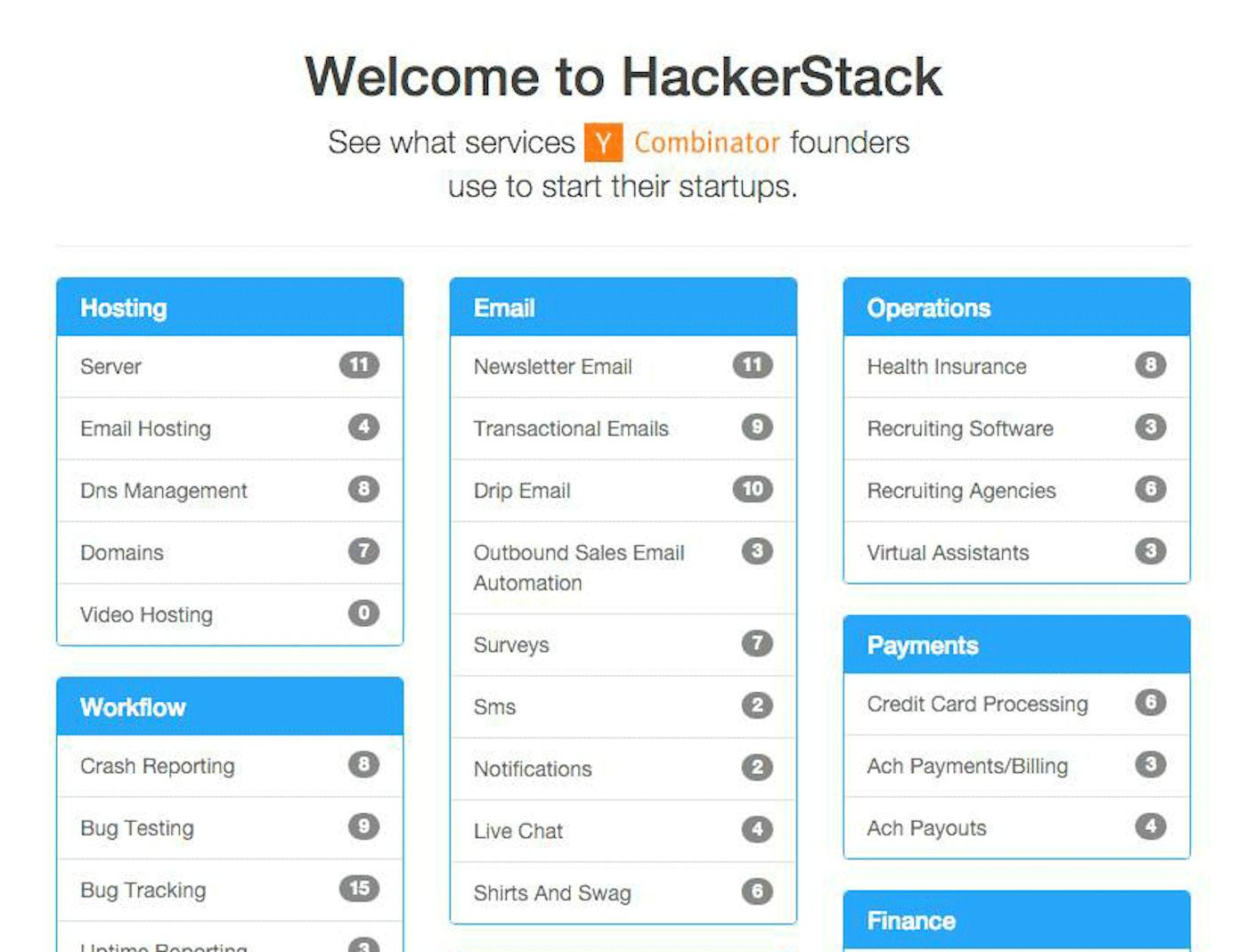
Back when Founderkit was Hackerstack.
The two-week prototype of Founderkit was pretty ugly — a makeshift logo in Photoshop, a placeholder .co domain that was available immediately, and a vanilla Rails/Bootstrap web application. The site was invite only (we'd approve folks manually), made creating reviews easy, and showed a collaborative rating for each tool in each category.
We also imported all the data from the original spreadsheet, so the site always had that "Aha, neat!" moment of seeing other peoples' ratings and reviews of tools, even as the first user. It was simple, but it worked.
Besides server costs, I think our only costs were for Urlbox. We used Urlbox to grab screenshots of sites for each tool to make the review and rankings pages more visually interesting. Our expenses came out to about $90/month total.
How have you attracted users and grown Founderkit?
We shared Founderkit with YC founders via the email list, leading to the first 100 or so members. The prototype worked so well that I actually got an email from Jessica Livingston, asking if we were somehow scraping reviews from the YC email list archives (which we weren't).
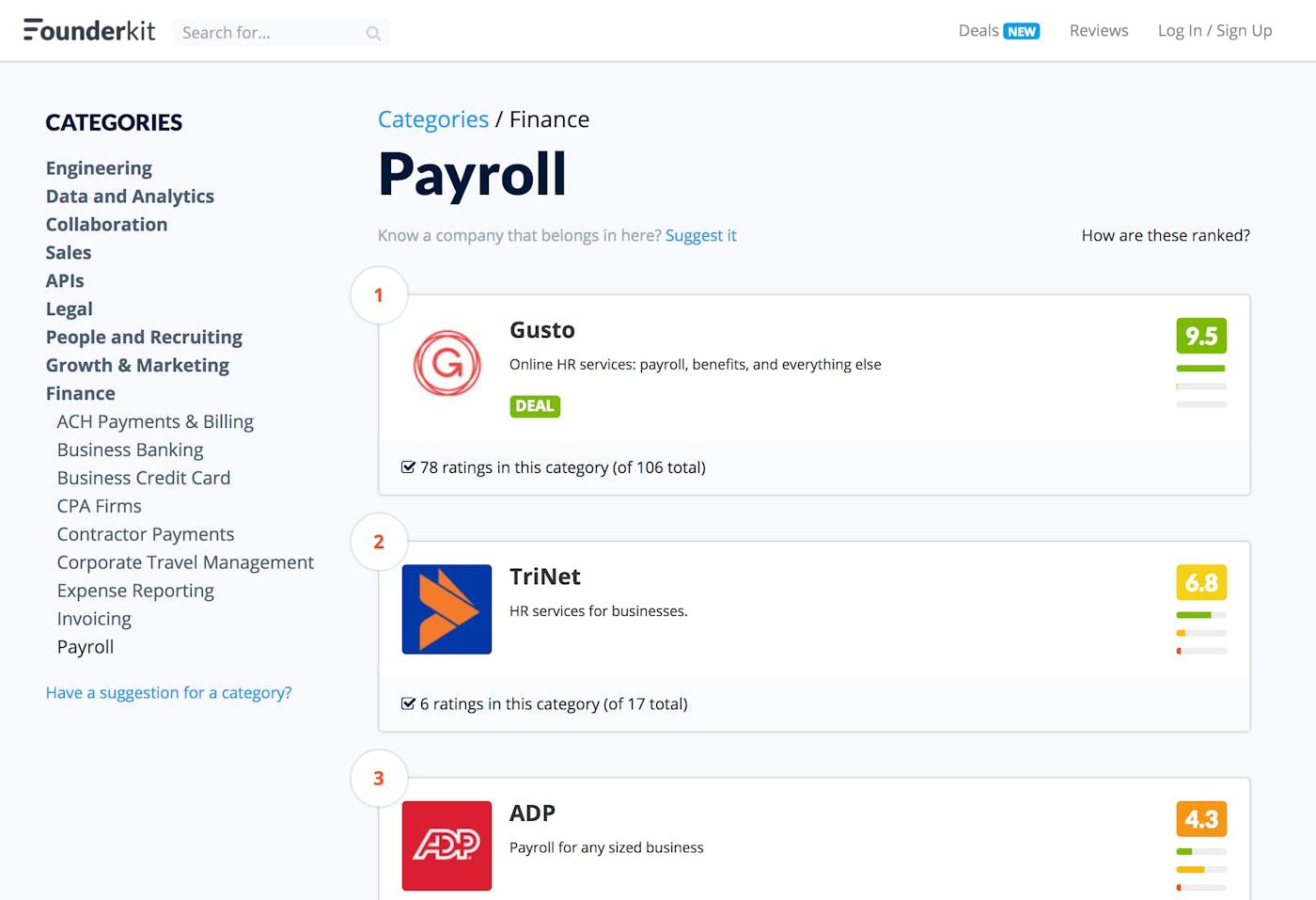
The "Payroll" category page on Founderkit.
We had just started consulting at the time, so we had time to dream up features, but hardly any time to implement them. But the site just kept growing. Founders would tell us it was the first place they'd look before choosing a new tool, and they continually requested new categories. You'd think when we stopped tending to it that it would just die, but around the time we finished consulting six months later, it was being used by almost every active founder within YC. It was time to open it up to more founder networks.
Next we reached out to other groups of leading founders such as Slow Ventures (via Facebook), First Round, Social Capital (via their Slack), True Ventures, TechStars, Resolute.vc. Some investors didn't have founder email/Facebook groups or Slack, but we just kept pushing. We set Founderkit up so that when you're part of a group like First Round, you can see recommendations and ratings scoped within that group. In groups like YC with batches, members also see each others' batches (like the "Summer 2011" batch). We made sure that being part of these groups offered a special, worthwhile experience. By then we were up to about 1,000 very experienced founders, and you could bet your startup on the reviews.
Finally, we launched Founderkit on Product Hunt. Combined with Hacker News, it led to more than 50,000 founders visiting the site, and it's grown significantly since then.
What's your business model, and how have you grown your revenue?
After the launch on Product Hunt and Hacker News (during which we somehow kept the site up), the founders of Gusto, Hellosign, and others reached out to say congrats and that they were all passing Founderkit around their offices. When we asked them if we were referring any traffic (via a barely visible link on each company page), they referred us to their marketing folks, asking to dig into their analytics. Not more than an hour later, one of the marketing execs called me to say that "we were referring the best traffic they'd ever seen," and asked if they could pay us to refer more.
We all agreed that we'd never, ever, mess with ratings or rankings on the site. Ever. So to encourage founders to try their services, we suggested they give founders something, much like companies give huge credits and discounts to YC founders. Thus Founderkit Deals was born.
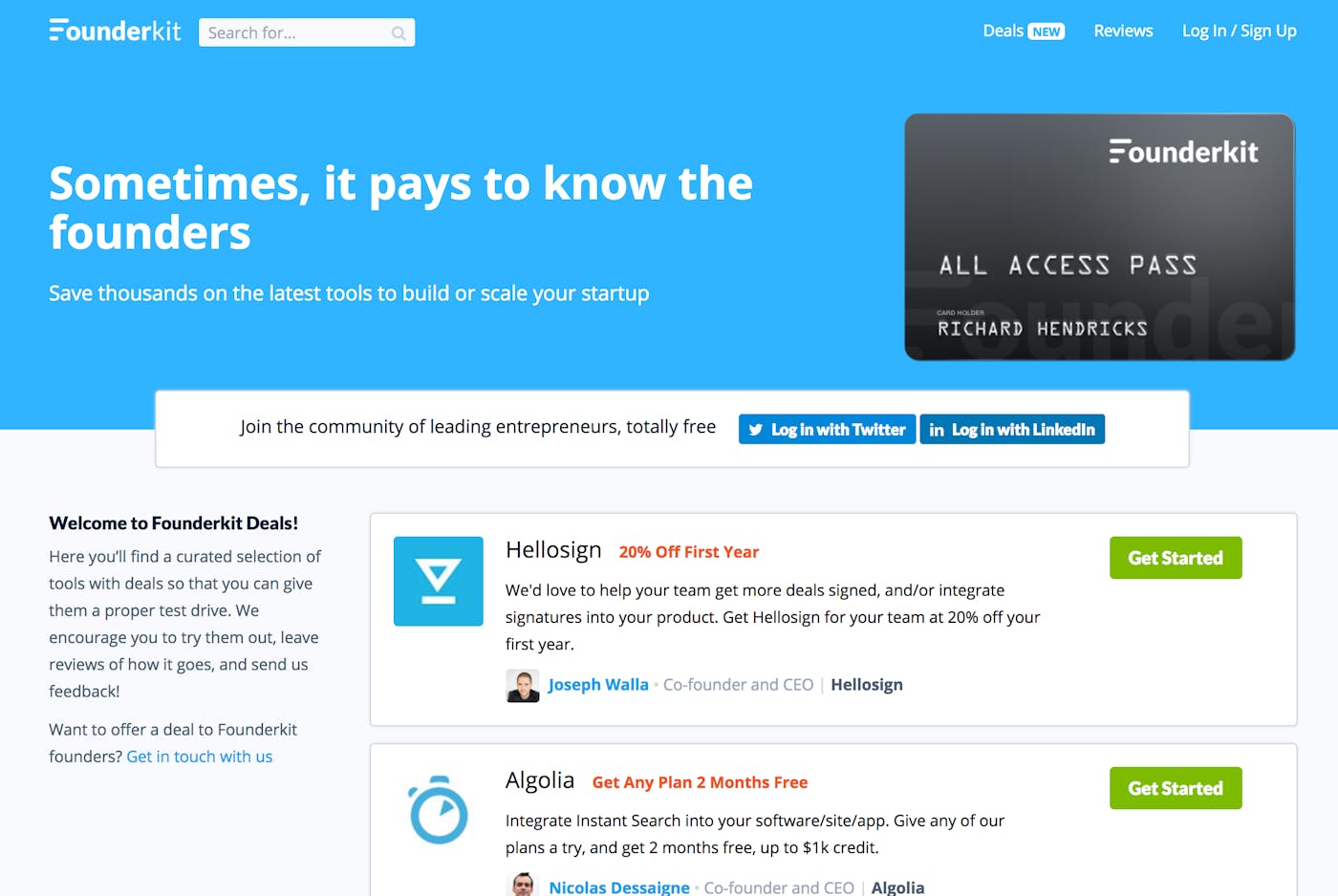
Founderkit Deals is a list of credits, discounts, and extended trials on leading tools for startup founders. It's a paid feature for companies, since the point is to encourage founders to try out their services, separate from ratings and rankings, and we're paid a flat fee, regardless of whether a founder signs up and/or pays for the service. We currently have over a dozen deals featured on Founderkit, and have many more coming.
What are your goals for the future, and how do you plan to accomplish them?
Our goal for Founderkit is to build a place where founders can help each other start and scale their startups successfully. We've got a lot planned and will be soon launching a v2 of the site which will reveal a lot more of the ultimate vision for the site.
What's been challenging so far? And what's been helpful?
There've actually been many times we've almost killed Founderkit. But founders kept coming back. When it was just a tiny site within YC, we'd see 20% of our users return every month, which was higher than we expected. As a review site, we expected founders to use us perhaps once every 6 months. However, founders relied on it to make decisions and came back to leave reviews about things that caused them to switch tools. Our original goal for the site was to create a no-bullshit place where founders could find the recommendations they needed, and get back to work, and we'd succeeded, so we kept going.
While we often obsess about the direction in which to start, it's starting itself that allows us to learn. It certainly helped that we'd both built marketplaces before, and knew the ins and outs of solving the chicken or egg problem. We'd established friendships with hundreds of founder friends in the startup community over the years, so we were able to build a product that served the communities of which we were a part.
Do you have any advice for aspiring indie hackers who are just starting out?
Two things — The first would be to just get started, and worry less about the five- or even two-year vision. Ship something, and keep shipping. Get the engine running and the revenue coming in, as you can always optimize and grow. It's amazing how motivating that first Stripe charge can be!
Founders often get roadblocked or distracted by things that will only matter a number of "ifs" down the road. And most of the time, what you learn in a first release or iteration, even with 10 users, teaches far more than sitting around second guessing.
Secondly, launch fast and validate your user acquisition strategy immediately. We often take massive shortcuts, such as reducing a product down to manual emails and a Google Spreadsheet or form, as we did with the first version of Founderkit, or skipping right to running Facebook ads just to get started, even while we're building the product in parallel. This often forces you to fall in love with data and results, rather than with features and other aspects which just eat time.
Where can we go to learn more?
Come join us on Founderkit.com. We'd love your feedback (you can't hurt our feelings), and if there's anything we can do to be of help to your startup, feel free to shoot us a reply to the welcome email when you join.

You can try any scripts file for your product page. I did the same integration as you can see on this page.
Perhaps a silly question, but your site features many product and company logos. Given that many logos are copyrighted, do you ask every individual company permission to use their trademarks, or do you know/assume they endorse this? Many other websites, such as tech stack comparison sites similarly publish logos from hundreds of other companies, and I was just wondering whether this is considered fair use.
How do you get founders to review the software? Besides out of the kindness of their heart?
Really great point... any marketplace generally needs a little elbow grease on one side more than the other. As you guessed, in a reviews site (as with Yelp), that side is the content generation. First, we made it ridiculously easy to leave reviews. Second, we wove it into a core part of the experience... signup. You can generally get a sense of the priorities of a website by its onboarding. With Facebook and LinkedIn, it was making connections and inviting new ones. With ours, it's creating review/rating content. Third, we turned reviews written into a karma score, to offer some competition for those who find enjoyment in sharing their opinion to compete with one another. Hope that helps and that you find Founderkit useful!
how well has the karma score concept worked?
What are some of the bigger problems beginners face in developing something that is a marketplace?
This comment was deleted 9 years ago
This comment was deleted 9 years ago