Going Against a VC-Funded Competitor to Grow to
$400/mo
Hello! What's your background, and what are you working on?
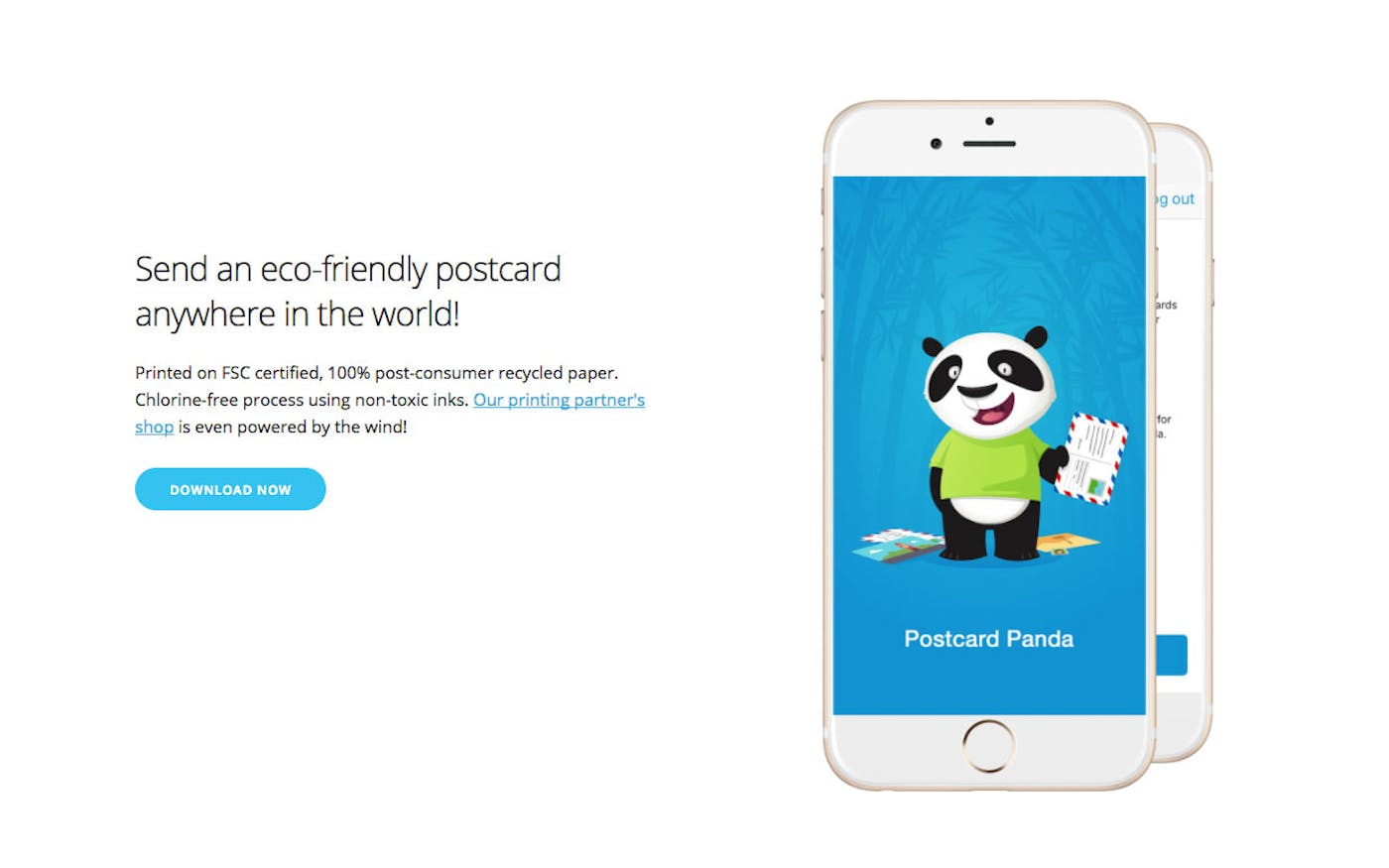
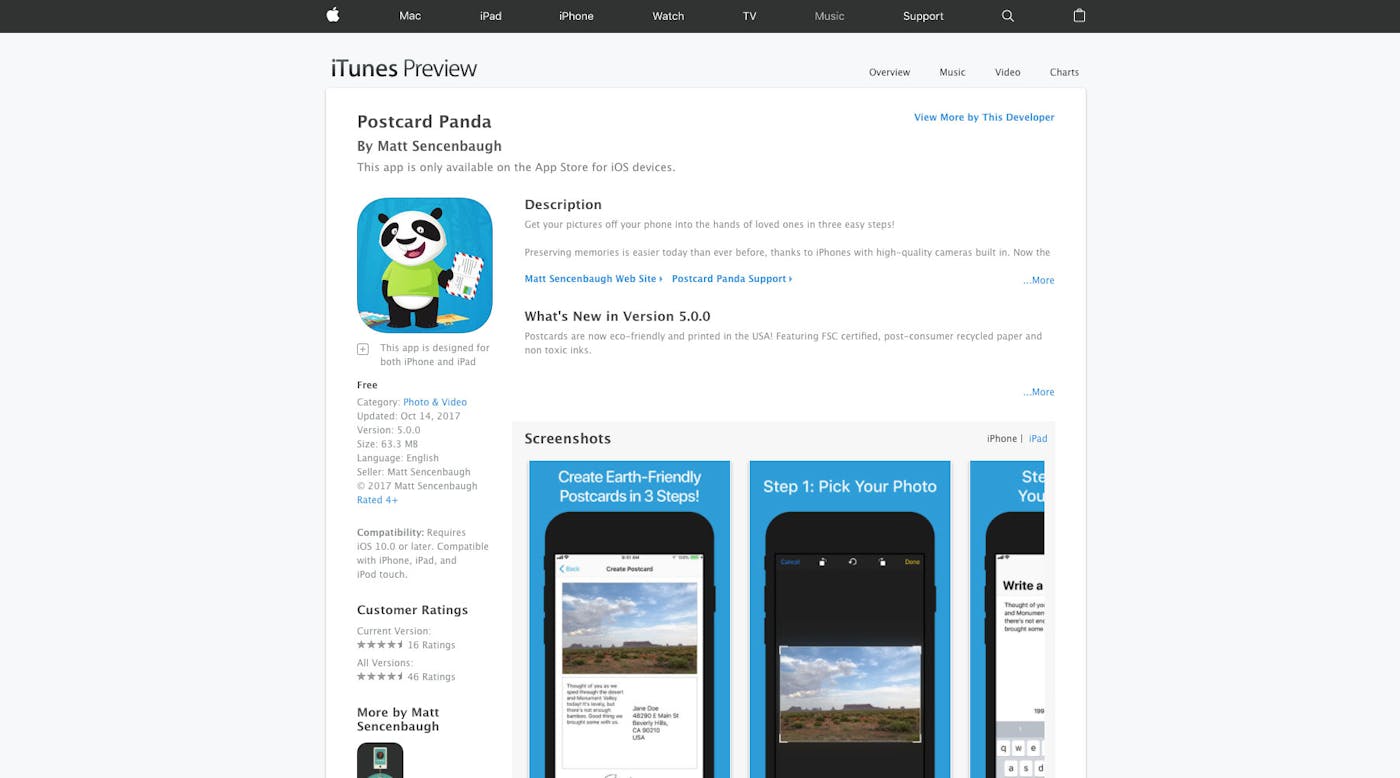
I'm Matt Sencenbaugh, and I created Postcard Panda — an iOS app that lets you send eco-friendly postcards in the mail.
I grew up in Washington before moving to California to study computer science at Stanford. I'm currently juggling a part-time job, running a Saas called WrestlingIQ, and attempting to make Postcard Panda viable.
Today over 1k people have used Postcard Panda, with monthly revenue between $400 and $600 dollars in the last few months.
What motivated you to get started with Postcard Panda?
Arrogance.
Back in December of 2013 I was in the midst of some soul searching and traveling after the startup I'd helped found royally screwed a good friend of mine we'd hired. (I quit immediately after.)
I was visiting my parents over Christmas and my dad had taped an episode of Shark Tank which featured an app called Postcard On The Run. Selena Gomez was an investor, and I think one of the 'sharks' invested too. I had that knee-jerk reaction all developers have at some point:
"Why does that idea need venture capital? I can build a better version of that product myself that is also cheaper."
I spent the next six weeks snowboarding in Tahoe and building the v1 of Postcard Panda. I launched to huge crowds downloading my app and sucker punching that Postcard On The Run company right out of the gates.
Kidding. Totally, completely kidding. I launched to crickets and my v1 wasn't better than theirs. Thus Postcard Panda was born.
What went into building the initial product?
I sat in my short-term apartment rental and coded up the first version, using a fairly well known API-to-print service to handle the heavy lifting. I paired everything down to its core and launched an app with only a guest checkout experience and zero bells or whistles. The very first version probably took 30 hours of my time and $700 for a logo.
I did basically everything wrong.
I didn't talk to any potential customers. I didn't do the math on how the unit economics would work. I had no mailing list to launch to. And I had no plan on getting the word out after I launched it.
How have you attracted users and grown Postcard Panda?
This graph should give you an idea of how bleak the app was from February 2014 to September 2015:

Yep, that's $162.85 — or about $8 per month in revenue. Then the "big (lucky) break" happened, which ironically came when Postcard on the Run went out of business. I was lucky enough to be number two in the app store search, and when they pulled the plug I went to number one for 'Postcard On The Run'.
I made $210.94 in revenue in October 2015, which was more than I'd made in the entire life of the app so far. The app was still basically a really bad v1 at that point, but I decided to put more effort with this glimmer of hope.
I launched v4 in November of 2015. V4 offered user accounts, which drove much of the retention and growth for the following year as I rode the coat tails of a company that went out of business (reruns are still a thing!).
User retention is quite good in Postcard Panda, and I do get a fair amount of word of mouth referrals. Once users are in I seem to be in an ok place, although the usage is heavily skewed to typical vacation months so I'm in a yearly cycle. This means that I tend to compare last month vs a year ago when doing metric analysis.
Revenue since October 2015 has at its highest peak been $840.35, and the average somewhere around $400.
V5 recently launched, which adds an optional subscription model and moves things to an eco-friendly printing format. The move to eco-friendly makes me feel better personally, and I hope it will become a real differentiator for Postcard Panda.
Currently, I'm experimenting again with Apple search ads (the first experiment did not go well), plugging away at blogger outreach, and thinking about introducing a referral program.
What's your business model, and how have you grown your revenue?
With the launch of version 5 Postcard Panda makes money in two ways. The first is transactional revenue from postcards. The second is annually recurring revenue from Panda Plus, which is an optional subscription.
I'm in the minority of iOS apps that charge credit cards directly in the app, since in-app purchases are for digital purchases only.
Tip: Apple Pay has been really popular in the app — it's how ~40% of transactions in the last six months have been completed. It's worth the build time if you collect cards directly, and Stripe makes it easy.
The biggest issue with the business model is that the margins are very low, especially when compared to traditional software. Postcard Panda has real costs associated with hiring a printing company, the paper, ink, and stamps.
Your initial gut reaction may be that I get to keep extra revenue since Apple doesn't take a cut anymore, but the unit economics mean that I'm losing much more than 30% to fulfill each order. If you are considering entering the physical goods space as a software developer, spend a fair amount of time in a spreadsheet doing analysis before you pass go.
The biggest drivers of revenue growth have come from a few features and seasonality. User accounts were a big win, since they enabled customers to save their payment methods and allowed to duplicate postcards and send them to more people. (I have a couple customers who have sent 100+ cards to family members.)
Summer months are my best by far… unfortunately I haven't found the hack to make it July every month of the year yet.
Here's a look at the last several months of revenue:
| Month | Revenue |
| May | 636 |
| June | 408 |
| July | 497 |
| August | 456 |
| September | 264 |
| October | 399 |
V5 included a price change as well as the subscription option, and you can see that it has already been a better month than September for a traditionally non-vacation month.
What are your goals for the future?
The big driver of change in v5 was my angst about the environmental impact of sending postcards in the mail. The cards I send are now printed on FSC-certified, 100% post-consumer recycled paper using a chlorine-free process with non-toxic inks. My printing partner is also powered by the wind.
My goals for the future are to attempt to migrate the postcard industry towards a more environmental future. Hopefully that means that Postcard Panda also does better as a business, but I generally hope to apply pressure to other companies to follow suit.
In terms of raw numbers, I'm hoping to hit $1k per month in revenue in the next six months.
If you had to start over, what would you do differently?
If I had to start over I would work directly with a real printing shop, rather than using an API. I got burned with my first API partner because they deprecated their iOS SDK without letting me know. One day the production app just stopped working.
For v5 of Postcard Panda I did some outreach to many eco-friendly printing partners to get prices and estimates. I had to spend about an extra week building out the back end infrastructure to generate batches of PDFs from user submitted postcards, but now I get to keep more of the margin.
It really wasn't that scary to seek out a business relationship even though I had never done that before. If you want to sound smart, and potentially high brow, you can call it "disintermediation".
Some people might say that getting a partner lined up is too much effort for an "MVP", but I disagree. An often overlooked challenge in business is personal motivation.
If the business you are starting today turns out to be successful, would you still want to be running it or would you be miserable? If you aren't motivated enough to put in the effort to make a project actually viable, then you probably shouldn't be starting it in the first place.
You absolutely need to be ruthless with pairing down your idea to the core to get something out the door, but that doesn't mean taking shortcuts that cleave all of the usefulness out of your product.
Have you found anything particularly helpful or advantageous?
One of the best things I ever did was move to part-time, which has given me an "infinite runway" to work on my own stuff. I don't think I would leave my day job even if Postcard Panda covered my salary, but it's a nice balance that leaves me a lot less stressed and creatively satisfied.
Another hack that I've recently adopted is having a separate checking account for each project. (This can be a separate personal checking account if you are a sole proprietor.) Then I "invest" the project with a "seed" fund, which to me usually means taking a small amount of money out of my savings — $5,000 or less.
I have a simple spreadsheet where I then track all of my revenue and expenses for the project. Early on in the project this tends to be negative, so I then either pay my credit card directly from that account or transfer it to my main savings where my card gets paid from.
This simulates a burn rate and makes you honest about how much you are spending on the project. It's really easy to spend thousands of dollars on unneeded tooling if your project's expenses are blended with your personal expenses. It's a lot harder to do that if you have a tiny number dwindling down to zero in a bank account.
I tend to use the Pomodoro Technique for focus and exercise four to six times a week to stay physically sharp. It's amazing how much physical activity also improves my mental acuity.
I read quite a bit with a skew heavily towards sci-fi and fantasy. My favorite author in that genre is likely Brandon Sanderson, with my favorite "classic" being Snow Crash by Neal Stephenson. If you could care less for that style of fiction, my book recommendations for entrepreneurs are:
What's your advice for indie hackers who are just starting out?
Keep grinding.
I was a wrestler for most of my life, and the competitors I respected most on the mat were people with consistent, ferocious energy reserves. No flashy moves or huge peaks and valleys of energy. Just smart, consistent effort through an entire match backed up by a lot of training behind the scenes. The same is true for makers looking to start a business.
This stuff takes a long time to materialize, so you have to be ready to be in it for the long haul. Of course you need to make really smart decisions, but every day that you show up with energy is a win for the business.
Where can we go to learn more?
You can find my personal blog at mattsencenbaugh.com, and my Twitter @MattSencenbaugh.
Please feel free to leave a comment or question below. I'll be hanging around to answer questions.

Love this Matt - especially the eco-friendly angle. I am certain you will soon pass $1000/month.
I'm pedantic, but hey: there's a small mistake above the "bleak graph". It says February 2015 but guess it should be February 2014 (dunno if Courtland & team can easily correct it?).
Also: any chance you can share a bit more about how the startup you co-founded screwed over your friend? It's obviously not directly related to Postcard Panda, but it may nonetheless be a helpful lesson for the audience (if you're willing/able to share...).
Best of luck getting to and surpassing 1k!
Nice catch Scott, I've sent over a note to get that fixed up.
In regards to the departure from my original startup, there isn't much to it. We brought in a new CEO who fired my friend because they didn't fit in with the 'culture'. Never mind that about six weeks before that same friend had been offered a special one year stock vesting schedule if they decided to defer medical school an additional year to work for the company, which was accepted.
Some people might say it's the CEO's prerogative to make hiring and firing decisions on a dime and I'm ok with that viewpoint. But I'm certainly not going to stick around in that same environment. Life's too short to work in a toxic environment. Some blog posts you might find interesting that are related are https://mattsencenbaugh.com/leaving-my-baby-a-journey-into-the-abyss/ and https://mattsencenbaugh.com/why-i-refuse-to-negotiate-on-equity/
Will definitely read those. Thanks for the answer and links!
$700 on a logo seems like a lot! but it worked so ¯_(ツ)_/¯ . congrats on your hustle and also doing something good for the environment. i think mobile apps are particularly challenging. have you explored using linktexting to increase conversion from website to download?
I've found that $700-$1000 is normal for a good designer. Keep in mind that also included an iPad icon and a splash page (the giant image that shows when the app opens). Sometimes I make my own icons, as the trend toward a single letter on a solid color means poor photoshoppers like myself can occasionally skate by. But for illustrated icons like Postcard Panda's I don't have a chance in the world.
I have not explored linktexting, have you? I would be really curious to hear about the numbers from someone who has implemented it.
i know the founder of linktexting and have not used it myself. the numbers are legit, theres a decent uplift in conversion. only if you get a fair amount of website traffic that you think is not converting tho. if youre converting well then you dont need it
Thanks for the article Matt, lots of great insight. I'm particularly intrigued by your point about working part-time. I've often thought about that option, but concluded that I should wait until a side project is getting serious traction (i.e. decent monthly sales) before shifting. What do you think?
Chris
p.s. I also love Snow Crash, if you haven't read it already, check out The Diamond Age (also by Neil Stephenson and even better IMO)
Diamond Age is a great book too! Have you checked out The Cryptonomicon?
In regards to the part-time question, I think going part-time is the best possible thing you can do if you are serious about building your own business. The alternatives never appealed to me.
In order to get serious traction, or even a simple product built, with a full time job means that you are working overtime. I wasn't willing to sacrifice my weekends or other hobbies to kill myself to ramp up a software product.
Alternatively you could save up enough savings to give yourself runway to go full time on your own products. Ben Orenstein (http://www.benorenstein.com/) did this and it seems to be going well for him. I didn't quite have the savings cushion to live in this reality and wanted to start making now. The other option is go to full time on your product and freelance. But freelancing comes with it's own problems, mainly that it takes a lot of work to keep your clients flowing through the door.
So - part time it was. The first thing I did was create a budget. You don't need fancy software, just a simple spreadsheet (I use one my gf made - http://treading-lightly.com/2017/01/simple-budget-spending-tracker/). Once I had done that for about three months, I knew what my salary needed to be. My part-time job pays enough for me to still sock away money every month to my savings, contribute the max to my roth IRA, live fairly comfortably, covers my health insurance and allows some travel (I'm actually getting on a plane to New Zealand in about 48 hours). The flip side of this is that I'm generally thrifty in other areas of my spending, for example my girlfriend and I only eat out about once a month.
YMMV, but the fact that I absolutely know I have two days a week to dedicate to whatever I want has been a huge creative boon and stress reliever for me.
The Cryptonomicon is one I haven't got round to - definitely on the list!
Nice breakdown of the options and your reasons for choosing part-time. In the past I've not struggled with working evenings and weekends, but recently I've experienced some back pain and burnout that has made me think that this approach isn't sustainable long term (although I've kept it up pretty happily for about 4 years until now). Part-time is appealing because it feels like you're not risking too much - watching my savings erode away would be very stressful.
Thanks for sharing your thoughts.
Love the panda design! That icon/mascot is awesome. :)
Did you hire someone to design that for you?
Wow, that must have been rough with the first API partner deprecating the iOS SDK out of nowhere. It sounds like you've done a great job of gradually improving the app over time in spite of some challenges, and that's crucial.
Good luck with your $1k goal!
Thank you, I appreciate the kind words. Best of luck to you with Strides and Summit, I'll have to check them out.
I think the mascot is the best money I've spent so far, well worth the money. David Laplante of https://www.picardconsultants.com/ is the designer behind the icon.
Nice, thanks man! If you'd like early access, I'd love to have you on the Beta team. Keep up the great work!
Hey Matt, congratulations on your early success with Postcard Panda and wishing you even greater success in the future. I love the fact that your initial motivation was arrogance - I'm in a similar boat as well.
It's really interesting to learn that summer months are your best when I thought a lot of people go away for vacation in the winter as well.
Do you currently have an API at the moment? One of the ideas that I'm pitching right now is leveraging my CRM to automatically send all your existing customers a card to say "thanks for their business".
December and January seem to be relatively good too, but not quite as good as summer. My personal (not rigorous) hypothesis is that people tend to fly to their families during winter instead of away from their families so sending a card is not high on the priority list when you see them face to face.
I do not currently have an API, but have thought about it in the past. With v5 is has come to the front of my mind again as I do not know of any eco-friendly print to api services out there. If you or (anyone else) wants to discuss this in detail you can email me directly at [email protected]. Let's talk specifics, numbers and prices offline.
Best of luck with Orchestra btw, looks slick!
Yeah. That was my hypothesis as well.
Sure - I'll send you a note and we can connect. Thanks for your comment.