“I’ll just post on Upwork” is not a client strategy. Here’s what I built instead.
Let me tell you about a specific kind of panic. You open a spreadsheet. You name it “potential clients.” You stare at row 1, column A. And you have absolutely nothing to type.
Not because you’re bad at your job. I’ve run a web agency (dricomm.com) for years — I know how to build a good site, write decent copy, deliver work people are happy with. That was never the problem. The problem was always this: knowing who to talk to, and knowing what to say that isn’t “hi, I do websites, need one?”
The skill nobody teaches you
Here’s something I think gets missed a lot: “finding clients” and “doing the work” are two completely different skills. You can be excellent at one and genuinely stuck at the other. Most freelance advice assumes if you’re good enough, clients find you. Sometimes that’s true. Mostly, it isn’t — especially early on, especially in crowded fields.
So what do people actually do? They post on Upwork and compete with 40 other bids. They wait for referrals that may or may not come. They tell themselves they’ll “get to marketing” once they have more time — which never comes, because the work itself takes all the time.
I did all of this. For years, across multiple projects (dricomm, and later around.md). And I noticed something: it wasn’t that I lacked opportunities. It’s that finding them took hours I didn’t have, and once I found a business that might need me, I still had to figure out what to actually say to them that wasn’t generic.
Nobody guarantees you a client. But the odds aren’t fixed either.
Here’s the mental shift that changed things for me: waiting for clients and hunting for clients have wildly different odds, even though neither one is guaranteed.
If you wait — you get whatever comes. Could be nothing for months.
If you hunt — and you hunt specifically, picking businesses that visibly need what you do (a restaurant with a site frozen in 2019, a clinic with no online booking, a shop using stock photos instead of their actual products) — you’re not gambling anymore. You’re starting conversations with people who were already halfway to needing you. You just showed up first.
That’s the whole idea behind what I’ve been building.
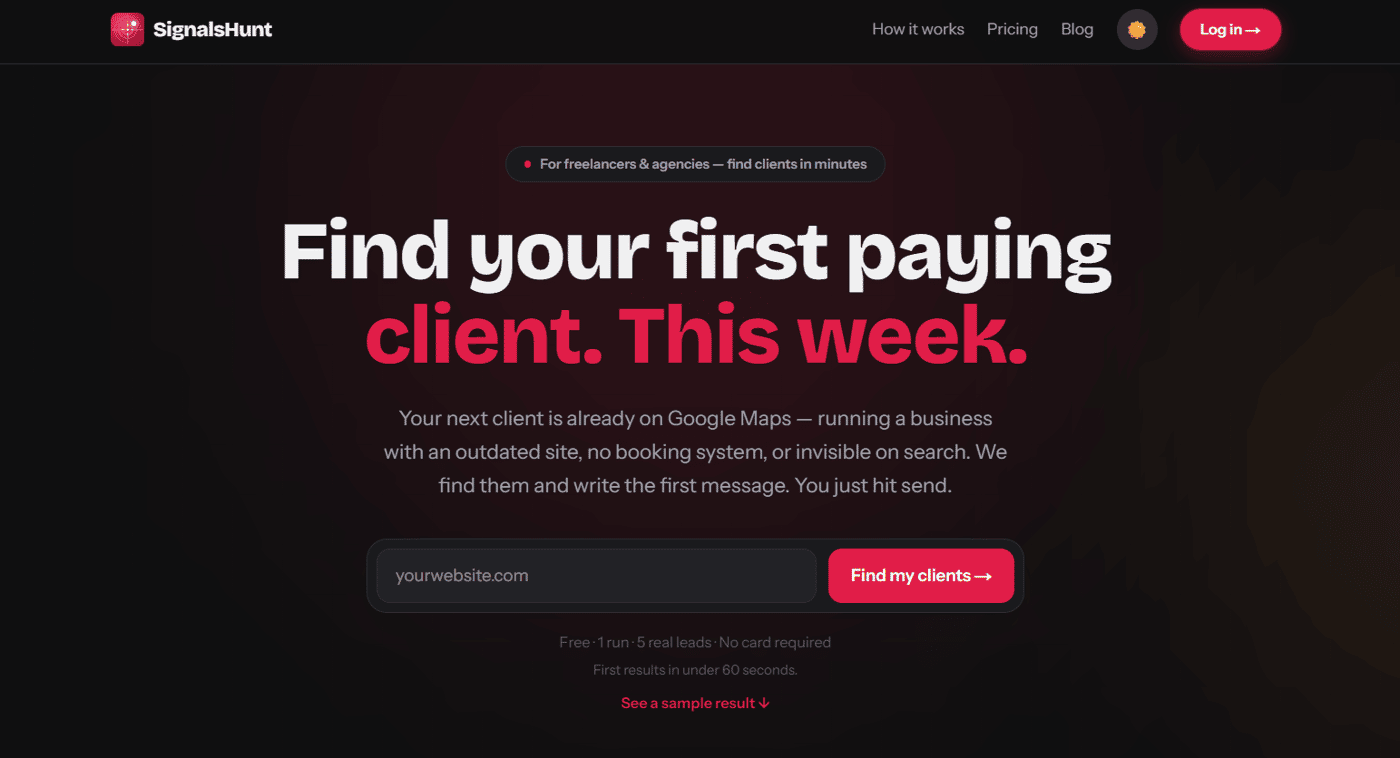
What SignalsHunt actually does
You paste your own site. An AI reads it and works out who your realistic first client is — not a vague “small businesses,” but something specific. Then it searches real local businesses on Google that match, and — this is the part I care about most — it actually visits each one’s website and looks for something concrete: an old copyright year, no mobile-friendly layout, no online booking, stock photography, missing social links, whatever’s relevant to what you do.
Then it writes you three messages — an opener and two follow-ups — that reference that specific thing, instead of “I help businesses like yours.”
You still send it yourself. You still have the conversation. I didn’t try to automate the human part — I automated the part that was eating my time and killing my momentum before the human part ever got a chance to happen.
Does it work? Honestly — yes, but not magically
I use it myself for dricomm. So far: over 100 emails sent using it, real replies from real people, one paid client, one more in an active conversation right now. Not a hockey-stick story. Just a tool that turned “I should really find some clients” from a dread-inducing task into something I actually do, consistently, because the hard part — the staring-at-a-blank-list part — is gone.
Who this is actually for
If you’re good at your craft and bad at (or just exhausted by) the hunting part — this is for you. Web designers, developers, copywriters, SEO folks, marketers, photographers, consultants. Anyone whose bottleneck isn’t skill, it’s the first move.
Free plan gives you 5 real leads, no card needed, just to see if the whole idea even makes sense for your niche: signalshunt.com
I’ll be honest that this is still early and growing — but the core idea, I’m convinced of: the odds are better when you hunt. I just wanted to make the hunting part take a minute instead of an afternoon.


I tried it, I like it - I'll get the PRO version.
Thanks for your feedback!
nice!
Thank you!
So each time I run with the same site, it will give 20 new leads and not repeat the old ones?
Thanks for sharing this post! Indie Hackers is one of the best communities for entrepreneurs to exchange ideas, validate products, and learn from real startup journeys. Discussions like this help founders avoid common mistakes and discover new opportunities. If you're interested in exploring more online platforms, you might also want to check out C444games .vip. Looking forward to more great insights!
Thank you!
"You paste your own site. An AI reads it and works out who your realistic first client is — not a vague “small businesses,” but something specific. Then it searches real local businesses on Google that match, and — this is the part I care about most " = brilliant!!!
Thank you)
This is a really useful idea. Finding the right people to reach out to is often harder than doing the actual work. I like that it helps make outreach more specific instead of sending the same generic message to everyone.
Thank you!
No product can retain customers consistently, unless it’s exceptionally good and represents the customer’s top choice.
I agree! But it's worth a try!
Wow this sounds like a good idea. Now that everyone and their mothers are building saas, services like these will be needed more and more. Thanks for sharing.
Thank you for your review!
Really well-executed positioning shift — going from "who's complaining online" to "who actually needs help right now" is the difference between outreach that gets ignored and outreach that gets read. The detail of actually visiting each business's site and referencing something specific and real (outdated copyright year, missing booking option) instead of generic "I help businesses like yours" copy is exactly the kind of qualification layer most lead-gen tools skip. That's the part that actually earns a reply.
The free-plan-first, low-commitment structure is smart too — letting people see real, sendable messages before asking them to trust the tool with money is the right sequencing.
Great work — following this closely. On a related note, we're tackling a similar "specificity over generic output" problem in a different space with PotenAI (AI-driven career/potential analysis that references a user's actual answers instead of generic labels) — funny how much of building trustworthy AI products comes down to the same core discipline: make the output reference something real, not something plausible-sounding.
You can join the waitlist: https://nopick.site