Mastering solution product
management
How solution product management elevates product strategy.

How solution product management elevates product strategy
The pressure to release features is high, yet you have a nagging feeling that you are overlooking something in the rush to get features out. How can you find time to handle your nagging feelings?
That nagging feeling is you don't know enough about the solution that includes your product. Of course, you know how a customer uses your product. However, the broader solution using your product isn't an easy subject. For example:
Your APIs and UI have multiple use cases
You have several key verticals of customers using your product
You have lots of partners using your APIs
Your product market is huge
There are benefits to knowing more about your broader solution:
A competitive edge: prioritizing features for the solutions your customers need, helps customers meet their objectives faster
Reduces customization: tailoring a solution that builds on your product reduces the special one-off requests for your product
Less product risk: handle dependencies before your profit is impacted
Cultivating your solution product management skills, leads to these benefits:
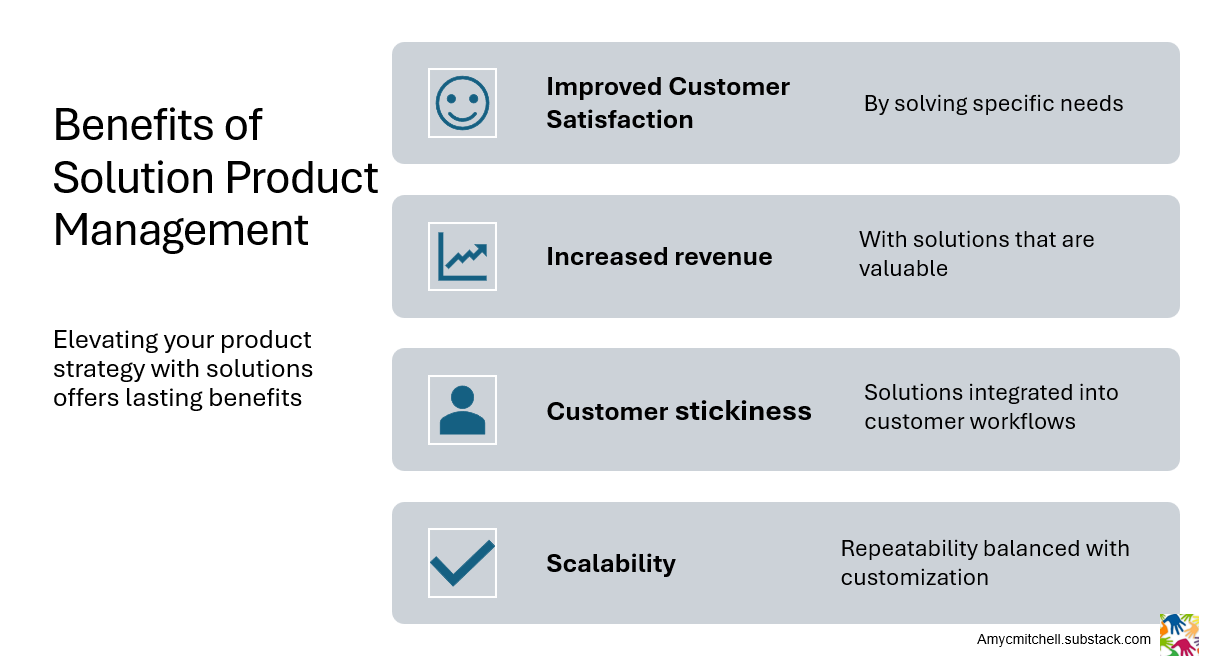
The trick to opening these benefits is improving your solution knowledge one bit at a time
Solution product management applies to all product Managers
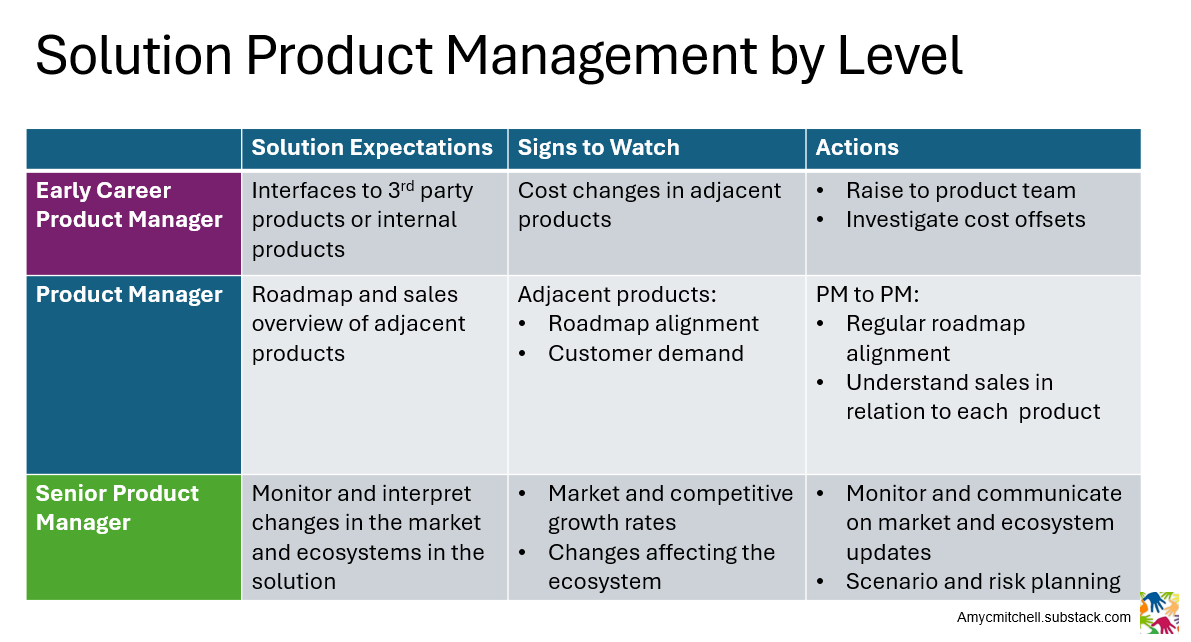
First, some myth-busting - any level of product manager can do solution product management. Solution product management isn't just for very senior people in your organization. Each level of product management can contribute to solution product management:
Early career product manager: Deep connection on the external interfaces in their functional area.
Solution opportunity: Often don't realize the value of their knowledge
Example: The product manager for a partner-specific developer's kit is hearing about the partner's licensing changes that will increase prices.
Technique: customer's cost changes affect all products in the solution
Action: Experiment with product changes that offset the partner changes
Established product manager: relationships with 1-2 related products in the organization
Solution opportunity: Neglect relationships with product managers in their organization
Example: Product manager notices that a new product isn't getting sales
Technique: One product issue affects all products in the solution
Action: Review customer feedback and collaborate to handle the top 3-5 issues from that product in your product
Experienced product manager: Define the market and ecosystem solution for target customers
Solution opportunity: Market and competitive changes that affect customer spending
Example: Market growth is slowing due to AI initiatives in your target customers
Technique: Know your solution ecosystem
Action: Share your knowledge regularly and include the team's feedback in your point of view. Drive change cross-functionally through relationships
A summary of the solution product management activities by level is below:
You're probably thinking these actions aren't enough to save yourself from the feature release cycle. You are right - doing these techniques alone isn't enough to define and leverage your product's solution! What can you do for a valuable product solution?
Solution techniques for a solution mindset
You and your organization are super aligned with your customers and responding to customer needs. You are so responsive that each major customer has a custom solution with your product and 3rd party products. Your customers are extremely happy because you handle their problems - even when the problem is outside your control.
Due to the close work with customers, your solution includes your product plus 3rd party products.
Using the solution techniques brings out the solution mindset. How does this work? It gets product teams and the organization to a common understanding of your customers' solution.
Solution technique: customer cost changes affect products
Solution product managers have multiple listening points for customer feedback. For example:
External partners' business development leads
Product managers and engineering leads that interface with external partners
Sales leaders
Customer success managers
Services teams that handle the products' installed base
Solution product managers watch for trends that affect their customers' costs and revenue. Some of the trends that a solution product manager watches for:
Changes in the licensing of any product in the solution
Regulatory and compliance changes that affect to cost to the customer
New technology (i.e. AI or Cloud) that replaces part of the solution
Monitoring the listening points and keeping a watch for customer cost impacts enable a solution product manager to update products, processes, or business metrics in response.
Solution technique: one product issue affects all products
Solution product managers watch for weak links in their solutions. From the customers' perspective, a complete solution is needed. If a product or service is preventing the customers' outcome, then the rest of the products and services in the solution are impacted.
As product managers define customer use cases, the product dependencies become clear in the solution. Some typical solution dependencies are:
Two products interface with each other via APIs or standard protocols
A database in a central location
A cloud service with a separate cloud account
Security devices such as a firewall or identity access
If one of these products can't support the solution, then the rest of the solution struggles.
The best prevention of solution failure is to focus on the weak products and services. Product managers with a solution mindset can head off devastating product issues by:
Documenting the solution reference architecture
Clear interface documentation
Solution roadmaps
Guiding stakeholders to solution priorities
Strong relationships among the contributing product managers
Product managers with a solution mindset can keep a weak product from hurting solution success.
Solution technique: know your solution ecosystem
More and more solutions have dependencies on a group of similar products. Sometimes this grouping is called an ecosystem. Examples of ecosystems are:
Public Cloud providers
Marketplace of apps
Marketplace of freelancers
Data management platforms
Security protocol endpoints
Home networking
AI agents
When a solution touches these ecosystems, then the solution has a dependency on the ecosystem. Solution product managers and stakeholders watch for changes that can impact their solution. Some key items to monitor:
Mergers and acquisitions
Market spending changes to alternatives
Regulatory requirements - data privacy, country-specific
Compliance requirements - financial/point of sale, security/encryption, Environmental, Social & Governance (ESG)
If an ecosystem issue hits a solution, then the product managers adjust the solution strategy with stakeholder agreement.
For the slides in this article and a solution example, please head to the resources tab (for paid subscribers).
Solution techniques lead to a solution mindset
Product managers that include these solution techniques can reduce their product customization requests by considering the whole solution for their customers. By tailoring the whole solution for customers, off-the-shelf products can be used with customization in services and automation.
Shifting the product mindset to a solutions mindset opens these possibilities. The key changes for product managers to add solution techniques are:
Building product-to-product relationships
Aligning roadmaps
Scenario planning and risk management
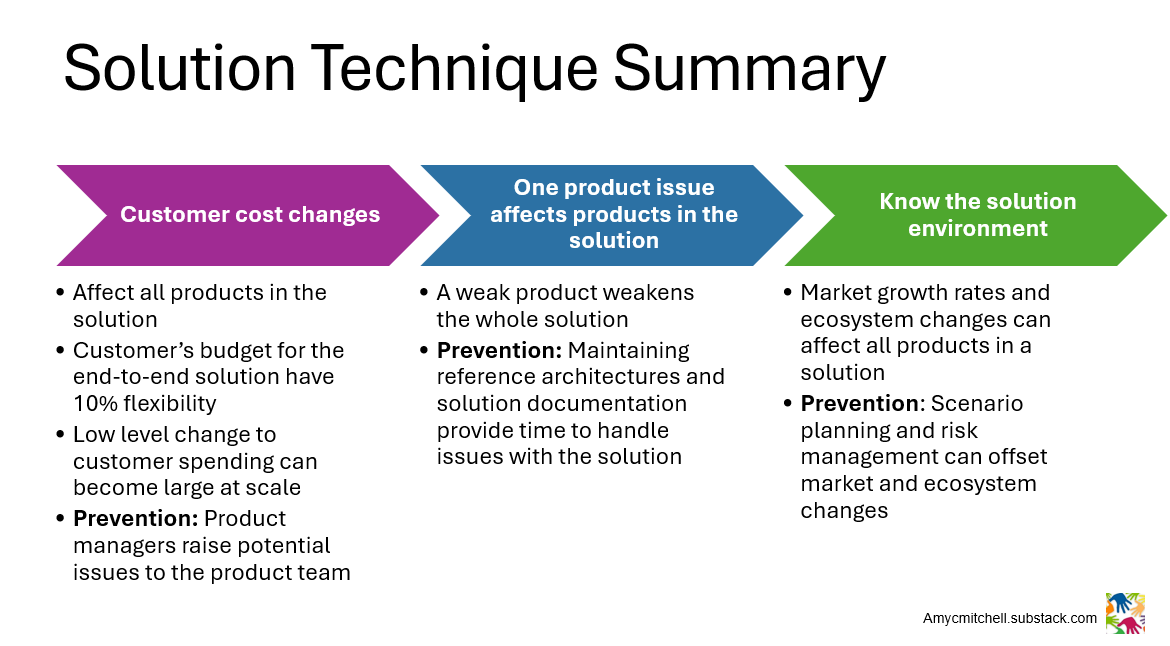
The summary of the solution product management techniques is below:
Solution product management unlocks strategic success
Product managers who embrace a solution mindset position themselves to elevate product success by:
Anticipating customer spending constraints and proactively designing value-driven solutions
Leveraging standard products while customizing to meet specific customer needs
Navigating market volatility through solution-level risk management that adapts to shifting challenges
By thinking about solutions, not just features, product managers drive strategic business growth. In the world of products, solutions are game-changers.
This article was originally published here.
