Taking the leap and building a 6-figure-ARR
portfolio

Pauline Clavelloux always wanted to build a business, but she couldn't quite get herself to start. Then, after nearly ten years at IBM, she took the leap.
She had a few failures and an exit, and she now has a portfolio of SaaS products bringing in over $100k ARR.
Here's Pauline on how she did it. 👇
Failures and exits
I’m Pauline Clavelloux, a French tech entrepreneur. I worked for 9.5 years at IBM before becoming a full-time indie hacker.
I started indie hacking during COVID and built several SaaS products from scratch; some failed, one sold, and four others serve clients:
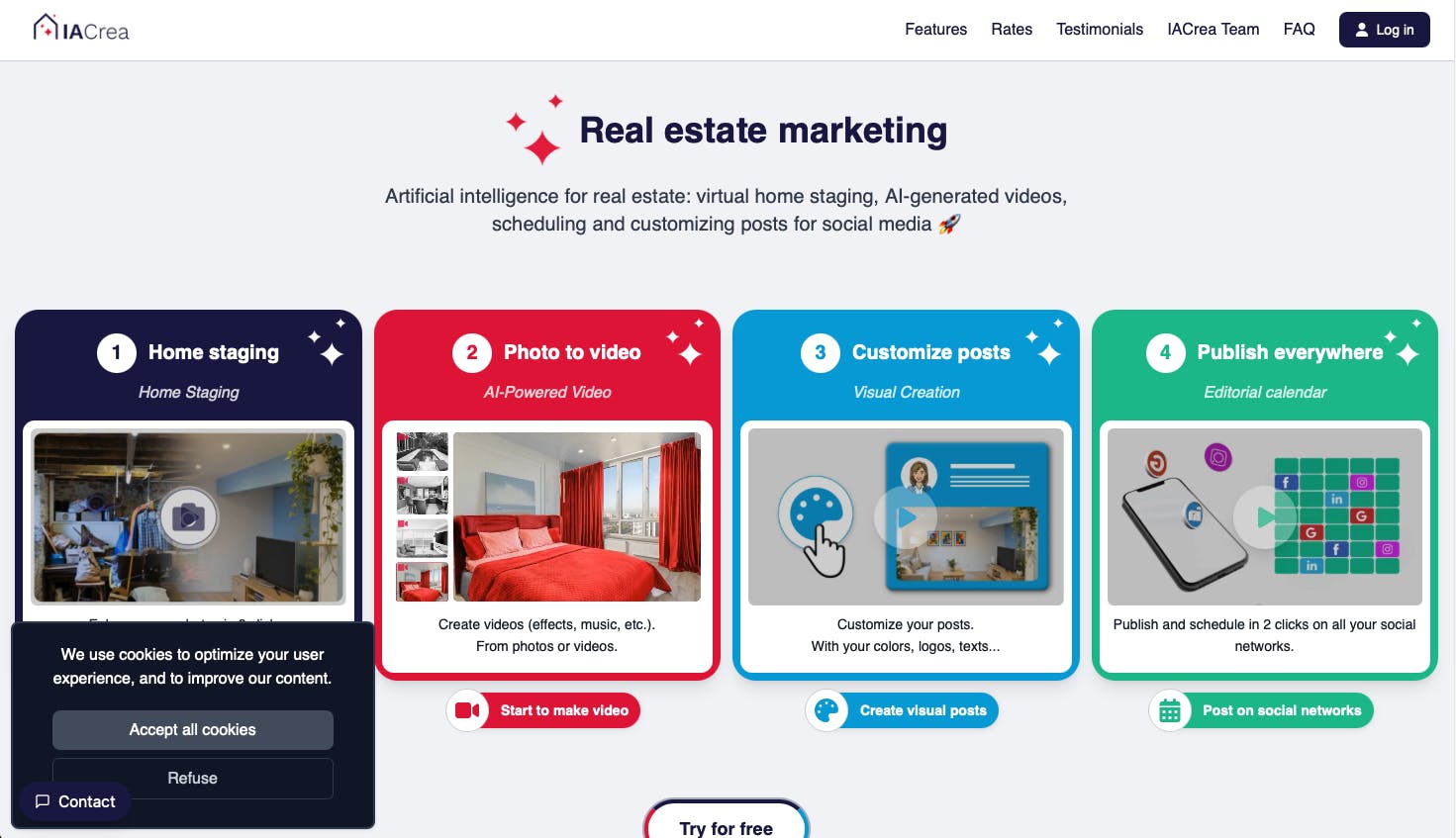
IACrea, an AI-powered real estate marketing suite that transforms property photos into virtually staged images, videos, and ready-to-post social media content.
Feedbask, a customer feedback and support widget with different actionable modules (live chat, feedback collection, bug reports, feature requests ...) directly inside their app.
Subclip, a web app that automatically adds subtitles to videos, translates and dubs into other languages, etc.
Refindie, an affiliate management tool for SaaS creators without upfront cost.
I reached €100K+ ARR back in 2024, and revenue increased in 2025.
The first taste of indie hacking
I’ve always wanted to start a business, ever since I was a kid.
I constantly had new ideas, but before COVID, I never started anything. The main reason was fear: I didn’t know where to start, and the administrative side of running a business felt overwhelming.
During COVID, I saw some friends launching their own online projects. They already knew how to handle the business setup, and that gave me the push I needed. I teamed up with a friend and built my first product: a crypto trading bot. It was a complete business failure... but also a personal success, because it worked and traded automatically for me!
I eventually stopped it, but that experience changed everything.
I realized how much I love building things, working for myself, and having the freedom to work from anywhere. That sense of independence is something I never felt while working a 9-to-5 job. I love working from home.
A lean mindset
When I built my first real product, I had a technical background in web development, but I learned how to run a business through experience.
The first versions of my SaaS products were extremely simple. I didn’t focus on design or scalability; I just wanted to see if people would use it.
For IACrea, for instance, the very first version only supported uploading one photo at a time and returning one AI-generated image. But it was enough to get the first paying users.
I keep my process lean:
Build fast, even if it’s ugly.
Launch early, get feedback.
Improve only what matters.
Quit if no traction.
That mindset helped me ship multiple products quickly. Each one taught me something new about tech, about users, and about what drives revenue.
A simple stack for every project
My tech stack is quite simple:
Frontend + Backend: Next.js + Tailwind CSS
Auth + Database + Storage: Supabase
Payments: Stripe mainly, and Polar for Subclip
Hosting: Vercel & AWSGrowing four products
Building is easy, distribution is hard
Building the product was the easy part; making people aware of its existence was hard.
I tested many approaches: social media, video content, SEO, physical events, direct conversations with users... and over time, I learned that distribution is key.
For IACrea, we initially grew by staying close to the market: Facebook groups, in-person networking events, and partnerships with industry players. Direct conversations and trust were crucial early on.
For Feedbask, Refindie, and Subclip, we have mostly driven growth through social media. Regularly posting about the product, sharing real use cases, and building in public helped attract early users who understood the value.
Overall, adapting the distribution strategy to each product and audience made the biggest difference. Each channel compounds differently over time, and what works for a SaaS might not work for another SaaS.
I'll also say that building in public is extremely helpful. Sharing what I’m working on, what’s not working, and why lets me get early feedback and stay close to real user needs.
Solve your own problems
Start by solving a real problem you personally experience; it makes the problem clearer and the motivation stronger.
For example, customers kept asking the same questions, and answering them manually was time-consuming and unproductive. Frustration led me to build Feedbask: a centralized inbox accessible to the whole team that included context. Soon, it will also pre-fill replies based on past conversations to avoid rewriting the same answers repeatedly. Can't wait for that!
Turning internal pain points into a product was a huge advantage. When you build something you personally need, you know what's needed, and what's not working well with other solutions. And if you fail to monetize it, at least it's useful to you!
Parting advice
Here's my advice:
Don’t wait to be “ready” or to get the perfect product to share your work.
Build in public early, talk to users as soon as possible, and let feedback guide the product. People especially love to see the journey and your product evolve.
Systematize repetitive tasks instead of handling them manually.
Focus on learning fast rather than trying to get everything perfect.
Be resilient, and be prepared to fail. Founders who are successful on their first attempt are VERY rare. You see many successful people online, but usually, it took them a few years to get revenue.
What's next?
My main goal is to keep building useful, simple products that solve real problems for the real estate area and business owners, the two audiences I can reach. I want to grow all my SaaS sustainably to at least $30k MRR each.
And I want to continue sharing my journey openly, building in public, and showing that you don’t need a huge team or massive funding to build profitable, meaningful products.
Lastly, I recently started creating videos (find my YouTube profile here) and I'd like to growth that channel
You can follow along on my newsletter and on social media: X profile, YouTube, and LinkedIn. And here's my portfolio.

Leave a Comment
Very cool! I am starting a small business and would appreciate feedback on how to get it off the ground!
This is a really solid case study in disciplined, portfolio-driven SaaS building. What stood out most was how you combined a lean execution mindset (build fast, validate early, quit if there’s no traction) with multiple distribution strategies tailored to each product — too many founders assume one channel fits all, but you showed that Facebook groups, social media, partnerships, and direct conversations each play very different roles depending on the audience and product.
I also appreciate the emphasis on solving real personal pain points as the engine for product ideas — that’s a core principle for sustainable indie businesses because it aligns motivation with measurable market demand. Pairing that with a simple, maintainable stack (Next.js/Tailwind/Supabase/Stripe) demonstrates that complexity isn’t a prerequisite for ARR success when distribution and user feedback loops are prioritized.
One question I’d love to see explored more: how you prioritize time and resources across multiple products as traction diverges — do you have a framework based on revenue/retention signals, or is it more qualitative? Either way, this journey is a strong blueprint for anyone aiming for durable SaaS ARR without overengineering.
This is a great reminder that the journey is rarely linear. What stood out most to me wasn’t the €100k ARR, but the sequence: failures → learning → lean execution → distribution.
The “build fast, quit if no traction” mindset paired with solving personal pain points feels like the real advantage here. Also refreshing to see how differently distribution worked for each product — there’s no single playbook, just constant adaptation.
Really solid example of how consistency and resilience compound over time.
A lean mindset isn’t about cutting corners—it’s about respecting your energy and attention. Build the smallest version that teaches you something real, listen to users, and let clarity emerge through action, not overthinking. 🌿
Need a Fast and Flexible Loan?
We offer loans for personal needs, investments, business expansion, home renovations, and more! With amounts from $10,000 to $5,000,000 and a low 2% interest rate, we're here to help you reach your goals.
Loan Options Include:
Personal & Business Loans
Real Estate & Investment Loans
House Renovation & Car Loans
Debt Consolidation & Student Loans
For fast service, / The post was too long and was therefore cut off by the system.
For fast service, email us at [email protected]
with your loan details. We'll respond quickly and help you move forward!
Strong example of long-term product building especially valuable given how few women we still see in indie SaaS.
Pauline, your journey from a decade at IBM to a $100k ARR portfolio is a masterclass in escaping what I call the 'Hierarchy of the damned', that corporate structure where potential goes to die in exchange for security.
As a Mentor and author of 'Startup Inferno', I’ve mapped the 9 circles of entrepreneurial failure, and I see your success as a deliberate climb out of the Vestibule of indecision. Most people spend their lives 'wanting' to start; you actually chose to burn the boats.
A few 'Mentor-level' observations on your path:
The Validation Grill: your approach to IACrea (building the 'ugly' version first) is exactly how you survive the Circle of Lust. You didn't fall in love with a complex vision; you fell in love with a solved problem. In 2026, founders who prioritize feedback over 'perfect code' are the only ones who reach the purgatory of profit.
The Distribution trap: you hit the nail on the head, building is technical pride, distribution is commercial humility. Many founders get stuck in the Limbo of Unseen Products because they refuse to do 'things that don't scale' like you did with Facebook groups and manual outreach.
A Word of Caution on the 'Circle of Fragmentation': Managing four distinct SaaS products is a feat of strength, but as a Mentor, I have to warn you about the split focus. Diversification is a shield, but extreme focus is a sword. Be careful not to let the maintenance of four 'Infernos' prevent you from scaling one into a true $1M ARR Paradise.
Your transition from 'Internal Pain' to 'Product Solution' (Feedbask) is the ultimate Customer Impact Map. You didn't guess the market; you lived the market.
Keep building in public, Pauline. You are showing people that the exit from the corporate Inferno isn't a leap of faith, it's a series of validated steps.
Respect for the hustle.
Great post, appreciate the honesty about the hardships of distribution.
"Quit if no traction"
When is the right moment to quit? No users, too few users? Is there a rule of thumb here?
“Really inspiring journey. I like how you highlighted that building was the easy part but distribution was the real challenge — I think a lot of us learn that the hard way. What channel ended up working best for your first paying users?”
I love analyzing products, even when I'm just playing. I look at the UX, the interface logic, the speed. And to be honest, most casinos are pretty average. They work, but they don't inspire you to come back. Wageon https://wageon-h.click/73516/8357?l=3990&utm_source=wl stood out in this regard. The first thing that catches your eye is the cleanliness of the interface. You don't feel like you're being inundated with information. Everything is structured, and you immediately understand where everything is. The second is speed. This is critical. When the site responds instantly, you don't even think about it, but it greatly affects the overall experience. The third is stability. While playing, there wasn't a single moment when something "broke" or behaved strangely. The end result is a very solid product that is simply a pleasure to use. For now, this is my main site, and so far it confidently holds its position as a favorite.
The IBM-to-portfolio-founder arc here is genuinely instructive. Nine and a half years builds real institutional knowledge — enterprise sales cycles, how procurement thinks, what B2B buyers actually need — and you can see it in the product choices: IACrea addresses a professional use case with clear ROI, Feedbask solves an internal tooling gap for SaaS teams, Refindie targets a pain point that every growing SaaS hits eventually.
What's notable is the diversification isn't random. Each product serves a different slice of the SMB/SaaS ecosystem, so cross-promotion is possible without direct cannibalization. That's harder to design than it looks.
Refindie's no-upfront-cost model is also a smart distribution wedge: affiliate tools have high switching costs once embedded in a referral flow, so free-to-start trades early revenue for strong retention. Classic land-and-hold.
At RovaAI we're building in the AI-for-sales-prep space and the portfolio mindset resonates — different products teach you which acquisition channels are product-specific vs. which actually generalize. Congrats on the €100K+ ARR, Pauline.
Hey!
I noticed your checkout flow doesn't have a 'Save' logic. I'm building a tool that automates this for an 11% performance fee. Want to be our first Beta tester?
pauline, this is the thing that clicked for me reading your story. you didn't pick a winner. you let the market pick it for you.
most of us treat shutting down a product like failure. you treat it like R&D. that one mindset shift turns a messy portfolio into a compounding lab.
i'm genuinely curious about one thing though.when you feel the pull to start product number five — do you have a hard rule? like "if it's below $X MRR or Y% month-over-month growth, it gets sunset"?
or do you let the new thing run in parallel until it earns its slot in your 4-product carrying capacity?
i'd love to see a short post on that decision rubric. bet it does numbers 👀
keep building in public. we're all learning from it.
The emphasis on building lean, launching early, and not being afraid to fail is something all indie founders should internalize—especially the part about “build first, polish later.” The story reminded me that growth isn’t just about feature lists, but about listening to users, refining based on feedback, and being persistent. It’s a practical blueprint for anyone looking to evolve from idea to sustainable ARR without overthinking every step.
This was such an encouraging and realistic read! I love how Pauline’s journey shows that you don’t need a perfect product or massive funding to build something meaningful — you just need to start, iterate, and learn fast. The way she kept her tech stack simple, focused on solving real problems, and adapted distribution strategies for each product really highlights that execution and audience understanding beat complexity.
This is a really inspiring example of building a portfolio the right way — shipping lean, learning fast, and letting distribution do the heavy lifting over time.
I’m curious about your decision framework across multiple products once they diverge in traction:
• What metrics trigger “double down” vs “maintain” vs “sunset”?
• Do you use a fixed time budget per product, or re-allocate weekly based on signals like retention / expansion / support load?
• Any rules for avoiding context switching when you’re running several SaaS at once?
Would love to learn how you prevent the portfolio from becoming 4 half-finished products.
This really resonates with me.
About a year ago I saw you in an interview, and I remember thinking “okay, it is possible.” At the same time, I got stuck in that exact trap you describe: trying to make everything perfect before launching.
That mindset led to a lot of frustration. I kept telling myself I needed the product to be fully polished before showing it to anyone. In reality, that just slowed everything down.
Yesterday I finally launched a waitlist, and the product is already functional — something I’ve been validating and sharing little by little instead of waiting for perfection. Reading your feedback and seeing what you’ve achieved reinforces that this is the right path.
Thanks for sharing this. It’s genuinely motivating to see the long-term result of focusing on progress over perfection.
This is exactly the kind of situation I keep running into.
When someone says “I’ll get back to you in a few days”,
the hardest part isn’t waiting — it’s not knowing what they actually mean.
Do you usually follow up, or do you treat that as a soft no?
Really inspiring story. The lean approach, building in public, and solving your own problems clearly paid off. It’s refreshing to see how simple stacks, real distribution work, and resilience matter more than perfection. Great motivation for anyone stuck overthinking the start.
This is such an inspiring and real indie hacking journey 👏
What stood out most to me:
Lean MVPs > perfect products
Building in public + direct user conversations
Solving your own problems first (Feedbask is a great example)
Same simple stack reused across products — execution > novelty
The “building is easy, distribution is hard” line hits hard 💯
Love how you adapted different go-to-market strategies per product instead of forcing one channel everywhere.
Also refreshing to see honesty about failures before hitting €100k+ ARR — that part is often missing online.
Massive respect for taking the leap after 9.5 years at IBM and proving that solo/lean founders can build sustainable SaaS portfolios 🚀
Following along — excited to see these products scale to $30k MRR each.
You mention “building is easy, distribution is hard.” For your first 10 - 50 paying users, which single distribution channel actually worked, and what did you explicitly stop doing because it didn’t?
Congrats on the success! I was at IBM for over a decade myself, so I can really relate to your desire to ditch the 9-5!
Hi, thanks for sharing your story! You mentioned using social media to promote Feedbask, Refindie, and Subclip. I’m curious, which channel worked best for you?
Interesting insights. In early-stage products, clarity often matters more than features — especially during onboarding.
This is a great example of how “simple but consistent” beats clever but overbuilt. I especially liked the part about distribution being harder than building — that lesson took me a while to internalize too. Building in public + direct conversations seems to be a recurring theme among people who actually ship and survive long term.
Love the focus on lean, simple products and building in public. It makes the whole journey feel much more human and sustainable. Thanks for sharing this!
A great reminder of hard work and honest, appreciated.
What’s compelling here isn’t just the €100k+ ARR number, but the repeatability of the approach. This reads less like a single success story and more like someone learning how to manufacture clarity: ship ugly, test demand, cut fast, and move on without ego. I like the emphasis on distribution changing per product — it quietly dismantles the myth of a universal growth channel. “Solve your own problems” also lands differently here because it’s paired with willingness to kill things that don’t convert, which is where many founders get stuck. The throughline isn’t brilliance or luck, it’s resilience plus fast feedback loops. This is what sustainable indie hacking actually looks like when you zoom out.
Pauline left IBM to become an indie hacker, built multiple SaaS products, faced failures, and now earns $100k+ ARR. Her success comes from building fast, staying lean, solving real problems, and focusing on distribution over perfection.
True
What really stands out here is how intentional the distribution choices were for each product. Lean building is common advice, but matching where you show up to who you’re building for is what actually compounds.
One pattern I’ve seen work especially well for that “stay close to the market” phase is using Reddit not as a promo channel, but as a listening layer spotting the exact complaints, comparisons, and workaround threads that later turn into positioning and early demand. It fits nicely with your approach of building simple, validating fast, and letting real user friction guide what’s worth scaling.
Great story, thanks for sharing!
Personally, I think you should focus on your best returning product.
Very cool, I've been following her as she is part of the numerous french indie hackers that made it. Cool article about her
I agree with the "distribution is hard" piece. Maybe you can share some more details in follow up posts.
This resonates hard. Currently in a similar phase - data engineer by day, shipping SaaS products by night.
A few things that stood out:
"Build fast, even if it's ugly. Launch early, get feedback." - This is the antidote to the perfectionism trap. My first version of PMHNP Hiring was embarrassingly basic, but it validated that people actually wanted a niche job board for psychiatric nurse practitioners.
"Distribution is key" - 100% the hardest part. I've automated content distribution across 8+ platforms just to stay consistent without burning out. Building the product feels like 20% of the work; getting eyeballs on it is the other 80%.
The portfolio approach - Love that you're running 4 products instead of obsessing over one. Lets the market pick the winner instead of you guessing.
Question: With 4 active products, how do you decide where to allocate your time when all of them need attention? Do you have a framework or is it based on revenue/traction signals?
Bookmarking your YouTube - always good to see the journey documented.
Every successful SaaS-preneur says the same thing about distribution. It's why I am focusing on building my distribution right now. You can imagine the confidence, developing a saas knowing there's an audience and a distribution channel ready for it.
Super inspiring read. The long-term mindset and portfolio approach don’t get talked about enough. What surprised you most along the way?
Really inspiring journey. The lean, portfolio-based approach—shipping fast, validating early, and tailoring distribution to each product—highlights what sustainable indie SaaS building looks like today. The focus on real problems, simple stacks, and consistent user feedback is a great blueprint for founders aiming for durable ARR without overengineering.
Thank you for your sharing.
Love the "Portfolio" approach—balancing product intuition with the learning curve.
"This is such a bold and inspiring move! Building a portfolio of products instead of betting everything on one 'perfect' idea is a strategy I deeply resonate with.
As a PM turned Maker currently building Babyfilter, I’ve found that the biggest challenge in this 'leap' isn't just the code—it's managing the transition from 'defining' a product to actually 'shipping' it. Sometimes my PM brain wants to over-engineer the roadmap, but the 'Maker' reality forces me to focus on the MVP and learn from real user feedback.
I’m curious: as you build your portfolio, how do you decide when to double down on one product versus moving on to the next? Is there a specific metric (like initial SEO traction or a certain number of signups) that signals 'this one has legs' for you?
Wishing you huge success on the journey to 6-figure ARR. I'll be following your progress!"
stay lean is the most important thing
This is incredibly helpful for me as a founder — thank you so much for sharing!
I like how you leaned into repeatable execution rather than waiting for a perfect idea. It’s a good reminder that distribution, iteration speed, and staying close to real user problems compound just as much as code quality.
Also refreshing to see the honesty around what didn’t work early on. That part is usually missing from success posts.
Thanks for sharing, this is motivating in a very grounded way!
Hi Pauline, thanks for sharing your journey!
I really like your lean approach — building fast, launching early, and improving based on real feedback. It’s easy to get stuck on perfection, but your story shows how important learning by doing is.
Also, your point about distribution being harder than building really hits home. Making people aware is a whole different challenge.
Turning your own frustrations into products like Feedbask is inspiring — solving real problems makes all the difference.
I’ve had many projects myself before finding the right one, so your resilience motivates me.
How do you stay motivated when some projects don’t work out?
Thanks again and good luck!
This resonates hard. Pauline's story of going from failures to $100k+ ARR is exactly where I am right now.
Currently building 3 AI SaaS products after similar false starts. The key insight I'm taking from her: ship quickly, iterate based on feedback, don't overthink.
I built 3 products in 48 hours instead of perfecting one over months. Early feedback shows the portfolio approach works—different audiences, different pain points.
Revenue model is recurring subscriptions ($97-297/mo per product). Still in testing phase with early users, but the velocity feels right.
Questions for others building multiple products:
- How do you balance marketing across 3 products simultaneously?
- Did you start with one product then expand, or launch multiple at once?
- What's your unit economics at early stage?
Great read. Thanks for sharing the unfiltered journey, Pauline.
That’s a great approach shipping fast and learning from real users can make a big difference in early-stage SaaS. While testing ideas and documenting product workflows, some builders also use tools like a text to handwriting converter to turn typed notes or drafts into handwritten-style pages for brainstorming, planning, or sharing concepts visually.
This was such an inspiring and practical story. I love how you didn’t wait for perfect conditions, you shipped early, learned fast, and let real users guide you. The honesty about distribution being the hard part really hits home; too many founders focus only on building. Thanks for sharing not just the wins, but the mindset and steps that made it possible. Really fascinating read!
Her face turned red when she received the news that the company had to let her go. ~
In the beginning, I wrongly thought that a good product would sooner or later get noticed. What I discovered instead is a separate skill distribution you must practice just as deliberately.
Your process break down on the stack is valuable since it shows repeatability not magic.
Are you now biased toward ideas that have distribution baked in? Or are you still willing to brute-force distribution if the problem feels strong enough?
This comment was deleted 6 months ago