Pivoting from product to tech-enabled productized service and growing to $50k/mo

Ryan Doyle built a product, got backed by Y Combinator's Calm Fund, and then pivoted into a tech-enabled service. Today, Sales.co is making $50k/mo.
Here's Ryan on how he did it. 👇
Moving back to the farm
I graduated from college and took a sales job with a tech company in Palo Alto. I knew that I wanted to build a company of my own, so I started building software on nights and weekends in 2020.
I just always liked building things. I grew up on a farm, and I liked being able to create and then see what I created. When I got into college, I played with entrepreneurship a bit and decided I might have the right disposition for it. I was curious enough to want to try things and stupid enough not to care about too many of the risks.
I think, overall, I looked at the path that was expected of me and saw that I could either go build something for somebody else and be a part of that journey, or focus on building a skill set and a base of assets that I controlled. I figured I'd rather take the risk of going out and learning this stuff myself.
So, I quit my sales job and moved back to my family's farm to build the tools that I wished I had as a salesman.
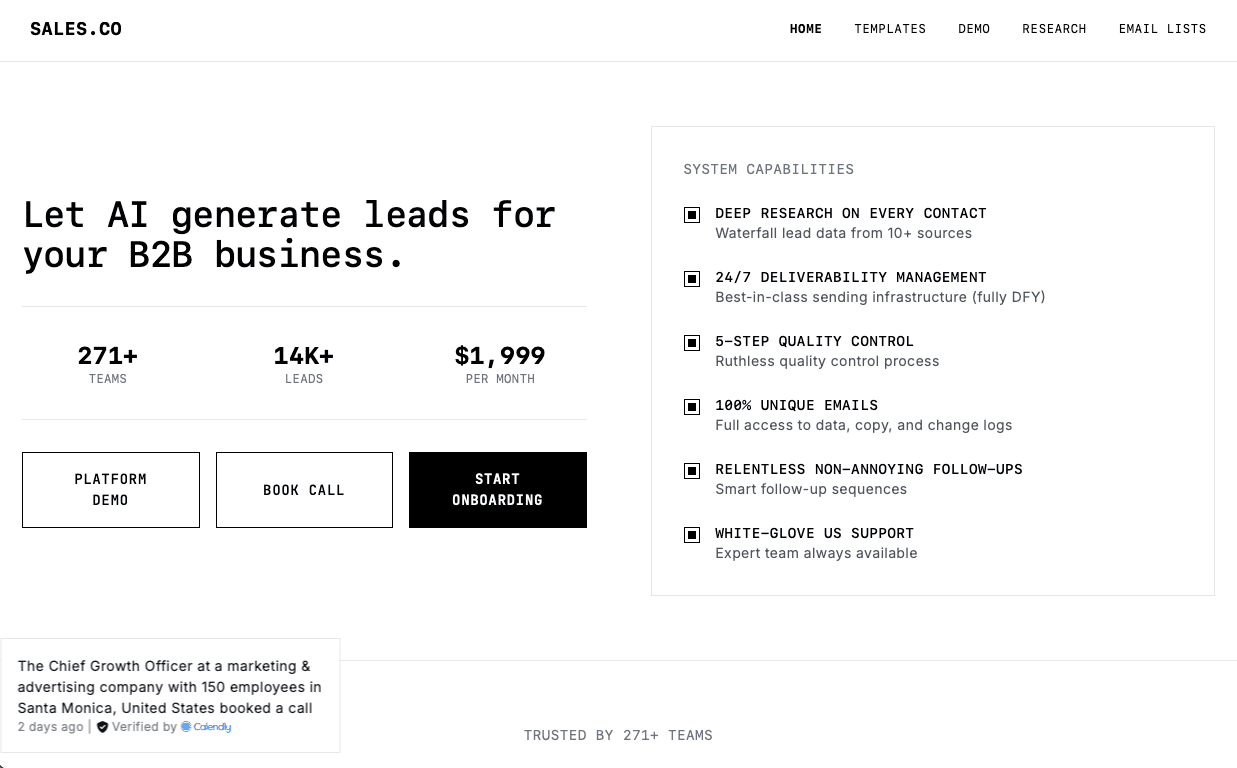
One eventually caught on. It was called Magic Sales Bot, and it was the first cold email writer built with GPT. It got backed by Y Combinator's Calm Fund, and that grew into what is now Sales.co, a lead generation service that we fulfill with the software we're building.
Building the "product"
Initially, it was a pure service. I really advocate for starting with services.
People are building all these different things without knowing what outcome they're actually trying to create for businesses. But when you go service-first and try selling that service, you really figure out what problems people actually have and what they're willing to pay you for. And from there, you'll find out what product to build.
So that's what went into building the initial product — working with a dozen different B2B companies and figuring out the commonalities between them all. And then building the infrastructure between them.
My partner, Jakob, and I built a lot of the infrastructure starting in Airtable with Python and JavaScript automations on top of that. And that has really never stopped. It's just become different layers of automation — things that we would do manually in the early days that we now automate through code that we've written.
And then, when we became the managers of this system, we started building automations into those levels as well. It never stops because as soon as we started doing really well with one service, we started branching out to other services.
As far as stack, Jakob's a big Python guy. I'm a big JavaScript guy. I like to do most of my backend work in Node and my frontend work in Next.js, but our website is just simple HTML. We've got a MongoDB database that we run all of our millions of cold emails' worth of data out of, and we've built all our own cold email infrastructure in Python on top of that.
Productized services
We run on a monthly subscription. We have businesses put the $3,000-$30,000 monthly subscription on a credit card.
It's just month-to-month. They put a dollar down to start, and we onboard them over the course of a week. Once they're ready, they see everything that we have prepared for them, and we begin their subscription in this way. It's really lowered the risk for them while providing an easy way to do cash collection for us.
Growth via dogfood
Cold email, cold email, cold email. That's how we grow.
Obviously, an advantage is being able to send thousands and thousands of cold emails a day — and do it well.
Any idea that we want to try, we can test on the market quite easily. That's something that, usually, only someone with an audience can do. And no one's really thinking of this. Or, if they are thinking of it, they're thinking about how hard it is or that it won't work instead of just trying.
Other marketing tactics we've tried:
Ads: This does well, but the leads are less qualified.
Partnerships: We reached out to other agencies and resellers but again, lower quality.
SEO: We started with programmatic SEO, with some success. We're leaning more into long term seo now
Beating a dead horse
Not to beat a dead horse, but here's my advice: Start as a service and then build your software around that.
If I had to start over, I would start with services instead of even going the Magic Sales Bot route. I suppose it was necessary. It helped me realize that I'm not the next Pieter Levels. And it also helped me find my niche.
It's the right niche for me. I've got the people skills for it. I've got the intuition for it. And it is fun in its own way.
What's next?
From here, world domination.
Generate cash to buy software businesses.
Use my hacking skills to bless the world in excess of how God has blessed me.
In no particular order.
You can learn more at Sales.co, CommunityMentions.com, JakobGreenfeld.com, and RpDoyle.com.

Leave a Comment
Love this pivot story, going from pure product to a tech‑enabled, productized service makes a lot of sense, especially when you’re aiming for more predictable revenue and clearer outcomes.
A few things I would like to explore:
1) Which part of the service did you decide to systemize first with tech, and how did that change your margins or capacity month to month?
2) Are you planning to lean even more into tech so it becomes closer to a SaaS over time?
Would be super interested to hear how you handle scope creep and expectations with clients now that the service is more standardized
Planned on chilling this Sunday. This post reminded me to go back to work.
Haha, I feel you!
There's so much to build and so little time! :)
Starting with services before building tech has also been a game changer in my own marketplace journey. By working closely with customers and manually delivering results early on, I uncovered nuances and frustrations I’d never have spotted from behind a screen. Only after mapping those patterns did I begin to automate and productize—turning a hands-on service into a scalable platform. It’s slower up front, but it builds real empathy and a stronger foundation for growth.
Magic Sales Bot being the first cold email writer built with GPT is a detail that matters more than it sounds. In 2020-2021, before ChatGPT went mainstream, building on GPT-3 for a specific business workflow was a genuine first-mover position. The early distribution from that novelty and YC Calm Fund's backing validated the demand. The question was always whether the software alone was sticky enough — and the pivot to tech-enabled service answered "not quite, but the outcome we can deliver with it is."
The tech-enabled productized service model is underappreciated in founder circles because it doesn't fit cleanly into either "I'm building SaaS" or "I'm running an agency." But it captures meaningful advantages from both: the software gives you delivery leverage that pure services don't have (you can serve more clients without proportional headcount growth), while the service model lets you charge for outcomes (qualified leads) rather than seats, which commands much higher ACV than typical software pricing.
"Built the tools I wished I had as a salesman" — but with the important prerequisite that he actually was a salesman in Palo Alto first. The insight about what outbound sales workflows actually need isn't something you synthesize from the outside; you get it from having spent time grinding through the workflow yourself.
The move back to the farm to cut burn while building is also an underrated founder decision. Palo Alto rent vs. living with family on a farm is probably $3-4K/month in savings, which at early-stage is the difference between 6 months and 12 months of runway. Lower burn rate = more time to find what works.
At RovaAI we're also in the sales workflow space and the product-vs-service tension Ryan describes is something we think about constantly.
🤖 An automation tool to build apps / tools / websites like Google’s AI Studio — but lighter, faster, and more cost-efficient.
⚡ Runs on Cursor and leverages AI to generate code, build logic, optimize workflows, and dramatically shorten development time.
🧩 Supports the whole journey: idea → MVP → production-ready product. Easy to customize and scale as your needs grow.
💰 Operating cost is only ~500,000 VND/month (≈ $20), ideal for individuals, indie hackers, small startups, or teams that need to experiment fast.
—
(Available on GitHub for download, testing, and demo.)
🤖 An automation tool to build apps / tools / websites like Google’s AI Studio — but lighter, faster, and more cost-efficient.
⚡ Runs on Cursor and leverages AI to generate code, build logic, optimize workflows, and dramatically shorten development time.
🧩 Supports the whole journey: idea → MVP → production-ready product. Easy to customize and scale as your needs grow.
💰 Operating cost is only ~500,000 VND/month (≈ $20), ideal for individuals, indie hackers, small startups, or teams that need to experiment fast.
—
(Available on GitHub for download, testing, and demo.)
github. /onmou/runner
If you've fallen victim to financial fraud and are struggling to come to terms with the loss of your hard-earned money, don't lose hope. TECHY FORCE CYBER RETRIEVAL is here to help. With a team of experienced professionals specializing in cyber security and financial fraud investigations, they have a proven track record of successfully reclaiming lost funds for numerous clients. Their expertise and dedication make them the ideal partners in your pursuit of justice. Contact TECHY FORCE CYBER RETRIEVAL today to take the first step towards reclaiming what's rightfully yours and securing your financial future.
WhatsApp them or call them with (+ 1 5 6 1 7 2 6 3 6 9 7)
Visit w.w.w. techy forcec yberretrieval .com
Telegram (@)Techcyberforc
Haha, thanks for sharing
Great post
HIRE A FASTEST CYBER RECOVERY EXPERT TO RECOVER YOUR LOST OR STOLEN BITCOIN/ETH/USDT/ THE HACKANGELS
I simply want to share my story about THE HACKANGELS RECOVERY EXPERT. To all of you out there. One has to be careful. A lot of scammers are out there taking money from innocent traders. I was a victim of these crypto scammers. They made me lose my hard earned funds. The best thing that happened to me this year was seeing an article about THE HACKANGELS RECOVERY EXPERT. A professional hacker and private investigator. I invested $954,300 in a cryptocurrency platform and it turned out to be a scam and I had no idea how to get my money back until I reached out to a recovery company called THE HACKANGELS RECOVERY EXPERT. I explained my situation to them. I was shocked to hear that they had recovered all of my stolen cryptocurrency in just 48 hours. I said that I will not hold this to myself but share it to the public so that all scammed victims can get their funds back. To anyone who may find themselves in a similar unfortunate situation. I highly recommend THE HACKANGELS RECOVERY EXPERT. Quickly reach out to them on their hotline:
WhatsApp: (+1(520)200-2320
If you're in London, you can even visit them in person at their office located at 45-46 Red Lion Street, London WC1R 4PF, UK. They’re super helpful and really know their stuff! Don’t hesitate to reach out if you need help.
Really interesting pivot and growth journey — thanks for sharing the detailed reasoning behind each step.
I’ve found something similar when building my own product: the hardest part isn’t always the tech, but figuring out the biggest bottleneck to growth without adding complexity.
Curious — how did you decide when to stop iterating on the product itself and focus more on scaling the service side? Was there a specific signal or metric?
Through repeatable, high-demand solutions, businesses can grow to $50k/month through the transformation from a product to an integrated technology-enabled productized service.
Its very nessecary to find yur own niche rather than sos
Shiny object syndrome
Pivoting from a traditional product to a tech-enabled productized service can unlock recurring revenue and scalability. By automating core processes, standardizing offerings, and leveraging technology for delivery, businesses can reduce manual work and increase margins. Focusing on solving a specific client problem consistently allows growth to $50k/month, while maintaining efficiency, predictability, and the ability to reinvest in expansion.
Really interesting point about ‘starting as a service’, I think a lot of new founders underestimate how important that mindset is. It flips the instinctive approach of building first and only then trying to find an audience. Thanks for reminding me/us!
Pivoting from a product to a tech-enabled productized service helps unlock predictable revenue and faster growth. By packaging services with clear pricing, automation, and defined outcomes, businesses reduce complexity and scale efficiently. This model allows faster customer onboarding, better retention, and higher profit margins, making $50k/month achievable through consistent delivery, smart marketing, and continuous optimization.
Ryan’s story is a great example of how powerful it is to start with a service, validate the pain, and then build tech around it. What stood out to me is how much of Sales.co’s early traction came from cold outreach and testing ideas quickly, which is exactly the type of content that performs extremely well on Reddit when shared in the right communities like r/Entrepreneur, r/SaaS, and r/sales.
There are a lot of founders there actively looking for discussions around productized services, cold email infrastructure, automation stacks, and early growth loops. When positioned properly, posts like this can generate real discussions and qualified interest, not vanity engagement.
I help SaaS founders and productized-service builders share their stories on Reddit without getting flagged, by matching the narrative to relevant subreddit conversations. If you’re ever interested in getting Sales.co or your lessons in front of those audiences, I can point you to the specific subreddits and angles that work best.
Pivoting from a traditional product to a tech-enabled productized service can unlock scalable growth and recurring revenue. By systemizing delivery with technology, many founders streamline operations, attract high-value clients, and steadily grow to $50k per month through predictable pricing, automation, and performance-driven marketing.
This post hits close to home. I'm currently pivoting from a traditional "CEO role" to exactly this model — a tech-enabled service for building MVPs.
My "tech enablement" is heavy use of AI agents (Cursor/Windsurf stack) to replace the need for a large dev team. It allows me to ship complex backends (FastAPI/Redis) in days, not months, which makes the unit economics of a "productized service" much more viable.
Curious about your scaling phase: at $50k/mo, did you have to hire human operators to manage the "service" part, or did you manage to automate the delivery itself?
Really inspiring
RECOVER YOUR LOST BITCOIN // WITH THE HELP OF GEO COORDINATES RECOVERY HACKER
I’m Thermos Lucas. I'm here to tell my testimony about how. GEO COORDINATES RECOVERY HACKER enabled me to recover my stolen BTC. A few months ago I lost $673,000 worth of BTC to a fake investment company. I don’t know how they got my email but I received an email from Investment Bank with a good proposal on how I could make millions out of my investment with them. I was convinced when they showed me profits from other clients that had invested in their platform, I began investing with them. When it was time to withdraw my profits, their website was shut down and I tried contacting them but they wanted me to pay a huge amount of fee to be able to withdraw my funds which I did until they cut me off and stopped all communication with me. I was shocked and devastated, I realized there was nothing I could do to recover my funds, I had gone to the authorities but they couldn’t assist me. I did some research online and I came across a post about GEO COORDINATES RECOVERY HACKER Their professional team was super and it took them less than 48 hours to get my funds back from these scammers. Geo Coordinates Hacker is here to provide that service for you. I highly recommend their services to everyone. If you suspect your Credit card, email & password, Facebook, Instagram, twitter Accounts have been hacked, you need to recover stolen money from scammers, report the incident to GEO COORDINATES RECOVERY HACKER, they can help you recover your BTC. in addition, GEO COORDINATES RECOVERY HACKER, can provide you with educational materials for staying safe online. They can also identify potential security breaches or vulnerabilities that may have led to the loss of your information. Please contact the following email address:
Email: geovcoordinateshacker@gmail.com
Website: https://geovcoordinateshac.wixsite.com/geo-coordinates-hack
Telegram: @Geocoordinateshacker
The truth always put the wrong people in the right place, and we all need help getting the truth
This kind of situation is becoming more common, especially with crypto investment scams and “recovery” services popping up everywhere. What I’ve noticed is that the most reliable insights usually come from communities where people openly discuss these cases, and Reddit is one of the strongest places for that.
Subreddits like r/cryptoscams, r/bitcoin, and r/cybersecurity already have ongoing conversations about these issues, and they help people understand what’s real, what’s risky, and what to avoid.
I help founders and creators share their stories and resources on Reddit without getting flagged, and I can point you toward the right subreddits if you'd like to raise awareness or educate people on topics like this.
If you're interested, I can guide you on how to approach Reddit authentically and safely.
This was a really interesting perspective. Ideally, you can build something that generates revenue and build a enterprise software around that. Do you think it makes it easier or more difficult at scale?
Love this breakdown. The pattern here is something I’m seeing everywhere: founders who start with a service end up building far better products because they’re forced to solve the real problem, not the imagined one.
The other thing Ryan nailed is the “$1 to start” friction removal. It sounds simple, but lowering the activation cost flips the psychology entirely. Once someone sees the system working, the subscription becomes obvious.
Funny enough, we’ve been experimenting with something similar on the operations side —and giving businesses a way to activate a trained assistant or call rep for one dollar as part of our 2026 rollout. The early data validates exactly what Ryan talks about: remove the risk, prove the value fast, then scale the relationship.
Huge respect to Ryan. This is the exact kind of playbook more indie founders should study.
This is excellent validation for me. Recently quit my job and immediately went into services that can be fulfilled by skills I already have. Still figuring out the niche, but I can already sense the problems faced by potential clients.
Really inspiring. I'm just starting my founder journey and stories like this help a lot. Thanks for sharing.
Great post. Really appreciate you sharing this journey. Your approach of starting with services before building software is something more founders need to hear. It's easy to build in a vacuum, but you actually went out and figured out what people would pay for first.
Curious about the transition from Magic Sales Bot to the full service model. Was there a specific moment where you realized the service wrapper was the actual business?
'Start as a service and then build your software around that.'
This advice needs to be framed.
We often over-glamorize the 'SaaS Founder' and undervalue the 'Service Provider.' But starting with a service is the ultimate form of customer research. You get paid to learn exactly what features to build.
Moving from manual Airtable workflows to Python automation is exactly how a scalable operation should evolve. You aren't guessing the roadmap; you are living it. Great pivot.
The bit about "figuring out the commonalities between a dozen B2B companies" is where so many people bail too early. They work with 2-3 customers, think they've spotted the pattern, and rush to productize. Doing the boring service work longer than feels comfortable is probably the actual moat.
Curious about the $1 to start onboarding approach - how much tire kicking do you filter out versus legitimate customers who just needed the low friction entry point? Seems like it could go either way.
Nice content. Keep sharing more like this.
Congus, I'm just a beginner, long way for this.
Start with a service to learn what customers truly need. Sell the outcome first, automate repeatable parts, then build your product. Use tools like Airtable, scripts, and cold email to scale efficiently.
Great example of why “service → product” is such a powerful path. Selling the outcome first forces you to understand what B2B buyers actually want, then you automate the repeatable parts. Also love the Airtable → scripts → full infrastructure evolution… that’s the real behind-the-scenes of productized services. And using cold email as both the engine and the experiment loop is classic dogfooding done right.
Really liked this breakdown. The reminder to start with a service instead of jumping straight into building a product is spot on.
I frequently fall for that mistake. It’s so easy to think you know the problem until you actually work through it with real customers. I recently read 'Million dollar weekend' outlining the importance of a mailing list, interesting to see how you used cold email both for growth and for validating ideas quickly.
Love this breakdown. Starting with services to understand the real problem before building anything is the move most founders skip. Your path from manual work → automation → full product is exactly how durable systems are built. Also appreciate the honesty around using cold email as your first growth engine. Simple, clear, effective. Rooting for what you build next.