Hitting a 7-figure ARR after one failure and one exit
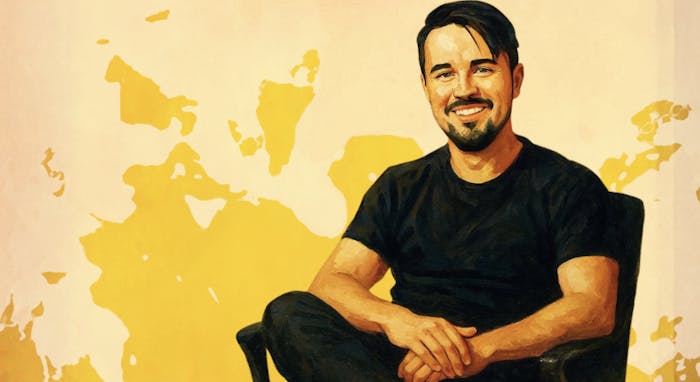
After one failure, Vedran Rasic built his second SaaS and exited successfully. Then, with the momentum of that success, he built LeadDelta.
Three years later, it's about to cross a seven-figure ARR — and it's competing with companies that took millions in funding.
Here's Vedran on how he did it. 👇
From first computer to 7-figure ARR
My family lost all their savings in a bank crash in post-war Yugoslavia. Ten years later, all they recovered was 600 EUR — just enough for my first computer.
I've been building ventures since my early twenties. I started selling for a student organization at university because no one else would. One of our corporate partners needed someone to manage their digital assets, so I offered to run it. Next thing I knew, I'd hired my roommates and we were off.
Later, I helped run a digital studio building products for others, which introduced me to SaaS. In 2017, I moved to Canada to help launch MyShop, which didn't work out. In 2018, we launched Autoklose, which did well and got acquired in 2020. That impacted me in a major way. It allowed me to buy my first home, settle (but just for a bit), build up some basic savings, and go bigger and bolder next time.
Now, I live in San Francisco and I'm working on LeadDelta, which launched in 2022. We're close to 7-figure ARR. Tiny and profitable.
Finding the idea
The idea for LeadDelta had been in my head since 2017 — it was a no-brainer.
I kept thinking: How do we level the playing field when everything comes down to contacts and who-knows-who? Why not help power networkers sync their contacts into one hub and provide intelligence on top of it? And why stop there... Why not help companies do the same and grow from warm intros instead of cold spam?
Whether you're fundraising, selling, or marketing — you go back to your network. That's where you start.
I had the know-how from my previous exit, a team that wanted to build with me, investors willing to help de-risk, and plenty of ideas.
Starting small
Coming off my previous startup success, I knew I needed to de-risk fast. Unless I'm splitting the atom, there's no reason to raise big money or build for months — just release as soon as possible. This was before the AI hype.
We acquired a tiny product for a few thousand dollars, spent a month refactoring and building it to our liking. One month later, I had 500+ people subscribed to my landing page and a product ready for public testing.
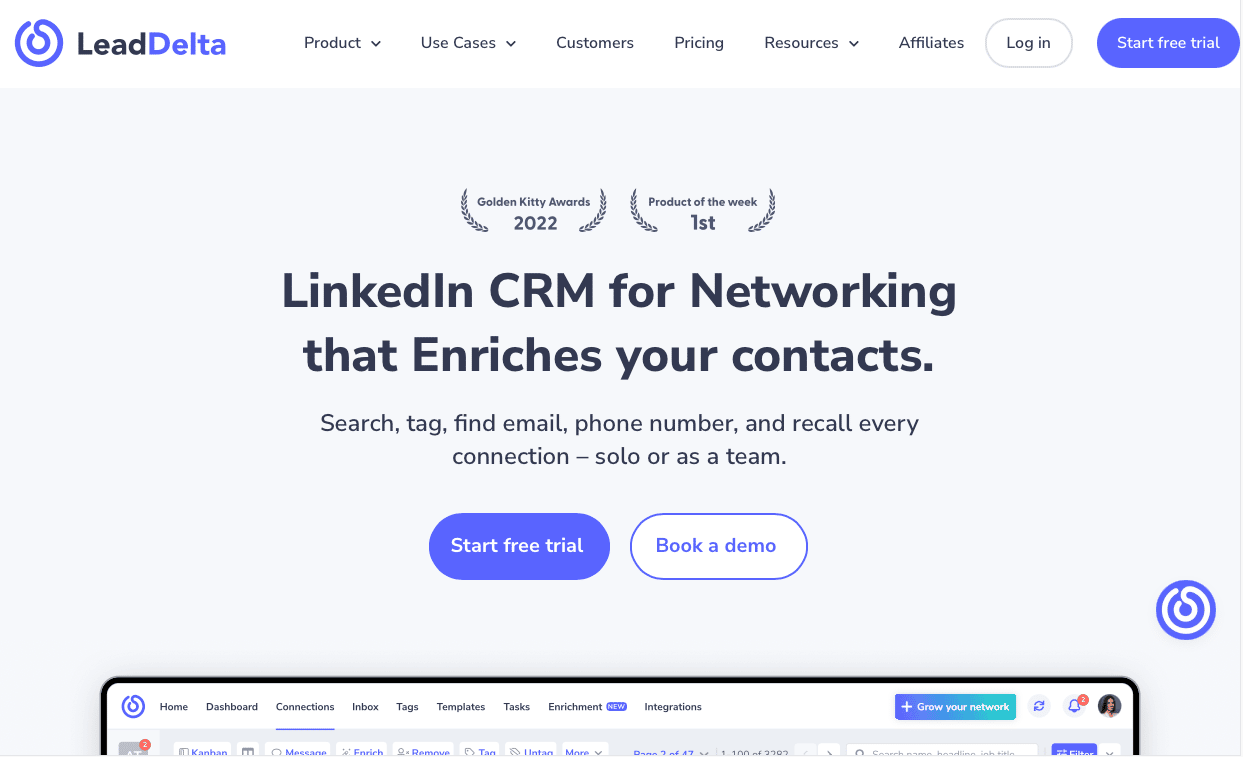
It was a simple contact manager for LinkedIn. One table. Tags and notes. That's it. And people loved it.
While everyone else automated and scraped, we positioned ourselves as the manager of their connections. People gave us a chance, left great reviews, and it grew from there.
Tech and tool stacks
We're a tiny, profitable team of 9, fully remote. I split my teams into Sellers and Builders, so I'll share the tools we use accordingly. We use dozens of tools, but here are the main ones:
Communication & Ops:
Slack
Google Workspace
Sales:
LeadDelta – brings our networks together, prospects, engages, and enriches
HubSpot – deal management
Loops – marketing and transactional emails
Screenstudio, Loom – videos
ChatGPT, Perplexity, Claude – ops and agents
Product:
Cursor
MongoDB
Linear
Figma
And the product tech stack is MongoDB, GCP, and React/Node.
Organic growth at each stage
Here's how we grew.
0-10K users: I started with my own network. I used LeadDelta to message everyone about the launch. My network provided the first users; we then asked those who enjoyed the product to leave reviews and write posts with use cases. Excellent strategy.
We optimized SEO from day one. Then, we built a community around me and the product, supported by networks like AppSumo, Product Hunt, and Indie Hackers.
10-20K users: We shipped and launched new features every week, building momentum. We then became Product of the Day three times in a row, and soon after, Product of the Year in January 2023, alongside ChatGPT, Miro, Canva, and other unicorns. That opened many doors.
20-35K users: We doubled down on content, SEO, and partnerships. We generated great organic traffic and formed partnerships to foster growth. We have approximately 500-600 affiliates, but only 10-50 generate substantial income and significantly contribute to our growth.
What worked for us (in no particular order):
Product Hunt: Three times Product of the Day, Product of the Year. Huge community support
LinkedIn: Strong network engagement, posting, engaging with content using our custom feeds, messaging, and tagging to build audiences.
Cold email: We've experimented with multiple approaches. We treat it like display ads — it yields much cheaper impressions. We don't pretend to know what people need at any particular moment. We just appear occasionally, saying, "Hey, we're here, here's what we built."
Shipping weekly: People know we continuously invest in the product. It's not just a cash cow; I ensure it remains high quality and improves.
Partnerships: We engage in different programs and sponsor events. Now that I'm in San Francisco, we pursue more of these.
Chrome Web Store: We have solid positioning on the Chrome Web Store.
Currently, we focus less on hype and more on strategic outreach. The next level of growth will come from doubling down on what works and, potentially, building supportive products for specific niches.
Leveraging a B2C2B model
Our model is B2C2B with a free, no-credit-card 7-day trial.
We start by selling to individuals, who then help us sell to their teams — we aim to win the company this way. This is a challenging approach, even though it became attractive around 2019. We have executed it with enough levers to make it work.
Our pricing is straightforward: Start with a starter plan, expand features, and add credits as you upgrade plans. You can invite team members or community members to join your workspace, share your network, and buy additional enrichment credits to find email and phone numbers.
And we now have specific add-ons. We aim to be the best LinkedIn product — when you need LinkedIn enrichment and data discovery, you come to LeadDelta. We do this safely without compromising your account. So you can enrich data, search through 500M people and 40M companies, find the best business emails, personal emails, and personal phone numbers, based on a LinkedIn profile URL.
Find your pricing sweet spot
Change pricing often. I change pricing every three to six months.
If you're building a product for everyone, you're building a proof of concept with various audiences. Run pricing tests. Ask what's too little, what's too much, what's fair. Do the math. Figure out what to charge, and then continuously experiment.
If you're building for a particular group, it's even easier. Test different pricing — maybe even 10X or 100X compared to your original plans.
Recently, we 3x-ed our pricing. Still, some people get on a call and say, "This is cheap."
The challenges facing solo founders
Here are my main challenges:
Being a solo non-technical founder
Managing too many moving parts in the tech stack
Building on the wrong infrastructure initially
Networks that don't want you
Competition from every direction, hiring fast, and companies that raised $20M, $30M, and even $68M competing with us
This isn't easy. If I could start over, I'd be more grounded in reality, rather than acting like a superhero who can solve every problem.
You cannot always bend reality. I was completely out of my mind to think I could challenge extremely expensive data problems with $500K or $800K in funding. But, in the end, I guess it worked out! Those companies that raised millions are at the same revenue level as us.
Start lean and build a good life
Here's my advice:
Start lean, start ASAP.
Build and distribute great products and services. It's very simple. Everything else — even fundraising and attending conferences — wastes time and money. Focus on building and talking to your customers. If you have too many customers, niche down.
Don't trust people who say reputation is nothing. This idea seems popular now, but it isn't true.
Clearly define what you want to accomplish. Instead of a moving target, set a SMART one (Specific, Measurable, Achievable, Relevant, and Time-bound). If your goal is to make money, be clear about it. If your goal is to be a celebrity founder, be clear about it. Whatever your goal, be clear, then focus on making it happen. Once you achieve it, set a new one.
Keep two things in your mind: "Am I building?" And "Am I selling?" As Elon Musk would say: "What did you get done this week?"
Don't forget to live a good life. Making great products is part of that — but it isn't everything.
What's next?
For LeadDelta, I've been excited about AI before it became a buzzword. Now I am focused on transforming LeadDeltainto a product that provides real-time intelligence for professional networks.
My full focus is on the product. We aim to continue growing 100% year over year while remaining profitable.
Other than that, I want to play long-term games with long-term people. I moved to San Francisco to achieve that.
Follow along
If you'd like to motivate me to write more in-depth on any of these topics, add yourself here and pressure me into shipping: https://vedran.substack.com/
Your subscription will motivate me to take this seriously!

Leave a Comment
What a journey. Congrats.
Thanks so much! It feels like it didn't move much. haha still getting there!
Love this story — start small, de-risk fast, use your own network, and compound from real traction. The B2C2B play + weekly shipping shows you don’t need huge funding to beat funded competitors. Quiet, profitable growth is underrated. 🚀
Wow… this is incredibly inspiring. I love how you went from literally nothing to building something tiny, profitable, and growing 7-figure ARR
Congrats! This was very educational, thanks for giving so much detail especially at the organic growth part.
thanks Ani!
Great post, another thing I believe a lot of folks miss.... is to make sure to rapidly stress test any business ideas (before putting months of your time and effort into them).
yes, 100%
great and nice of you
nice
Really cool idea! I like the simplicity of the UI. What are you planning to add next?
oh, man.. I love your journey
throughout the entire content.. I was bombarded with many crucial learning and experiences from a first-hand founder..
like, you couldn't have possibly nurtured me more for me to feel indebted to you
congrats on the product.. it serves a very useful purpose and I wish you all the success
looking forward to reading more of your stories in the upcoming future
best
This is a great breakdown, especially the part about staying focused on a single problem.
Thanks for sharing your experience.
Thank you! I hope to share more in Substack and here too!
Really impressive turnaround! It’s inspiring to see resilience after a failure and an exit. In my experience, bouncing back with a clear focus and leveraging prior lessons is what turns setbacks into stepping stones. Curious how you kept your motivation high through the rebuilding stage.
I guess I am relentlessly persistent :)) no other explanation it didn't make sense to continue
Congratulations on hitting 7-figure ARR after navigating failure and an exit — that’s really inspiring! Your story shows resilience and insight. I’m also working on something in a similar spirit — check it out: Staydify Systems — would love to hear your thoughts if you have the time.
'Start lean, start ASAP.'
That advice is gold. Vedran proving that you can reach 7-figure ARR while competing against VC-backed giants with $68M in funding is incredibly inspiring.
It really shows that strategy and execution beat pure capital. The B2C2B model using a 'Trojan Horse' strategy (individual to team) is brilliant. Thanks for sharing the detailed breakdown!
@James Fleischmann
Incredible breakdown, Vedran, especially the way you compounded growth through community-driven channels. One thing I see founders at your stage consistently overlook, though, is Reddit. The audience that resonates with LeadDelta’s “network intelligence + productivity” angle is already active across a handful of very targeted subreddits, and posts like this one tend to perform extremely well when positioned correctly. I help SaaS founders engineer high-signal Reddit visibility that drives actual users (not vanity engagement) by aligning product stories with ongoing community conversations. If you’d like, I can share exactly which subreddits match LeadDelta’s userbase and how to approach Reddit without getting flagged. Happy to help.
Micheal (Preshtechsolution)
Thanks, Mike! Indeed we are not big on reddit.
Great to hear, Vedran. Reddit could be a big unlock for you. If you’re open to it, let’s continue the conversation on Telegram so I can walk you through the exact subreddits and approach that would work best. It’ll be easier to explain there.
@Preshtechsolution.
I love this : Start lean, start ASAP.
that's the way to go!
Amazing journey!
Thanks Nina, much appreciated!
Bouncing back to hit a 7-figure ARR after experiencing one failure and one exit shows incredible resilience, strategic learning, and entrepreneurial grit. You’ve leveraged past mistakes to optimize business models, sharpen decision-making, and scale sustainably. This trajectory demonstrates not just financial success but a mindset of adaptability, persistence, and calculated risk-taking—key traits for long-term startup growth.
thanks!
Long time lurker, first time taking the plunge into actual startup world and this resonated so much! Thank you for sharing your journey
thanks Maneesha! Keep it up!
Awesome James, happy for you. Would love some more insight on your SEO strategy that worked so well for you.
The growth experience from the first computer to the seven digit ARR is truly an inspiring story. I hope your company and products continue to improve
Thank you! There's rarely if ever time to reflect like this. Glad it helps others, as well. Thanks Yu!
This was insanely motivating to read. The part about losing everything, getting just enough for a first computer, and turning that into multiple ventures and now a near 7-figure ARR company—that hits differently.
I love how small you started with LeadDelta. One table, tags, notes… and it worked because the positioning was right. While everyone chased automation and scraping, you focused on helping people manage actual relationships—much harder, but clearly more durable.
Also appreciate how transparent you were about pricing, changing strategy, and not trying to bend reality. It's refreshing to see someone openly say “I thought I could solve this problem with way less capital than I realistically needed—but still made it work.”
Congrats on building something profitable, lean, and long-term. Looking forward to following what you launch next. 👏🔥
Thanks a lot Chuc! I hope it helps you build and scale your ventures. Cheers!
Thats inspiring
thanks!!
Great post, educational!
Keep shipping!
This is a fantastic breakdown of the bootstrapped, product-led growth journey. Vedran's focus on de-risking, starting small with a focused MVP, and the relentless "shipping weekly" mentality is a masterclass.
The B2C2B motion for a LinkedIn tool makes perfect sense—win the individual power user, and the team sale often follows. The point about changing pricing every 3-6 months is also gold; too many founders set it and forget it.
A key question about the tech stack, given the focus on data and enrichment: You mention building on the "wrong infrastructure initially" as a challenge. For a solo founder today starting a data-intensive SaaS, what would be your absolute non-negotiable first decision regarding infrastructure or architecture to avoid that same pitfall?
spotich .com
It's going to sound obvious, but think long-term. Think of all the potential partnerships and APIs you want to bring in. Is it a multi-tenant? Do you have real-time collab? or will have etc.
True 2
True
Love seeing this journey......success isn’t about fancy features or huge funding, it’s about starting small, shipping fast, learning from real users, and letting your network do the early evangelism. Lean execution + constant iteration beats hype every time.
over a long enough period of time :)
Thank you for sharing Sonu!
What an inspiring journey, Vedran! Your story really resonates with me, especially the part about starting lean and shipping fast. The fact that you acquired a tiny product, refactored it in a month, and had 500+ people subscribed before launch is a powerful reminder that execution beats perfection.
A few things that stood out to me:
1. The B2C2B model - This is fascinating and seems like a smart way to build momentum. How do you handle the transition from individual users to team sales? Do you have dedicated playbooks or does it happen organically?
2. Pricing experimentation - You mentioned changing pricing every 3-6 months and recently 3x-ing it. That's bold! What metrics do you track to know when it's time to adjust? And how do you communicate these changes to existing customers?
3. Competing with well-funded companies - This is the part that hits home. You're competing with companies that raised $20M-$68M, yet you're at the same revenue level with a team of 9. What do you think gives you the edge? Is it the speed of iteration, the focus on profitability, or something else?
4. The "start lean" philosophy - You mentioned you'd be more grounded in reality if you could start over. What specific advice would you give to someone who's about to start their first SaaS? What would you do differently?
Also, I'm curious about the AI transformation you mentioned. You said you've been excited about AI before it became a buzzword. How are you thinking about integrating AI into LeadDelta without it feeling like a gimmick?
Thanks for sharing your journey - it's a great reminder that you don't need millions in funding to build something meaningful. Looking forward to seeing where LeadDelta goes next!
weff
Thanks for such a great summary! Basically we've vectorized our data so that you can interract with your network the way your brain works... "who's this person I know from Canada, that now lives in SF, that works at company X" ... instead of filters and search functions.
Really cool idea! I like the simplicity of the UI. What are you planning to add next?
10M dollar question :))
Double down on app layer AI. 🙌
The 600 EUR detail is doing real work in this story. A family that lost their savings in a post-war Yugoslav bank crash, with a decade of recovery yielding just enough for a first computer — that shapes a very specific relationship to financial risk and resourcefulness. Founders from that background typically have a much higher tolerance for personal adversity and a much lower dependence on external validation than the median Silicon Valley founder. LeadDelta being "tiny and profitable" competing with funded companies isn't a constraint; it's a philosophy.
The Autoklose exit sequence matters: failure (MyShop) → successful exit (Autoklose, 2020) → buy home, stabilize, go bigger. Each step de-risked the personal balance sheet before taking the next product risk. This is the right way to compound through a founder career — use each exit to build a safety buffer, then swing harder. Vedran didn't blow the Autoklose proceeds on lifestyle; he used them as runway capital for LeadDelta.
"Tiny and profitable competing with funded companies" is actually a durable competitive position in B2B SaaS. Funded competitors optimize for growth metrics to justify their valuation; they over-hire, over-build, and carry structural costs that a bootstrapped team doesn't. When market conditions tighten, funded competitors start cutting — which is exactly when bootstrapped products can accelerate by just staying the course.
The B2C2B approach for LeadDelta is smart distribution: individual users try it, get value, then bring it into their teams. Bottom-up acquisition in B2B consistently outperforms top-down in both efficiency and retention when the product genuinely solves an individual workflow problem first.
Congrats on the near-7-figure milestone, Vedran.
This is the kind of founder story I actually like reading because it’s not “I had a genius idea and it magically worked.” It’s way more like: build something small, get it in front of people fast, stay lean, keep shipping, and use distribution like a weapon.
And I respect the honesty about the hard parts too. Competing with companies that raised $20M+ is brutal, and people act like “just build better” is enough when distribution and data costs are a whole war by themselves.
The last section is probably the best advice in the whole thing:
“Am I building?” “Am I selling?”
That applies to literally everything, from SaaS to AI home health software. If you’re not doing one of those two things, you’re probably just staying busy.
Really solid breakdown of how starting small and shipping fast actually reduces risk instead of increasing it. I like how you resisted over-engineering and focused on a very clear positioning rather than chasing automation trends.
The 0–10K users strategy is especially practical — leveraging your own network, reviews, and SEO from day one is something more founders should copy. Building credibility early makes a huge difference.
I’m working on a small utility tool myself (Randoms Object Generator – ), and this post reinforces how simplicity, fast feedback, and organic distribution can outperform complex launches. Thanks for sharing such a transparent growth playbook
बहुत ही जानकारीपूर्ण और अच्छा लिखा गया आर्टिकल है 👍 ऐसे ही लेटेस्ट और भरोसेमंद अपडेट्स पढ़ने के लिए मैं अक्सर DNP India Hindi विज़िट करता हूँ, जहाँ ऑटोमोबाइल से लेकर ट्रेंडिंग न्यूज़ तक बढ़िया कवरेज मिलती है। कंटेंट क्वालिटी वाकई सराहनीय है, शेयर करते रहें।
There’s a pattern here that resonates: success often isn’t about a single “eureka moment”, but about consistent, iterative improvements over time.
What you describe echoes something I’ve noticed in product feedback loops — the moment you start treating signals not as noise but as data to inform design decisions, the product actually becomes easier to evolve.
Curious — were there any specific feedback signals you found were early predictors of what eventually drove growth?
Vedran's journey from a bank crash recovery fund buying his first computer to a 7-figure ARR is the ultimate bootstrap story. The strategy of 'starting small'—acquiring a tiny product and shipping fast—is brilliant de-risking.
This mirrors my path with Abubyte POS, an offline-first system built for emerging markets. That foundational, 'solve-a-real-problem' grind creates immense transferable value. It also brings a founder to a pivotal point of leverage, just as Vedran experienced after his first exit.
For me, that leverage means passing on this $287k technology asset to fully commit to my next venture in AI. I'm running a concise 7-day acquisition window at an $85k OBO—not just a sale, but a strategic transfer to a builder who can scale it. This allows me to 'go bigger and bolder next time,' exactly as Vedran describes.
Incredible proof that focused building, followed by decisive strategic moves, creates extraordinary outcomes. Congrats on the near 7-figure milestone.
Nice
inspiring. thanks for sharing.
Great Idea
Interesting perspective. I’ve seen similar results when keeping things simple instead of overengineering.
Really insightful read. Looking back, which decision had the biggest second-order effects -the initial positioning, the B2C2B motion, or the decision to stay lean and profitable?
Stories like this are valuable because they expose the trade-offs, not just the outcomes.
This was a really insightful read — especially the part about starting small and de-risking early.I loved how you highlighted releasing quickly instead of overbuilding. It’s a great reminder that clarity often comes from shipping, not planning.Thanks for sharing such an honest breakdown of the journey.
Congratulations on hitting 7-figure ARR
Really solid breakdown. Proof that focus and iteration can match (or beat) heavy funding.
Amazing journey, hitting 7-figure ARR with lean, validated growth is exactly the type of story that thrives on Reddit.
Founders like you often underestimate how much early traction and community engagement can accelerate adoption.
If you ever want to turn your growth insights into posts that drive targeted users and real discussions on Reddit, I’d be happy to share a few strategies that actually get traction for AI/SaaS launches.
Huge respect for your journey. going from a tough early failure to an exit and now building LeadDelta toward a 7-figure ARR with a lean, profitable team is genuinely inspiring. The B2C2B strategy and focus on organic momentum show that bootstrapped founders can compete with funded players if they stay grounded and ship consistently. Thanks for sharing such a detailed playbook, it’s super motivating for other founders trying to find their path
Huge respect — going from a failure to an exit and then pushing a new product to 7-figure ARR as a tiny, profitable team is wild. The way you kept things lean, shipped fast, and built momentum through your network is a real playbook. Love how you treat pricing, product velocity, and staying grounded. Lots of founders try to jump straight to “big raise first,” but your path shows how far discipline + consistency can go. Thanks for sharing the breakdown — super motivating.
What impresses me most here isn’t just the growth, but the way Vedran keeps turning small, low-risk moves into serious leverage. It’s a good reminder that the real advantage isn’t being bootstrapped or funded, but learning faster than anyone else and adjusting before competitors even notice.
The B2C2B approach is also a smart wedge. Individuals adopt it because it helps them personally, teams adopt it because it improves coordination, and companies eventually follow. That’s how a simple contact tool evolves into a real network-intelligence layer.
Overall, this is a great example of what happens when you combine focus, quick iteration, and an honest read on what actually matters. It’s rare to see someone play the long game with this level of clarity.
Seeing someone mention Amplift, I want to say that it has indeed helped me a lot, and I hope more people will use it.
I'm using an AI marketing tool called Amplift, and I feel it has helped me solve a lot of problems.
Such success is inseparable from marketing, but even if you don't understand marketing, using an AI marketing tool called Amplift can also help.
@james-fleischmann, it's been a joy working with you. Thanks for all the thoughtful questions. Oh, and btw, the auto follow-up questions felt like magic, great product you've built!
agree 100%
I'm Andrew Shiner, and I never envisioned a scenario where I would lose my life savings in a Bitcoin transaction. However, that's exactly what happened when I made one wrong click on a fake wallet update, resulting in the disappearance of $188,000 in a matter of seconds. The emotional aftermath was overwhelming, with feelings of stupidity, shame, and hopelessness dominating my every waking moment. For days, I grappled with the weight of my mistake, struggling to come to terms with the loss. It seemed as though my financial security had been pulled out from under me, leaving me with nothing but despair.
Nevertheless, I soon realized that I couldn't remain in this state of hopelessness. A turning point came when a friend reached out to me with a message that would change everything: "Techy Force Cyber Retrieval, they specialize in this." Initially, I was skeptical due to the prevalence of scammers in the online space. My skepticism was rooted in the fear of falling prey to yet another fraudulent scheme. However, something within me urged me to take a chance and explore this potential solution. With a mix of trepidation and hope, I decided to proceed, marking the beginning of my journey towards recovery and redemption. It's essential to acknowledge that falling victim to such scams can be a devastating experience, but it's not the end. The key takeaway from my ordeal is the importance of seeking help and being open to potential solutions, no matter how daunting they may seem. In the realm of cryptocurrency, vigilance is crucial, but so is the ability to learn from mistakes and move forward. My story serves as a testament to the human capacity for resilience and the possibility of overcoming even the most seemingly insurmountable challenges.
HIRE A FASTEST CYBER RECOVERY EXPERT TO RECOVER YOUR LOST OR STOLEN BITCOIN/ETH/USDT/ THE HACKANGELS
I simply want to share my story about THE HACKANGELS RECOVERY EXPERT. To all of you out there. One has to be careful. A lot of scammers are out there taking money from innocent traders. I was a victim of these crypto scammers. They made me lose my hard earned funds. The best thing that happened to me this year was seeing an article about THE HACKANGELS RECOVERY EXPERT. A professional hacker and private investigator. I invested $954,300 in a cryptocurrency platform and it turned out to be a scam and I had no idea how to get my money back until I reached out to a recovery company called THE HACKANGELS RECOVERY EXPERT. I explained my situation to them. I was shocked to hear that they had recovered all of my stolen cryptocurrency in just 48 hours. I said that I will not hold this to myself but share it to the public so that all scammed victims can get their funds back. To anyone who may find themselves in a similar unfortunate situation. I highly recommend THE HACKANGELS RECOVERY EXPERT. Quickly reach out to them on their hotline:
WhatsApp: (+1(520)200-2320
If you're in London, you can even visit them in person at their office located at 45-46 Red Lion Street, London WC1R 4PF, UK. They’re super helpful and really know their stuff! Don’t hesitate to reach out if you need help.