Can marketing drive revenue growth
again?
Revenue growth helps to drive up stock market prices and shareholder value. CMOs need to get back in the growth game.

Revenue growth helps to drive up stock market prices and shareholder value. CMOs need to get back in the growth game -- their current focus on "brand equity" and "awareness" falls short of needs.
Credit: Eldon Dedini, The New Yorker, The Cartoon Bank
There has been a distinct slow-down in advertiser revenue growth during the past 15 years, ever since the 2008 global financial meltdown. Although advertiser media spend more than doubled, and digital / social creative deliverables grew exponentially, topline results have been disappointing.
Twenty of the top fifty advertisers saw their revenue grow slower than GDP growth of 2.1% percent per year. The list of 15-year revenue growth underperformers includes such blue-chip names as IBM, GSK, Novartis, P&G, McDonald's, Bank of America, Unilever, Wells Fargo, Sanofi, Pfizer, Sony, Verizon, Honda, Colgate and Toyota, along with retailers Macy’s, Best Buy, Gap, Kohl’s and eBay.
There’s more to revenue growth than effective marketing, of course. Product, price, distribution, customer experience and other factors play their roles. Amazon, as the most effective retail marketing company in the world, counts on product line depth, product availability, customer reviews, speed of delivery, ease of purchase / returns and extensive customer purchase histories to secure its competitive position — achieving a 24.5% compound annual revenue growth rate since 2009.
Others in the +10% per year growth rate category include Netflix (24% per year since 2009), Apple (17%), Intuit (12%), Progressive (11%) and Microsoft (10%).
Overall, taking into account the 45 major advertisers who had positive revenue and stock price growth rates between 2009 and 2023, we see a mathematical correlation between revenue growth rates and stock market price growth rates.
Advertisers that had near-zero revenue growth rates saw their stock market shares grow at a 4.3% per year rate. However, for every 1.0 percent increase in revenue growth rate, stock market shares increased at a 1.4 percent rate.
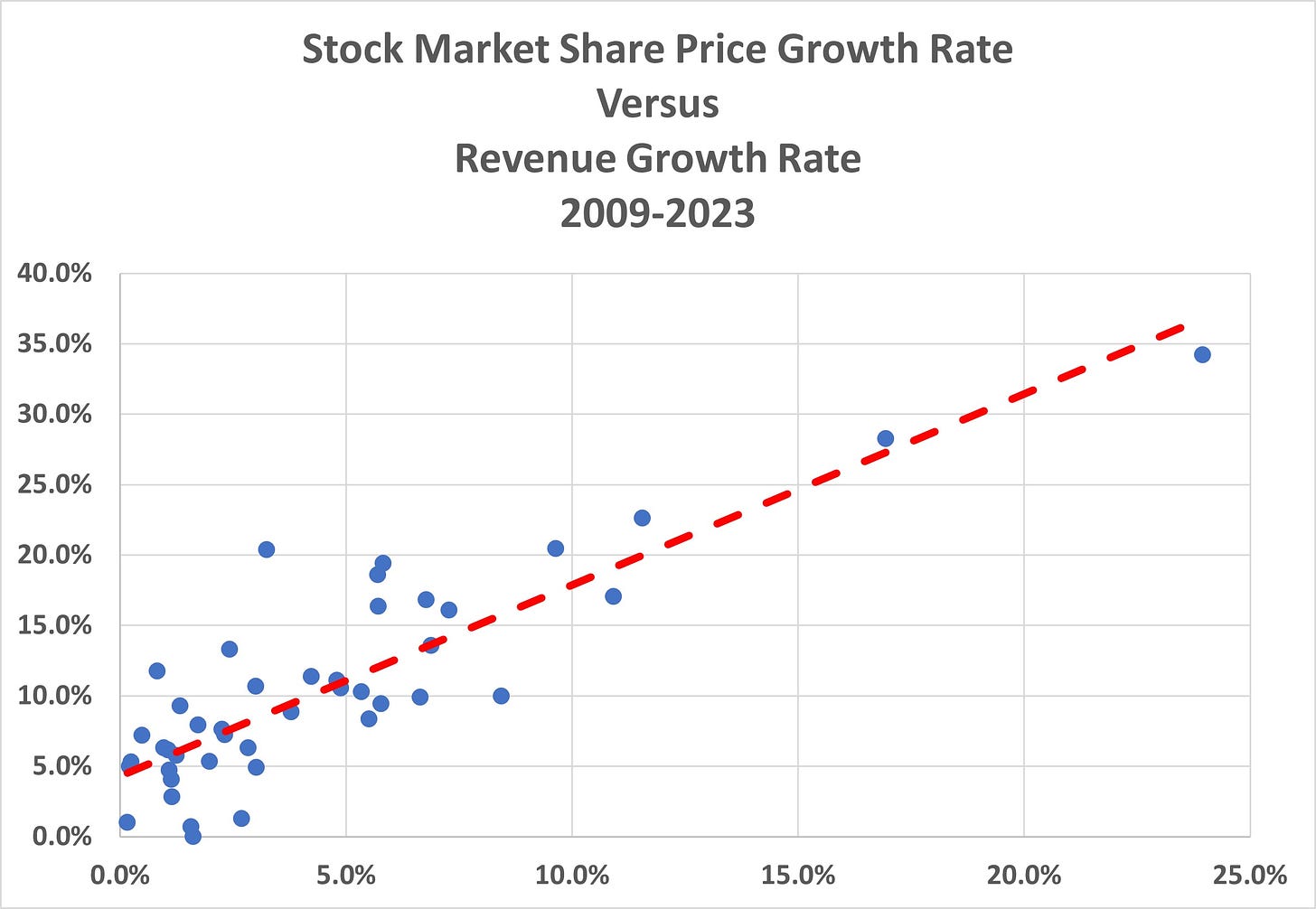
Source: Farmer & Company analysis of revenue and share price data from Macrotrends.net
The data are a little messy at the low end of revenue growth — other factors are certainly at play — but the overall trend is compelling, and it should encourage CMOs to focus their attention on “what works” to drive revenue growth rates —exploring what levels of media spend should be made by media channel.
Media Mix Modeling (MMM) programs should be fully exploited, along with other types of analyses that take a critical view of current patterns of media mix.
The extraordinary inflation of media spend and creative scopes of work during this period has to be looked at with some skepticism. Much of the investment in dollars and manhours has been wasted. One can only surmise that Marketing was seduced by the prospect of the improved targeting offered by social and digital media — believing that better targeting would lead to better results. Media dollars chased this concept, but they have not delivered the goods.
The targeting assumption needs to be looked at critically, and CMOs should lead the inquiry on behalf of their companies.
They need to be asking:
What explains the underperformance of legacy brands during the past 15 years? Why did they once grow and now are not growing, despite the massive increase in digital / social spend thrown their way?
What media mix and creative campaigns have the greatest probability of restoring revenue growth to these brands?
What role should media and creative agencies play to help develop an understanding of these dynamics? Should agencies continue to be service providers who do what advertisers expect (at the prices they are prepared to pay), or should they be upgraded to “strategic partnership” roles, asking them to participate in the examination of how to make marketing spend more effective?
Marketing, I think, is at an inflection point. Up to the present, Marketing has been engaged in understanding and organizing itself to handle the increased complexity of the digital / social landscape.
That job is done. What’s now required is for Marketing to focus its operations, cut back on channels and campaigns that can be shown to deliver no strategic value, and recommit itself to growing revenue for the benefit of C-Suite colleagues and shareholders.
This article was originally published here.
