Carving out a $6.3k MRR niche in a saturated market

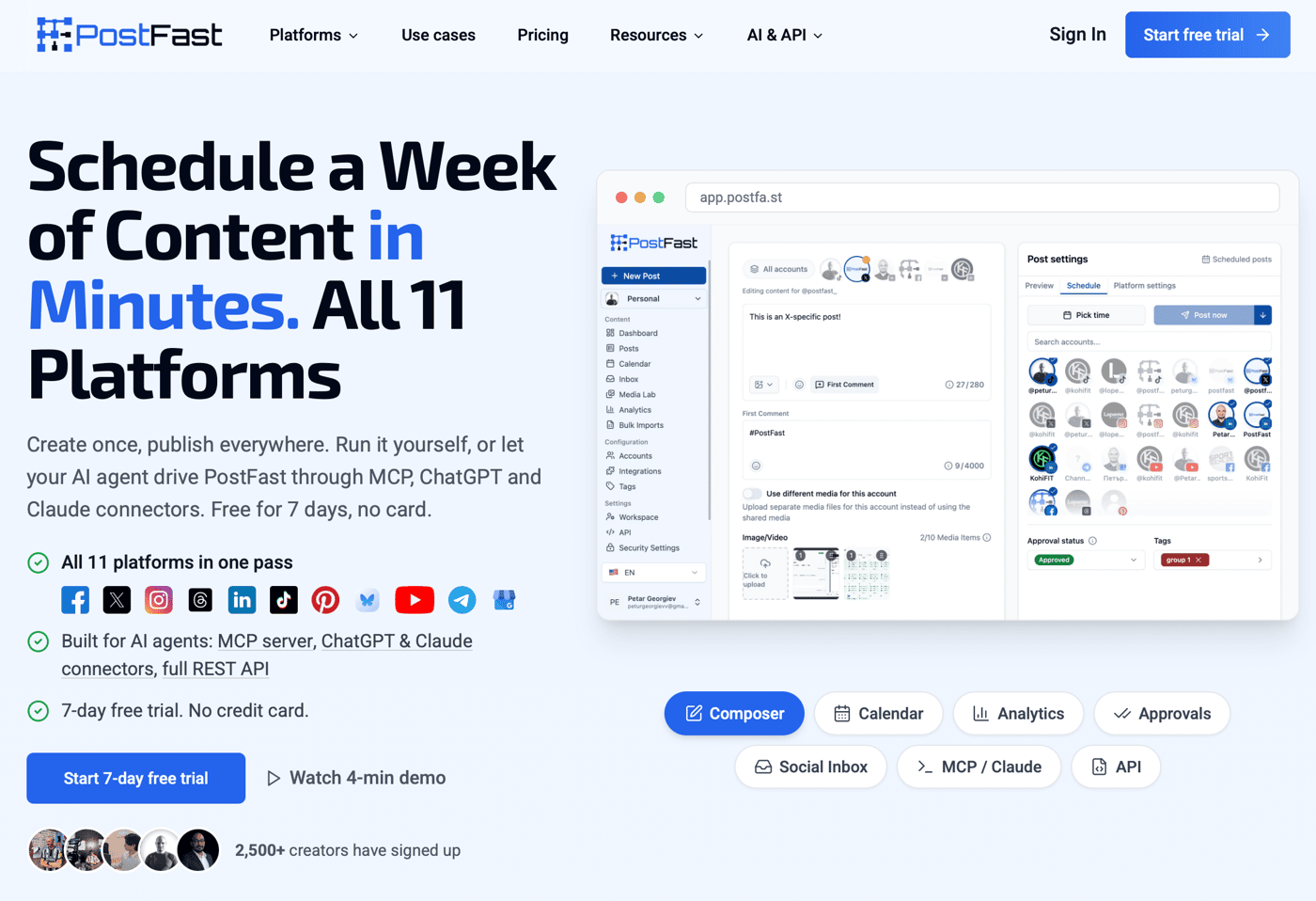
Petar Georgiev had a need, but the tools on the market were either too expensive or too basic. So he built an alternative. And now, PostFast is bringing in €5.4k MRR.
Here's Petar on how he's doing it. 👇
From maritime to software
I'm a software engineer. I initially studied to become a Navy Officer and ship's captain, but I transitioned to working a remote software engineering job while building projects on the side.
I needed a social media scheduler and tried a few. Some were too expensive; others were affordable but lacked functionality, quality UX, and speed. So, I decided that paying for these tools made no sense.
Seeing that I had an unfulfilled need, I realized others might too. And there was a proven market, so I didn't even need to validate it. If the products I tried were making money, why couldn't I?
Now, PostFast is my main project right now. It's in a saturated niche, but I was able to achieve profitability in about half a year, and it's now doing great! We have a €5.4k MRR. To stand out, I made it very easy to use, with what I think is the best UX in the industry. It's also crazy fast compared to most of my competitors. And I pre-process each video/image, which minimizes posting failures to platforms — a common issue in the industry.
Building the initial product
I built PostFast in a few months of coding, mainly on nights and weekends. I have my own template-building side projects, so I used those to speed up the process.
My main advice here is to build instead of thinking too much. Most people seek the best plan, best book, etc., but their biggest blocker is building. You can only learn from doing it.
I built a project behind closed doors before PostFast. It took over two years of work and incurred constant, expensive GCP expenses, as I didn't know Hetzner then. I lost money every month for years, but I learned a ton from that project. The biggest lesson was to ship your product and iterate; do not wait for the next feature.
I use the following stack:
NextJS for the public part
ReactJS for the dashboard (internal)
NestJS for the backend — I have two services, but I split one into two, so let's say three.
Kafka, Redis, and some other libraries.
I've had issues with Kafka; it couldn't handle certain events, so I moved many events to Redis' BullMQ, which works quite nicely. I also use my product, SendHeron, as an email provider for both marketing and transactional emails.
Overall, I'd say parsing, validating, and reformatting images and videos have been my biggest challenges. FFMPEG is crazy hard; without AI help, it would have taken me many months — and it still took me months to make it work properly
Keeping costs low and funding the project with a FT job
Financially, I didn't need much money initially.
Costs were low before launch, but after launch, expenses rose without immediate revenue:
Accounting
X API (quite expensive and increasing)
Hosting
Domains
Etc.
Initially, I spent maybe 350-400 euros per month on all expenses, taxes, etc. Luckily, I had a full-time job at the same time.
My advice is to keep your expenses as low as possible. For example, self-hosting is easy nowadays. But avoid all the "free" tools. They'll eventually bottleneck your operations and kill your margins.
Compounding SEO
The hardest part for me is marketing. I hate it. But I do like SEO. That's where I get most — maybe all — of my customers. It's the best channel. Especially if you start early. It compounds.
I spend a lot of time on this:
Backlink research and cold outreach for backlinks
On-site optimization
Alternative and comparison pages
Money pages
Tool building
Achieving good SEO typically takes months — even half a year or more for some. Even with my skills and background, it requires significant time and money because my niche is heavily blocked by industry giants with 20 years of experience. I'm trying to overcome them on money words in Google, which is hard.
Aside from SEO, I tried all the "launch" stuff, including directories, Product Hunt, and so on. I tried building in public. I tried to go viral. None of it worked for me. I may have gotten a few customers from X — one that I know of is still a power user! — but that's about it.
One other thing that did work for me was changing my pricing. My initial prices were quite low, so this increased my revenue and brought in even more customers. People often think low prices indicate a bad product. Especially cold leads from SEO.
The small, human stuff is what counts
I write personal emails manually to each customer and still answer support questions myself. This builds significant trust, as I rarely take more than a few hours to answer a support ticket after it's submitted.
Even if I can't fix the issue right away, I still answer and reassure them that I'm working on it and will improve it. And I always follow up after the fix.
It's the small, human stuff that counts.
Building something that can't be vibe-coded
My advice? Learn SEO and focus on niches where giants already have a market. Giants often struggle to ship products fast. Grab a piece of that market.
But find something that Claude cannot easily build with a simple prompt. If there is no moat, you'll be dead in the water.
For example, my platform approvals now take over 20-30 days each. Rejections add another 20+ days, making the process slow and annoying. And you cannot post to all accounts without these approvals. So, while you can vibe-code my project, you cannot vibe-code my entire infrastructure.
The underlying complexity makes it not worth vibe-coding.
What's next?
I just launched Social Inbox, which will allows users to fully manage social interactions, such as comments, in their ChatGPT/Claude interfaces or their n8n automations. From here, I'll continue iterating on PostFast while I await a few approvals (again). I want to further increase API usage and build an even stronger backlink profile to compete for gated niche keywords.
I might also launch a few more products, as I'm already using one internally — SendHeron. But these products are currently secondary; their goal is to improve PostFast's scale.
You can learn a lot from my website, PostFast, my blog, peturgeorgievv, or my X profile, where I post a lot.

Leave a Comment
Platform approvals as a unique advantage is something I would like to keep thinking about. Anyone can vibe code the dashboard, nobody wants the 20 or 30 day review cycle and the media preprocessing that actually stops failed posts. When you choose the next comparison page, do you pick keywords you can rank for in 90 days, or the money pages the incumbents already own?
Raising prices to eliminate the 'cheap product' perception on cold SEO leads is such a counterintuitive but essential lesson. Building compounding SEO through comparison pages and manual backlink outreach beats one-off Product Hunt spikes every single time. Combining high-speed UX with manual, personal support emails builds the exact kind of trust needed to steal market share from slow industry incumbents. Congrats on hitting €5.4k MRR
Hitting €5.4k MRR in a notoriously saturated space is wild, especially while ignoring viral launches in favor of the slow grind of compounding SEO. Your realization that raising prices actually boosted conversions from cold traffic is such a good reminder that a race to the bottom only signals low quality to serious users. Since you're battling 20-year industry giants on search, have you found better ROI building long-tail comparison pages or targeting hyper-specific use-case keywords?