Hitting $10M ARR with RPG-style programming courses

Lane Wagner was unimpressed by online education options for backend developers. So, he built what he views as the best educational content out there. And now, his RPG-inspired education platform, Boot.dev, is bringing in $10M ARR.
Here's Lane on how he did it. 👇
Fixing backed education
I'm a backend engineer with experience in JS/TS/Python and Go.
I always felt in-person or live education was too inefficient, but online education wasn't a great experience. Backend development in particular was underserved.
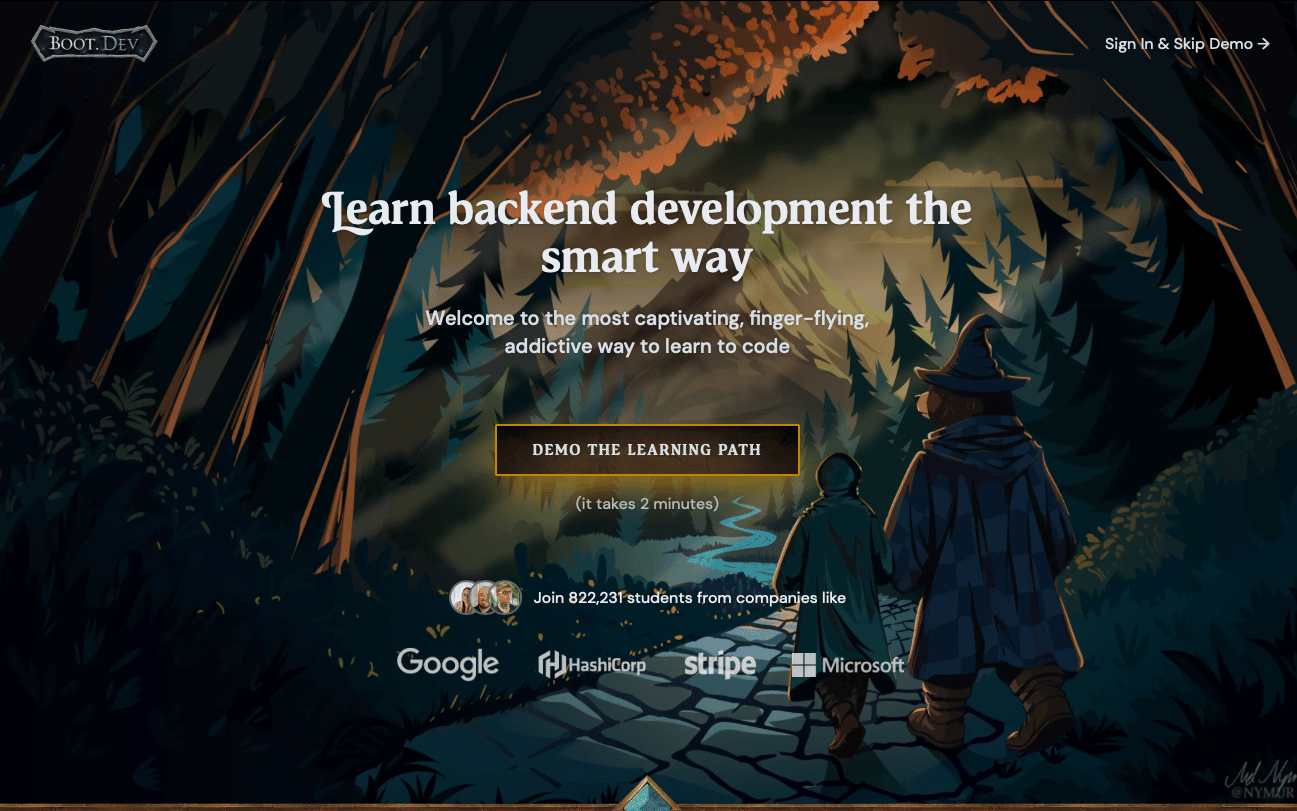
So, I started Boot.dev to teach backend online. And it has slowly morphed into the most immersive programming education platform available — thanks to us into interactive tooling and an RPG theme.
I went full-time on Boot.dev in 2022, and I've been full-time since. We're now a team of 13 and we just hit $10M ARR.
Starting with Markdown
The product started with a lot of Markdown — i.e. writing — and a lot of Go and JavaScript code.
Our stack is solid and should serve us well for a long time to come:
Go
Postgres
K8s
Docker
GCP
Nuxt
Typescript
Cloudflare
It has changed slightly from when we started, in that we're no longer using JS and Vue for the frontend. And of course the app itself has grown quite a bit.
Focusing on quality
These days, we work with external authors on our new courses. Our in-house editing team works closely with these authors and our video animators to ensure tip-top quality in everything we ship.
The future of online learning is quality first, not quantity first. So we focus on shipping slowly, owning our own content, and making it the best that it can be.
Organic content and paid ads
Outside of organic content, very little marketing was done for the first few years.
To this day, we mostly attract users via YouTube. We publish lots of organic content there, but now, we also work with influencers to get the word out. Blogging has been helpful for SEO, but video builds trust.
The fact that all our content is free to read and watch is actually crazy helpful for getting a lot of free traction and organic reach.
We're also getting pretty successful with direct-to-consumer advertising on YouTube, Google, and Meta.
Free content and paid features
All the content on Boot.dev is free to read and watch. The interactive features are paid (after a free trial). Specifically, paid features include:
Boots, our mascot and AI assistant
Writing and running code in the browser
The CLI tool
Certificates of completion
Unlockable spellbooks (cheatsheets) and solutions.
It's a monthly or yearly subscription.
Stay lean and branch out
My biggest advantage has been staying super lean.
I only hire when I'm 110% sure I can effectively use the role. We'll probably hire a little more aggressively this year, but the goal is always the same: profitable, incremental growth.
I don't want to do mass layoffs due to overhiring (looking at you, ZIRP)
And a piece of advice: Do NOT try to sell to other indie hackers. Find a different customer base.
What's next?
I want to grow a lot. I see no reason Boot.dev shouldn't be the one-stop shop for the best coding and tech education in the world.
We already think that every course we ship is the absolute best out there. But it's gonna take us a while to ship courses on all the subjects we want to cover.
You can follow along on my X and Boot.dev's X. And check out Boot.dev.

Leave a Comment
Lane’s journey is a masterclass in 'System over Volume.' After 11 years in corporate leadership, I’ve seen how traditional education fails because it lacks immersion. Boot.dev's RPG theme isn't just a 'gimmick'; it's a retention system. Also, his point about 'video builds trust' hits home—I’m currently building a YouTube engine for the US credit card niche, and it’s clear that in 2026, organic video is the only way to bypass the 'AI noise.' Quality-first is the only sustainable ROI.
Hey we just build a new learning platform called Microswab it's a platform where you learn life changing skills online for free. You earn passive income monthly by learning skills, around $700 to $3K monthly just by learning valuable skills online if you are interested here's the platform link Copy the link and Google it
microswab.netlify.
Add this at the ending of the Link (app) so it looks like .app
You nailed it on organic video being the way to cut through AI noise. Most creators I work with start YouTube thinking 'post consistently and hope,' but what Lane did here is the real unlock: treating video like a system.
The difference is data. Lane knows which videos drive signups, which topics retain viewers, what thumbnails get clicks. Most solo creators in spaces like credit cards never build that feedback loop, so they're guessing in the dark.
If you're building a YouTube engine for your niche, that's the piece worth obsessing over early. Happy to chat about how to set that up systematically if useful.
very good!
Gamification moves engagement metrics but rarely moves completion. The underlying problem is that quitting costs nothing - no record, no consequence, no one whose opinion you value noticed you stopped. RPG mechanics create dopamine but don't create skin in the game. Curious whether Boot.dev tracks where students actually go quiet - is it front-loaded or week 3+?
This is so nice, I've recently build a SaaS web app which makes studying easier. If anyone want's to try it, check my profile. I would really appreciate a feedback!
HIRE BEST BITCOIN RECOVERY EXPERT HERE / REVENANT CYBER HACKER
I never imagined that one bad decision could shatter my life the way it did. Like many people, I was drawn into cryptocurrency by stories of financial freedom and security for my family. When an online “recovery scheme” promised to help me retrieve funds I had previously lost, I was desperate and hopeful. Instead, I walked straight into another trap. Within weeks, $172,000, my life savings, was gone. The realization was devastating. I couldn’t sleep. I avoided my family because I didn’t know how to explain that everything I had worked for over the years had vanished in silence, stolen by faceless scammers hiding behind fake platforms and convincing words. Every unanswered email and every ignored message felt like another punch to the chest. I truly believed my future was over. I reported the incident to different platforms and authorities, but the responses were cold and discouraging. I was told crypto losses were “almost impossible” to recover. That sentence echoed in my mind daily. I felt ashamed, broken, and completely alone. That was when I came across REVENANT CYBER HACKER. At first, I was skeptical. After being scammed once, trusting anyone again felt impossible. But from the very first consultation, something was different. They listened, really listened to my story without judgment. They explained the process clearly, showed verifiable evidence of past recoveries, and never made unrealistic promises. REVENANT CYBER HACKER treated my case with urgency and professionalism. Their team traced blockchain transactions, identified wallet movements, and coordinated the recovery process step by step, keeping me informed throughout. For the first time in months, I felt a sense of hope. When I received confirmation that my $172,000 had been successfully recovered, I broke down in tears. It wasn’t just about the money; it was about getting my life back. REVENANT CYBER HACKER restored more than my funds; they restored my dignity, my peace of mind, and my belief that justice is still possible in the digital world. Today, I share my story so others don’t lose hope. If you feel trapped, ashamed, or helpless after a crypto scam, know this: recovery is possible. REVENANT CYBER HACKER gave me a second chance when I needed it most.
Email : revenantcyberhacker( @ ) Gmail (. ) com
WhatsApp: + 1 (208) 425-8584
WhatsApp: + 1 (913) 820-0739
Telegram @revenantcyberhacker
The "don't sell to other indie hackers" line at the end is one of the most honest things I've read on this platform.
There's a whole cottage industry of people building products for founders and developers the people most likely to admire what you built and least likely to pay for it. They'll study your funnel, reverse-engineer your pricing, and then go build their own version instead of subscribing.
The RPG angle is interesting for exactly the opposite reason you went to the people who already pay for progression systems, unlockables, and skill trees. Gamers have trained spending behavior. Developers who game are the intersection.
Free content driving trust into paid interactive features is also a cleaner model than most ed-tech companies realize. The content builds the audience. The interactivity closes the conversion. Most platforms get this backwards and paywall the content itself.
Team of 13 at $10M ARR is a number worth sitting with.
Trust the Experts: Your Premier Solution for Cryptocurrency Recovery – ShadowRoot Recovery Experts
When my cryptocurrency assets were compromised by a fraudulent online platform, I found myself at a loss. Fortunately, I discovered ShadowRoot Recovery Experts — a trusted partner during my most challenging time. Their team’s unwavering professionalism, technical expertise, and relentless dedication enabled me to navigate the complexities of the situation, ultimately recovering my stolen cryptocurrency assets and restoring my financial stability.
If you are facing similar challenges or seek to protect your cryptocurrency holdings from malicious actors, do not hesitate to contact ShadowRoot Recovery Experts. They are the trusted professionals equipped to help you reclaim what is rightfully yours.
Connect via SMS: +1 (530) 425-6052
Telegram: +1 (530) 425-6052
Email: shadowroot47 (@) outlook . com
Awesome story! I love how Boot.dev combines Go, Postgres, Kubernetes, Docker, GCP, Nuxt, and TypeScript to deliver a high-quality, interactive backend education platform. The mix of free content with paid interactive features like the CLI tool, AI assistant, and browser-based coding makes learning engaging and practical. Really inspiring fonts cursive how you stay lean while focusing on quality over quantity!
The product insight here is sharper than it looks on the surface. Backend dev education was genuinely underserved — not because nobody tried, but because it's harder to make interactive. Frontend dev has the browser as a natural playground: open DevTools, change a CSS rule, see it immediately. Backend is invisible by default. Building in-browser execution for Go, Python, and systems-level code is an actual engineering challenge that created a real moat.
The RPG theme isn't a cosmetic layer — it's a solution to the online course completion problem. The average Udemy course completion rate is under 10%. Streaks, XP, level-ups, and a character that visibly progresses turn passive video-watching into something that costs something to quit. Boot.dev's retention is almost certainly multiples higher than a standard video course format.
$10M ARR with a team of 13 is also notable for the unit economics: ~$770K ARR per person is exceptional for EdTech, which typically has high content production costs. The "slowly morphed" language in the intro suggests the interactive tooling was added incrementally rather than big-bang designed — which is usually how good EdTech gets built: you discover what actually helps people learn by watching people struggle.
Backend development is where the AI coding wave creates a new demand surge too — as AI handles more of the syntax, understanding what the code is actually doing becomes more valuable than ever. Good timing for a fundamentals-first platform.
Nice project!
I recently built a small AI Tools Directory as well where people can discover useful AI tools.
Curious to know the role of a UX AUditor in all of these milestone.
many creator upload youtube video but stuggle to get views
most of the time the issue is poor video SEO wrong audience targeting oe weak promotion strategy
i help creator improve youtube visibility ranking audience reach through proper optumization and promotion
if anyone need help growing their youtube channel feel free to reach out
Lane huge congrats on hitting $10M ARR 🎉. The RPG theme + interactive tooling is more than a gimmick; it’s a retention engine, and pairing free, high-quality content with paywalled hands-on features (Boots, in-browser coding, certs) is a masterstroke. I also love the 'stay lean / hire only when 110% sure' mindset - it shows discipline. Quick question: what metric or feedback first told you your interactive labs were ready to move from 'nice demo' to core paid product?
Love this direction. The “one‑stop shop for tech education” vision resonates — especially when the market is shifting toward fundamentals-first learning.
I’m building something similar in the teen/parent segment with FutureEngineer Academy, and the biggest unlock has been focusing on depth over breadth early on. Your approach of shipping the best possible course before expanding the catalog is exactly the right long game.
Excited to see how your company evolves. Following along on X — keep shipping.
I wanted to share a transparent look at how we’ve been building and evolving our product over time.
We started with a lot of Markdown and a simple backend written in Go. Over time, the stack matured into Go, Postgres, Kubernetes, Docker, GCP, Nuxt, TypeScript, and Cloudflare. We’ve made some frontend changes along the way (moving away from a JS + Vue setup), but overall we’ve tried to keep the architecture stable and long-term focused.
On the product side, one of the biggest shifts has been prioritizing quality over speed. We now collaborate with external authors, and our internal editing and animation teams work closely with them to ensure everything we publish meets a high bar. We ship slower than many platforms, but we believe depth and polish compound over time.
Marketing-wise, we relied almost entirely on organic growth in the early years —particularly YouTube. Long-form educational content helped us build trust. Blogging supported SEO, but video drove stronger engagement. Only recently did we start experimenting more seriously with paid acquisition (YouTube, Google, Meta), primarily to amplify what was already working organically.
Our model is simple:
All educational content is free to read and watch.
Paid subscriptions unlock interactive elements (in-browser coding, tools, certificates, etc.).
Keeping content open has been surprisingly powerful for distribution and brand trust.
Operationally, staying lean has been one of the biggest advantages. Hiring only when absolutely necessary has allowed us to grow profitably and avoid the pressure cycles that come with overexpansion.
Looking ahead, the goal isn’t rapid expansion it’s steady, sustainable growth while continuing to raise the bar on course quality.
I’d be interested to hear how others here are balancing:
Quality vs. speed of shipping
Organic growth vs. paid acquisition
Staying lean vs. hiring ahead of growth
Always curious how other founders are thinking about these trade-offs.
If you want to be clearer without pitching:
The free-content-first model is powerful. In developer ecosystems, transparency + depth usually wins long term.
One channel I’ve seen work surprisingly well for education products is Reddit not through promotion, but through highly contextual discussions around specific learning pain points.
When done correctly, those threads can compound for months and bring in extremely qualified users.
Feels aligned with your “quality first” positioning
Hitting $10M ARR with a 13-person team is an incredible revenue-per-employee metric. success really proves that gamification isn't just for consumer apps or beginner front-end courses.
Applying an RPG-style progression loop to complex, traditionally dry topics like backend development and architecture is a brilliant retention mechanism. Most programming platforms suffer from massive drop-off rates because the dopamine hit of 'making something work' takes much longer in backend coding compared to UI/UX. The RPG elements effectively bridge that dopamine gap, keeping students engaged until the core concepts finally click.
I’d be curious to hear what the primary acquisition engine looks like at this scale—are you still relying heavily on SEO, organic content, and community word-of-mouth, or have paid ads become the main growth lever now that your LTV is so dialed in?
Lane, $10M ARR with RPG-style coding courses is epic! 🎮 The gamified approach + quality-first content and organic YouTube/SEO funnel is a masterclass in building something devs actually stick with.
I love this so much, it's very similar to products I want to build from here on out.
Going to start digging in to courses tomorrow, time to start actually understanding what's going on in the backend. Thanks for sharing!
From hating backend education options to building and hitting .
I'm still in the 'hating my own broken tools' phase with my Python monitor after 680h grind
I love this story. What really stands out to me isn’t just the $10M ARR, it’s the focus on fixing a real problem in backend education. Making it interactive and RPG-style is smart. It turns learning from passive watching into actually building.
I also respect the quality-first mindset. Shipping slower but better content builds real trust.
As a backend engineer myself, this really resonates. I’d be excited to contribute, whether that’s building more realistic backend labs, improving infra and scalability, or adding AI-driven personalization to the learning experience. This feels like a product built by engineers who actually care. I’d genuinely love to work together if there’s an opportunity.
motivational
Good luck to you!
Free YouTube to WAV Converter on Toolesh : Extract High-Quality Audio Online
Looking to extract pristine audio from YouTube videos? Whether you’re a musician sampling sounds, a podcaster sourcing clips, or simply preserving your favorite content, converting YouTube to WAV format gives you uncompressed, studio-quality audio. This comprehensive guide shows you how to convert YouTube video to WAV using free online tools, explains why WAV format matters, and helps you choose the best YouTube to WAV converter online for your needs.
Wow, this is inspiring. I’ve struggled with backend learning myself and it’s true — so much content online is either outdated or low-quality.
This gives me motivation
The "Stay lean and branch out" section really resonates with me.
"I only hire when I'm 110% sure I can effectively use the role" — this is exactly the discipline that separates sustainable businesses from the overcapitalized startups that flame out after a few years.
As someone bootstrapped, I've learned that spending money wisely isn't about being cheap—it's about being strategic. Every hire, every expense needs to clearly contribute to growth. When you stay lean, you maintain optionality and avoid the panic of mass layoffs when market conditions change.
This is genuinely inspiring.
I joined Boot dev myself and it completely changed how I approach learning programming. The RPG-style progression, clear structure, and focus on fundamentals made it stick in a way most courses never did for me.
Reading how this grew into a $10M ARR business is motivating, especially as someone building a product while still learning and improving technically. It’s a great reminder that great learning experiences, when done right, can scale massively.
Huge respect to the team — stories like this keep me going.
At what point did you realize your project needed to focus on revenue instead of features?
Huge congrats on hitting $10M ARR, Lane! That's seriously impressive—especially with a lean team of just 13 and staying profitable while building something as creative as RPG-style backend courses.
Massive respect for the journey from side-project Markdown to this level—super motivating for the rest of us grinding away. Keep crushing it! 🚀"
This keeps it enthusiastic, specific (referencing key points like the RPG theme, quality focus, free content, team size, and full-time since 2022), and encouraging without being over-the-top or salesy.
Thanks for sharing! The decision to keep the core content free while monetizing interactive tooling feels like a smart way to drive traction. Congratulations on reaching $10M ARR with such a lean team.
Very inspirational 👌
Tips?
Hey we just build a new learning platform called Microswab it's a platform where you learn life changing skills online for free. You earn passive income monthly by learning skills, around $700 to $3K monthly just by learning valuable skills online if you are interested here's the platform link Copy the link and Google it
microswab.netlify.
Add this at the ending of the Link (app) so it looks like .app
Interesting take. I’ve seen similar results when the content is very structured.
Hey we just build a new learning platform called Microswab it's a platform where you learn life changing skills online for free. You earn passive income monthly by learning skills, around $700 to $3K monthly just by learning valuable skills online if you are interested here's the platform link Copy the link and Google it
microswab.netlify.
Add this at the ending of the Link (app) so it looks like .app
after trying the demo, I honestly don’t see what makes this different from other programming games that already exist (won’t name any). Not saying it’s bad! I actually wish I had learned with tools like this. Maybe it's just a different learning style or cheaper, I didn't do any research about this. Congrats on the success!
Hey we just build a new learning platform called Microswab it's a platform where you learn life changing skills online for free. You earn passive income monthly by learning skills, around $700 to $3K monthly just by learning valuable skills online if you are interested here's the platform link Copy the link and Google it
microswab.netlify.
Add this at the ending of the Link (app) so it looks like .app
This is one of those posts that quietly rewires how you think about “edtech”.
You didn’t chase trends, cohorts, or hype — you went deep on one underserved audience (backend devs), obsessed over quality, stayed lean, and let the product + content do the marketing. $10M ARR with a 13-person team is a masterclass in focus.
Also love the clarity of the model:
Free, genuinely useful content → trust
Paid capabilities (not paywalled knowledge) → value
Slow shipping + owned content → defensibility
The RPG + interactive tooling angle feels like the kind of thing that only works when the fundamentals are rock solid — which they clearly are.
Big respect for the “don’t sell to other indie hackers” advice too. Hard-earned wisdom there 😄
Excited to see how far it goes--feels like you’re building the Stripe of backend education.
Hey we just build a new learning platform called Microswab it's a platform where you learn life changing skills online for free. You earn passive income monthly by learning skills, around $700 to $3K monthly just by learning valuable skills online if you are interested here's the platform link Copy the link and Google it
microswab.netlify.
Add this at the ending of the Link (app) so it looks like .app
Love the UX, really smooth...
Appreciate the detail on how you structured your RPG style programming courses and how you tested them with your audience.
I’m interested in how you balanced adding new content versus improving existing modules once you started to see traction. Was there a specific signal that guided that decision?
Thanks for sharing.
Hey we just build a new learning platform called Microswab it's a platform where you learn life changing skills online for free. You earn passive income monthly by learning skills, around $700 to $3K monthly just by learning valuable skills online if you are interested here's the platform link Copy the link and Google it
microswab.netlify.
Add this at the ending of the Link (app) so it looks like .app
I honestly thought I’d lost everything. A few weeks ago, I clicked on what I thought was a legit link, and within hours, I realized my crypto wallet had been drained. I was in total panic mode. I had been saving for months and had no idea how to even start recovering what I lost. My friends told me about Wizard Hilton Cyber Tech, and although I was super hesitant at first, I decided to give it a shot because I didn’t know where else to turn.
The team at Wizard Hilton Cyber Tech was amazing. From the first phone call, I felt like I wasn’t just another case number. They actually cared about getting my funds back. They explained everything to me in detail, step by step, so I didn’t feel completely lost in the process. They worked tirelessly for what felt like forever. Honestly, I lost track of time, but eventually, they came through. I couldn’t believe it when I saw my funds restored. It wasn’t just about the money. It was about feeling like there was still hope after everything felt so hopeless. I can’t express enough how thankful I am. If you’re in a similar situation, I truly believe these guys can help. It’s not an easy road, but with the right team at Wizard Hilton Cyber Tech crypto recovery services, it’s possible to get your crypto back. Email : wizardhiltoncybertech ( @ ) Gmail (. ) com
WhatsApp number +18737715701
This is such an inspiring journey — I love how you combined your backend engineering experience with a clear gap in education to create something that’s genuinely useful. The way Boot.dev evolved from Markdown-based content to a full interactive, RPG-themed platform is fascinating — it really shows the power of iterating based on real user needs.
I also appreciate the “quality first, not quantity first” approach. In online education, it’s so tempting to churn out content, but focusing on polished, immersive experiences clearly pays off — $10M ARR and a lean, happy team is proof of that.
Curious: when you’re evaluating a new course or feature, how do you decide whether it should stay free content versus a paid interactive feature?
Hey we just build a new learning platform called Microswab it's a platform where you learn life changing skills online for free. You earn passive income monthly by learning skills, around $700 to $3K monthly just by learning valuable skills online if you are interested here's the platform link Copy the link and Google it
microswab.netlify.
Add this at the ending of the Link (app) so it looks like .app
Amazing story and a great app, I’m already using it and love it.
Hey we just build a new learning platform called Microswab it's a platform where you learn life changing skills online for free. You earn passive income monthly by learning skills, around $700 to $3K monthly just by learning valuable skills online if you are interested here's the platform link Copy the link and Google it
microswab.netlify.
Add this at the ending of the Link (app) so it looks like .app
Fantastic growth story! What were your biggest challenges to unlock distribution? How did you manage those?
Hey we just build a new learning platform called Microswab it's a platform where you learn life changing skills online for free. You earn passive income monthly by learning skills, around $700 to $3K monthly just by learning valuable skills online if you are interested here's the platform link Copy the link and Google it
microswab.netlify.
Add this at the ending of the Link (app) so it looks like .app
bots in comments are getting crazy...
Give a try to my Reddit Extension. It's a Chrome extension called Pulse of Reddit that basically acts like my own alert system for Reddit.
Anytime someone posts something with keywords I care about like 'looking for a designer' or 'best SEO tool' it pings me right away. It’s saved me so much time and helped me hop into threads while they’re still fresh.
If you’re tired of manual digging and want to catch those conversations early, I’d really recommend giving it a look.
It’s free to start and super simple to set up.
Website:
pulseofreddit.com
Nice breakdown! Curious — what was the hardest part when you first launched?
Give a try to my Reddit Extension. It's a Chrome extension called Pulse of Reddit that basically acts like my own alert system for Reddit.
Anytime someone posts something with keywords I care about like 'looking for a designer' or 'best SEO tool' it pings me right away. It’s saved me so much time and helped me hop into threads while they’re still fresh.
If you’re tired of manual digging and want to catch those conversations early, I’d really recommend giving it a look.
It’s free to start and super simple to set up.
Website:
pulseofreddit.com
Really love how Templifica blends design and usability — I’m curious how you prioritize which templates or features deliver the most value. I’m trying to learn from your process!
Hey we just build a new learning platform called Microswab it's a platform where you learn life changing skills online for free. You earn passive income monthly by learning skills, around $700 to $3K monthly just by learning valuable skills online if you are interested here's the platform link Copy the link and Google it
microswab.netlify.
Add this at the ending of the Link (app) so it looks like .app
Great Insights!
Give a try to my Reddit Extension. It's a Chrome extension called Pulse of Reddit that basically acts like my own alert system for Reddit.
Anytime someone posts something with keywords I care about like 'looking for a designer' or 'best SEO tool' it pings me right away. It’s saved me so much time and helped me hop into threads while they’re still fresh.
If you’re tired of manual digging and want to catch those conversations early, I’d really recommend giving it a look.
It’s free to start and super simple to set up.
Website:
pulseofreddit.com
Love how gamifies backend learning — curious how you decide which features work best with the RPG approach versus traditional lessons?
Love how gamifies backend learning — curious how you decide which features work best with the RPG approach versus traditional lessons?
Hitting $10M ARR with RPG-style programming courses is possible by turning learning into a progression system. Gamified levels, quests, rewards, and real-world challenges keep students engaged longer, reducing churn. Scalable subscriptions, team plans, and enterprise licensing drive recurring revenue. Strong community features, certifications, and continuous content updates help increase lifetime value while making technical education feel fun, motivating, and addictive rather than overwhelming or boring.
Give a try to my Reddit Extension. It's a Chrome extension called Pulse of Reddit that basically acts like my own alert system for Reddit.
Anytime someone posts something with keywords I care about like 'looking for a designer' or 'best SEO tool' it pings me right away. It’s saved me so much time and helped me hop into threads while they’re still fresh.
If you’re tired of manual digging and want to catch those conversations early, I’d really recommend giving it a look.
It’s free to start and super simple to set up.
Website:
pulseofreddit.com
Your product manager has been a great inspiration to me. How long did it take from your product launch until you acquired your first user?
Hey we just build a new learning platform called Microswab it's a platform where you learn life changing skills online for free. You earn passive income monthly by learning skills, around $700 to $3K monthly just by learning valuable skills online if you are interested here's the platform link Copy the link and Google it
microswab.netlify.
Add this at the ending of the Link (app) so it looks like .app
Give a try to my Reddit Extension. It's a Chrome extension called Pulse of Reddit that basically acts like my own alert system for Reddit.
Anytime someone posts something with keywords I care about like 'looking for a designer' or 'best SEO tool' it pings me right away. It’s saved me so much time and helped me hop into threads while they’re still fresh.
If you’re tired of manual digging and want to catch those conversations early, I’d really recommend giving it a look.
It’s free to start and super simple to set up.
Website:
pulseofreddit.com
that last advice is gold, the tpot has become such a weird place now everyone building tools for themselves, everyone is building either a social media scheduler, or something for the other indie hackers.
Btw the build an http server in go course with the primeagen is GOLD. I highly recommend
Hey we just build a new learning platform called Microswab it's a platform where you learn life changing skills online for free. You earn passive income monthly by learning skills, around $700 to $3K monthly just by learning valuable skills online if you are interested here's the platform link Copy the link and Google it
microswab.netlify.
Add this at the ending of the Link (app) so it looks like .app
Give a try to my Reddit Extension. It's a Chrome extension called Pulse of Reddit that basically acts like my own alert system for Reddit.
Anytime someone posts something with keywords I care about like 'looking for a designer' or 'best SEO tool' it pings me right away. It’s saved me so much time and helped me hop into threads while they’re still fresh.
If you’re tired of manual digging and want to catch those conversations early, I’d really recommend giving it a look.
It’s free to start and super simple to set up.
Website:
pulseofreddit.com
Hey we just build a new learning platform called Microswab it's a platform where you learn life changing skills online for free. You earn passive income monthly by learning skills, around $700 to $3K monthly just by learning valuable skills online if you are interested here's the platform link Copy the link and Google it
microswab.netlify.
Add this at the ending of the Link (app) so it looks like .app
"Do NOT try to sell to other indie hackers" - I wish someone told me this a year ago. Zero conversions on othewr IH channels like X.
did the RPG mechanics actually move completion rates?
Every gamified platform claims "engagement" but most online courses still sit at <10% completion.
Hey we just build a new learning platform called Microswab it's a platform where you learn life changing skills online for free. You earn passive income monthly by learning skills, around $700 to $3K monthly just by learning valuable skills online if you are interested here's the platform link Copy the link and Google it
microswab.netlify.
Add this at the ending of the Link (app) so it looks like .app
Give a try to my Reddit Extension. It's a Chrome extension called Pulse of Reddit that basically acts like my own alert system for Reddit.
Anytime someone posts something with keywords I care about like 'looking for a designer' or 'best SEO tool' it pings me right away. It’s saved me so much time and helped me hop into threads while they’re still fresh.
If you’re tired of manual digging and want to catch those conversations early, I’d really recommend giving it a look.
It’s free to start and super simple to set up.
Website:
pulseofreddit.com
Hey we just build a new learning platform called Microswab it's a platform where you learn life changing skills online for free. You earn passive income monthly by learning skills, around $700 to $3K monthly just by learning valuable skills online if you are interested here's the platform link Copy the link and Google it
microswab.netlify.
Add this at the ending of the Link (app) so it looks like .app
Hi there, I'm Aditya, and I will offer a partnership in my business in exchange for a financial support. Interested? Let's talk!
Hey we just build a new learning platform called Microswab it's a platform where you learn life changing skills online for free. You earn passive income monthly by learning skills, around $700 to $3K monthly just by learning valuable skills online if you are interested here's the platform link Copy the link and Google it
microswab.netlify.
Add this at the ending of the Link (app) so it looks like .app
Give a try to my Reddit Extension. It's a Chrome extension called Pulse of Reddit that basically acts like my own alert system for Reddit.
Anytime someone posts something with keywords I care about like 'looking for a designer' or 'best SEO tool' it pings me right away. It’s saved me so much time and helped me hop into threads while they’re still fresh.
If you’re tired of manual digging and want to catch those conversations early, I’d really recommend giving it a look.
It’s free to start and super simple to set up.
Website:
pulseofreddit.com
Hey we just build a new learning platform called Microswab it's a platform where you learn life changing skills online for free. You earn passive income monthly by learning skills, around $700 to $3K monthly just by learning valuable skills online if you are interested here's the platform link Copy the link and Google it
microswab.netlify.
Add this at the ending of the Link (app) so it looks like .app
Really inspiring to see this scale - that level of revenue with an educational product shows how much value there is when you deeply understand your audience. Curious how you kept retention high after initial launch? Thanks for sharing!
Hey we just build a new learning platform called Microswab it's a platform where you learn life changing skills online for free. You earn passive income monthly by learning skills, around $700 to $3K monthly just by learning valuable skills online if you are interested here's the platform link Copy the link and Google it
microswab.netlify.
Add this at the ending of the Link (app) so it looks like .app
Give a try to my Reddit Extension. It's a Chrome extension called Pulse of Reddit that basically acts like my own alert system for Reddit.
Anytime someone posts something with keywords I care about like 'looking for a designer' or 'best SEO tool' it pings me right away. It’s saved me so much time and helped me hop into threads while they’re still fresh.
If you’re tired of manual digging and want to catch those conversations early, I’d really recommend giving it a look.
It’s free to start and super simple to set up.
Website:
pulseofreddit.com
Hey we just build a new learning platform called Microswab it's a platform where you learn life changing skills online for free. You earn passive income monthly by learning skills, around $700 to $3K monthly just by learning valuable skills online if you are interested here's the platform link Copy the link and Google it
microswab.netlify.
Add this at the ending of the Link (app) so it looks like .app
Hi
Hey we just build a new learning platform called Microswab it's a platform where you learn life changing skills online for free. You earn passive income monthly by learning skills, around $700 to $3K monthly just by learning valuable skills online if you are interested here's the platform link Copy the link and Google it
microswab.netlify.
Add this at the ending of the Link (app) so it looks like .app
This really reinforces how underrated organic intent channels are when quality is the product. YouTube worked here because it captures people already trying to learn backend same dynamic I’ve seen on Reddit, where devs openly compare courses, vent about learning gaps, and ask “what actually works.”
When those conversations are treated as discovery and positioning signals (not promotion), they compound quietly over time. That’s where a lot of durable growth seems to come from.
Happy to share how I’ve helped teams systematize that approach on Reddit if useful.
📩 michealprecious616@gmail.com | 💬 @preshtechsolution
Hey we just build a new learning platform called Microswab it's a platform where you learn life changing skills online for free. You earn passive income monthly by learning skills, around $700 to $3K monthly just by learning valuable skills online if you are interested here's the platform link Copy the link and Google it
microswab.netlify.
Add this at the ending of the Link (app) so it looks like .app
Love what you’re buildin; free, skill-focused learning with real income upside is a strong value prop, especially for beginners looking for practical outcomes.
A platform like this can get early traction fast on Reddit, where people actively discuss skill-building, side income, and learning paths. When you join those conversations the right way, it helps validate demand and attract users who already care about the outcome.
If you want to explore how Reddit can help Microswab grow organically, feel free to DM me;happy to share what works.
Give a try to my Reddit Extension. It's a Chrome extension called Pulse of Reddit that basically acts like my own alert system for Reddit.
Anytime someone posts something with keywords I care about like 'looking for a designer' or 'best SEO tool' it pings me right away. It’s saved me so much time and helped me hop into threads while they’re still fresh.
If you’re tired of manual digging and want to catch those conversations early, I’d really recommend giving it a look.
It’s free to start and super simple to set up.
Website:
pulseofreddit.com
Nice idea , tools like this solve a very real problem for people who rely on Reddit for leads and insights. Catching threads early is a big advantage.
This is also the kind of product that can grow well on Reddit itself when promoted strategically; especially by getting it in front of the right subreddits, early adopters, and power users who’ll actually leave feedback and reviews.
If you’d like to explore how to drive more users and real-world reviews for it on Reddit, feel free to DM me. Happy to share a few ideas.
Hey we just build a new learning platform called Microswab it's a platform where you learn life changing skills online for free. You earn passive income monthly by learning skills, around $700 to $3K monthly just by learning valuable skills online if you are interested here's the platform link Copy the link and Google it
microswab.netlify.
Add this at the ending of the Link (app) so it looks like .app
Hi
hello
Hitting $10M ARR with RPG-style programming courses is about turning learning into a game levels, quests, rewards, and real skill progression. By combining engaging storytelling, hands-on coding challenges, clear career outcomes, and strong community retention, these courses keep learners hooked, motivated, and willing to upgrade driving massive growth through fun, results-driven education.
Hey we just build a new learning platform called Microswab it's a platform where you learn life changing skills online for free. You earn passive income monthly by learning skills, around $700 to $3K monthly just by learning valuable skills online if you are interested here's the platform link Copy the link and Google it
microswab.netlify.
Add this at the ending of the Link (app) so it looks like .app
Give a try to my Reddit Extension. It's a Chrome extension called Pulse of Reddit that basically acts like my own alert system for Reddit.
Anytime someone posts something with keywords I care about like 'looking for a designer' or 'best SEO tool' it pings me right away. It’s saved me so much time and helped me hop into threads while they’re still fresh.
If you’re tired of manual digging and want to catch those conversations early, I’d really recommend giving it a look.
It’s free to start and super simple to set up.
Website:
pulseofreddit.com
Hey we just build a new learning platform called Microswab it's a platform where you learn life changing skills online for free. You earn passive income monthly by learning skills, around $700 to $3K monthly just by learning valuable skills online if you are interested here's the platform link Copy the link and Google it
microswab.netlify.
Add this at the ending of the Link (app) so it looks like .app
This is inspiring. Quality-first content, staying lean, and giving real value for free before monetizing clearly worked. The “don’t sell to other indie hackers” advice hits hard. Respect the long-term thinking 👏
Hey we just build a new learning platform called Microswab it's a platform where you learn life changing skills online for free. You earn passive income monthly by learning skills, around $700 to $3K monthly just by learning valuable skills online if you are interested here's the platform link Copy the link and Google it
microswab.netlify.
Add this at the ending of the Link (app) so it looks like .app
Give a try to my Reddit Extension. It's a Chrome extension called Pulse of Reddit that basically acts like my own alert system for Reddit.
Anytime someone posts something with keywords I care about like 'looking for a designer' or 'best SEO tool' it pings me right away. It’s saved me so much time and helped me hop into threads while they’re still fresh.
If you’re tired of manual digging and want to catch those conversations early, I’d really recommend giving it a look.
It’s free to start and super simple to set up.
Website:
pulseofreddit.com
Congratulations! First players, feedback, and community-building are critical in gaming. This looks like a solid solution for new game founders and studios.
Hey we just build a new learning platform called Microswab it's a platform where you learn life changing skills online for free. You earn passive income monthly by learning skills, around $700 to $3K monthly just by learning valuable skills online if you are interested here's the platform link Copy the link and Google it
microswab.netlify.
Add this at the ending of the Link (app) so it looks like .app
Give a try to my Reddit Extension. It's a Chrome extension called Pulse of Reddit that basically acts like my own alert system for Reddit.
Anytime someone posts something with keywords I care about like 'looking for a designer' or 'best SEO tool' it pings me right away. It’s saved me so much time and helped me hop into threads while they’re still fresh.
If you’re tired of manual digging and want to catch those conversations early, I’d really recommend giving it a look.
It’s free to start and super simple to set up.
Website:
pulseofreddit.com
Hey we just build a new learning platform called Microswab it's a platform where you learn life changing skills online for free. You earn passive income monthly by learning skills, around $700 to $3K monthly just by learning valuable skills online if you are interested here's the platform link Copy the link and Google it
microswab.netlify.
Add this at the ending of the Link (app) so it looks like .app
As someone who is new to and intimidated by backend developing this seems like it would be good fun!
Hey we just build a new learning platform called Microswab it's a platform where you learn life changing skills online for free. You earn passive income monthly by learning skills, around $700 to $3K monthly just by learning valuable skills online if you are interested here's the platform link Copy the link and Google it
microswab.netlify.
Add this at the ending of the Link (app) so it looks like .app
Give a try to my Reddit Extension. It's a Chrome extension called Pulse of Reddit that basically acts like my own alert system for Reddit.
Anytime someone posts something with keywords I care about like 'looking for a designer' or 'best SEO tool' it pings me right away. It’s saved me so much time and helped me hop into threads while they’re still fresh.
If you’re tired of manual digging and want to catch those conversations early, I’d really recommend giving it a look.
It’s free to start and super simple to set up.
Website:
pulseofreddit.com
Loved the breakdown of building an RPG-style learning product to $10M ARR — inspiring quality focus, community engagement and practical growth insights. Really valuable for founders thinking differently about education platforms!
Give a try to my Reddit Extension. It's a Chrome extension called Pulse of Reddit that basically acts like my own alert system for Reddit.
Anytime someone posts something with keywords I care about like 'looking for a designer' or 'best SEO tool' it pings me right away. It’s saved me so much time and helped me hop into threads while they’re still fresh.
If you’re tired of manual digging and want to catch those conversations early, I’d really recommend giving it a look.
It’s free to start and super simple to set up.
Website:
pulseofreddit.com
Congratulations! Sound very interesting. I'm currently developing AI SaaS launch Kit's for new SaaS founders who have problems with getting their first users.
Give a try to my Reddit Extension. It's a Chrome extension called Pulse of Reddit that basically acts like my own alert system for Reddit.
Anytime someone posts something with keywords I care about like 'looking for a designer' or 'best SEO tool' it pings me right away. It’s saved me so much time and helped me hop into threads while they’re still fresh.
If you’re tired of manual digging and want to catch those conversations early, I’d really recommend giving it a look.
It’s free to start and super simple to set up.
Website:
pulseofreddit.com
I appreciate your response. ~
The role playing game ("RPG") element isn't magical in itself. What it does is create momentum for learners.
What stands out is that you prioritized quality for so long before scaling hard. That's usually the part that gets skipped. They jump to ads or funnels before the product experience is tight. A simple way to think about it is: First: Make the first win obvious and fast. Then: Reinforce progress in small, concrete steps. Only then: Amplify with distribution.
I often see education product creators overwhelm their early users. There's often too much content and features without enough clarity around, "What do I do next?" I am curious what early signals told you the format was working? Completion rates, repeat usage, or something more qualitative?
Hey we just build a new learning platform called Microswab it's a platform where you learn life changing skills online for free. You earn passive income monthly by learning skills, around $700 to $3K monthly just by learning valuable skills online if you are interested here's the platform link Copy the link and Google it
microswab.netlify.
Add this at the ending of the Link (app) so it looks like .app
Give a try to my Reddit Extension. It's a Chrome extension called Pulse of Reddit that basically acts like my own alert system for Reddit.
Anytime someone posts something with keywords I care about like 'looking for a designer' or 'best SEO tool' it pings me right away. It’s saved me so much time and helped me hop into threads while they’re still fresh.
If you’re tired of manual digging and want to catch those conversations early, I’d really recommend giving it a look.
It’s free to start and super simple to set up.
Website:
pulseofreddit.com
thank for share
Give a try to my Reddit Extension. It's a Chrome extension called Pulse of Reddit that basically acts like my own alert system for Reddit.
Anytime someone posts something with keywords I care about like 'looking for a designer' or 'best SEO tool' it pings me right away. It’s saved me so much time and helped me hop into threads while they’re still fresh.
If you’re tired of manual digging and want to catch those conversations early, I’d really recommend giving it a look.
It’s free to start and super simple to set up.
Website:
pulseofreddit.com
Love this breakdown — building real value and then scaling the product and community together is a huge differentiator.
A few things stood out to me:
The discipline to ship real deliverables before chasing scale
The focus on workflow mastery over gimmicks
Turning educational products into predictable revenue engines
This resonates with how we approach product work at Fluxvex :
We help founders turn ideas into production-ready SaaS and AI products — not just prototypes — with clean architecture and real usage in mind.
For anyone thinking about turning a product or concept into a repeatable revenue generator: execution quality and product reliability often matter more than hype.
Would love to hear what parts of the tech stack others are standardizing on as they scale beyond early revenue.
Give a try to my Reddit Extension. It's a Chrome extension called Pulse of Reddit that basically acts like my own alert system for Reddit.
Anytime someone posts something with keywords I care about like 'looking for a designer' or 'best SEO tool' it pings me right away. It’s saved me so much time and helped me hop into threads while they’re still fresh.
If you’re tired of manual digging and want to catch those conversations early, I’d really recommend giving it a look.
It’s free to start and super simple to set up.
Website:
pulseofreddit.com
Hey we just build a new learning platform called Microswab it's a platform where you learn life changing skills online for free. You earn passive income monthly by learning skills, around $700 to $3K monthly just by learning valuable skills online if you are interested here's the platform link Copy the link and Google it
microswab.netlify.
Add this at the ending of the Link (app) so it looks like .app
Love how you leaned into storytelling and community — turning learning into an experience made your audience feel like they were part of something, not just consuming content. It’s a great reminder that connecting emotionally and creating a sense of progression can be just as valuable as the material itself. Congrats on the ARR milestone — and thanks for sharing the journey.
Give a try to my Reddit Extension. It's a Chrome extension called Pulse of Reddit that basically acts like my own alert system for Reddit.
Anytime someone posts something with keywords I care about like 'looking for a designer' or 'best SEO tool' it pings me right away. It’s saved me so much time and helped me hop into threads while they’re still fresh.
If you’re tired of manual digging and want to catch those conversations early, I’d really recommend giving it a look.
It’s free to start and super simple to set up.
Website:
pulseofreddit.com
"Do NOT try to sell to other indie hackers. Find a different customer base."
This is underrated advice. The IH/Twitter builder crowd is a tiny market that everyone fights over. Backend devs learning to code is massive in comparison.
The RPG gamification angle is clever — coding education has a completion rate problem, and game mechanics solve for motivation better than most realize.
Question: When you switched from quantity-first to quality-first content, did you see a dip in output that scared you? Or did the improved retention justify it immediately?
Hey we just build a new learning platform called Microswab it's a platform where you learn life changing skills online for free. You earn passive income monthly by learning skills, around $700 to $3K monthly just by learning valuable skills online if you are interested here's the platform link Copy the link and Google it
microswab.netlify.
Add this at the ending of the Link (app) so it looks like .app
Give a try to my Reddit Extension. It's a Chrome extension called Pulse of Reddit that basically acts like my own alert system for Reddit.
Anytime someone posts something with keywords I care about like 'looking for a designer' or 'best SEO tool' it pings me right away. It’s saved me so much time and helped me hop into threads while they’re still fresh.
If you’re tired of manual digging and want to catch those conversations early, I’d really recommend giving it a look.
It’s free to start and super simple to set up.
Website:
pulseofreddit.com
I really like this idea. RPG-style progression is genius for education. I've been teaching myself development using AI tools (built a Chrome extension recently) and the traditional tutorial format is so dry. The gamification aspect makes grinding through technical concepts way more tolerable especially if you are into the big RPGS like Baldurs Gate 3. Would be curious to know what retention/completion rates look like compared to traditional course platforms.
Give a try to my Reddit Extension. It's a Chrome extension called Pulse of Reddit that basically acts like my own alert system for Reddit.
Anytime someone posts something with keywords I care about like 'looking for a designer' or 'best SEO tool' it pings me right away. It’s saved me so much time and helped me hop into threads while they’re still fresh.
If you’re tired of manual digging and want to catch those conversations early, I’d really recommend giving it a look.
It’s free to start and super simple to set up.
Website:
pulseofreddit.com
Congrats, that's awesome. I just built a platform that is half the price of Gumroad, I would love feedback, get cocoonly is the domain. Thank you
Give a try to my Reddit Extension. It's a Chrome extension called Pulse of Reddit that basically acts like my own alert system for Reddit.
Anytime someone posts something with keywords I care about like 'looking for a designer' or 'best SEO tool' it pings me right away. It’s saved me so much time and helped me hop into threads while they’re still fresh.
If you’re tired of manual digging and want to catch those conversations early, I’d really recommend giving it a look.
It’s free to start and super simple to set up.
Website:
pulseofreddit.com