Growing an AI orchestration platform to $3k MRR in 4 weeks

Santanu Dasgupta built an AI orchestration platform and launched it into a crowded market. Four weeks later, Meerkats.ai's MRR is over $3k.
Here's Santanu on how he did it. 👇
20 years in GTM
I’ve spent 20 years working on go-to-market for SaaS companies, across the US, Europe, and India — starting out as a developer at an Oracle mobile database spinout in the Bay Area, before moving into GTM and growth.
I later worked with startups and enterprises on scaling demand generation and revenue at Gartner Consulting and Tata Consultancy Services, where I saw firsthand how much GTM still depends on manual work, fragmented tools, and agency-heavy execution.
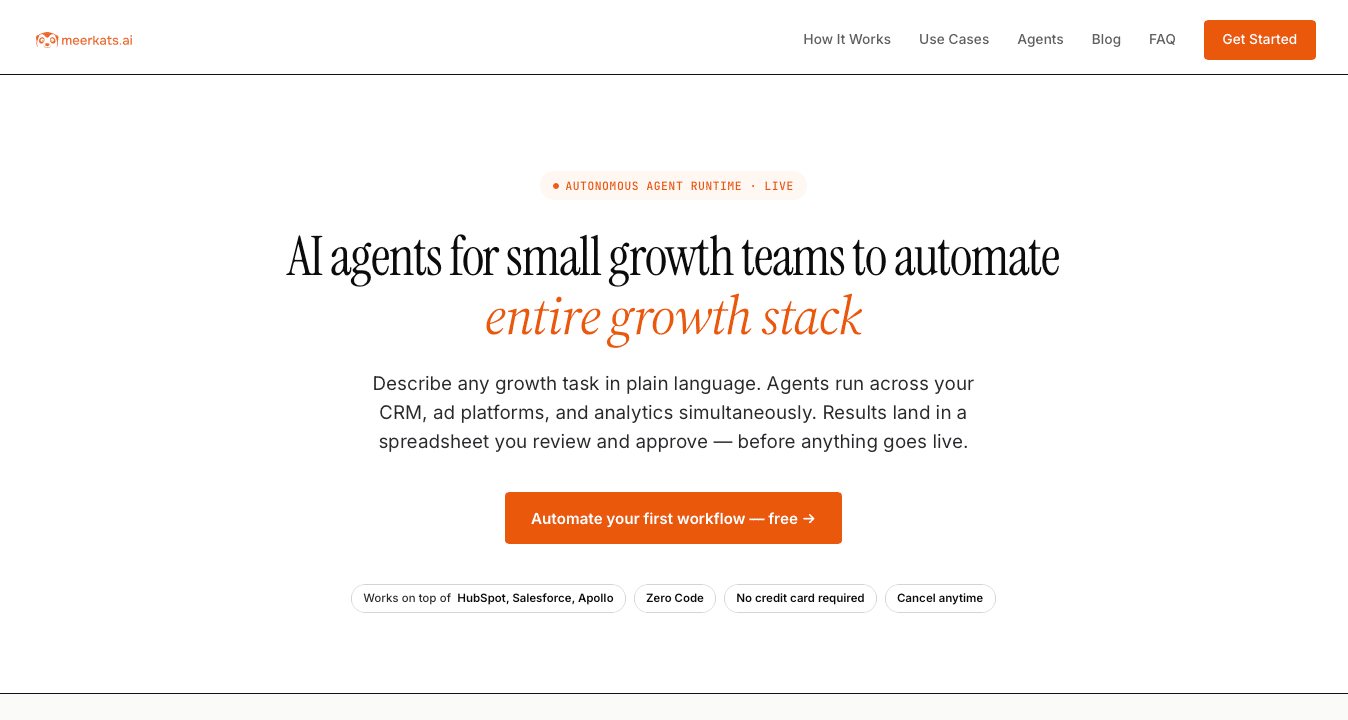
That insight led me to start an AI orchestration product called Meerkats.ai. We’re essentially building a digital growth agency in software. Meerkats replaces a lot of the repetitive work SDRs, marketers, and agencies typically handle — capturing and enriching relationship data, generating leads, running campaigns, and following up — all from a simple chat interface.
Startups' GTM teams are selecting Meerkats.ai over platforms like Claude Managed Agents and OpenAI Agent Harness, as they want flexibility in model choice (bringing the cheapest model that is appropriate for the task). Also, they may not have the in-house talent to build in Agent Harness, so they are offloading the entire task to Meerkats as a “Service as a Software” or even outcome-based service.
We launched the platform four weeks ago and are currently doing $3k+ MRR. To keep the lights on, we got funding from the University of Chicago Polsky Center as part of the Alumni New Venture Challenge. We also offered Agency services as part of the platform to fund operations. And we got generous credits from Azure, OpenAI, and Anthropic towards model costs.
Building V1
We built the initial system with the following components:
A spreadsheet UI for viewing lead lists and an enrichment platform.
Infrastructure to scale enrichments to 50K+ rows in under 30 minutes.
Integrations with third-party servers, and enabling dynamic code execution based on user requirements.
Autonomous Agents with full manus-like capabilities, including memory management, sandbox code execution, evals, tool selection, Skills.md, and files for a knowledge base, helped us create an end-to-end native AI platform. The entire setup is sometimes called an Agent Harness and enables Agents to work reliably at scale across multiple workflows. These systems can plan and execute open-ended tasks, pick the right tools and models for the task, handle execution errors, and request human attention when required.
The initial product leveraged AI models like Claude, Gemini, Codex, and agentic frameworks such as Claude Skills SDK, Codex, LangChain, Crew AI, AutoGen, and Google Cloud Platform (GCP). It also drew inspiration from the capabilities of OpenClaw.
As far as the rest of our stack, it's:
Supabase
Google Cloud Platform for scaling
Fly.io for sandbox code execution
React frontend and Node.js server
MCP servers and CLI endpoints in GCP containers
We chose Supabase because it offers the wonderful feature of Row Level Security, as well as powerful features like built-in authentication, real-time updates, and MCP server hosting. It felt much more modern than Mongo, hence we migrated.
Business model and growth channels
Our business model is consumption-based, factoring in the number of enrichments and actions an LLM performs and the task's complexity. We aim to make it very easy to start a growth flow, usually at the top of the funnel, and then help agencies or businesses with other revenue-impacting workflows. We are also seeing demand from customers for agencies to package our service as an “Outcome-as-a-service” where the customer pays the agency for a particular outcome or task completed — similar to what they would get if they hired a VA, but an Agent completes the task.
We have three growth channels:
We combine cold and targeted outreach to agencies in our network. We specifically target agencies that run marketing campaigns for their clients without using AI.
We run educational events online and offline to educate agencies on how to best leverage AI Agents for revenue.
We attract users through LinkedIn posts.
If I were starting over, I'd do more content marketing and build bigger audiences up front.
Threats and opportunities
Suggested header: Why content marketing is crucial for startups
The biggest challenge for us was how rapidly AI capabilities developed — the competitive landscape and differentiation changed completely.
Fortunately, we made the right architectural choices, releasing the right product at the right time.
The key lesson was this: Navigating rapid tech changes is tough for startups, but even tougher for incumbents. Startups and indie hackers should view this disruption as an opportunity, not a threat.
In my case, automation technology has been relatively stable over the past 10 years, with players like Make.com, n8n, Zapier. This stack is now considered legacy with AI orchestration, new models, and orchestration frameworks.
Find the bottlenecks
Here's my advice:
Understand agentic behavior: Focus on agents that handle processes end-to-end, not just AI wrappers.
Identify customer problems where AI solutions can drive revenue and cut costs.
Find tasks that are repetitive and are done manually — convert them to Agents. Start with one high-value task that is painful, directly impacts revenue, or customer experience. Use that as a wedge to rapidly expand to other tasks.
What's next?
My future goals are to build an AI-native company at scale with minimum headcount that delivers significant value to customers through rapid growth, selling more to existing customers, and reducing wasteful spend/headcount. To get there, we'll use our own agents for customer support and growth strategies.
I also want to improve agent reliability through evals and CI/CD pipelines.
You can learn more about our growth story on our blog, or connect with me on X and LinkedIn. And check out Meerkats!

Leave a Comment
Interesting story, especially the SaaS positioning and the focus on real GTM workflow pain. $3k MRR in 4 weeks is a early validation signal in such a crowded market. Curious to see which channel compounds best over time: outbound, content, or agency partnerships.
AI orchestration is becoming infrastructure fast, real differentiator now sits in workflow understanding, distribution, and execution speed. Agency distribution combined with outcome-based delivery feels like a strong wedge for SMB and mid-market adoption.
I agree startups have a structural advantage over incumbents here. Legacy automation stacks were built for static workflows. AI-native orchestration creates adaptive execution layers that sit much closer to how human operators work.
4 weeks to $3k is wild — was there a specific angle or niche within AI orchestration that gave you that initial traction, or did you find product-market fit more gradually?
The niche wedge point really resonates.
You mentioned starting with one high-value, painful task as a wedge — that's exactly the approach I'm taking with what I'm building now (automated CRM for aesthetic clinics, starting with WhatsApp response automation).
The temptation is always to build broad from day one, but watching how Meerkats focused on agency GTM pain first makes the case for going deep before going wide.
Curious: at what point did you feel confident enough to expand beyond that first use case? Was it a revenue threshold, or more about seeing a pattern in how customers were stretching the product?
Fast traction is useful.
But crowded AI markets usually don't fail because of competition.
They fail because the workflow underneath isn't painful enough to change.
Speed gets you signal.
Pain gets you retention.
Four weeks to $3k MRR sounds great until you look at what's actually funding the lights staying on: a university grant, agency services on the side, and credits from Azure, OpenAI, and Anthropic covering model costs. That's not a criticism, most early traction is propped up by something other than the core product, but it means the $3k number isn't really telling you whether the consumption-based pricing works yet. Worth revisiting that figure once the credits run out and the model bill is coming out of actual margin.
The positioning against Claude Managed Agents and OpenAI Agent Harness is the more interesting bet. Betting that agencies want flexibility on model choice and don't have the in-house talent to build their own harness is a real wedge, but it's also exactly the gap the big labs are racing to close with their own managed offerings. The advantage might be temporary rather than structural, which changes how much you'd invest in that specific angle versus the agency relationships underneath it.
The "find one painful repetitive task and use it as a wedge" advice is the one I'd hold onto. It's the right sequencing: prove the narrow thing works before trying to sell the full orchestration story, since most buyers can't picture "replace your GTM stack" but can picture "stop doing this one manual thing every week."
Fast traction is useful.
But crowded AI markets usually don't fail because of competition.
They fail because the workflow underneath isn't painful enough to change.
Speed gets you signal.
Pain gets you retention.
That’s a really strong result in just 4 weeks — especially for an AI orchestration product, where adoption usually takes longer because users need to trust it inside real workflows.
Reaching $3k MRR that quickly is a clear signal that something in the positioning or the use case is landing well, not just early curiosity. At that stage, it’s less about the number itself and more about the fact that people are willing to pay and integrate it into something meaningful.
It’s an early but important validation that the problem being solved is real enough for people to commit money and change their workflow around it.
intersting story
The "service as software" positioning is the right one for agencies. The customers who converted fastest for me building in the voice AI space weren't looking for another tool to configure. They wanted their phone answered, appointments booked, and a number to call when something broke.
Packaging orchestration as an outcome changes the conversation from "can your API do X" to "here's what it costs your business when a lead doesn't get called back in 5 minutes." That framing closes faster because the buyer already knows the number.
The enrichment wedge you described is smart for the same reason: verifiable output builds trust fast. For voice AI, the equivalent is showing a before/after on missed call rate in the first 30 days. That number convinces SMBs faster than any feature demo.
So I started looking for an alternative and found this site: . I installed it—and finally everything became clear: the battery level displays properly, you can set up notifications, and there’s a handy widget.
Really insightful story on Indie Hackers. The way the founder combined industry experience, fast execution, and AI automation to reach $3K MRR so quickly is genuinely inspiring. I especially liked the focus on solving real operational problems instead of just building another AI tool. A great reminder that strong positioning and execution matter as much as the product itself. Valuable read for startups and agencies alike. — Wavve Digital Marketing
$3k MRR in 4 weeks in agent orchestration is genuinely fast — most teams in this space burn 6+ months on infra before they ever touch a paying customer. Curious whether Santanu wedged into one workflow vertical first or shipped a horizontal toolkit. From what I'm seeing in this space lately, the vertical wedge is the one that compounds.
If you have an NVIDIA GPU (24/32GB VRAM or higher), I can help transform it into a high-performance AI image and AI video generation system (Docker based Self-hosted/Cloud).
I also design and deploy high-volume, multi-language translation and transcription automation pipelines, SaaS project using Python and FastAPI, optimized for scalability, accuracy, and cost efficiency.
If you’re interested in building or scaling AI infrastructure like this, feel free to message me to discuss the details
A CRYPTO/DATA BASE RECOVERY EXPERT WITH A LICENSE: ALPHA KEY
After contacting Alpha Key Recovery, a licensed cryptocurrency recovery expert, about my case, I was able to get back on track after a month of being depressed over being conned out of $379,800 in cryptocurrency investments with the wrong broker. Alpha Key Recovery Hacker Expert is a recovery hacker that I will be proud to refer anyone to because of what I have seen out here with scammers.
WhatsApp : +15714122170
Signal : +15403249396
The GTM-first approach resonates a lot with what I'm seeing from the GitHub side. I'm building GitPulse Weekly scanning 500+ trending repos weekly to find open-source projects with massive traction but no commercial product yet. The pattern you describe service funding product discovery shows up constantly in the data. Tools like MoneyPrinterTurbo hit 57k stars before anyone built a hosted version. The gap between "people love this" and "someone is charging for this" is still huge.
Congrats on $3k MRR in 4 weeks the outcome-based pricing angle is exactly where this market is heading.
Congrats on month one. The shift that moved the needle hardest for us was AI agents changing what a "project" costs to deliver.
Before: a mid-complexity integration (webhook pipeline, a few UI screens, basic auth) ran about 18-22 hours of subcontractor time at market rate. After wiring up a proper agent workflow, the same project class lands closer to 6-8 hours total. Agents cost roughly $12-18 in API tokens per project at current volume. The subcontractor equivalent was $400-600.
I assumed the savings would mostly come from writing code faster. I was wrong. The real gain was in the review-fix-verify loop. Agents catch their own obvious mistakes if you build the feedback cycle correctly, which compresses the QA tail dramatically.
Month one you're still figuring out which project types fit the model. By month three you'll know exactly which client archetypes are actually profitable and which ones eat the savings in back-and-forth.
The “Service as a Software” framing is the part I found most interesting here.
It seems like the agency layer is doing two jobs at once early on: funding the company, while also revealing which workflows are repeated enough to deserve productization.
Curious how you decide when a service pattern is stable enough to turn into product — repeated customer demand, revenue threshold, or just seeing the same workflow show up often enough across accounts?
Good job
Gregory's question about the platform overhang is the most important one. I'd push the framing further: the real threat isn't that Claude Managed Agents or OpenAI Agent Harness will build prebuilt GTM templates. It's that when a VP of Sales asks Claude or ChatGPT 'what should I use for AI-assisted GTM?', the answer they get is shaped by training data from before Meerkats existed, not by what's actually available now.
This is an AI visibility problem that every AI-native startup is quietly running into. The buyers who would switch to your product never discover it because the AI tools they use for research don't know to surface it. The moat Gregory's pointing at (workflow knowledge, integrations) is right, but it has to be legible to AI systems that are becoming the first stop in software discovery.
The 'Service as a Software' framing actually helps here. Client relationships generate case studies and testimonials that create the kind of dense, specific training signal that surfaces in AI-mediated search. Pure SaaS often doesn't.
We're thinking about this a lot at 3vo.ai - curious whether it's on Santanu's radar as a distribution channel to build intentionally, not just a nice-to-have.
Totally agree — I learned this the hard way when building my first product. Execution always reveals what theory misses.
I don't think anyone can simply achieve the same by following the post. It has a lot to do with his 20 years of experience in GTM. For the same reason, as a senior engineer it's easier for me to build a complex platform but too hard to figure out and execute the right GTM strategy.
Twenty years in GTM is the unfair advantage here. Most AI orchestration startups I see as an angel are built by AI engineers trying to solve a GTM problem they have read about, not lived. Two things stand out. First, the 'Service as a Software' framing is doing real work for you. Outcome-based pricing for AI agents is where this whole category is heading, and most founders are still stuck pricing per seat or per credit. At Henson Group we shifted from seat-based to outcome-tied managed services around year four, and it changed our deal sizes by roughly 4x almost overnight. Second, the obvious overhang: what happens when Claude Managed Agents and OpenAI Agent Harness ship prebuilt GTM templates? Your moat has to be the workflow knowledge and the integrations, not the orchestration layer itself. Curious what you are doing to deepen the workflow side now while the platforms are still general purpose.
Hitting $3k MRR in 4 weeks in a crowded market is an elite execution speed. Most founders spend months over-engineering the technical backend before checking if the market actually wants to pay for it. The lesson here is clear: distribution and speed-to-market beat feature complexity every time. Focus on the core transformation for the client, not just the tools.
Good one.
Santanu - the agency services + SaaS hybrid model to fund early operations is a smart move. That approach also tends to surface legal friction fast: client agreements, service scope docs, IP ownership clauses (especially with AI outputs) become urgent very quickly once you have paying clients.
I'm doing research on early-stage founders navigating the contract and legal template layer - particularly around AI and agency work where ownership questions are still murky. Your setup sounds like exactly the kind of edge case worth understanding. Would love a quick 20-minute conversation if you're open to it: calendly.com/lior-solomon/30min
Congrats on K MRR in 4 weeks - the GTM automation angle is well-timed.
This is amazing, with AI, coding is a breeze and the velocity at which products are shipping is mind blowing. The OaaS positioning is brilliant,
very interesting. I am also doing the same and since AI is here, I feel my code at light speed.
4 weeks to $3k MRR in a crowded AI orchestration market.
The "outcome-as-a-service" positioning is smart. Agencies don't want another tool to manage. They want results.
Great playbook for anyone building in this space.
AI is lowering the barrier to creation so much. We’re seeing the same thing in the writing space.Interesting breakdown. One thing I keep noticing with AI orchestration products is that teams usually want flexibility, but only if the routing stays understandable. For developer/agent workflows I’d start with explicit modes or aliases like fast-research, deep-debug, cheap-batch, or fallback-large before doing too much invisible auto-routing. It makes onboarding and support much easier because users can see why a model/provider was chosen and compare outcomes over time.
This resonates a lot with what we’re currently building ourselves.
We initially started with a private AI workspace because we needed it internally, but very quickly realized the bigger opportunity is the transition from simple human-in-the-loop workflows to much more autonomous human-over-the-loop systems.
Once you start combining orchestration, memory, routing, transcription, agents, and infrastructure together, the actual challenge becomes reliability and trust — not just model quality anymore.
Also agree that a lot of companies probably underestimate how many repetitive internal workflows are still held together manually today. If we already feel this pain ourselves while building our own company, there are probably many others facing the same thing.
The "Service-as-Software" framing is sharp. I've seen this pattern work — agencies want outcomes, not tools. Packaging AI automation as something they can resell to their clients is way more compelling than "here's another API to integrate."
Interesting that content marketing is what he'd double down on if starting over. I had the same realization — cold outreach feels productive but content compounds. A blog post ranking for a niche keyword keeps bringing leads for months. We get more qualified traffic from a single article about "YouTube SEO tools comparison" than from a month of social media activity.
$3K MRR in 4 weeks with enterprise pricing is impressive though. Most indie builders (myself included) underprice and go volume. Consumption-based pricing takes courage.
Interesting concept - basically turning GTM and outreach into an agent-driven system. The orchestration + enrichment angle is pretty powerful.
This part stood out to me: teams often want flexibility in model choice, but the operational bottleneck becomes configuration drift across tools.
For AI developer workflows, I'm seeing the same pattern: Cursor, CLI agents, eval scripts, and app code all end up with separate keys/base URLs/logs. Putting a small OpenAI-compatible gateway in front can make model switching and fallback much less chaotic.
Curious if Meerkats exposes a single internal gateway for model routing, or if each agent/tool talks directly to providers?
Impressive trajectory — $3k MRR in 4 weeks for an AI orchestration platform is no small feat. The hardest part of that space is usually getting the first enterprise team to trust an external orchestration layer. Curious what your customer acquisition looked like: was it mostly warm intros, cold outbound, or did any content/community channel pull its weight early on?
Good post — one thing I'd add to the "agent reliability through evals and CI/CD" line.
The biggest pre-eval win in my experience running multi-agent systems in prod is hard-capping the orchestration loops. Saw a YC team burn through $4k of OpenAI credits in 14h because three agents kept clarifying each other's clarifications until the user's session timed out. Dashboard looked fine. Sentry was green. Just a steady stream of "successful" LLM calls eating tokens.
Hard cap at N turns and the system returns whatever it has — cheap fix, saves the credit card.
Curious if Meerkats has guardrails on that since you're chaining several models. Per-agent timeout, total-turn cap, token budget per workflow, or something smarter?
This is a much more realistic startup story than the usual “launched an AI wrapper and got rich in 48 hours” posts.
The interesting part isn’t the $3k MRR — it’s that they tied the product directly to revenue workflows instead of building another generic AI tool. Agencies and GTM teams already spend money on lead gen, outreach, enrichment, and ops, so replacing manual work there is an easier sell than inventing a brand-new behavior.
Also smart that they funded early growth with services + software together. A lot of founders avoid services because it’s “not scalable,” but services are often what teach you what the actual product should be.
The “outcome-as-a-service” angle is probably the biggest insight here. Most businesses don’t care about agents, orchestration, or frameworks — they care about booked meetings, qualified leads, and revenue.
Feels like the winners in AI won’t just be the people with the best models, but the people closest to expensive business problems.
AI orchestration in 2026 is the category where almost every indie hacker I know has either tried to build something or has paid for three competing tools at once. The interesting thing about your number is that $3k MRR in 4 weeks does not look like a viral curve, it looks like 60 to 100 users paying $30 to $50 each, which means you are charging real money to small teams with budget. What is the second-week retention on those 60 users? Orchestration tools tend to die in week 3 when the user realizes their workflow has changed and the prompts they wrote no longer match.
The "Outcome-as-a-Service" framing is the right lens. Agencies still pricing by the hour in 2026 are being arbitraged by the ones pricing by deliverable backed by AI.
One thing to think through though: consumption-based pricing has a cliff problem at scale. The customer who gets the most value (highest usage) ends up the most price-sensitive because their bill grows linearly with success. We solved this at SocialPost with tiered caps plus an enterprise tier that flips to outcome-based. Worth modeling before your power users do the math themselves and churn to a competitor with predictable pricing.
"4 weeks to $3K in a saturated space" was a great tag line
4 weeks to $3K in a saturated space is the part I keep rereading. Was it cold outbound, content, or a single channel that broke open first?
hi james, I am jr fsd and looking for some remote opportunity or contract based work if u know anything regarding this it will be helpful fr me
Really impressive execution speed.
What stood out to me is the focus on solving actual GTM workflow friction instead of just competing on model capabilities.
Feels like AI orchestration + strong distribution experience is becoming a very powerful combination right now.
The interesting tension in AI right now is that the technology evolves so quickly that technical advantages decay fast, but customer understanding doesn’t.
A lot of startups may win less from having the best model and more from deeply understanding painful workflows and integrating into them faster than incumbents.
For anyone reading — the "start with one high-value task that is painful" advice is crucial. Don't try to automate everything at once. Find the task that costs you the most time or money. Automate that. Then expand. That wedge approach works.
This is superb
This is superb
4 weeks to $3k MRR on AI orchestration is good speed. The question that
predicts month 3 vs month 12 outcome: where are these customers coming
from, and is the channel repeatable without you personally being there?
The trap on AI infra products right now is that the first 50 customers come
from founder-network or hand-curated outreach, and growth stalls when that
runs out. The next 500 require a channel that compounds (SEO, partnerships,
referral, paid). Worth checking which bucket your current customers are in.
Curious what your top-of-funnel looks like right now.
$3k MRR in 4 weeks in the AI tooling space is impressive. Curious what channel converted best early on — founder audience, SEO, or outbound?
Really interesting journey and impressive progress in only four weeks.
I also found your point about startups adapting faster than incumbents very true in the current AI landscape. The pace of change is honestly overwhelming sometimes 😅
Curious: what has been your most effective growth channel so far for getting early users?
👏👏👏
I'm glad those hit the mark! It sounds like you’re looking to balance the "wide net" of organic growth with the "high-intent filter" of direct sales.
If content marketing is your magnet and email/events are your filters, let’s look at a different but complementary growth engine: The Strategic Integration & Community Play. This approach focuses on where your target audience already spends their money and time.
Really resonates — especially the "one high-value painful task as a wedge" point.
Building JewelViz (jewelviz.com) — AI jewelry photos for Indian jewellers. The wedge is simple: jewellers spend ₹50,000 on photoshoots. We replace that with a 60-second AI tool.
Still at 0 paying customers but this breakdown gave me clarity on what to prioritize next. Thanks Santanu!
I found this article really useful and informative. Keep sharing more quality content like this.
https://v4itservices.com.au/computer-repair-service-bondi-junction
Great insights shared in this post. The explanation is detailed and easy for readers to understand.
https://v4itservices.com.au/computer-repair-blacktown/
I think being industry specific is the key to building something useful rather than being jack of all.
Curious how you decided what not to build early on. That seems like where most time gets lost.
Currently facing this exact hurdle with ChefPASS. The technical infrastructure is fully built and live on iOS and Android natively via Bubble. The supply side is also validated with 30 vetted freelance chefs ready to work. However, acquiring the B2B venues (the actual payers) is the current bottleneck.
Given the deep GTM background mentioned in the post, did the initial cold outreach for Meerkats require heavy personalization for every single target, or did a high-volume, standardized approach yield those first few paying customers?
Congrats on hitting $3k MRR so fast, Santanu! That is a massive milestone.
As we build Zappnod (our visual AI automation platform), we have been heavily focused on solving the brittleness of AI orchestration. Most platforms break the second an upstream API response shifts its nested variables.
To fix this, we engineered a compiling layer that parses natural English prompts directly into executable backend code, but with a built-in self-healing loop. If a variable reference is mismatched or a schema changes, the compiler automatically heals the logic tree on the fly before exporting.
Are you handling variable mapping manually, or have you integrated any automated parsing to prevent runtime crashes? Sending you continued scaling success!
The "flexibility in model choice" point is underrated. Most teams don't just use one model — they're juggling Claude, GPT, Gemini depending on the task and cost profile.
We ran into the operational side of this building AiKey. The problem isn't calling different models, it's managing the credentials underneath — multiple accounts, rotation when limits hit, keeping keys out of codebases. The orchestration layer gets messy fast if the credential layer isn't abstracted properly.
Curious how Meerkats handles model switching under the hood — do customers bring their own API keys, or do you abstract that entirely on your side?
Really inspiring breakdown — especially how you focused on shipping fast instead of overbuilding. The part about validating demand early and getting to $3K MRR in just 4 weeks shows how important distribution + execution is in the AI space right now.
Also loved the transparency around launching in a crowded market instead of waiting for a “perfect” idea. Most founders get stuck planning while you just started shipping. Great reminder that speed and customer feedback matter more than originality sometimes. 🚀
Congrats on $3K MRR! What was the biggest unlock that took you from $0 to first paying customers? That early stage is brutal
building my PM tools I hit this same labeling problem - my 'orchestration layer' ended up being a config file and three prompts. curious what Meerkats actually does that prompt chaining libraries don't - that's the crowded market question
Really liked this
The "service as software" idea makes a lot of sense. Feels way more useful than another AI dashboard.
Curious what got you the first paying customers so fast?
Really interesting to see orchestration becoming the actual product layer now, not just the model underneath.
Curious — what ended up being harder in the first few weeks:
building the orchestration system itself, or figuring out the right workflows/use-cases that people were actually willing to pay for?
"What's your biggest pain point when trying to build a SaaS product?"
the 'service as software' framing is what got me here. most platforms are still just automating steps, you guys are actually owning the outcome which is a different thing entirely
curious what your moat looks like as this space gets more crowded - is it the agency relationships or something deeper in the pipeline?
nice
Interesting point about keeping agent workflows reliable at scale.
I’m building a FastAPI-based analytics platform and one of the hardest parts has been maintaining deterministic behavior across multiple runtime surfaces while combining async jobs, state management, and AI-assisted workflows.
The part about evals, execution reliability, and orchestration becoming the real bottleneck resonated a lot.
Interesting read on how quickly AI orchestration platforms are growing right now. I liked the focus on solving repetitive GTM work with agents instead of building AI just for hype.
The part about startups moving faster than incumbents in adapting to AI shifts was especially insightful. Reaching $3k MRR in just four weeks is an impressive early validation.
Great idea
Don't stop make it large.
hello
very good,thanks
Your 20 years of GTM experience probably gave you an unfair advantage here that's easy to miss — you already knew which manual workflows were painful enough to pay to fix, which let you skip the discovery phase that kills most AI tool startups. The "service as a software" model is smart for exactly this reason: staying close to customers while the product matures keeps you from building features for imaginary users. The point about incumbents like Make.com and Zapier being harder to adapt than startups really resonates — they have years of user behavior assumptions baked into their UX that makes pivoting to AI-native workflows feel grafted-on, whereas you can design around agent-first from day one. Of the three growth channels you mentioned (network outreach, events, LinkedIn), which has produced the highest-quality leads in terms of actually converting to paying customers?
Really impressive how you focused on solving real GTM pain points instead of just building another “AI wrapper.” The part about using agencies as both distribution and validation was especially smart. A lot of founders underestimate how important distribution and customer proximity are in the early stage. Congrats on hitting $3k MRR so quickly
Really impressive story and execution. I especially loved how you focused not just on “AI features,” but on building reliable end-to-end workflows that actually solve painful GTM problems.
The part about turning repetitive agency and SDR work into scalable agent systems was incredibly insightful, and your thoughts on productization and AI orchestration gave me a lot to think about.
This was genuinely one of the most helpful founder stories I’ve read recently, and I feel like it’s going to influence how I approach building my own services moving forward. Thanks a lot for sharing this so openly.
The Outcome-as-a-Service framing is the part of this story that compounds. Agencies have always sold outcomes (qualified leads, ranked first page, brand awareness), they've just had to do it with people. When the cost basis flips from headcount to compute, the agency margin restructures and the smart ones expand instead of shrink. From the MSP side, we saw the same pattern with managed services 15 years ago: the firms that survived priced on outcome and let software eat the labor under the hood. The interesting question is whether your design partner agencies will eventually compete with you, or co-sell. Most platforms underestimate how fast their best agency customers will try to white-label.
I like it. I think it's good work to world! blessing you
Nice
very good
One thing I keep wondering with AI orchestration tools: as the space gets more crowded, what's the moat? Speed-to-market matters, but I think the builders who survive long-term are the ones who deeply understand why their users need orchestration in the first place — not just what they need.
The GTM discipline here stands out more than the speed. Twenty years of enterprise sales muscle means Santanu knew exactly which signals to trust — and critically, which ones to ignore.
Most early-stage founders scaling into B2B hit the same wall: their CRM looks healthy, their pipeline metrics look full, but the actual conversion data at the SQL level tells a completely different story. ARR gets recognized early, churn gets hidden in "paused" accounts, activation rates are calculated on signup not on first meaningful action.
Getting to $3k MRR in a crowded market in 4 weeks usually means someone ran clean data — not just good outreach.
I help early-stage B2B founders audit exactly this layer before they scale. Put together some free SQL diagnostic scripts for validating whether your funnel numbers are real → https://growthwithshehroz.gumroad.com/l/psmqnx
Curious: how much of the $3k came from the initial design partner cohort vs. net-new inbound?
Great!
interesting timing - AI orchestration is getting crowded fast. the 4-week number is real but retention at month 3 is where these platforms diverge. what's the churn looking like?
interesting timing - AI orchestration is getting crowded fast. the 4-week number is real but retention at month 3 is where these platforms diverge. what's the churn looking like?
this looks useful !!!
The "ran successfully but produced nothing" problem is exactly what keeps me up at night too.
I've been building in the n8n/Make/AI agent space for clients, and the hardest part isn't the workflow itself — it's knowing whether the output was actually correct after deployment. Execution logs show green. The client sees wrong data.
That gap between "workflow ran" and "workflow worked" is what I ended up building around. Curious whether Meerkats has any plans to surface output validation signals, not just execution status.
Really interesting point about GTM still depending on fragmented tools and guesswork after sending outreach or proposals.
One thing I keep thinking about: as AI automates more outbound work, visibility into buyer engagement becomes even more important. Otherwise teams still end up guessing when silence means “not interested” vs “still evaluating.”
The data layer being the real product is a line I'm going to keep thinking about.
I'm building Nyata AI — a community AI for Bristol residents (free meals, local services, charity directory) — and the gap between "the model works" and "the answers are actually correct today" is what eats up my time. Charities change hours, services close, and new ones open. The model is the cheap part; the freshness pipeline is the moat.
Question: How are you handling decay on enriched data over time? Once a row is enriched and has been sitting in someone's spreadsheet for 3 months, does Meerkats re-verify it, expire it, or leave that to the customer? Curious whether you're treating enrichment as a one-shot or a subscription to the current truth.
Really inspiring growth story — hitting $3K MRR in just 4 weeks in such a competitive AI space is impressive. The biggest takeaway for me was focusing on solving repetitive GTM problems with real automation instead of just building another AI wrapper. Also loved the point about content marketing and distribution being just as important as the product itself. Great insights for indie founders building in AI right now.
Nice
The "Outcome-as-a-Service" framing is the most interesting part of this to me. It maps perfectly to how agencies actually buy things. They don't want another dashboard to manage, they want results they can resell to clients.
One thing I've noticed building in AI myself (aisa.to, AI skills assessment): the hardest part of selling an AI product isn't convincing people the AI works. It's convincing them they can trust the output without checking everything manually. Your enrichment wedge is smart because the output is immediately verifiable, like you said the data is either right or it isn't. That builds the trust layer fast.
The question for scaling is whether that trust transfers to higher-stakes workflows where verification isn't as binary. Curious how you're thinking about that.
This is fascinating. 'Digital growth agency in software' — that's a bold positioning. $3k MRR in 4 weeks is solid for a launch.
Quick question — you mentioned agencies are a key customer. When you cold outreach to agencies, what's the one thing that gets them to reply? Are they scared AI will replace them, or excited to use it to serve more clients?
I'm building Bexra — Helping entrepreneurs find, build & grow. Still pre-launch. Your point about 'start with one high-value task that impacts revenue' is exactly what I'm trying to figure out for my own GTM.
Also curious — you said you'd do more content marketing earlier. What kind of content has worked best for you? Technical deep dives? Case studies? Founder stories?
Thanks for sharing the real numbers and the stack. Supabase + Fly.io is an interesting combo.
The Outcome-as-a-Service framing is the actual story here. Consumption-based feels clean until customers realiz they can't predict the bill. Outcome-pricd agents land better because the buyer knows what they're getting before the meter starts.
20 years of GTM experience and still shipping at this pace — respect.
The “digital growth agency in software” angle is smart, especially for agencies who don’t want to build their own agent harness.
One thing I noticed: you launched into a crowded market (AI orchestration) and hit $3k MRR in 4 weeks. That’s solid. But crowded markets eat startups that guess instead of validate.
I built TrendyRevenue – an AI tool that validates startup ideas in 10 seconds (market demand, competitor gaps, revenue potential, trends). It’s the “go/no-go” filter before you build or pivot.
For Meerkats.ai, if you ever test new features or target a new agency vertical, run it through the free tier (one analysis, no card). It’ll tell you which sub-niche has real demand vs just hype.
The Pro plan ($39/mo) adds source-cited competitor gaps + revenue modeling — the “why” behind the signal.
Since you’re already doing cold outreach and LinkedIn, imagine layering that with data-backed positioning. Your GTM would get even tighter.
Either way, congrats on the launch. The University of Chicago backing is a nice signal. Keep building in public — it helps everyone.
five intelligence agencies just published agent guidance. first word in the title: careful. curious if meerkats has a stance on the silent-failure case - agent runs, consumes tokens, returns 200, produces nothing. that's the one exception escalation rules weren't built for.
One thing I think a lot of people are underestimating right now is how quickly “AI tooling” is turning into “AI operational infrastructure.”
The interesting part of your story is not just the $3k MRR in 4 weeks. It’s the shift from isolated AI features to end-to-end workflow ownership.
Most companies are still treating AI as a productivity layer sitting beside existing operations. But the real leverage starts appearing when the system begins owning execution loops across GTM, follow-up, enrichment, qualification, reporting, etc.
Your point about “service-as-a-software” is especially important. I think a lot of SMBs do not actually want more tools. They want outcomes without needing to hire larger teams or orchestrate fragmented systems themselves.
Also agreed on the architectural timing point. The pace of change right now heavily favors smaller teams that can adapt quickly without enterprise inertia slowing them down.
Great example of how deep GTM experience + fast execution can still win in crowded AI markets. The focus on solving repetitive revenue workflows instead of just building “AI wrappers” really stands out. Also interesting to see content marketing mentioned as the one thing they’d double down on earlier.
The "Service as a Software" framing is interesting - it's a smarter wedge than just selling a platform.
Agencies are already comfortable paying for outcomes, so packaging it that way removes the "Rebuilding workflows" objection entirely.
The point about rapid AI capability shifts being harder on incumbents than startups is underrated.
Make.com and Zapier spent years building moats that are now partially irrelevant , a four-week-old product can leapfrog them architecturally because there's no legacy to protect.
One thing I'm curious about , you mentioned targeting agencies that run campaigns without AI.
How are you finding that pitch lands? Are agencies generally open to the idea that their manual workflow is the problem, or do you have to reframe it as "we make your team faster" rather than "we replace what your team does"?
Yes, automation technology has been relatively stable over the past 10 years and helped a lot of SaaS companies. Good job.
"We're in a similar spot. How did you get your first users?"
Curious about the Outcome-as-a-Service piece. How are you actually pricing it when the agent completes a task vs a human VA would? Feels like this is where the agency model breaks, and I'd love to hear how others here are thinking about it too.
Going from launch to $3k+ MRR in 4 weeks with a GTM automation platform is a strong early signal, especially with that hybrid SaaS + service angle.
Curious—what’s actually driving most of that revenue right now: product usage, agency services, or a mix of both?
If useful, I can map your funnel (lead → onboarding → service/product split → Stripe revenue) and show where you might be leaking or underpricing—free.
Super impressive — $3K MRR in 4 weeks is no joke. Love how you focused on real workflow orchestration instead of just another AI wrapper. The service-as-software angle feels especially powerful. Curious how you’re thinking about long-term defensibility in such a fast-moving space?
It's really nice, and the growth channels you mentioned are kinda perfect for this kind of platform. content marketing would also attract alot of small scale agencies, but specific funnels like email marketing and events filter out realistic paying audience. Really gave me a new perspective.
Nice concept. I’m helping test DealDoctor — a tool that gives founders brutally honest feedback on positioning and startup blind spots.
Reading this from the other side — engineer building solo, prepping launch, GTM is the part I'm least comfortable with. The line that hit hardest: "if I were starting over, I'd do more content marketing and build bigger audiences up front."
Is that purely a distribution call, or did you find content also sharpened your thinking on positioning along the way?
The "Service as a Software" framing is really interesting and I think it's where a lot of the AI tool market is heading. Especially for small teams who don't have dedicated marketing ops people but still need the output that a full agency would deliver.
What caught my attention is the agency services layer on top of the platform. That's a smart funding mechanism but also a product insight. Most AI tools try to be fully self-serve from day one and then wonder why activation is terrible. The reality is that someone still needs to configure the workflows, define the ICP, set up the sequences. Having humans do that setup while the platform handles execution is probably the right hybrid for this stage.
I run a marketing agency and we use AI heavily in our workflows now. The tools that actually stuck for us were the ones that handled one specific task really well, not the ones that tried to replace the entire agency function at once. Enrichment is a great starting wedge because the output is immediately verifiable. Either the data is accurate or it isn't. That builds trust fast.
Curious about the $3k MRR breakdown. Is that mostly from the platform subscriptions, the agency services layer, or a mix? And how are you thinking about the transition from agency-supported onboarding to fully self-serve as you scale?