Making $9k/mo with a mobile app until platform risk took its toll

Building 10 iOS apps from his parents' house
I had a 9-to-5 but kinda forced myself to get fired. I wanted freedom from the mundane life and the satisfaction of building something of my own — my own little kingdom.
I started web development in 2022 by taking an HTML and CSS course. From there, I applied for the Apple Developer Academy in 2023-2024 and began building iOS apps. I love the idea of people using what I build on their phones.
I've built ten iOS apps now. Monthly revenue across those apps has been going up and down recently. The best month was $9k. Now, just a couple of months later, it's at $1.5k.
I still live with my parents, so my expenses are low. And I'm making enough to keep my expenses off their backs. Sometimes I do freelance for some extra cash, but I earn mostly from X and my products.
Building a temporary solution
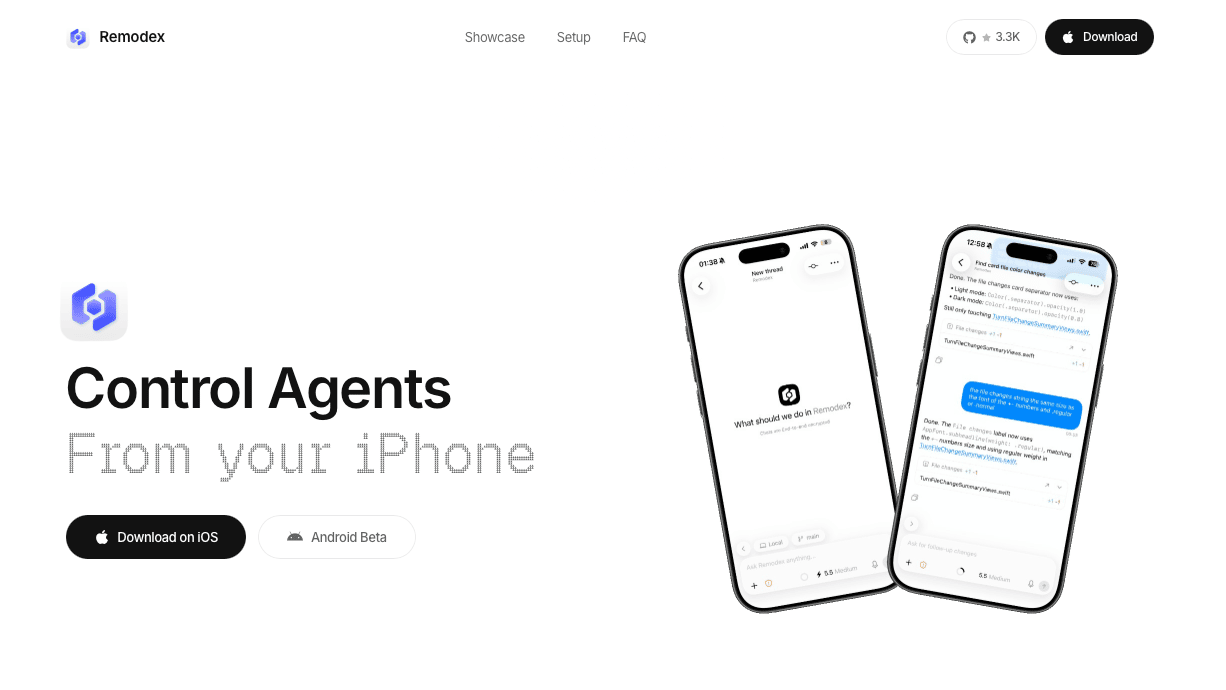
Most of my revenue comes from Remodex, but it was never meant to last. It was a temporary solution.
Remodex was the most-used viral solution for using Codex on a phone. But then OpenAI released their own version, as I knew they would. That's the reason for the decrease in revenue.
But it was super valuable in the interim. And I'm still trying to keep it alive with a soon-to-be-released update. Even now, it has some useful features that the Codex app doesn't have.
Other than that, I'm mostly focused on Synara, an open-source GUI/ADE for serious agentic work. You can run every coding agent in parallel and ship without losing context. It's still free, but a mobile app with a subscription is on the way!
Building v1.0 in two weeks
It took me one or two weeks to build v1.0 of Remodex, just me and my PC. I didn't sleep much, lost a ton of weight, and pushed like hell to bring the app out there as fast as possible.
Getting it done that quickly was a mind game. Sometimes I was carried by motivation. Sometimes it was momentum. Sometimes, it was just the fact that if I didn't do the work, nobody would do it for me.
Here's the stack:
Nextjs/Tanstack
TailwindCSS
Convex/Supabase
Stripe/Polar
SwiftUI
SwiftData
RevenueCat
Organic growth on X
I grow all my apps organically via X. I have nearly 11k followers, which is a big help.
I started by doing a lot of detailed, well-thought-out posts at first to grow an audience and go viral in the right way. I used Grok to find viral posts in my niche. Then, I used Claude to reshape my posts to make them more interesting.
But eventually, I started doing daily videos about my process and lessons learned. As of today, it has been 352 days of recording every single day.
Tired, happy, sad, sleepy, lacking motivation... I post a video. Every single day.
X growth isn't easy. There were days when X changed their algo and I went invisible, and it seemed as though all the progress I had made was worthless. It's a rollercoaster.
But it certainly paid off. Not only for my products, but also because I get paid as a creator. X changed my life, and it keeps on changing it — mostly in a good way.
Here are a few tips if you'd like to grow your following:
Use a clear profile picture so people know you're not a bot.
Have a clear bio so that people know exactly who they are looking at as soon as they open the profile.
Use images and videos because they perform better than normal text.
Make sure your posts are spaced out about 2-3 hours from each other.
Quote and repost your own content.
Reply a lot.
Other than X, I launched on Product Hunt, Tinylaunch, Uneed, and a few other places. I tried promoting on Reddit once, but they're super strict, so I refused to keep going there.
The mental struggle of indie hacking
Believe it or not, my most difficult challenges have been mental. Indie hacking really messes with your mind.
You're alone, trying to compete with giants. You're the only one who can bring this forward. And the only one who can sink it. It takes some nerve to do this. There will be sleepless nights. And you'll need to do some real deep talk with yourself to make it work.
You have to push yourself, especially at first. You need to show yourself that you've got this. You need to grow your confidence.
It requires a lot of work, but it's super worth it.
Some other things that helped me were:
Keeping this rational and coming at it from a problem-solving standpoint.
A lot of positive self-talk.
Talking to ChatGPT — but not in its usual sugar-coated way.
Physical activity, like workouts and walks to blow off steam.
Go all in on AI and building in public
My advice? Go all in on AI. This is clearly where we're headed.
I'd suggest that you let AI guide you to what you need to learn to be an indie hacker. Let it help you understand. Then, let it help you build.
From there, watch YouTube videos, talk to people who have more experience, and ask for feedback.
And share your progress in public — even if you think no one cares. Because soon enough, somebody will care, and that will motivate you like never before

Leave a Comment
The "10 apps, one took off" detail is the part that stuck with me more than the $9k number itself. That's the actual game, right — enough shots on goal that one catches, rather than betting everything on picking the right idea upfront. Makes the OpenAI hit sting less like a single point of failure and more like "one bet decayed, the portfolio didn't."
One thing I'm curious about: Synara being open source is a pretty different bet than Remodex was (closed wrapper, single platform dependency). Was that a deliberate lesson learned — i.e. open source as a hedge so the value isn't just "convenience on top of someone else's product" — or more about the ADE/dev-tool space just expecting that model? Curious how much of that decision was platform-risk-driven vs. just what the category demands.
The platform risk part really caught my attention. $9k/month is a great spot to be, but if a large part of the business relies on a platform you do not control the revenue can still feel awfully fragile. ~
It was nice to see how quickly the first version got built, and how they dealt with everything that came after. It is one thing to get something to work in 2 weeks. Growing it healthily and coping with the mental aspect is another problem.
Most people don’t discuss this too often in the indie hacking space. Even if a business is operational, it may not be stable.
Sorry that OpenAI shipping the same idea hit the revenue. When a platform can eat the product, the next dollar often comes from a buyer who wants the workflow around it, not another clone of the feature. Curious who paid you at $9k, solo builders or teams that needed the extra layer?
Really appreciate the honesty here, especially admitting the $9k→$1.5k drop instead of just showcasing the peak.
The Remodex situation is a good case study in platform risk that's easy to underestimate when you're building fast. Wrapping a first-mover convenience layer around someone else's core product (OpenAI/Codex here) can work great short-term, but the platform owner catching up is almost inevitable once the use case proves itself. Feels like the real question going into Synara is: what's the durable wedge that isn't just "convenience until the platform closes the gap"?
Also curious about the X strategy — 352 days straight is wild discipline. Did you notice a lag between posting consistently and actual conversion to paying users, or was growth pretty linear with the posting cadence?
Such an honest breakdown of the rollercoaster of indie hacking—hitting $9k/mo solo is a massive milestone, and taking a hit from platform risk when OpenAI launched their native app is the nightmare scenario every wrapper/utility founder fears.
A few thoughts on how Emanuele is handling the transition and tactical takeaways for anyone building on top of major platforms:
1. Moats beyond UI wrappers: Moving toward proprietary features that first-party apps won't prioritize (like multi-agent parallel orchestration or custom local workflows) is key to surviving platform risk. Big tech native apps focus on mass-market simplicity, leaving specialized power-user workflows completely open for indie tools.
2. Audience as the durable asset: While app revenue fluctuated from $9k to $1.5k, the 352-day video streak and 11k followers on X are assets that a platform API change cannot erase. When you cultivate a loyal audience, launching product #11 (like Synara) starts with immediate momentum on day one.
3. Pacing & longevity: Building v1 in two sleepless weeks and posting daily videos for nearly a year proves immense grit, but establishing sustainable boundaries is as critical as shipping fast to avoid long-term founder burnout.
Kudos to Emanuele and James for sharing both the peak wins and the raw setbacks so transparently!
You make a point to go all in on AI, and I only started using it to build early in 2026. I feel like I was too late to be an early adopter, as a lot of people already made their millions from AI. But it feels weird and disorienting, because at times it feels like this is just the beginning and there's still time left to get ahead, and other times it feels like the end of AI is near and we should brace ourselves for what comes next instead.
The world moves and changes fast, and I really hope to invest time and money into emerging technologies instead of sitting on the sidelines and complaining like I have done for years.
Platform risk is the invisible tax on mobile app builders — you can be doing everything right and still get blindsided by a policy change. That's a brutal way to lose momentum at $9k/mo.
Platform risk is one of those things that looks fine on a P&L right up until it does not. Curious what the actual trigger was here, a policy change, an algorithm shift, or something account specific. That distinction matters a lot if you are ever trying to explain to someone else why revenue dropped, since “platform changed the rules” reads very differently than “we did something wrong.”
Your $9k-to-$1.5k swing is a useful reminder that platform risk can invalidate the problem framing, not just the distribution channel.
For a portfolio of apps, I’d classify each one by what is actually portable: the user-owned workflow or data, the demand source, and the platform capability being wrapped. Then set a trigger before the next shock: if one platform supplies most of the revenue or core capability, spend the next release cycle moving one valuable workflow toward an asset you control, such as a recurring process or a direct audience.
The 352-day posting streak is impressive, but I’d measure it by how much demand it moves from X into channels you can still reach when the algorithm changes. For Synara, what part of the workflow stays valuable if a platform you depend on ships the same feature next month?