Launching countless apps until one gained momentum and hit $3.3.k MRR

Jakub Mužík has built countless apps while working a 9-to-5 job that bores him. Most made $0. But then one took off. Now, Leadverse is at $3.3k MRR.
Here's Jakub on how he's doing it. 👇
Getting tired of corporate work
I have worked as a Salesforce developer in a 9-5 job for eight years. After a few years in a corporate environment, you learn most things. The work grows repetitive, and you simply trade time for money — nothing I enjoy.
Four years ago, for my bachelor's thesis, I built a mobile app: a simple social media app that mapped your current location and showed local events around you. It was the first time I built an app that people downloaded and gave positive feedback about. The feeling was amazing. Since then, I've been non-stop building and working on side projects in my free time.
I've built countless apps. Most made $0. Then, I finally built something that clicked almost immediately: a social media lead generation tool.
Ten months ago, I saw a post on Reddit. Someone was asking other builders what they were building and offering to send them Reddit posts from people seeking their solutions. The post went viral. Hundreds of people commented, needing help with lead generation. And it gave me an idea.
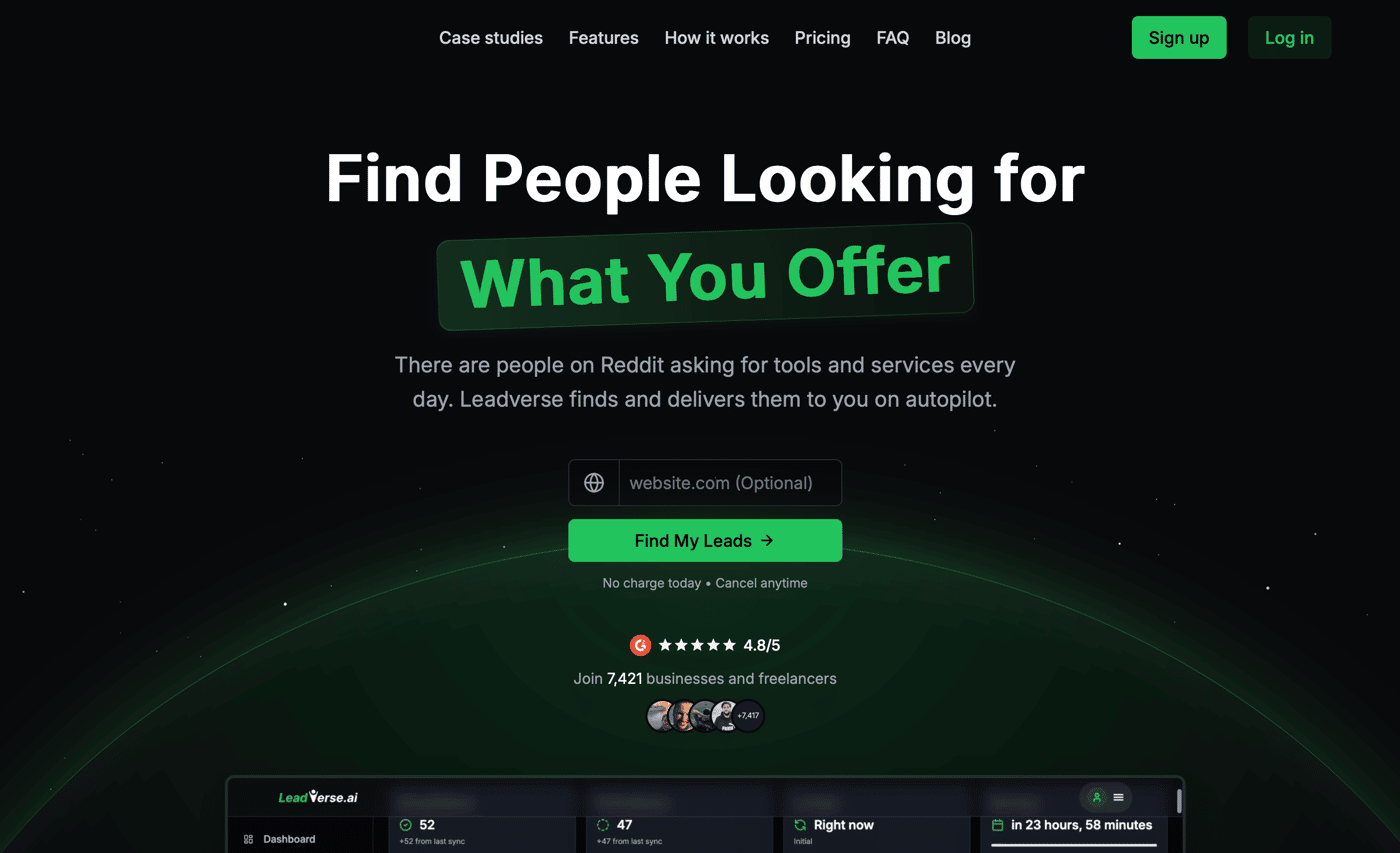
So, I started building my own lead generation tool, Leadverse. The idea is simple: You paste in your product or service, and the tool continuously looks for new social media posts asking for what you provide. This removes the 'spam' approach of cold email tools, because you only reach out to people already asking for your help. And since the DMs are automated too, you can get traffic on autopilot.
Fast forward to today, I've crossed $20k in gross revenue, with 130+ paying customers and $3.3k MRR.
Finding time to build
I'm building it solo, fully bootstrapped. I build it on nights and weekends.
My dev background made building it straightforward. The MVP took about a month, but that's just because I'm very busy with my 9-to-5 job, freelance gigs, and family — I recently had a baby. So, finding free time to focus on my side projects is my biggest challenge.
After building it, I posted on Reddit in the same format I saw working before — asking other builders to share what they were building and offering to send them leads for free.
The post went viral, as I expected, bringing in traffic and my first paying customers.
Technical difficulties
Here's my stack:
React (frontend)
Supabase (backend)
Stripe (payment gateway)
Resend (email automation)
The biggest technical challenge so far has been balancing LLM costs and output quality. The entire lead generation engine I built is fully AI-powered, and the LLM API calls account for 90% of my costs. So, I'm continuously optimizing LLM prompts and changing models to cut costs while maintaining high output quality.
Finding the right business model
I started with a freemium model. Everyone could sign up and use the tool until they reached a certain number of leads. It seemed like the safest option, but it wasn't.
My main traffic source is Reddit, which means:
Many users have no intention to use the tool long-term.
People sign up just to test the free tier once.
Reddit is amazing to grow your traffic; however, you must account for slightly lower user quality. Normally, I wouldn't care, but it increases my cost per user, so my model didn't make sense.
I switched to a three-day free trial with CC details required upfront and saw improvement almost immediately. Fewer people started the trial, but the conversion rate was much higher.
This meant less money wasted on non-serious users and more money from users who intended to use the tool.
Then, I increased the free trial from three days to seven days. This further increased the numbers. Three days was too short. People didn't have enough time to see the value.
I still use a 7-day free trial today and do not plan to change it anytime soon.
Finding the right pricing model
As far as pricing, I initially thought cheaper was better. I was wrong.
I've experimented extensively with pricing, lowering prices for a few weeks, increasing them, and always watching the data. Lowering prices never improved conversion. Quite the opposite. If you price it too cheaply, there's a certain threshold where trust decreases, and it feels low quality. People bounce before even trying it.
I also saw fake users more often. By fake users, I mean those using "special" credit cards that fail to convert after a week due to "insufficient funds." I never knew people did that until launching my own SaaS.
Overall, I started with a €9/mo plan and a €14/mo plan. After about a month, I switched pricing from EUR to USD. Conversion increased. No other changes occurred at that time.
A few months later, I added a third $19 plan and a custom plan option. The Custom plan allowed users to change limits and adjust pricing based on their needs.
This marked another significant turning point. So far, around 30 users have opted for the custom plan. I can't believe I didn't do this sooner.
Dogfooding and posting on Reddit
All of my revenue has come organically from Reddit. Two tactics:
My tool promotes itself. I use it to automatically find and contact people asking for help with lead generation.
I post two times per week on Reddit. Certain post formats almost always work: sharing a story, your product growth, your revenue numbers, and adding valuable insights you've learned. Then casually mention your tool name. That's it. This format almost always works, and once you go viral, traffic is almost guaranteed.
Apart from that, I've built some free tools and optimized my page for search engines. However, I haven't noticed much conversion from this organic traffic yet. Something I need to work on. I started with this months after launch, and I wish I'd started from day 0
I've also started offering affiliate partnerships. I have around 20+ partners now, but I still don't see any conversions coming from that. It's nothing I'd recommend.
Landing page tweaks
Landing page tweaks have also been helpful. I started with a very simple landing page. Over time, I made these changes (in this order):
Added a walkthrough video right under the hero section
Made the entire page more personal (added my photo, replaced all "we/us" with "I/me")
Collected real testimonials and placed them before pricing and on the checkout page
Replaced my custom checkout with Stripe-hosted checkout (people worried about entering credit card details on my site)
Added “Book a free demo” option
All of these changes drove conversion.
Get inspired and share your learnings
Building in public on X has also been a huge advantage. I regularly post my progress, insights, and failures on my X profile in the Build in Public community. This helped me meet other amazing founders and get inspired by them.
That's probably the best advice I can offer: Get inspired.
You don't need to reinvent the wheel. See what already works — whether it's a product idea, marketing strategy, or post patterns. Surround yourself with people with common interests, get inspired, share your own learnings, and keep going.
What's next?
From here, I want to get enough recurring revenue to quit my 9-to-5 job and go fully into indie building.
You can follow along on X, where I share my story and progress. And check out my SaaS: Leadverse.ai.

Leave a Comment
I really enjoyed reading this. I think the most interesting part is that the breakthrough didn't come from the first idea, but from continuously building and learning from the previous attempts.
I'm especially curious about the AI side — since LLM costs became 90% of your expenses, what was the biggest optimization that helped you reduce costs while keeping the lead quality?
i build my side projects too but building project is entirely different from aquairing userbase and maketing product
Really inspiring case study. The biggest takeaway for me is that building the product was only half the challenge—the real growth came from testing the business model, pricing, trial length, and landing page based on actual user behavior. I also like the idea of dogfooding the product instead of relying entirely on traditional marketing. The journey from $0 to $3.3k MRR while working a 9-to-5 shows how consistent experimentation can compound over time.
The pricing section was probably the most interesting part for me. It’s easy to assume cheaper pricing means more conversions, but the point about going too cheap actually reducing trust makes a lot of sense.
I also like the shift from freemium to a card-required trial — fewer signups but better-quality users seems like a much healthier metric. Did you notice whether the 7-day trial mainly improved conversion because people had more time to see leads come in, or was it more about giving them time to actually contact those leads and get a response?
Love this. The grind is real. Countless apps making $0 before something finally clicks. That's the part people don't see. They just see the $3.3k MRR and think it happened overnight. Building on nights and weekends with a newborn? That's insane dedication.
The part about switching from freemium to a credit-card-required trial was especially interesting.
It shows how optimizing for more signups can be very different from optimizing for serious users. The Reddit traffic brought a lot of attention, but requiring payment details upfront seems to have filtered for people with stronger intent.
I also found the pricing experiments useful — especially that lowering the price didn’t improve conversion and could actually reduce trust. A good reminder that price is also a positioning signal, not just a conversion lever.
Really inspiring case study. What stood out to me most is that building the product was only the beginning—the real growth came from continuously testing pricing, trial length, landing pages, and the overall business model based on real user behavior. I also love the idea of dogfooding the product rather than depending entirely on traditional marketing. Going from $0 to $3.3k MRR while working a 9-to-5 is a great reminder that consistent experimentation and small improvements can compound into meaningful growth over time.
yeah exactly, managing your daily life with these side projects and whatnot is kinda very difficult. its my first time shipping a real product and it was really hard for me cuz i gotta manage my uni as well...
You said you mostly gained traffic from reddit. You make an app and you host the app and the next step is getting clients. Conversion is Crucial.
There’s something powerful about treating product development as an experimentation system rather than expecting the first idea to work.
Shipping repeatedly gives you more opportunities to learn about distribution, positioning, and what people actually pay for.
The interesting question for me is how you decide when to double down on an app versus move on to the next experiment.
The point about lowering price actually decreasing trust stood out to me, it's counterintuitive until you watch it happen to your own signups. My path's a bit different from yours, I've had one product (a chat app) that failed once, so I tore it down and rebuilt it from scratch rather than moving to a new idea. Did you ever consider doing that with any of the earlier apps, going back to rebuild instead of starting fresh, or did a new idea always feel like the better bet?
The "most made $0 one took off" pattern resonates - ran into this exact wall with a niche iOS app last month. One thing that surprised me: Apple rejected our 1.1 because subscription metadata lacked a EULA link - even though the app itself linked to it. If you ship subscriptions put the EULA URL in every localization's description not just the app UI. Cost us a full review cycle. Curious whether anyone else got caught by App Store subscription metadata rules after an update?
Great post. I like how you were able to share what worked and what didn't.
This is amazing! I'm now having ideas of my own. Thank you so much mate.
his is the exact kind of realistic, grounded story we need more of. The detail that stood out most to me was the success of the Custom plan. It’s fascinating how 30+ users essentially raised their hands to say, "We have a bigger budget if you let us set our own limits." Have those custom plan users given you any insights into what features a higher-tier "Enterprise" plan might look like in the future?
How do you search for the potential of the app that will work for you? I need a roadmap to build my own. Need your suggestions
Research and deploy is the only way. You won't figure it out unless you have tried a few times and got your real feedback
Really helpful read — especially the part about switching from freemium to a 7-day free trial with CC details upfront. I'm working on an AI product myself, so this is super helpful.
Interesting that adding the walkthrough video was one of the landing page changes that improved conversion. Did you ever experiment with an interactive demo instead, or compare the two? I've been thinking about the trade-off between showing the product in a video and letting people actually try it.
Congratulations! Be vigilant. Interested in what’s ahead for you. I just published DRAMA SQUARE via Indie Hackers myself. Best,
man this is the kind of story that makes me want to quit my job lol. building on nights and weekends with a baby? that's next level dedication. the pricing experiments were genius - cheaper isn't always better. 7-day trial with cc details upfront was the real turning point. you turned mistakes into lessons. absolute legend.
The switch from freemium to a 7-day trial and the pricing experiments stood out to me. It’s a great example of how reducing low-intent users can matter more than simply increasing signups. The Reddit distribution strategy is interesting too.
Loved reading this! I am in the "building and deploying apps until something hits" phase right now, and this post gave me hope. Thanks for sharing.
Man, the pricing psychology part hit home. "Cheaper = less trust" feels backwards until you've actually watched it happen to your own signups. And ha, the fake trial credit card thing, first time hearing that but it explains a lot! Appreciate you just laying out the real numbers instead of the usual highlight reel. Bookmarking this one.🙌
Really enjoyed this one—especially the honesty around experimenting with pricing, freemium, and landing-page changes instead of assuming there’s one “right” strategy. 👏 Going from countless $0 projects to $3.3k MRR while working a 9-to-5 is seriously impressive.
The Reddit-driven growth is particularly interesting. Do you think the biggest growth lever from here will be doubling down on Reddit, or finding a more scalable acquisition channel beyond founder-led content?
Hi,
I’m currently at the beginning of my own journey, but taking the second approach for now: putting all my energy into one product and trying to give it the best possible chance before moving on.
From your experience, how would you decide whether a product needs more time and better distribution, or whether the market is simply not responding strongly enough?
Curious how this works in practice — what channels have driven the best results for early-stage products so far?
Love the idea. We're trying different outreach strategies at the moment so I'll check out your app. Does the events app still exist? Seems like a cool idea too. Best of luck with your projects.
Really useful how you spotted people already actively looking for leads on Reddit, then built around that demand and went back to the same channel for distribution.
It made me add another question to how I evaluate ideas: where are people already spending money to solve this problem? That could reveal both stronger purchase intent. And this has been a hole in my current approach so far. Im glad I read your post!
Fantastic breakdown, Jakub! The strategy of dogfooding your own tool on Reddit to find leads is brilliantly meta. 💡
Quick question on the custom pricing model: Did you manually negotiate those ~30 custom plans, or did you build an automated slider/calculator right on the checkout page?
Wishing you continued growth with Leadverse! 🔥
The risk nobody has flagged yet is that your acquisition and your product are the same motion. Leadverse finds and contacts leads, and Reddit is where you sell it, so if Reddit tightens self-promotion you lose the channel and the live demo in the same week. At 3.3K MRR that is survivable, which is exactly why I would spend the next quarter proving one channel whose sentiment you do not depend on, even if it converts worse than Reddit does today.
Reddit can bring a lot of traffic, but the intent is all over the place. The trial change is a good example of optimizing for paying users, not signup volume.
This is encouraging to read. I'm at the early stage with FadeOut. A few months post-launch, small but engaged user base, strong repeat usage. The part that resonates most is the momentum piece. I'm finding that the product sells itself when someone actually experiences it at a real event, but getting that first experience is the hard part. How did you know when you'd found the one worth doubling down on?
This is a great reminder that consistent experimentation can eventually uncover the right product-market fit. Launching multiple ideas, learning from each attempt, and continuing to improve based on real user feedback is a much more sustainable approach than expecting the first product to succeed. The journey to recurring revenue is often built through small lessons over time.
https://gtamobiles.com/
Swapping a traditional freemium model for a 7-day trial with CC required upfront is such a crucial shift for AI wrapper tools. Reddit traffic brings massive volume, but filtering out tire-kickers to protect API margins is everything.
Also, incredible insight on switching to Stripe-hosted checkout and shifting pricing from EUR to USD—trust friction is so real. How are you currently managing lead scoring/intent to ensure the automated DMs don't hit false positives?
Congrats on hitting $3.3k MRR while juggling a 9-to-5, freelance gigs, and a newborn! That’s an incredible hustle. Spotting a viral Reddit thread and immediately productizing the demand is classic customer-first validation.
Regarding your stack and LLM cost optimization—are you currently routing different prompt complexities to cheaper models (like Mini/Flash models for initial relevance scoring) and reserving larger models only for draft generation? Optimizing that AI spend is a huge bottleneck at $3k–$10k MRR, so I'd love to hear how you're tackling token efficiency
Great inspo. I'm currently working on building apps myself so it's great to see that someone has already acheived success this way.
"Until one gained momentum" — this is the part nobody talks about. How many apps did you ship before this one? I'm on my first serious attempt (ThumbRank) and trying to figure out if I'm persistent or just stubborn.
Great power of observation, really inspiring and great breakdown.
Inspiring story! Kudos for not giving up and continuing to build and test. What other platforms are next on your list that you plan on connecting the platform to for more "leads"? And yes, there are not many who want to work 9-5 anymore in an office-that era is gone.
The "most made $0, one took off" pattern matches what I've seen shipping iOS apps: the winner is usually the one where you had a distribution channel before you had the app, not the one with the best build. I've been building an EV road-trip planner (Drive Charge Eat) and the only thing that moved the needle was going where the specific frustration already gets discussed, rather than launching broadly. Question for Jakub: with the earlier apps, did you kill them on a fixed timeline or wait for a signal?
its a really good idea thank you for sharing learned a lot
The key distinction is intent, not channel. A Reddit post where someone is already asking for a solution is fundamentally different from spraying cold messages at a scraped list. The next moat for a product like this is proving lead quality: response rate, qualified conversations, and revenue by source. That keeps the system optimized for outcomes instead of impressive lead counts.
It's a good idea.
Really inspiring story, Jakub. A few things stood out to me:
Pricing insight is gold. The fact that lowering prices hurt conversion is counterintuitive but makes sense - people associate price with quality. I'm building a SaaS right now and was debating whether to go cheaper. This convinced me not to.
Reddit as the only traffic source is fascinating. Most people spread across 5+ channels and dilute their effort. Focusing on one platform that works seems much smarter.
The freemium vs. trial shift is something I need to think about. I'm currently using a limited free tier (3 uses/month), but hearing that a 7-day trial with CC converted better makes me reconsider.
Quick question: when you first posted on Reddit and it went viral, did you already have Stripe checkout set up? Or did you start with manual payments?
Thanks for sharing this - these real numbers and honest learnings are exactly why I come to IH. 🙌
This really resonates. I've bounced between a few different projects myself before landing on something I actually wanted to keep building. The hardest part for me wasn't building the thing, it was figuring out which idea was worth sticking with versus which one just felt exciting for a week.
Curious how you knew this was "the one" versus the other apps you'd shipped before it. Was it user feedback, revenue traction, or just your own gut feeling that kept you going?
This is a brilliant breakdown of finding a go-to-market strategy that actually works. Replicating the exact Reddit post format that inspired the idea to get your first users is incredibly smart.
I am currently developing a platform to automate billing infrastructure—essentially allowing professionals to turn tracked project time into a ready-to-send invoice with one click. I have been trying to figure out the right way to approach Reddit for organic growth, and your advice on sharing transparent growth stories rather than just dropping links is highly valuable. Congratulations on the momentum.
A great reminder that persistence pays off. Launching again and again, learning from every attempt, and staying consistent can eventually turn one idea into real momentum. 🚀 $3.3K MRR is a solid milestone!
Your pricing evolution here hits on something foundational: a measurement system determines which customers you actually see and can learn from.
The freemium trap with Reddit traffic teaches a hidden lesson. You didn't just learn about pricing - you learned that low-friction signups measure willingness to test, not commitment to solve a problem. Requiring CC details upfront made "people who care enough to give payment info" visible. The custom plan doubled down on this - it measures who's serious enough to negotiate rather than pick a fixed tier.
That's your hidden system speaking. Same with the 3 to 7 day trial extension. You shifted from "how quickly can someone see ROI" to "how much time does someone actually need to discover they have this problem." Much deeper measurement.
The constraint-driven building (nights/weekends with a new baby) probably shaped this more than it looks. Constraints force you to optimize for real signal vs noise. You couldn't afford 1000 free trial users learning slowly - you needed the 100 who'd convert. That measurement discipline became your product strategy.
This is a great example of how persistence + actually listening to the market can turn a side project into a real business. The pricing and free-trial experiments were especially interesting — going from 3 to 7 days based on user behavior is a great reminder that you have to test assumptions rather than just guess.
I also like the “dogfooding” approach. Using your own lead generation system to find people who are already asking for the problem you solve feels much more natural than blasting cold outreach.
$20k revenue, 130+ paying customers, and $3.3k MRR while working a 9–5 and raising a family is seriously impressive. Congrats, and best of luck getting to the point where you can make indie building your full-time thing!
The most common trap I see is founders treating the 'countless failed apps' phase as a waste of time. Looking at your path, the pivot isn't just in the product, but in how you frame your own capacity. When you're working a 9-to-5, every hour spent building a feature that doesn't solve a burning pain is a tax on your mental bandwidth. I learned the hard way that moving to $3k MRR usually requires killing the 'developer' mindset where you ship for the sake of shipping, and moving to a 'validator' mindset where you stop building the moment the feedback loop suggests low intent. How did you distinguish between a product that needed more time versus one that was simply a non-starter for your target audience?
Six tries before one clicked really resonates — I just shipped my first small tool and already feel the pull to second-guess it. What made you keep going after the ones that didn't gain traction, instead of walking away?
This is inspiring for me as I am going through your initial experience where I am building and turning out some solid products and ideas but really haven't just focused enough on one as I get too excited and come up with other ideas. I need to get your focus to buckle down and put energy into one project rather than between my 20+. Getting traffic to my sites has also been extremely difficult. I've tried reddit a few times but posts can get banned so easily, even when following rules or many require you make a ton of posts first.
The Reddit idea hunting approach is underrated - communities there are literally telling you exactly what they pain about. Curious how long you sat on that idea before actually building it out?
I can relate to this. There’s something different about building your own product and seeing real people use it. Even the failed projects teach you what eventually makes the right idea click.
Cool.
Great breakdown. Growth rarely comes from one magic tactic.
It usually comes from testing the right business model, pricing, landing page, trust signals, and distribution until the whole system starts working.
The Reddit part is interesting too: organic works best when there is already real intent.
The volume approach can work sometimes as in this case. Other times it can be an impediment to success where the founder doesn't fully engage with each idea before abandoning them or cannot give each idea the maximum attention and effort they require. Kudos to Jakub
The custom plan detail is the buried lede: 30 buyers designing their own package is the market telling you there is a higher tier you have not priced yet. I would interview those 30 before touching anything else, they are your roadmap and your next price point. Price acting as a trust signal is a pattern I have watched for two decades, it filters out the wrong customers before revenue ever enters the picture.
nice, very informational
Inspiring and informational for me because I've recently launched a new product and facing issues in getting the clients. But this stuff is really helpful
good writing
I love how your own product became part of your customer acquisition strategy. Finding people who are already actively looking for a solution feels so much smarter than simply increasing the volume of cold outreach. Very interesting business, and even more impressive that you're building it alongside a full-time job and a family. Congrats! <3
I've read his reddit post 1 year back. He was telling like he got 3 or 4 paying customer that month. Really happy to see the progress he made. Appreciate his consistency and transperancy.
Really I liked your workflow. Additionally i learned something very important thing which is pricing. Specially by " If you price it too cheaply, there's a certain threshold where trust decreases, and it feels low quality. People bounce before even trying it.".
Interesting journey. The validation process behind this caught my attention. Getting revenue quickly usually means the problem discovery phase was strong. Curious: what signal made you confident this was the right problem to pursue? I'm exploring how founders discover opportunities before building.
Great work keep consistent
I think in the world of indie hacking nowadays distribution is far more important than developing. You can develop a great product but if you dont focus on distribution you will get stuck.
And I think that was the main reason your initial apps would have failed too.
Great reminder that consistency and experimentation can eventually pay off. Launching repeatedly and learning from each attempt is a powerful way to find what works.
cool stuff!
Really inspiring journey. What stood out to me most is that the breakthrough didn’t come from endlessly polishing one idea — it came from shipping repeatedly, learning from each attempt, and recognizing when something finally showed real momentum.
$3.3K MRR is impressive, but the bigger lesson is the persistence and speed of iteration behind it. Curious: looking back, were there any early signals that made you realize this app was different from the previous ones?
This is a great reminder that momentum often comes from volume and iteration, not from nailing the first idea. The Reddit-native "help people who are already asking" approach for lead gen makes a lot of sense, since it skips the cold outreach problem entirely. The landing page iteration list is also genuinely useful for other builders to reference. Wishing you a smooth transition out of the 9-to-5.
Great article!
What's most fascinating to me is that it was momentum gained from sending out a lot of ideas — not momentum gained from getting the first idea right.
It's a good difference between creating a lot of things and jumping from idea to idea. When each firing provides you with a better idea of the market, pricing, acquisition or positioning, the unsuccessful products do a valuable job.
I also liked the emphasis on business model and pricing based on actual use, as well as business model, when I saw the real usage.
One could get so caught up in the decision making process that one spends too much time getting it right before anyone has even used the product.
After that many experiments, it is worth noting that a volume of $3.3k MRR is a pretty good example of how shipping volume can lead to better judgments.
Really appreciate how transparent this is, especially the pricing section. The point about cheap pricing lowering trust rather than boosting conversion is something a lot of early founders learn the hard way I've seen the same pattern with SaaS products where dropping the price actually increased churn instead of reducing it.
The shift from freemium to a 7-day paid trial with CC upfront is the real unlock here though. It's a good reminder that "more signups" isn't the goal "the right signups" is. Curious how you're thinking about scaling the Reddit channel without it becoming saturated as more people copy the same post format. Are you diversifying distribution yet, or doubling down on Reddit since it's still converting well?
Congrats on crossing $20k gross solid proof that shipping many small bets eventually compounds into one that works.
The useful lesson here is that the winning product was not the first idea—it was the one with a clear trigger and a reachable audience. I like that you treated the seven-day trial and pricing changes as experiments rather than beliefs. For a side project with limited hours, I’d track one activation event before optimizing conversion: the moment a user sees a lead that is specific enough to contact. That should tell you whether the product is creating value before trial length or price muddies the signal. The Reddit distribution loop is also unusually strong because the channel contains the pain, not just attention. As you move toward leaving the 9–5, which metric gives you more confidence: recurring revenue, the number of customers who would notice if Leadverse disappeared, or the repeatability of acquiring the next ten customers?
This comment was deleted a month ago