Building a product in 20 hours and growing it to a 5-figure ARR

Val Sopi left a successful service company in order to access stable, recurring revenue.
His first attempt, BlogMaker, started as a challenge to create a product in 20 hours. Now, it's at a 5-figure ARR.
Here's Val on how he did it. 👇
Wearing many hats
I'm a graphic designer by education, and a developer and marketer by trade. I wear many hats and enjoy jumping from product to sales on a daily basis.
Initially, I ran a successful web shop serving larger organizations and non-profits with bespoke web applications. But I wanted to build SaaS products to create more stable and predictable revenue streams — and to offer the potential to exit at some point.
BlogMaker.app began as a personal challenge. I wanted to test my limits and launch a fully working product within 20 hours. This was back in April 2021, when we hand-coded everything — no vibe coding or AI involved.
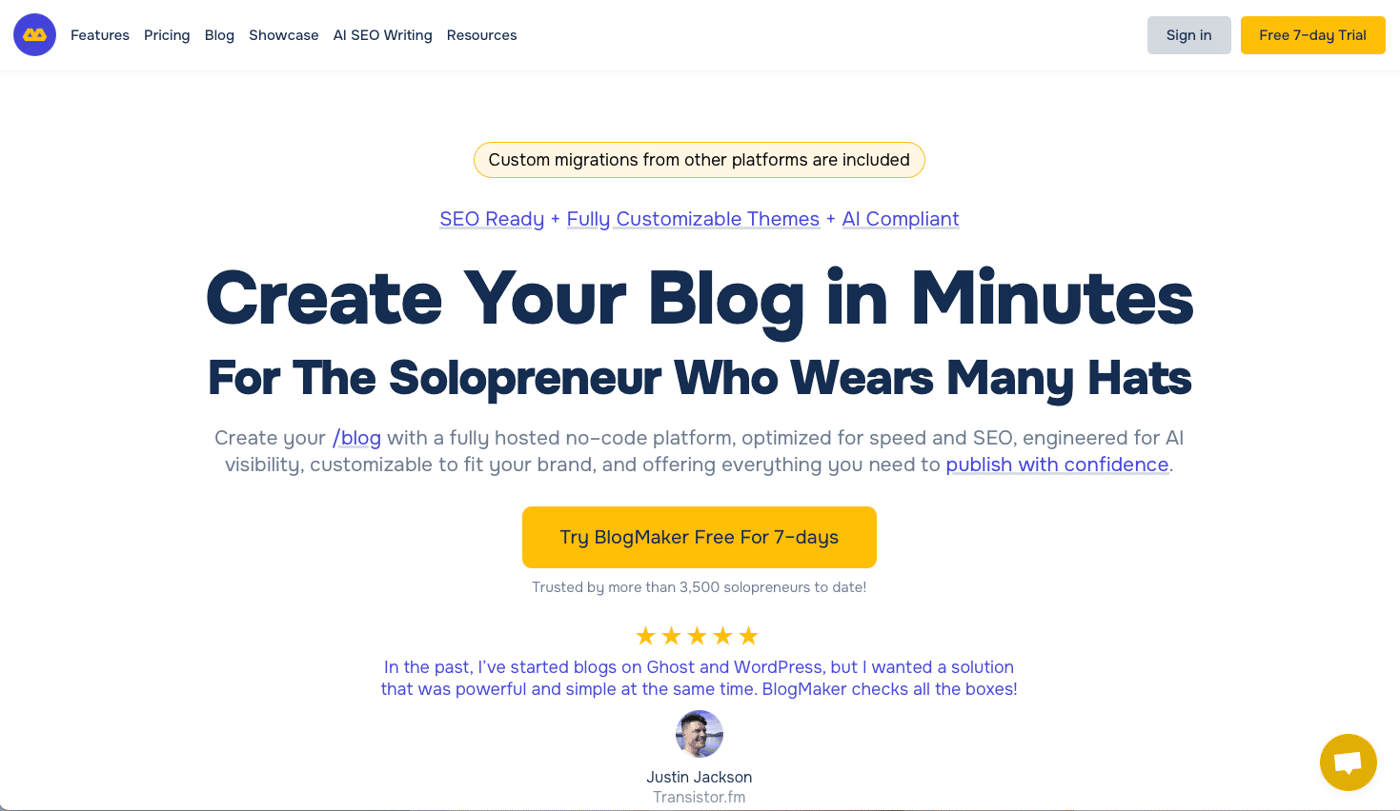
So, I built a blog engine for small teams and solo founders who want to publish for SEO purposes. I went full time on it in October 2022, after noticing positive traction and retention. It's currently a 5–figure ARR business with 50% month–to–month growth.
A minimal stack
The initial version took about 20 hours, as I mentioned. That was split into about 3 sessions. I had a working product and payment from a customer right after launch.
Since those early days, BlogMaker has gone through hundreds of updates.
I work with a highly customized forked version of CodeIgniter3 for the backend and jQuery for the front. It's my favorite combo for shipping fast. And I work with zero external libraries to reduce the overhead of constantly upgrading various dependencies.
Since I run solo, I keep that to a minimum.
SEO and partnerships
One of the biggest challenges I faced was unlocking a distribution channel that consistently delivered. I haven't completely overcome that challenge.
Initially, I told everyone I knew in all my circles: Twitter, Slack, even offline meetups.
I'm still super active on Twitter, but it doesn't bring in new customers. I mostly share lessons and my journey with my online friends. My user base doesn't overlap much.
These days, I focus on SEO and AEO because they are the most viable intent-based approaches to growth.
SEO initially feels like a slog, but it's amazing how quickly you can rank with even short articles that answer a simple question — a strategy AI also relies on.
So, I run two blogs. One covers feature updates and product news. The other is about SEO strategy, and it's where I publish "vs" and "alternative to" posts, as well as "how-to" articles based on questions people search for.
Other than that, I produce videos about the product, new features, demos, and other content that resonates with my target audience. I also update the guide, change website copy, build relationships and partnerships, and sometimes do cold outreach.
A good example is a recent partnership with RightBlogger.com, which directly integrates with BlogMaker and helps customers write highly comprehensive SEO articles with AI.
Iterating on pricing
Initially, BlogMaker offered only yearly prices; while good for clients, this made building a sustainable business difficult. I transitioned to monthly pricing, but that proved challenging because the brand was previously positioned and consistently marketed with yearly pricing. Consequently, signups expected yearly pricing and did not convert.
However, recently, monthly recurring revenue (MRR) has almost overtaken all previous MRR from yearly subscriptions, proving again that a monthly subscription model offers a sustainable approach for a growing business.
Increasing prices also had a positive impact on revenue, but I never increased prices for existing clients. Instead, I offered them a way to gracefully upgrade to newer plans and features.
Self care is crucial when indie hacking
In this journey, I've realized that taking care of myself is paramount to my product's success.
When I started building SaaS products, I would go days without much physical activity because building and growing a product would suck me in. But that quickly backfired and eventually led me to a burnout circa 2020, which was not fun to experience.
Now, I try to balance myself, even though I can still outwork anyone on the planet!
That means I try to get 7K steps per day. I also go to the gym at least four times a week to lift weights. Whenever I feel off, lifting weights is my escape.
I also meditate. It helps me become more patient and focused. It also helps better observe myself and detach from my thoughts, which often stem from my environment, upbringing, etc. Distinguishing between beneficial and detrimental thoughts has been a game changer.
The right way to find PMF
I see a ton of early-stage indie hackers focusing on the product first. This is highly risky because you don't know if many people experience the problem you're trying to solve regularly.
While "scratching your own itch" can be a good approach, it requires significant luck to succeed; many other people must share your specific need.
I now highly recommend looking for what people buy (the product), what types of customers buy it (potentially business people), and how they find the product (channels and distribution).
Other criteria include why you are the right person to build such a thing (and if not, how you can become that person), and your unfair go-to-market advantage.
What's next?
My immediate goals for BlogMaker are to grow it to a 5-figure MRR business with at least 80% in profits. Long-term, I plan to continue iterating based on the latest technologies and customer requirements.
The world of SEO, now with AI, is moving fast, and I want BlogMaker to be at the front of it all.
I also recently started another product, AMSDeck.com, geared towards bigger organizations. This product came from extensive research, based on Rob Walling's teachings, particularly his most recent course, which I highly recommend: The SaaS Launchpad. You cannot skim this course; it demands dedication and offers significant rewards.
You can follow along on my podcast and I occasionally blog at valsopi.com. The holding company of one that produced BlogMaker, AMSDeck, and other products is Handmade Spaceships, Inc.

Leave a Comment
Need a Fast and Flexible Loan?
We offer loans for personal needs, investments, business expansion, home renovations, and more! With amounts from $10,000 to $5,000,000 and a low 2% interest rate, we're here to help you reach your goals.
Loan Options Include:
Personal & Business Loans
Real Estate & Investment Loans
House Renovation & Car Loans
Debt Consolidation & Student Loans
For fast service, / The post was too long and was therefore cut off by the system.
For fast service, email us at XAPCREDITSOLUTION@gmail.com
with your loan details. We'll respond quickly and help you move forward!
Hey we just build a new learning platform called Microswab it's a platform where you learn life changing skills online for free. You earn passive income monthly by learning skills, around $700 to $3K monthly just by learning valuable skills online if you are interested here's the platform link Copy the link and Google it
microswab.netlify.
Add this at the ending of the Link (app) so it looks like .app
I really likes the info you just shared. They are very helpful and one thing that caught my eye is how you keep up your helps that's actually even a best reminder for too, Thanks for that.
Wishing to use your tool one day for my work!!!
The "scratching your own itch requires luck" point is so real. I built SelfOS (productivity app — tasks, goals, habits in one place) exactly this way. Started because I was frustrated juggling 4 different apps and wanted one system.
Got lucky that others had the same problem. ~50 downloads in the first month, 6 paying subscribers, $22 MRR. Tiny numbers compared to Val's, but it validated that I'm not the only one with this itch.
Two things from this post that resonated:
1. Monthly vs yearly pricing — I started with both and monthly is definitely converting better. People want to try before committing to a year, especially for an unknown app.
2. Self-care section — Didn't expect this in a growth post but it's the most important part. I burned out hard in 2024 trying to ship features while working a full-time job. Now I have hard stop times and actual breaks. Productivity app founder learning productivity the hard way, lol.
Curious about the "20 hours" constraint — did you find that limiting scope actually helped ship faster? I spent way too long on features nobody asked for before launching.
Yes the 20–hour limit totally helped. I still work the same, even when building new features or testing new products. I place a hard limit and go.
And yeah: gym and meditation have saved me many times over.
Hey we just build a new learning platform called Microswab it's a platform where you learn life changing skills online for free. You earn passive income monthly by learning skills, around $700 to $3K monthly just by learning valuable skills online if you are interested here's the platform link Copy the link and Google it
microswab.netlify.
Add this at the ending of the Link (app) so it looks like .app
the zero external libraries approach is underrated. been burned by dependency hell too many times. curious about the AEO angle you mentioned - are you seeing meaningful traffic from AI search results yet? feels like that's where things are headed but hard to measure right now.
Wow, what a great story, congratulations! Currently totally burned out after shipping my MVP, I can't even think. No revenue for 22 months, so I wish I had the skillset to have produced it in 20 hours like you rather than the 6 months it took me. I research both the idea, the market and carefully designed the product, but now that the MVP is shipped (deterministic only) would love feedback to refine for product-market-fit. Getting there is my next step, revenue being the biggest point of stress. Thanks for sharing, Paulina
What is your product about? I am really curious about it and how are you distributing it?
Hey Angel, wow, thanks! It is a decision platform - it takes a business question and translates it into either analytics specs or ML specs through two lenses: business or prompt. You can generate an on-the-job lesson or quiz through both lenses (flipping between business and prompt) within each module: business clarity, analytics translator or ML readiness (beta). Check out cool animation diagram here on the homepage virtual strategy tech :-).
I visited your webapp and there is a slight issue with navigation expecially the scrollbar, you might wanna fix that Paulina.
By the way I made this indiehacker group to discuss things like this and cross promote. Still needs a few more members to launch. You might wanna join. https://www.indiehackers.com/group/saas-onboarding-workflows
That's a solid idea. But let's be brutally honest. People who would pay for this are CTOs, CEOs and business executives who would like to simulate the possible outcome of a business decision before jumping into it. If you are advertising it to these people, they would even consider paying upwards of $99 per month for it, but to small teams or indies, they'd prefer to just fancy their luck on LLMs. I think you should really niche down, position it only for business executives and try to build in some good datasets and analytics... People pay a lot for verifiable data.
Thanks Paulina! Rooting for you!!!
Thanks so much Val, really appreciate that!
Many thanks for sharing many useful tips.
Great read. What stood out to me is the ruthless focus on a minimal stack and SEO instead of chasing every new tool or channel. Also refreshing to see an honest take on pricing experiments and burnout — not enough founders talk about that part. Solid example of execution > hype.
Distribution is hard part everyone says. I am also looking ways to build distribution channels for my product. Sometimes I got stuck, but now trying to see more makers and get more feedbacks is slowly helping me to improve everyday.
I am not close to any success. But I am trying to figure out the hard part.
I made this indiehackers group dedicated to helping members solve distribution problems like this, collective approach. We need a few more members to go live. Please check it out here
https://www.indiehackers.com/group/saas-onboarding-workflows
What really resonated with me here is not the “20 hours” headline, but the discipline of containment that follows it. The fast build worked because the stack, scope, and distribution were intentionally constrained — no dependency debt, no premature scaling fantasy, no audience mismatch. The real lesson is that PMF wasn’t found through inspiration, but through watching what people actually paid for, how they found it, and adjusting pricing and positioning accordingly. I also appreciate the unglamorous honesty around SEO as slow, intent-based work and self-care as infrastructure, not a perk. This is a reminder that sustainable ARR comes less from heroic sprints and more from repeated, survivable cycles of shipping, listening, and refining.
Shipping a product in 20 hours forces real priorities (which to be honest don't do normally).
The 5‑figure ARR from something that “small” is a great reminder: distribution + tight niche > fancy features.
Also, thanks for sharing actual numbers, not just feel‑good “launched a thing” screenshots. Makes the journey much more useful for the rest of us building in public.
Thanks Jeremy! On my twitter I share even more.
The yearly to monthly shift is interesting. I have 850 users but only 3 paying, still figuring out what makes people pull out their card. Did monthly start working right away or took time to pick up?
Monthlies took time because the market was primed that it's a "yearly only" product
That's a really horrible ratio. What's your product about?
how you get user from?
This is incredible, I am truly impressed with what you did with the product and how you did it all by yourself. I am also trying to build a Micro SaaS product which will tell the entrepreneurs/agencies about the compliance drifts early. Do agencies actually worry about silent compliance/security issues, or do problems only get attention after a client complains or something breaks? This is what I am trying to focus on.
Your journey inspires me to go ahead and talk about my product in the market, validate the idea before I build the actual product. Will definitely get in touch if I need any guidance.
Have a great day ahead.
Happy it resonated with you! Definitely validate a bit but don't get stuck on it forever.
This just proves you can actually sell anything, no matter how crowded the market is. This is the same thing Jasper AI and Anyword have been doing for almost 10 years. You just repackaged it for targeting small business owners who manage everything themselves.
It proves that 90% of the time your product is never the problem, either your marketing suck, or your product is less-quality, or you're selling the right product to the wrong market.
In my experience, solving a repeatable painful problem to solve for businesses and potentially enterprise is key.
How the hell do you guys build a full functional MVP in 20 hours. Even if you used AI
I've been coding for a while and the first 20–hour version of BlogMaker was very basic, but it covered the essentials: authentication, editor area, minimal settings, and the blog. That first version was built in 2021 when there was no AI.
One thing I understood by post is that things take time things really take time to get up like to just boost out or like because you your title was like building five figure in them and 20 hours product was built in 20 hours but the income took time it grie eventually so it always take time Shreya we should like have patience and I feel being very really optimistic and executive towards the product watch the betterment because if we stop at try to think that I product is good we need to constantly improve our product based on a user experience and user experience
Yes! you can launch quickly / but things do take a bit of time!
The zero external libraries thing really stood out to me. I've been burned by this so many times - you build something that works, then six months later half your dependencies have breaking changes and you spend a weekend just getting back to where you started.
The scratching your own itch point is interesting though. I'd push back slightly - I think the "luck" part depends on how niche the itch is. Generic productivity tools need massive luck. But if your itch is specific to a particular workflow (like accountants reconciling bank statements, or designers needing quick mockups), there's probably a whole profession dealing with the same friction daily. The luck is more about finding where they hang out.
Curious about the two-blog SEO split. Do you find the "vs" content cannibalises the product blog traffic at all, or do they genuinely serve completely different audiences?
Yeah the split was natural. No real strategy behind them. One is for the day to day so it humanizes the product and the other is more SEO driven. And yeah I try to stay away from external libraries as much as I possibly can. There's not enough time to keep up with them all.
cool to see someone juggle dev and marketing hats so fluidly. I've been down the rabbit hole of trying to build something quick and actually get paying users early on. took me a few tries to realize that shipping fast is only half the battle; getting consistent user traction and retention is where the real grind begins. Also, handling all the updates solo can get overwhelming, especially when managing dependencies and keeping things lightweight. • try focusing on super specific niches when you launch to get early feedback faster • keeping your stack minimal really helps avoid burnout on maintenance • sharing your journey openly can build a community even if it doesn't immediately translate into sales • experiment with short content answering real questions your users have — SEO is slow but worth the patience • don't underestimate offline or small group word-of-mouth as a way to validate ideas how did you decide which SEO topics to focus on first, and did you track which ones brought in the most engaged users?
Agree on all / and as far as SEO i look for low competition keywords and also what the competition is ranking for and then experiment. I haven't done a deep dive to see which do best, but overall they all add up over time.
"Looking for what people buy, what types of customers buy it, and how they find the product" - this is the research most builders skip because it's not as fun as coding.
The 20-hour challenge origin story is great. Constraints force focus. No time to overbuild, no time to second-guess - just ship and see what happens.
A few things that stood out:
The two-blog SEO strategy - separating product updates from "vs" and "alternative to" content is smart. One builds loyalty with existing users, the other captures high-intent traffic from people actively shopping. I should do this for my job board.
Monthly vs yearly pricing struggle - interesting that the brand positioning made the switch hard. Proof that pricing isn't just numbers; it's expectation management.
Self-care as a product requirement - easy to skip this section, but burnout is a real risk when you're solo. The "I can outwork anyone" mentality is a double-edged sword.
Question: For your SEO content, are you writing those "vs" and "how-to" articles yourself or using AI assistance? Curious how you balance authenticity with volume.
Thanks, Sathish. The "I can outwork anyone" mentality is definitely toxic, and something I had to learn about myself and know when to turn it off because it can lead me to some incredibly dark places.
As for SEO writing, I start with my own writing, then use AI to refine or expand, but I don't let it write the whole thing because it's bland.
My take for now is this: Even if you use AI to write your articles from scratch, you still need to go in and add your quirks.
Your 20-hour build-to-5-figure ARR journey is inspiring. Love how you leaned into no-code/low-code tools for speed while prioritizing user feedback loops early—it's a masterclass in validating assumptions without over-engineering.
One thing that stands out: your focus on organic growth via Indie Hackers and Twitter. Did you A/B test any landing page copy or pricing tiers post-launch to hit that ARR milestone? Curious about your tech stack evolution too—any plans to migrate core features to custom code as scale demands it?
Congrats on the traction—proof that momentum beats perfection every time!
I used actual code from the start. And AB testing is really meaningless when you don't have thousands of users. In our case we have to keep talking to our best customers and learn why they almost didn't buy.
Impressive example of disciplined indie execution. Shipping fast with a minimal stack, validating with real payments, and leaning into SEO as an intent-driven channel shows strong product and GTM fundamentals. The focus on pricing iteration, retention, and founder sustainability is a great reminder that long-term ARR growth is as much about systems and habits as it is about code.
Thank you, Brown. Yeah slow and steady does it! Also a God given patience helps : )
Love this 🔥 especially the SEO + “vs/alternative to” play ✅
One deep thing here: distribution isn’t traffic, it’s language matching 😄
Those “vs” pages work because they capture decision-stage intent, not learning-stage browsing. Most founders write content for awareness and wonder why it doesn’t convert.
Fast 25-min test: pull your top 20 search queries.
Tag each as: Learn / Compare / Buy.
Then rewrite one page to match the stage.
Compare pages need proof, constraints, and a clear “who it’s not for” ✅
Also, that pricing switch pain is real. Expectations don’t reset overnight, they lag.
Love the seo/growth tips!
This is gold: "distribution isn’t traffic, it’s language matching"
Insightful read! The balance between speed and sustainability is so key.
"Great post! Your take on managing energy instead of just time really hit home for me.
As a PM turned Maker currently building my first startup,BabyFilter, I went through a 'hyper-focus' phase where I was sitting for way too many hours. It actually got to a point where I felt physical discomfort in my knees while walking. That was a huge wake-up call—I realized that while the 'hustle' is great, if the body breaks down, the product stops too. Now I'm actively recalibrating my rhythm.
Also, your point about SEO outperforming Twitter for customer acquisition is fascinating. It makes perfect sense: many utility tools don't have that 'viral' or 'shareable' nature that thrives on social media. Twitter is often about broad awareness, but SEO captures users with clear intent. They are searching for a solution to a specific problem, which naturally leads to a much higher conversion rate.
Thanks for sharing these lessons. It’s exactly the kind of strategic thinking I need as I navigate my own build-in-public journey!"
"SEO captures users with clear intent" — Yes 100x agree! // customers finding out about your product via SEO are golden and have a high chance of converting to a paid customer // twitter has "no memory" and you constantly have to put a performance on there // i love the boring aspect of SEO: steady for a long time!
Hey we just build a new learning platform called Microswab it's a platform where you learn life changing skills online for free. You earn passive income monthly by learning skills, around $700 to $3K monthly just by learning valuable skills online if you are interested here's the platform link Copy the link and Google it
microswab.netlify.
Add this at the ending of the Link (app) so it looks like .app
The SEO angle is interesting. Most people push Twitter for SaaS growth but you're saying SEO actually works faster? I've always thought SEO was too slow for early-stage products. How long did it take before you started seeing real traffic from it? Also curious, did you focus on "how to" articles first or comparison posts like "X vs Y"?
SEO has a bad rep that it takes long. It really doesn't have to. Yes, VS and alternative articles are the low hanging fruit. How tos are good too. And anything relevant you can find on ahrefs, 0-10 KD, low volume even. And even writing things that you think a potential customer of yours would find helpful.
Hey we just build a new learning platform called Microswab it's a platform where you learn life changing skills online for free. You earn passive income monthly by learning skills, around $700 to $3K monthly just by learning valuable skills online if you are interested here's the platform link Copy the link and Google it
microswab.netlify.
Add this at the ending of the Link (app) so it looks like .app
This really resonated with me. ~
I did the exact opposite on my first project too — months spent “perfecting” the stack, the roadmap, every little feature — and it still fell apart once real users got involved.
What caught me off guard later was realizing how little that early build quality actually mattered. Speed of learning mattered way more. Shipping something rough meant users immediately showed me what was worth fixing and what just… wasn’t.
The real mindset shift was treating v1 as a learning tool, not a finished product. Once I saw it that way, cutting scope stopped feeling reckless and started feeling like the responsible move.
Practical takeaway: time-boxing the build forces clarity. If something can’t earn its place in a 20–30 hour window, it probably isn’t core to the problem yet.
Love your last paragraph! Totally agree. And we've all been there: building for hours/weeks/months on end and launching to crickets. All part of the process and learning. Things that shouldn't be repeated ever again, if possible : )
Hey we just build a new learning platform called Microswab it's a platform where you learn life changing skills online for free. You earn passive income monthly by learning skills, around $700 to $3K monthly just by learning valuable skills online if you are interested here's the platform link Copy the link and Google it
microswab.netlify.
Add this at the ending of the Link (app) so it looks like .app
Hey we just build a new learning platform called Microswab it's a platform where you learn life changing skills online for free. You earn passive income monthly by learning skills, around $700 to $3K monthly just by learning valuable skills online if you are interested here's the platform link Copy the link and Google it
microswab.netlify.
Add this at the ending of the Link (app) so it looks like .app
Great story! I'm also building a macOS menu bar app (Pacebuddy - CPU monitor with animations) and found your insights about minimal tech stack incredibly valuable.
Curious about your animation workflow since you mentioned hand-coding everything. Did you build all UI and animations from scratch, or use any frameworks? For menu bar apps, I've found performance is critical—any tips on optimizing animations to avoid battery drain?
Also resonated with your point about self-care. Building indie products is draining, and I've learned the hard way that burnout kills velocity. Thanks for sharing!
Thanks @pacebuddy! There are really no animations in BlogMaker / a quick menu drop–down here and there, but nothing major. It's a web app. And yeah / getting something to market can drain you, I learned the hard way that taking care of myself is the #1 task before anything else.
Hey we just build a new learning platform called Microswab it's a platform where you learn life changing skills online for free. You earn passive income monthly by learning skills, around $700 to $3K monthly just by learning valuable skills online if you are interested here's the platform link Copy the link and Google it
microswab.netlify.
Add this at the ending of the Link (app) so it looks like .app
Impressive speed-to-market! A question on the "Architectural Debt."
Building a functional product in just 20 hours and scaling it to a 5-figure ARR is a phenomenal masterclass in efficiency. Most founders get stuck in the 'perfection trap,' but your execution shows that distribution and speed often outweigh initial features.
As someone who is architecting a systematic pipeline for 70+ software solutions, I'm fascinated by your 'lean' approach. When you build at this incredible speed, how do you manage the trade-off between immediate shipping and future scalability?
Specifically, did you face any 'architectural debt' that became a bottleneck once you hit that 5-figure ARR, or did your initial tech stack (Cursor/Next.js) handle the growth seamlessly?
Thanks for sharing such a motivating story!
Hi Yoonjeong, the initial built was super clean. I did not ship quick and dirty. Quick yes, but I made sure the scaffolding/architecture can hold for whatever comes next. Always, thinking how things might grow.
Hey we just build a new learning platform called Microswab it's a platform where you learn life changing skills online for free. You earn passive income monthly by learning skills, around $700 to $3K monthly just by learning valuable skills online if you are interested here's the platform link Copy the link and Google it
microswab.netlify.
Add this at the ending of the Link (app) so it looks like .app
Hey we just build a new learning platform called Microswab it's a platform where you learn life changing skills online for free. You earn passive income monthly by learning skills, around $700 to $3K monthly just by learning valuable skills online if you are interested here's the platform link Copy the link and Google it
microswab.netlify.
Add this at the ending of the Link (app) so it looks like .app
The monthly pricing pivot and SEO content machine are gold. Big fan of the self-care emphasis too, burnout is the silent killer.
Can't wait for the next parts. Congrats on making it full-time! 💪
Happy those resonated with you DD / self care has been the biggest energy booster!
Hey we just build a new learning platform called Microswab it's a platform where you learn life changing skills online for free. You earn passive income monthly by learning skills, around $700 to $3K monthly just by learning valuable skills online if you are interested here's the platform link Copy the link and Google it
microswab.netlify.
Add this at the ending of the Link (app) so it looks like .app
For self promotions like this, consider joining my indiehacker group. We need a few more users to go live
I made this indiehackers group dedicated to helping members solve distribution problems like this, collective approach. We need a few more members to go live. Please check it out here
https://www.indiehackers.com/group/saas-onboarding-workflows
The two-blog approach is something I've been thinking about a lot — one for product updates, one for "vs" and "alternative to" content. The intent separation makes sense: product news keeps existing users informed, while comparison content catches people at the decision stage.
I'm building an AI SEO content tool right now and I've been running this exact experiment on my own blog before the product is even fully live — using my own articles as the first test case. The hypothesis is: if I can rank for "Surfer SEO alternatives" with my own content, the pipeline is good enough to sell. Early GSC data is showing impressions already after a week, which is encouraging.
Curious — how long did it take before your SEO articles started converting visitors into trials rather than just traffic?
The PMF section is the most honest thing I have read on here in a while.
Most early stage founders (myself included at some point) fall into the trap of building something they personally needed, then spending months trying to convince the market it has a problem. What you described flips that completely: start with what people already buy, find where they find it, then work backwards to whether you are the right person to build it.
The pricing iteration story is also underrated. Most founders treat pricing as a one time decision. The fact that monthly MRR almost overtook your yearly subscriptions after repositioning shows how much revenue is left on the table when pricing does not match how customers want to buy.
One thing I am curious about: the RightBlogger partnership you mentioned, how did that come about? Was it inbound because of your SEO content, or did you actively reach out? Asking because partnerships seem to be one of those channels that everyone says works but almost nobody explains how they actually landed the first one.
The 20-hour constraint as a product scoping tool is underrated. Artificial time limits force you to strip the product down to what actually delivers the core value — every feature that's "nice to have" gets cut because there's no time for it. Products built under hard constraints are often better-focused than ones built without limits, because scope creep never had a chance to start. The same principle shows up in the AudioPen half-day hackathon origin story — fast builds tend to produce focused products.
The "went full time in October 2022 after noticing positive traction and retention" detail is important. Most founders quit on traction alone (growing signups, excitement in communities) and then discover churn is high and the product doesn't actually retain. Waiting for retention confirmation before going full time is the right signal to wait for. Traction is a hint; retention is evidence.
The services-to-SaaS transition with a bespoke web shop background is also an interesting advantage. You understood what actual content/marketing teams need because you built custom solutions for them. Most SaaS founders building blog/SEO tools are guessing at the workflow; you'd already lived in it.
The 2021 timestamp is notable context. BlogMaker existed before AI content tools became ubiquitous — how has the AI writing tool explosion (Jasper, Notion AI, every product with an "AI blog" button) affected your positioning or customer conversations? Has it created headwinds or actually expanded the market for structured SEO publishing tools?
Quick question for founders here:
How do you currently detect when a customer might churn?
Is there a tool you rely on or mostly intuition?
Love the speed of execution here — shipping in 20 hours is impressive.
Curious, did the initial traction come from your existing network, or did you rely on cold distribution channels?
Also wondering how you approached pricing early on.
Love the "20-hour challenge" concept. It forces you to focus on the absolute core value instead of overbuilding. I took a similar approach with my storytelling platform — launched the MVP as fast as possible and let user feedback guide the next features. Val, how did you decide which feedback to prioritize in the early days when resources were limited?
This resonates a lot, especially the part about shipping fast with a minimal stack.
I’m a solo iOS developer, and I’ve found that reducing complexity is one of the biggest unfair advantages you can have. Every dependency, every abstraction layer adds friction — and friction kills iteration speed.
My sunlight planning app went through dozens of small iterations after launch, and most meaningful improvements came directly from observing how real users interacted with it — not from what I originally planned.
Also completely agree on SEO being intent-driven. Distribution is the hardest part. Building is finite. Distribution is infinite.
Curious — at what point did SEO start compounding for you? Was it after a certain number of articles, or did one specific post unlock consistent traffic?
I'm a designer, developer and marketer like you but not sure how to start something with this AI evolution. I'm confident to do what it takes but not sure how it will perform as business - any tips?
Thank you for sharing this story. What were your initial thoughts and approach for competition, validation, and market findings?
A risk with ultra-fast builds is locking in early technical shortcuts/debt, but it seems like you made it work. GGs
Loved the point about focusing on SEO + AEO as the most viable intent-based channel. For your “vs / alternative to / how-to” strategy, which format started converting first: comparison pages, alternatives, or question-based how-tos? And what was your first “signal” that SEO was working (rankings, trials, or retention)?
This is incredibly inspiring! Building a working product in 20 hours and growing it to 5-figure ARR is a testament to the power of shipping fast and iterating. I love your approach of using a minimal stack with CodeIgniter3 and jQuery - sometimes the best architecture is the one that helps you ship quickly and cache efficiently. Your emphasis on SEO and partnerships as growth channels is spot-on, and the reminder about self-care while indie hacking really resonates. Thanks for sharing your journey with BlogMaker - it's a great case study for aspiring indie hackers!
The pivot from a service company to recurring SaaS revenue is a dream for many here. You mentioned wanting 'predictable revenue streams' — was there a specific moment in your agency days that finally pushed you to take the 20-hour leap, or was it a gradual realization?
This is exactly the mindset needed for building marketplace and creator economy platforms! Fast MVP, focus on SEO for distribution, and iterating pricing/features based on real user feedback. The self-care part resonates too—building sustainable products requires sustainable habits. Gigsouk's journey aligns perfectly with these principles of lean execution.
This is exactly it.
Most people blame motivation, but it’s really decision overload.
Fewer decisions → more consistency.
Nice growth story. I’m building a consumer mobile app and trying to learn how people test ideas early. What was the first user feedback that made you confident this product was worth investing more time into?
I would love to know more about this. Made a working product my self in short amount of time with a lot of help and the planing was the most crucial part for me.
This resonates a lot — especially the part about Twitter activity not translating into customers.
I’m feeling the same gap right now: building is the easy part, consistent distribution is the real game.
Curious — when SEO started working for you, what was the first signal that made you double down? Rankings, signups, or retention?
Great story, Val! I love how you iterated on pricing and distribution to grow BlogMaker. In my experience helping indie founders exit via marketplaces, the factors that drive a higher multiple are often the things you mention: a clean codebase, recurring revenue with low churn, and documented processes. For founders considering a sale someday, it’s worth building those habits early (e.g. keep GA/Stripe metrics tidy, document your stack, outline any partnerships). Buyers look for clear retention cohorts and proof of MRR quality, and without them negotiations can stall. Keep crushing it!
Hi James, so you coded the whole solution yourself in 20 hours?
I'm curious what happened before you coded the app. Did you validate the product? Did you have an audience or network to share the first version?
This is such an inspiring and practical case study! I love how the author turned a 20-hour MVP challenge into a real 5-figure ARR SaaS business — it’s a great reminder that launching quickly, focusing on core value, and iterating based on real customer feedback beats perfection every time. The emphasis on keeping a minimal tech stack, experimenting with pricing models, and leaning into SEO/partnerships rather than chasing every shiny growth tactic feels very grounded and realistic for indie founders. Also really appreciate the honesty about self-care and burnout — that’s something too many indie hackers overlook. Overall, a great mix of tactical tips and mindset lessons for anyone building their first product.
Impressive pivot from services to a scalable product! The 20-hour MVP concept is bold. I'm building a Compliance OS (DAC Compliance Operating Layer), and timing is always a tension between speed and robustness in regulated spaces. How did you validate compliance or security concerns early on without slowing momentum?
Building a working product in 20 hours is impressive. I usually spend that time just configuring my Docker containers... haha. It’s a good reality check that we should focus on the core value first. Did you had a clear roadmap before starting the 20h clock or you just winged the features as you went?
This was really motivating to read. The part about building quickly instead of overthinking resonated a lot especially early on when it’s easy to get stuck trying to make everything “perfect” before showing it to anyone.
I keep noticing that most platforms optimize for visibility,
not for quality of answers.
When you need a very specific, non-generic insight,
where do you actually go?
the 20-hour challenge mindset is underrated imo. most people optimize for perfection when they should optimize for shipping.
interesting point about short articles answering simple questions being the same strategy AI relies on. been thinking about this a lot - as AI search grows, the game shifts from ranking to being THE answer.
curious what % of traffic comes from AI assistants now vs traditional search?
Love this breakdown — especially the part about distribution being the real unlock, not just shipping features.
The “SEO + programmatic pages + partnerships” combo feels like one of the few genuinely durable growth loops right now, especially for bootstrapped tools.
Also appreciate you calling out how long things actually take. A lot of people underestimate the compounding effect of hundreds of small updates over years.
Curious: when SEO started working, was it one breakout cluster of pages that drove most of the lift, or a slow accumulation across many pages?
Super inspiring as someone also working on small, focused products; this is a great reminder that tight scope, quick iteration, and talking to users can beat huge roadmaps and perfect architecture.
Speed helped here, but what really made it work was clarity about the problem and fast feedback. Simple builds tend to grow when they stay close to real usage.
Great story. Shipping fast to validate, then slowing down to build something sustainable feels like the right balance.
Also refreshing to see an honest take on distribution, pricing mistakes, and self-care those lessons matter more than the tech stack.
Do you think SEO is important to your product?
How would you suggest to market an AI SaaS product if my budget is less ($100 max)
How do you make sure you don’t forget important life things?
I’m exploring a small personal productivity idea and want to understand real behavior before building anything.
Outside of work — things like bills, renewals, appointments, or family commitments — how do you personally keep track of them?
What tools do you use today, and where do they break down over time?
This is exactly the kind of situation I keep running into.
When someone says “I’ll get back to you in a few days”,
the hardest part isn’t waiting — it’s not knowing what they actually mean.
Do you usually follow up, or do you treat that as a soft no?
Great story for inspiration. Thanks.
Thank you for your sharing.
Thank you for sharing your very detailed journey. It has taught me a lot. I'm working on a free online AI tools website, so SEO is crucial. I'll try a blogging style like "vs/alternative to" and see how it goes.
I share the same frustration in the distribution channel. Almost any channel in the first stage is so inefficient that it drives you crazy. Cold email/calls feel like a scam, warm introduction gives you biased feedback because they know you, and good luck with running paid ads for your first-ever product. So, I agree with a good SEO/AEO strategy that could take some time, but you can still see yourself visible to people that actually buy.
"Building a product in 20 hours and growing it to a 5-figure ARR".
What's next? 3 proven steps to winning the lotto! Yawn.
What stood out most to me here is how deliberately unsexy the execution choices are — and how effective they’ve been.
The 20-hour constraint, the minimal stack (forked CodeIgniter + jQuery), zero dependency sprawl, and the focus on intent-driven SEO all point to a builder optimizing for throughput and durability, not novelty. That’s a pattern I keep seeing in sustainable indie SaaS: boring tech, fast iteration, and ruthless clarity about distribution.
I also appreciate the honesty around pricing transitions. The takeaway that monthly pricing can outperform yearly even after an awkward repositioning phase is something a lot of founders intellectually know but emotionally resist. Preserving goodwill with existing customers while raising prices for new ones is a pragmatic middle path that doesn’t get discussed enough.
Finally, the PMF section resonates deeply: starting from what people already buy rather than what feels clever to build. That reframing alone could save a lot of founders years of misdirected effort.
Thanks for sharing a grounded, experience-backed perspective. This is the kind of story that’s more useful than “overnight success” narratives.
“If you build it, they will come.”
That’s what people believe when they start a project.
The harder part is selling an automobile to people who still operate horses and buggies. If you ask them what they want, they will ask for faster horses.
Building alone is not enough. Technical founders often get stuck building. Every time they are close to launch, they avoid switching hats and doing the hard work of marketing. Instead, they retreat to adding more features, because that is their comfort zone.
The reality is simple: when a startup fails, good code and bad code become obsolete at the same time. Failure is the great equalizer.
Founders who succeed and later write books often gloss over the hardest transition: changing hats. Becoming a CEO who can code is useful, but becoming a CEO who knows how to enter the next phase is what actually matters.
I would appreciate more insight into the next phase of your endeavour, when possible.
Also, try the walk-pads, under your desk, as we need to take care of our bodies, and in this game mind over matter, simply won't work.
Honest question. With giants like WordPress already dominating blogging, what made you confident this could still win and find its own space?
An eye opener indeed! Thanks for keeping it so simple without some tough jargon. Wonderful breakdown, enjoyed!
Great breakdown, great read!
Really informative breakdown, keeping it a simple read
Love this breakdown, especially the part about keeping the stack simple to ship faster.
I created an mvp within 72h and started marketing straight after. as the blog shows, this is the best way to test if an idea is useful!
CONSULT CRYPTO RECOVERY PROFESSIONAL WIZARD SERVICE
A few months ago, I was scammed and lost access to my crypto wallet, along with a significant amount of cryptocurrency. The emotional toll was crushing, I felt helpless and devastated. After contacting the platform and authorities with no luck, I was stuck. In desperation, I stumbled upon PROFESSIONAL WIZARD RECOVERY, a crypto wallet and funds recovery company. That helped me out and recovery all my lost funds. I'm relieved — I recovered $186,990 Crypt0 that was stolen by an investment scammer. Big thanks to PROFESSIONAL WIZARD RECOVERY. for their rapid help and to the authorities for their support. If you've been targeted, document everything, report it, and seek reputable recovery assistance. Stay vigilant. Talk to them WhatsApp : +44 7442 684963 for inquiries.
Cyber security agency PROFESSIONAL WIZARD RECOVERY #CryptoSafety #BlockchainSecurity #Blockchainledgers #cryptocurrency #cryptorecovery
CONSULT CRYPTO RECOVERY PROFESSIONAL WIZARD SERVICE
A few months ago, I was scammed and lost access to my crypto wallet, along with a significant amount of cryptocurrency. The emotional toll was crushing, I felt helpless and devastated. After contacting the platform and authorities with no luck, I was stuck. In desperation, I stumbled upon PROFESSIONAL WIZARD RECOVERY, a crypto wallet and funds recovery company. That helped me out and recovery all my lost funds. I'm relieved — I recovered $186,990 Crypt0 that was stolen by an investment scammer. Big thanks to PROFESSIONAL WIZARD RECOVERY. for their rapid help and to the authorities for their support. If you've been targeted, document everything, report it, and seek reputable recovery assistance. Stay vigilant. Talk to them WhatsApp : +44 7442 684963 for inquiries.
Cyber security agency PROFESSIONAL WIZARD RECOVERY #CryptoSafety #BlockchainSecurity #Blockchainledgers #cryptocurrency #cryptorecovery
I made a simple learning dashboard to keep myself accountable. Feel free to try it and share your thoughts. Let me know if it's shipable
learn-dashly(dot)nafiziqbal(dot)info
the AEO mention caught my attention. most founders i know are still focused purely on traditional seo metrics but the shift to ai-powered search feels like it changes everything.
curious - when you say you focus on AEO alongside seo, what does that actually look like in practice? are you optimizing for different things (like being the direct answer vs just ranking) or is it more about content structure?
feels like theres a gap in tooling for this. everyone has seo tools but almost nothing for tracking how your content performs in ai search results.
Totally get that. Reddit works best when you treat it as a signal and feedback loop first, not a distribution channel. Low karma isn’t really the blocker people think it is , it’s more about where you engage, how you warm the account, and the type of conversations you start with.
When you approach it intentionally, Reddit becomes great for early validation, catching confusion fast, and pressure testing positioning before you overbuild anything. Happy to compare notes on what’s worked (and what to avoid). I’m usually on Telegram @preshtechsolution if you want to continue the convo.
Great loved your idea and way of. Thinking
the zero external libraries approach is underrated. i went the opposite direction early on and spent more time updating dependencies than shipping features.
curious about the SEO + AEO split you mentioned. are you seeing meaningful traffic from AI search yet, or is it still mostly traditional google?
also the 20 hour challenge framing is smart. constraints force decisions. i do similar sprints now but with AI doing the grunt work.
Graduated from the Faculty of Law and Political Science, University of M'sila, an excellent experience.
Now a days products can be developed withing two hours. I myself created a website within an hour and launched it. it is fully functional
This story shows how building recurring revenue works. Val moved from services to SaaS, just like DQ MENU USA focuses on repeat customers with popular menu items.
From an SEO point of view, the key lesson is search intent. People search for things like “DQ Menu USA prices” or “best Blizzard flavors.” Val did the same by writing simple “how-to,” “vs,” and “alternative” content that people are already searching for.
When a designer, developer, and marketer become one person, the result is a profitable SEO product built with a forked PHP framework and zero dependencies - proving speed beats trends and control beats scale.
CarParkingMult is a real-world example of this mindset in action.
Built with a lean, forked PHP framework and zero dependency bloat, it prioritizes crawl speed, Core Web Vitals, and full technical control, exactly what modern SEO actually rewards.
Great read lots of practical takeaways here, especially around shipping fast, keeping the stack simple, and finding distribution early. The emphasis on SEO, partnerships, and pricing iteration really resonates. Solid reminder that growth is as much about marketing and positioning as it is about building.
Always happy to chat more about indie SaaS, PMF, or Reddit as a marketing/distribution channel if you’re exploring that space 👋
What stood out to me isn’t the “20 hours” part, but how intentionally lean everything stayed after launch — stack, pricing decisions, and distribution.
The mix of SEO as compounding infrastructure + honest iteration on pricing feels very real. Also appreciate the reminder that sustainability isn’t just MRR, it’s personal energy too. That part often gets skipped in these stories.
Great example of focus beating complexity over time.
It's amazing to see how far you've come. I can relate to almost every stage you mentioned. I started building a Visual Builder specifically for freelance web devs who wanted code export in frameworks like React.js or Next.js with backend integration, but I burnt out pretty quickly—even after validating the idea by offering free early access to the MVP and getting enough traffic to prove there was demand. Still, the burnout got to me and I ended up abandoning the project in 2024. Learned it the hard way, but it'll definitely help with the current Micro SaaS I'm building for local service businesses.
Love this approach—shipping fast, validating with real users, and doubling down on SEO/distribution is exactly how solo SaaS should be built.
The pricing iteration insight is gold too—monthly MRR really compounds if positioning is done right.
So if I understand thia article correctly, they build a solution to solve a problem they are also currently trying to solve for other people with the same problem also trying to solve it?
AI blogging tools are microsaas in my opinion and most of these large LLMs are actively adding these features to their suit. I woudn't bank on it if I were them.
I did not understand this.
my bad! I meant to imply that they have a problem they are still trying to solve for themselves. Then they made a saas to solve the problem for other people too even though they still have the problem themselves.
By the way Val, we need a few more people for this indiehackers group to go live. May I invite you to join?
https://www.indiehackers.com/group/saas-onboarding-workflows
This comment was deleted 8 months ago