Building a $1.7M/yr tech-enabled consultancy by productizing a repeatable 2-week service

Anthony Pierri found an underserved niche at his previous job and built a tech-enabled positioning consultancy to fill it. Now, FletchPMM is bringing in nearly $2M/yr.
Here's Anthony on how he did it. 👇
A love of growth
I had a long career bouncing around from field to field before eventually entering tech.
I've always been a bad employee. And I've always loved growing things. I spent many years working in churches, and loved helping them grow with new attendees. I've also always had musical projects on the side, and loved growing the audience and Spotify listenership.
I now run a positioning consultancy called FletchPMM that has helped 500+ B2B software companies find their positioning strategy, document it in an internal deck, and share it on a rewritten homepage.
Software companies struggle because they lack focus on a target market. They try to target too many groups at once, which dilutes their message and creates an undifferentiated product.
The same applies to a church or a band, by the way. In fact, with my current band, we apply the same positioning strategies we recommend to B2B software startups — with decent success! Our band has roughly 130k monthly listeners, and many songs have between 1-5M streams.
So, FletchPMM allows me to do what excites me: growth. Last year, we did $1.7M in revenue. This year, we are projecting to pass $2M. We have four full-time employees and several contractors.
Getting started
My cofounder and I met while working at an agency providing design, product management, and software development services. The company worked with businesses of all sizes, offering fully customized statements of work. This broadness in both its market and business offerings made repeatable, scalable marketing impossible.
We needed to create a repeatable offer that could be sold consistently to the same type of customer, ideally for a fixed price (a "productized offer"). Over time, we incubated ideas for this offer and eventually leveraged LinkedIn to find answers.
As we posted content about various potential offers, we felt a pull towards both "product positioning" and "homepages," especially for B2B software startups.
This led us to create the packaged offer we still sell today: 2-week positioning sprints that deliver a new positioning strategy and a homepage wireframe.
As we built this out, we realized this offer didn't quite fit the agency's focus. It primarily fell under marketing, and the company didn't offer any marketing services at the time.
We spoke with our agency's executives and agreed on an amicable spin-off. This allowed us to operate as a standalone consultancy, which we rebranded as "FletchPMM".
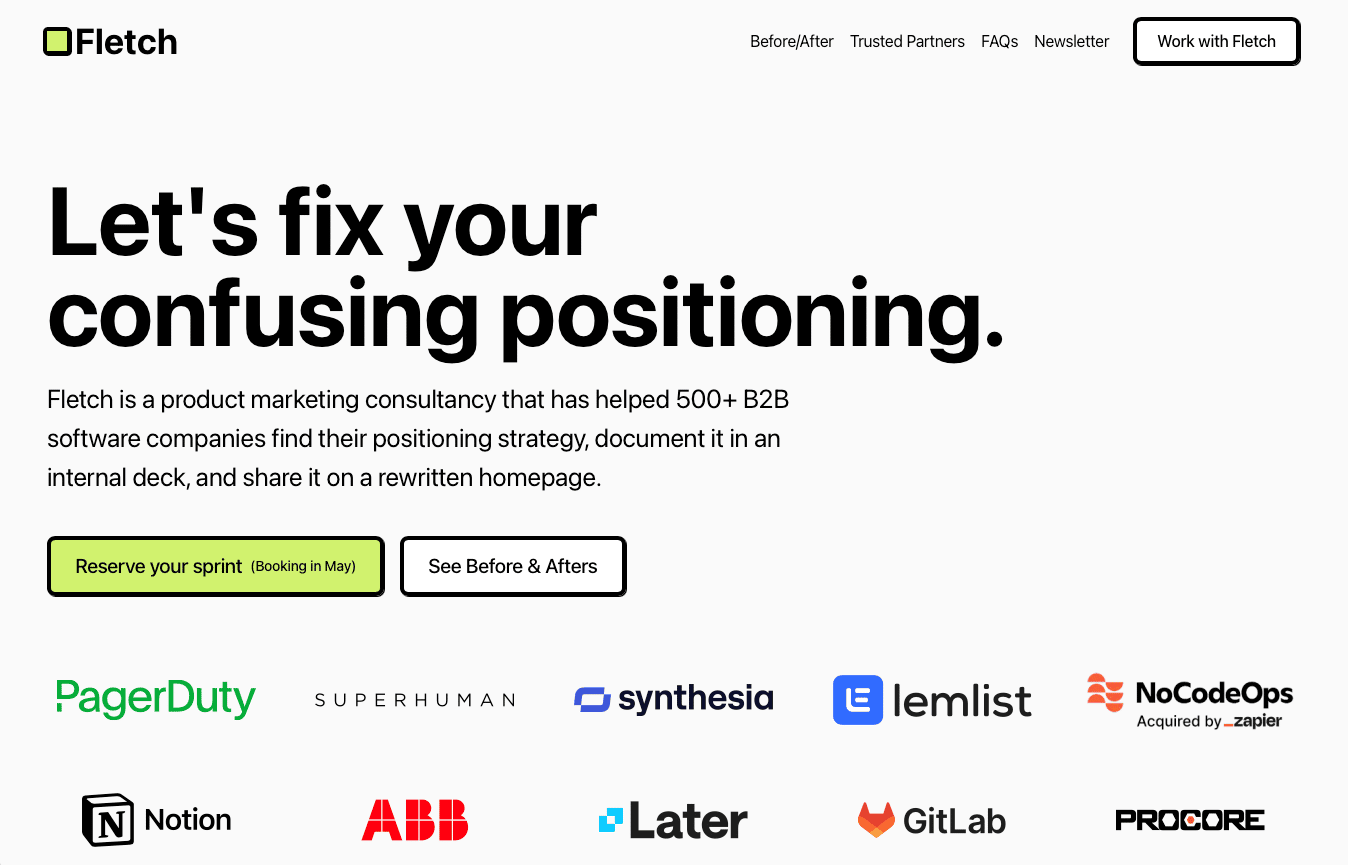
Pricing tiers
So now, we sell the flat-rate 2-week positioning sprints that I mentioned. It results in three deliverables:
4-6 positioning strategy options
An internal positioning strategy deck
A homepage wireframe with production-ready copy
We sell these sprints with three pricing tiers based on company size:
$10k - for companies making $2M or less in annual revenue
$20k - for companies making over $2M up to $20M in annual revenue
$30k - for companies making more than $20M in annual revenue
And we want to increase pricing, as the market allows.
Tech stack
We first built distribution: The audience came first, then the product we sell.
Once we found a pull for our current service, the next big hurdle was creating a repeatable process. This has been ongoing iterations over the last three years, culminating in a process standardized enough to bring in external consultants to help run our process with clients.
On a related note, here's our stack:
Figma: We use this to create all of our LinkedIn graphics, decks/presentations for clients, and even as our "infinite canvas" for running workshops.
Loom: We use this to send updates back and forth between our team members and clients.
ChatGPT/Claude/Gemini: We use these primarily to assist with research before client engagements and for AI-generated graphics, designs, etc.
Lovable: We use this to create several important applications used throughout the two-week sprint process with clients.
Attio: This is our current CRM of choice; we switched from Airtable to get a real CRM (though Attio has slightly underwhelmed us overall).
Zoom: Our video conferencing app.
Google: We use the Google suite for the usual things, and its folders as the backend for our AI work.
Slack: We use this for all internal comms.
Building custom internal software
We've found that the more we build custom software to automate and standardize our processes, the better! The Lovable apps have been especially helpful.
For example, we created an end-to-end "sprint management" app for internal use. It's essentially a project management app built around our specific two-week process. It outlines the exact daily tasks for each role, and automatically pushes any materials we upload to a project to the LLMs where we do the bulk of our work.
Marketing channels
A few posts went "viral" early in my posting, so that gave us some traction and the endurance to keep posting even during the long dry spells when 10+ posts did not perform at all.
Our main marketing channels are:
LinkedIn organic content: My cofounder and I have large LinkedIn audiences (~80k followers for me, ~68k for him). As these audiences grow, so does our word-of-mouth.
Speaking at marketing conferences
Being guests on podcasts or live webinars
Our newsletter
Referrals: Because of our sprint model, we work with 8-10 companies per month. The longer this continues, the more it snowballs with increasing referrals.
We are also testing new marketing channels this year:
A dedicated SEO effort
Paid LinkedIn ads
Transitioning from founder-led to company-led
The largest obstacle we are facing is transitioning from a primarily founder-led business to a company-led business.
Right now, most leads come because they follow my cofounder or me on LinkedIn. This creates a challenge if we ever want to sell the business — or step out in any meaningful way.
We are working on this transition, but it is a long process. We've significantly scaled back the number of sprints my cofounder and I run and brought on more contractors/team members to fill those gaps. And we're building their credibility by having them also post on LinkedIn to build their own brands. This also extends credibility to the company brand.
Focus on distribution first
Here's my advice: Focus on distribution first!
Now that everyone can build with AI, the biggest leverage will be letting people know about your product in a scalable, cheap way.
Pick a channel with an organic algorithm and spend 3-9 months cracking it before you build a thing.
What's next?
From here, I want to continue to grow the business and make it fully run without my cofounder or me in the weeds.
You can check out our positioning newsletter or follow Rob and me on LinkedIn. And check out FletchPMM!

Leave a Comment
This is such a strong example of how clarity around positioning can quietly drive everything else in a business.
What stands out is the consistency across completely different domains — churches, music, and B2B SaaS — but the same underlying skill: helping something grow by sharpening its message and focus.
FletchPMM feels like a very natural extension of that. The “positioning sprint” is especially compelling because it turns something usually abstract into a concrete, deliverable outcome in a short timeframe.
Also, the shift from agency chaos to a repeatable, productized offer is one of those moves that sounds simple but is actually where most companies either level up or stall.
Respect for the honesty about what’s working and what’s still evolving — especially the founder-led growth dependency. That’s a hard problem to solve, but a very important one.
And the band detail is just fun — it actually reinforces the core idea more than it looks like at first 👏
This was one of the most valuable takeaways for me: productizing a service instead of selling endless custom work. The repeatable 2-week sprint, fixed pricing, and standardized process make the business far more scalable than a traditional agency.
The other point that really stuck with me was "distribution first." As an engineer, it's easy to believe the product is the hard part, but stories like yours keep reminding me that attention and trust are the real bottlenecks.
I'm at the beginning of my own journey building AI SaaS products, and I'm trying to avoid making the mistake of building in isolation. If you were starting today with zero audience and an MVP, would you still spend 3–9 months focusing on one distribution channel before launch, or would you launch earlier and learn from real users while building your audience? I'd genuinely appreciate any advice from your experience.
The distribution first advice is something I am learning the hard way right now. Built the product, then started thinking about how to get people to see it, and those are completely different problems. The part about spending 3 to 9 months cracking a channel before you build anything is painful to read when you have already done it the other way round but it makes complete sense. LinkedIn organic content driving most of the leads is interesting too because most people assume you need paid ads to get consistent B2B pipeline going.
The productized sprint model is genuinely one of the cleanest ways to handle this. The constraint forces the conversation before work starts rather than mid-delivery, which is the only time it's actually painless to have.
What's worked well for me: put a single sentence in the project brief that explicitly defines what does NOT come with the sprint — not just what does. Clients sign off on inclusions easily; they rarely push back on explicit exclusions, and it eliminates the 'I thought this was included' conversation entirely.
The second layer is having a rehearsed, written response ready for the 'just one extra thing' moment — something like 'That's a great add-on, here's how we'd scope it as a phase 2.' Having that language pre-written means you're not improvising under pressure, which is where most boundary-setting breaks down.
I just watched one of your videos yesterday, and it was great. The breakdown of each YC-backed startup's websites was clear and compelling. If I were them, I'd consider having you all help with my site.
This's a great reality check.Over-thinking the perfect idea is a usually just a disguised fear of launching and getting rejected by the real market.The magic happens in the validation,not the brainstorming phase.
I had a similar issue with long-running tasks. Switching to FastAPI and background workers saved me. Good luck
good strategy and your mindset
Structured dispute resolution for landlords and tenants — with guided negotiation, documented communication, and state-aware workflows designed to help both sides reach fair agreements faster.
Productizing a 2-week service is a genius move for scalability.
The $1.7M/yr milestone proves that consistency and a clear process win over custom chaos every time.
In my daily work reviewing SaaS and tech tools, I see so many products trying to do everything, whereas your 'repeatable service' model shows the power of doing one thing perfectly.
Truly a masterclass in business efficiency!
Great to hear of someone else growing their Spotify listenership!
I genuinely found this post fascinating. I've spent most of my career working as a consultant along side working with CEO's as a technical co-founder. Both make sense for me; building a new product that scales as a business has an obvious benefit but incredibly hard. Working as a consultant is in my wheelhouse but doesn't scale and caps my earning potential unless I expand in to the agency model. Reading about your 'hybrid' approach and succeeding in productizing your skills and experience in this way is really encouraging. Best of luck with it!
BEST RECOVERY HACKER CRYPTOCURRENCY /BANK ACCT RECOVERY/ MARK WIZARD HACKERS RECOVERY
I became a victim of a romance scam that led me to invest $654,000 in Tether USDT on a fake site. After realising I had been scammed, I felt utterly hopeless and desperate for help. I began searching for a hacker online and came across Wizard Hackers Recovery. His professionalism and expertise gave me hope. Wizard Hackers Recovery worked to recover my lost funds, and I’m thrilled to say he succeeded! I am incredibly grateful for their assistance and highly recommend their services to anyone in a similar situation or any issues you can connect with them Thank you,
Email: :Markwizard 23 @ gmailcom
WHATSAPP +4915218465599
TELEGRAM : @ wizardhackersrecovery
BEST RECOVERY HACKER CRYPTOCURRENCY /BANK ACCT RECOVERY/ MARK WIZARD HACKERS RECOVERY
I became a victim of a romance scam that led me to invest $654,000 in Tether USDT on a fake site. After realising I had been scammed, I felt utterly hopeless and desperate for help. I began searching for a hacker online and came across Wizard Hackers Recovery. His professionalism and expertise gave me hope. Wizard Hackers Recovery worked to recover my lost funds, and I’m thrilled to say he succeeded! I am incredibly grateful for their assistance and highly recommend their services to anyone in a similar situation or any issues you can connect with them Thank you,
Email: :Markwizard 23 @ gmailcom
WHATSAPP +4915218465599
TELEGRAM : @ wizardhackersrecovery
Personal hero!
Productized services is the most underrated arbitrage in B2B right now. Most consultants undersell themselves by hourly billing or open-scope retainers. The moment you fix the scope, fix the timeline, and price on the outcome, three things happen: you can market it like a product, you can pre-sell with a wait list, and you can hire less senior people to deliver because the scope is constrained.
I invest in early-stage founders through Henson Venture Partners and see the same lesson on the other side. Founders who can't describe their offer in one productized sentence can't sell efficiently, no matter how good they are. Anthony's positioning sprint is itself a positioning lesson.
The distribution point is huge, but I think the deeper challenge is actually trust transfer.
Early-stage companies borrow credibility from founders because people connect with humans first. The difficult transition is teaching the market to trust the company independently of the personalities that built it.
Love the point about how the same positioning principles apply across completely different industries. Trying to target everyone usually ends up diluting the message. Great reminder that distribution and clarity are everything. Congrats!
The productization angle is what gets me - turning consulting work into a repeatable package is one of those things that sounds simple but takes serious discipline to actually pull off.
You’ve hit on the "Golden Ratio" of modern SaaS and service businesses: Reduced Friction + Forced Distribution. When the product is designed to be "sold, not just used," the marketing heavy lifting is already half-done.
Since you appreciate the "Distribution First" and "Tight Offer" philosophy, let’s pivot to a strategy that focuses on The Trojan Horse Entry. This is about getting inside an organization with a tiny, undeniable "Yes" that naturally expands into a full-scale implementation.
"Amazing growth, Anthony! The concept of a '2-week service' is brilliant. It creates so much clarity for the client. I’m currently launching my own SaaS codebases on Gumroad and I'm trying to bring that same level of 'speed to value' to my customers. Did you find it hard to say 'no' to custom requests that fell outside that 2-week window at the beginning?"
Really interesting model—this feels like one of those areas where packaging the service is actually the core innovation, not the underlying expertise.
What stood out to me is how strong the “repeatable 2-week system” angle is. Once you define a tight delivery window, it seems like a lot of the complexity (scope creep, prioritization, client alignment) just disappears or becomes much easier to control.
I’ve noticed similar dynamics in other domains too—when you force a short, standardized cycle, it almost becomes less about consulting and more about a production line for outcomes.
Curious how you think about:
deciding what fits into the 2-week scope vs what gets explicitly excluded
and whether you ever run into demand where clients try to “expand” the service beyond that structure
Feels like the real leverage here is less the service itself and more the constraint design around it.
This was a really smart example of turning a service into a scalable system instead of staying stuck in the traditional “agency grind.” The biggest takeaway for me was how they narrowed the offer down into a repeatable 2-week process with clear deliverables — that productized approach probably made sales, onboarding, and referrals way easier.
Also loved the focus on solving one painful problem exceptionally well instead of trying to be a full-service consultancy for everyone. A lot of agencies struggle because they customize everything from scratch, while this model compounds through process and positioning. Hitting $1.7M/year with a lean, specialized setup is seriously impressive 🚀
The founder-led to company-led transition is the part most service businesses underestimate. I ran an MSP for nearly 20 years where customers were buying me for the first decade and the company for the second. The unlock wasn't training contractors to sound like the founders. It was rebuilding the deliverable so the personality wasn't part of it. Once the output is identical regardless of who runs the engagement, the founders can step back without the pipeline collapsing.
Productizing a repeatable service is probably one of the most underrated business models in tech right now. It reduces operational ambiguity while making growth more scalable and predictable.
The 2-week structure is especially interesting because constraints often improve execution quality and client clarity at the same time.
Hey Anthony, I’d love to hear more about how you applied the same strategy to your band
Great article! The "distribution first" mindset is the real game-changer here. building an audience before finalizing the offer is a strategy many founders overlook until it's too late.
I'm particularly impressed by the tiered pricing model tied to company revenue; it aligns price with value rather than just time, which is rare in consulting. Also, using custom internal tools (like the Lovable sprint app) to turn a service into a repeatable system is exactly how you scale without burning out.
Quick question: As you hand off more sprints to contractors, what's been the biggest challenge in maintaining that "premium" storytelling quality in the final deliverables?
Make sense, it's a dream of most developers and we've seen case studies of reality, it can actually happen.
“Great insight 👍”
This is a very good example of turning skills into a product. The 2-week sprint is interesting because it makes things clear for both sides. The work is limited, goals are clear, and it avoids never-ending custom work that many agencies face.
I also noticed that you built an audience before finalizing your offer. Many founders do the opposite and then struggle to find customers later.
The pricing based on company revenue is also a smart idea. It focuses on value, not just time.
I’m curious, do bigger companies hesitate to pay $30k, or is it easier to sell because the sprint is clear and well-structured compared to normal consulting?
This is such a clean example of spotting a wedge inside a broken model and spinning it out into its own thing
What I find most interesting is the sequence they followed audience first then product then process Most people do it completely backwards they build a product in silence then wonder why nobody shows up Anthony and his cofounder basically used LinkedIn as a live market research lab posting about different potential offers until the market pulled them toward positioning and homepages That takes patience and a willingness to look like you don't have it all figured out yet
The pricing tier structure tied to company revenue is clever too It signals that they understand different company sizes get different levels of value from the same positioning work A startup at 1M ARR fixing their messaging might unlock way more relative growth than an enterprise at 30M so the sliding scale makes sense and it's a model many service businesses could adopt instead of charging one flat rate for everyone
The sprint management app built on Lovable is a quietly important detail Custom internal tools are how service businesses become product businesses or at least become dramatically more profitable When your process becomes software you stop selling your time and start selling a repeatable system This is exactly how agencies evolve into SaaS companies over time
The founder-led to company-led transition is the most honest and painful challenge here When both cofounders have 80k and 68k followers and the leads come because of their personal brands stepping back without killing the pipeline is incredibly hard Building up contractors to post and build their own credibility is smart but it takes years not months The question is whether the positioning sprint itself becomes the brand rather than the two personalities behind it
Your advice about distribution first hits hard now that AI makes building the product the easy part The bottleneck really is attention If you can't get people to care you don't have a business no matter how good the product is
Curious about one thing you said you sold the spin-off amicably to the agency leadership That's a rare story how did you negotiate the split and maintain a clean separation without burning relationships or ending up with messy shared ownership
Such a great read! The “distribution first” point hit hard. I feel like I’m stuck exactly there—knowing I need distribution, but honestly not sure where to start or how to approach it. Would love to learn how others here got past this stage.
Great article James! How many LinkedIn followers did you have when you started as opposed to now? Getting those first sales is crucial so I'm curious what your backup strategy was?
This is a masterclass in "narrowing the focus" until it hurts—and then reaping the rewards once the market actually understands what you do.
What’s particularly striking here isn't just the $1.7M revenue, but the amicable spin-off. Most founders wait for a "burn the boats" moment or a falling out to go solo. Incubating a productized offer within a generalist agency and then spinning it out is a brilliant way to de-risk the transition. It allowed you to validate the 2-week sprint model while you still had the safety net of the mothership.
The cross-industry insight about your band is the "aha" moment. It’s a great reminder that positioning isn't just a B2B SaaS problem; it’s a human attention problem. Whether it's a church, a punk band, or a CRM, if you try to be everything to everyone, you end up being nothing to anyone.
One question for you: As you’ve scaled toward that $2M mark, how do you protect the integrity of the 2-week boundary? I imagine as the price point or client size grows, the "Scope Creep Monster" starts knocking on the door. How do you keep the sprint from turning into a marathon?
The "productizing a repeatable service" framing is exactly what I needed to read today. I've been thinking about my project as either a tool OR a service — this shows it can start as service, become a product. The 2-week fixed scope is genius for managing client expectations. Saving this.
Love the "distribution first" philosophy — most dev teams build for months before talking to a single potential customer. The LinkedIn-before-product approach is something more technical founders need to hear. We always assume building is the hard part. Turns out telling people about it is. The sprint model is smart too — fixed scope, fixed price, repeatable process. Removes all the friction from the buying decision. Congrats on the $2M milestone. What did the first $10k look like?
The productization angle resonates — I've seen the exact same pattern on the data side. As a freelance BI consultant, I used to scope every engagement custom ("build us a data warehouse") and margins were brutal because every project felt like solving it from scratch. Switching to a fixed 3-week "Series A Data Foundation" sprint (warehouse + 3 core dashboards + 1 ETL pipeline, fixed price) cut my sales cycle in half — founders sign faster when the scope is capped.
The Lovable internal-tooling point is the part most service businesses miss. I rebuilt our intake/discovery as a templated SQL audit script that runs against the client's stack on day 1 — turned what used to be a 4-day discovery call into a 2-hour session with a pre-filled findings doc. Quality went up because the process stopped depending on which consultant ran the call.
Question for Anthony: when you brought on external consultants to deliver sprints, what did the first "failed" delivery look like? I'm at the stage where I'm considering bringing in a second engineer for delivery, and I'm trying to figure out where the quality drop usually happens — discovery, execution, or handoff?
The "Series A Data Foundation" is a killer name—it immediately frames the value around a business milestone rather than a technical chore. It’s the difference between selling a shovel and selling a solid foundation.
That shift to a templated SQL audit script is where the magic happens. Moving from a 4-day discovery to a 2-hour automated session isn't just a time-save; it’s a massive increase in ROI and client trust because it makes your expertise look (and feel) like a repeatable science rather than a custom art project.
Your question for Anthony about the first "failed" delivery is the million-dollar question for anyone trying to scale. In my experience, the failure usually hides in the Translation Layer. You can give a second engineer the audit script (Discovery) and the technical requirements (Execution), but the quality drop often happens when they have to translate those data points into the "So What?" for the founder (Handoff).
I’m curious if Anthony found that the breakdown was in the logic of the sprint or in the "storytelling" that makes the deliverables feel premium.
Great point on the storytelling layer, Jake. In my experience scaling BI delivery, the breakdown almost always happens at handoff — specifically when the second engineer understands the data but can't frame it as a business decision for the founder. We fixed this by building a "so what?" template into every sprint deliverable: each dashboard ships with a 1-page "Key Signals" doc that translates the numbers into founder-language. It sounds simple but it's what separates a report that gets filed away from one that actually drives a decision. Have you found that the quality issue shows up more on technical projects or in client-facing communication?
Amazing
The distribution first point is the most honest advice in this post.
Most founders I talk to do the opposite — build for months, then panic about marketing.
Quick question Anthony: before the LinkedIn audience existed, how did you land your first 3 clients? Pure cold outreach or something else?
YOU ARE ON ANOTHER LEVEL, BRO
Offering sprints with three pricing tiers based on company size, I am surprised I have never heard of that pricing model. It makes sense.
A thorough article, it covered many of the things I had questions about.
How did you build your audience and distribution?
this is such an underrated path — productizing a service instead of jumping straight into SaaS
i’m currently building small tools and starting to see the same pattern: what starts as a one-off solution can turn into something repeatable pretty quickly
curious — how did you figure out what part of your service was actually “productizable”?
Ngl this some crazy information
this works because the problem is tightly scoped
and the output is clearly defined
most services struggle because they’re too open-ended
this one is easy to understand, easy to buy, and easy to deliver
best information
The positioning insight about churches and bands applying the same strategies as B2B software startups is something most people would dismiss but it is actually the sharpest observation in this whole post. A niche audience that genuinely connects with you beats a broad audience that barely notices you — whether you are a SaaS company or a band trying to hit 1M streams.
The 40% fixed price model is interesting too. Most consultancies resist productizing because they think every client is unique. But you found that the problem is actually the same across 500+ companies — lack of focus on a target market. Once the problem is consistent the solution can be consistent. That is the unlock.
Curious about the transition from founder-led to company-led selling. At what point did you feel confident enough in the process to hand it to external consultants without the quality dropping? That seems like the hardest part of scaling any consultancy.
great work
This is solid. Productized offer + distribution first is the real takeaway. Most people build first and then struggle to sell. You did the opposite and it shows in the numbers. Also like how tight the offer is, easy to understand, easy to buy.
The productized offer model is so underrated. I run a marketing agency and we went through a similar evolution — started doing fully custom projects for anyone who would pay, then slowly narrowed down to a specific niche and repeatable deliverables. The difference in margins and sanity is night and day.
The founder-led challenge really hits home too. When clients are buying YOU and not the company, scaling becomes a ceiling. We've been working through this same thing — building systems and processes that can run without me being in every meeting. It's uncomfortable to let go but necessary if you want the business to outlive your personal bandwidth.
The "focus on distribution first" advice is gold. LinkedIn organic was our main channel too and it compounds like crazy once you crack the content formula for your niche. The early grind of posting with no engagement is brutal but worth pushing through.
Credit to the founder! Simple Solutions for Real Problems will create a winner near everytime. When it's win-win for everyone involved on business side and client side, that's when you are in the pocket.
The "distribution first" advice hits different when you're on the other side of it.
I launched DocReplacer this week and made the classic mistake — built first,
then figured out distribution. Watching you describe building LinkedIn audience
before the product is basically reading my mistake in reverse.
Quick question: In the early days before the LinkedIn audience existed,
how did you get your first 5-10 clients? Pure cold outreach, or something else?
This is a great example of how productizing a service creates scale. Most founders struggle because their MVP and service delivery aren’t structured or repeatable. We've been seeing the same pattern while working on structured build workflows at FoundersBar especially around turning services into systems.
Great breakdown of how a repeatable, productized service model can scale a consultancy into a high-revenue business.
Really interesting to see how focusing on one clear niche + fixed 2-week delivery system creates both operational efficiency and strong positioning. The emphasis on distribution first and building internal tools also stands out as a key growth lever.
This is a solid example of how service businesses can evolve into scalable, tech-enabled models without becoming full SaaS right away.
the "fixed scope, fixed price" model only works because positioning is a discovery output, not an implementation output. For most B2B services (engineering, GTM execution), the 2-week sprint becomes a meeting where you tell the client what they should do and they still need to do it. Curious you handl clients who say "ok now build it for us."
"I’m building a tool for a specific niche (STEM students). Do you think it’s better to launch on Product Hunt immediately, or should I focus on 'niche' communities like Reddit or Discord first?"
The “distribution first, then product” point really stands out. The 2-week sprint works because it is clear, repeatable, and easy for clients to understand. It feels less like open-ended consulting and more like a product with a fixed outcome.
I’m curious: what was the hardest part of turning founder knowledge into a process other people could deliver?
The internal Lovable sprint management app stood out to me more than the revenue numbers. Most consultancies treat their delivery process as tribal knowledge — it lives in the founders' heads and doesn't survive hiring. Building it into a custom tool that enforces the daily task structure is essentially turning a service into a product, which is the whole point.
I'm doing something similar on the editorial side — building internal tooling before I have significant volume, specifically because I want the quality to be consistent when volume arrives rather than trying to retrofit systems after things get chaotic.
One thing I'm curious about: when you transitioned parts of the sprint delivery to contractors, did the Lovable app reduce onboarding time meaningfully? Or did the tool reflect your process so specifically that new people still needed significant hand-holding to understand the "why" behind each step?
It’s fascinating how you’ve turned "bad employee" energy into a $2M positioning powerhouse and that 130k Spotify monthly listener flex is the ultimate proof that good positioning works everywhere! Moving from a broad agency to a "productized" 2-week sprint is such a classic win for scalability, especially when you've already cracked the distribution code on LinkedIn.
Using Lovable to build custom internal apps for your specific workflow is a brilliant way to protect your margins while scaling. It sounds like you're essentially building a "Fletch OS" to make sure the quality stays high even as you and your co-founder step back from the day-to-day sprints.
Since you're scaling back your personal involvement, what’s been the hardest part of "trusting the process" when someone else is leading a $30k sprint?
Building custom internal apps with Lovable is such a smart move for a consultancy. It turns a service into a scalable asset.
I'm curious though, as you automate more with LLMs through these apps, have you found the API/compute costs easy to track? I see a lot of founders starting with these tools and then hitting a 'compute wall' where they need to optimize their backend to keep those 20k− 30k margins high.
Great to see a PMM team taking the 'tech-enabled' path so seriously!
This hit close to home. I run Icon Labs — same productized model but for AI engineering: 2-week sprints that take a founder's Bolt/Cursor prototype and make it production-ready.
The "distribution first" line is the one most people skip. We almost did too.
One thing that's been huge for us: the 2-week constraint isn't just a delivery tool — it's a sales tool. "Fixed scope, fixed price, fixed timeline" removes 80% of the buying friction for technical projects. Clients who've been burned by open-ended dev contracts sign faster because the risk is capped.
The tiering by company size is smart. We tier by problem stage instead — Stack Audit ($1.5K) for founders with API cost blowouts, Production Sprint ($3.5K) for prototypes that need to survive real users, Fractional AI CTO ($2.5K/mo) for teams that need ongoing coverage without a $150K hire.
Curious if anyone here has successfully introduced a recurring retainer layer on top of one-shot sprints. That transition from transactional to recurring feels like the hardest part of this model.
Nice
Echoing what others are saying- “distribution first” stuck with me. But building trust organically takes time. I think way more than 9 months for most folks. I’d be interested to hear from folks who were able to take a similar route starting with a few hundreds of followers on a platform.
Also, the amount of AI slop on all the platforms right now makes it harder to build something organically starting now vs 10 years ago.
Anyone having real success growing your social media presence well starting fairly recently? How many followers/engagement do you need to launch a product to them?
Love how you turned a niche idea into a repeatable service. The distribution-first approach is brilliant letting the market guide the product. I want to know that how your team keeps the consistency in voice as you scale
The “distribution first, then product” part really stands out — especially now when everyone can build fast with AI.
What I found interesting is how the 2-week sprint acts as both a delivery constraint and a positioning tool. It forces clarity not just for the client, but also internally for your team — which probably made it easier to standardize and scale later.
I’m currently working with React/Node projects, and I’ve noticed the same pattern on a smaller scale: the more defined the scope (fixed timeline + clear output), the easier it is to deliver consistently and even upsell.
Curious — when you were early on, did you ever struggle with clients asking for “just one extra thing” outside the sprint scope? How did you enforce boundaries without hurting client relationships?
yeah that very informative
very informative nice ...!!!
🎯 1. Do the Math First (Revenue Model)
Target: $1.7M/year
You need a simple, repeatable unit:
Price per engagement: $8K – $15K
Example: $10K per 2-week sprint
👉 $1.7M ÷ $10K = 170 sprints/year
That’s:
~14 sprints/month
~3–4 sprints/week
So you’ll need a small delivery team + parallel execution, not just yourself.
🧩 2. Define a Productized Offer (This Is Everything)
Your offer must be:
Outcome-driven
Time-bound (2 weeks)
Clearly scoped
Strong examples:
“SEO Lead Generation Sprint (14 days → 20 qualified leads setup)”
“ISO Certification Readiness Audit (2 weeks → compliance roadmap)” (fits your domain)
“Website Conversion Optimization Sprint (2 weeks → +X% conversion fixes implemented)*
👉 Avoid vague offers like “digital consulting” or “strategy session”
⚙️ 3. Build a Repeatable Delivery System
Think like a product, not a service.
Week 1:
Audit / data collection
Diagnosis using templates
Internal analysis
Week 2:
Implementation OR action plan
Final report + call
Hand-off assets
Use:
SOPs (standard operating procedures)
Templates (reports, audits, dashboards)
Checklists
👉 Goal: deliver the same output quality every time with less thinking
Good framework, but the math breaks down at scale — 14 sprints/month means you're running a factory, not a consultancy. Anthony actually solved this differently: tiered pricing by company size ($10K/$20K/$30K) means you need far fewer sprints to hit the same revenue.
170 sprints/year at $10K = $1.7M
57 sprints/year at $30K = $1.7M
Half the delivery overhead, same revenue. The real leverage is qualifying upmarket faster, not running more sprints.
We do something similar at Icon Labs on the AI engineering side — our Fractional AI CTO retainer ($2.5K/mo) was specifically designed to reduce sprint dependency. One retainer client = 2 sprints worth of revenue, recurring, with zero reselling cost.
Anthony, this is a masterclass in productized services. The $10k/$20k/$30k tiering based on company size is brilliant — it removes the "custom SOW" friction that kills most consultancies while still capturing value from larger clients.
What really stood out: "We first built distribution: The audience came first, then the product we sell." This is the exact opposite of what most indie hackers do (build first, market later). Your LinkedIn audience became your validation engine — you felt the pull toward positioning and homepages because your audience told you, not because you guessed.
One thing I'm curious about: as you transition from founder-led to company-led, are you finding that your contractors' LinkedIn voices can authentically replicate what made your content work? Or are you building a separate "company voice" that doesn't depend on individual personalities? I've seen founder-led brands struggle with this handoff — the audience often follows the person, not the brand.
Also, using Lovable to build your sprint management app is a great example of "eating your own dog food" with AI tools. How has that changed your client delivery speed?
Great story. Bookmarked for sure.
great
The positioning sprint model is brilliant partly because of what it forces you to build internally: every stage of a 2-week engagement has to be scripted well enough that a different team member could deliver it consistently.
What most people underestimate about scaling a productized service is that the hard work isn't designing the sprint - it's building the communication layer that runs alongside it. The intake call has to surface the same inputs from every client. The mid-sprint check-in needs to handle scope pushback without derailing the timeline. The delivery handoff needs to make the client feel like the outcome was worth more than they paid.
Each of those moments fails silently at first. You don't notice until the 10th client engagement when you realize three clients had very different experiences of the same process - not because the work was different, but because the conversations around the work were improvised differently each time.
The consultancies I've seen scale productized services past 00k consistently have pre-written language for each of those touchpoints, not just a well-designed deck. That's the distribution side of repeatability that rarely gets written up.
Building in the same direction at 3vo.ai - particularly interested in how you handled the mid-engagement scope conversations as you moved from founder-led to team-led delivery.