Building a free Chrome extension in 3 days and turning it into a 5-figure-MRR ecosystem

When ChatGPT launched, Saeed Ezzati saw that, while the product felt magical, the workspace around it was almost nonexistent. So, he spent a weekend building a Chrome extension for himself.
Today, Superpower ChatGPT has over 420k downloads and 150k weekly active users. And the Superpower Daily newsletter has 350k subscribers. In total, the business has a 5-figure MRR .
Here's Saeed on how he did it. 👇
ChatGPT was magical but messy
I am a software engineer and solo founder based in San Francisco. Before Superpower, I worked as a full-stack engineer for about ten years at various companies, from large corporations to startups, while always keeping a side project alive on nights and weekends. I have always liked building small tools for myself. Superpower started that way, too.
When ChatGPT launched, I used it constantly. The back-and-forth conversation felt like a new kind of computing experience. But after a few days of heavy use, I kept running into the same problem: The conversations were useful, but the workspace around them was missing.
Important threads got buried. There was no good way to organize old conversations. Search was limited. Exporting was awkward. Prompts and useful answers were hard to reuse later.
It was one of those rare moments when a new product felt both magical and obviously incomplete.
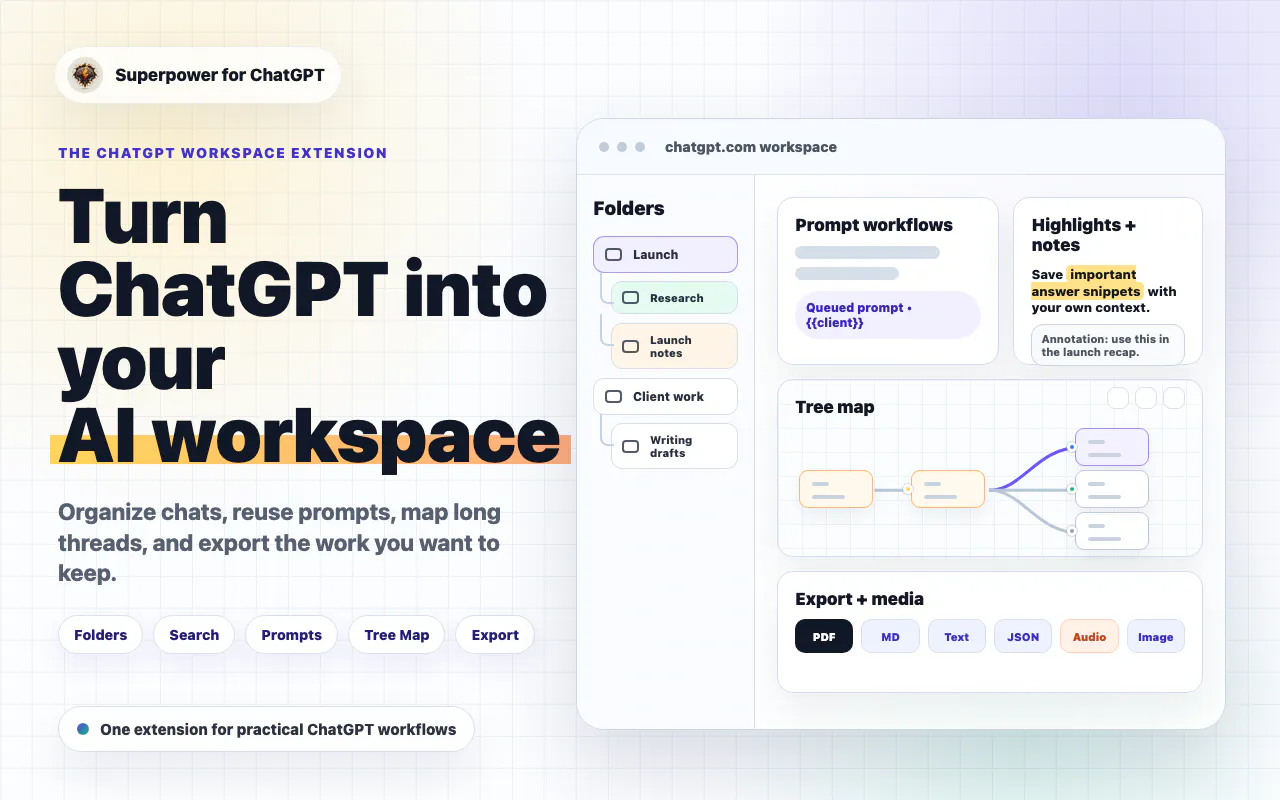
Within a few days, I built and launched the first version of Superpower ChatGPT on the Chrome Web Store. It started as a simple browser extension, but it grew into a productivity layer on top of ChatGPT, with features like local history search and sync, folders, conversation export, message pinning, prompt management, writing style and tone options, and much more.
Today, Superpower ChatGPT has over 420,000 downloads, more than 150,000 weekly active users, and thousands of reviews across browser stores. I also run Superpower Daily, a newsletter with over 350,000 subscribers, where I share AI news and useful AI tools.
The business is now at 5-figure MRR, and I still run it as a solo founder.
Prioritizing trust over revenue
My initial motivation was simple: I wanted ChatGPT to be better for my own use.
The first version was very small, but users understood it immediately. People installed it, used it, and started asking for more. Some wanted folders. Some wanted export. Some wanted better prompt management. Some wanted search.
The roadmap came directly from user emails, reviews, Reddit comments, Discord conversations, and repeated pain I kept seeing in public.
The business motivation came later. I saw Superpower as a side project at first, and I wanted to keep the product free because I believed the biggest opportunity was distribution and trust.
Free was not charity. It was distribution.
In a new category, asking people to trust a paid product too early can slow everything down. I wanted users first: real usage, real feedback, real reviews, and real trust. Once the product became part of people's daily ChatGPT workflow, Pro became a natural upgrade instead of a hard sell.
The question became, "How do I support a free product with a fast-growing user base without ruining the ChatGPT experience with random ads?'
That question led to Superpower Daily. Because the extension's users were already interested in AI, I started sharing AI news and useful tools inside the product. Users liked it enough that it eventually became its own newsletter.
Launching within a week of ChatGPT's launch
I built the initial product in two or three days and launched it on the Chrome Web Store within the first week of ChatGPT's launch. I had no funding, no team, no launch budget, and no complicated process. It was just me, my laptop, and a problem I wanted to solve.
The first version was not the product you see today. It only had a few features, and much of it was rough. But it solved one problem clearly enough that people immediately understood why it existed. If I had waited to build the full vision, I probably would have missed the timing.
The core extension is intentionally simple: vanilla JavaScript, HTML, and CSS. I do not use a frontend framework inside the extension. For browser extensions, I prefer direct control over performance, bundle size, and how the extension interacts with the page.
The hardest part was not building the first version. The hardest part was surviving the platform underneath it.
ChatGPT kept changing. Buttons moved. DOM structures changed. New features shipped. Old flows broke. Rate limits shifted. A normal web app controls its own environment. A browser extension lives inside someone else's product and has to keep working as that product evolves.
That is why the simplicity of the stack has been so helpful. It lets me adapt quickly.
Outside of the extension, server-side components support the product for subscriptions, account state, newsletter workflows, and internal tooling.
If I had to start over, I would invest earlier in internal tooling, automated testing, and a more robust way to handle ChatGPT UI changes. I would also build more of the web-app side earlier, so the business would depend less on browser extension constraints.
Two revenue streams
Superpower ChatGPT is freemium. The free plan includes most of the core value, with limits on some advanced features. The Pro plan removes limits and gives power users access to the full product.
For the first nine months, the extension was 100% free. That was an intentional decision. In a new market, trust and distribution mattered more than early revenue.
Revenue grew because the free product already had a large audience that understood its value. I did not need to tell users that Superpower existed or explain the problem from scratch. Many of them had already been using it for months. The paid plan became a natural upgrade for people who used ChatGPT heavily and wanted fewer limits.
The second revenue stream is sponsorships through Superpower Daily. The newsletter started to provide value to extension users without putting random ads into their workflow. Over time, it became a serious business by itself. Sponsors want to reach people who actively use AI tools, and that audience is a very good match for Superpower.
Costs were almost nothing initially — my main investment was time. And the margins are still high because I am still solo. I do not have employees. Main costs include servers, software tools, and the time to support and maintain the product. The tradeoff is that everything depends on my focus, so I've learned to look for repeated pain, not just loud feedback.
Product and distribution should not be separate jobs
Being early and shipping something useful when people actively looked for ways to improve ChatGPT was the biggest growth lever. I launched on Product Hunt, posted on Reddit, shared updates on Twitter/X, and made the extension easy to find in the browser stores. But timing only helped because the product solved a real problem.
Reddit was especially useful in the early days. People were already discussing ChatGPT workflows, prompts, productivity, and missing features. I could join those conversations, share what I built, and get honest feedback. It was not a polished marketing campaign. It was more like: "I built this because I needed it. Does it help you, too?"
One of my biggest lessons is that product and distribution should not be treated as separate jobs.
For Superpower, the product created distribution because users shared it. The extension created the newsletter audience. The newsletter brought people back to the product. User feedback shaped the roadmap. Discord, reviews, support emails, GitHub, Reddit, and social media all became part of the same loop.
The channels worked together.
The advantages of speed and feedback
Speed was the most helpful advantage. When ChatGPT launched, the market moved faster than most companies could react. As a solo developer, I could build and ship without meetings, approvals, or a roadmap process. That mattered.
Constantly talking to users was the second advantage. Reviews, emails, Discord messages, Reddit comments, and support requests are not just support work; they are product research. Users often describe the problem better than you can because they live with it every day.
The newsletter was also a good decision. It gave me a direct relationship with the audience instead of depending only on browser store discovery or social platforms. It also forced me to stay close to the AI market. When you write about AI every day, you notice trends, tools, and user behavior much earlier.
Give it away for free — but know why
My advice:
Start with a problem you understand personally. You build a much more useful product when you are also a user. You notice small annoyances outsiders miss, and these can become valuable features.
Ship earlier than feels comfortable. The first version doesn't need to express your whole vision. It only needs to solve one problem clearly enough for someone to care. Superpower wouldn't exist at this scale if I had waited for the "complete" version.
Give people something genuinely useful for free, especially if you enter a new market and need trust. But don't confuse free with having no business model. Free can be a distribution strategy, a feedback strategy, and a trust-building strategy. You still need to know your revenue source.
Build distribution while you build the product. Post in communities, write, share what you're learning, start a newsletter, build in public, or find another channel that fits you. A good product with no distribution is easy to ignore.
Finally, listen to users, but don't blindly follow every request. Look for repeated patterns. The best ideas usually show up more than once, from different users, in slightly different words.
What's next?
Superpower started as a small fix for my own ChatGPT workflow. The reason it kept growing is that the problem kept getting bigger.
More people are using AI every day, but their workflows are still messy. Conversations disappear. Useful answers get buried. Prompts are rewritten from scratch. Work is hard to reuse.
That is the opportunity I still care about: making AI work easier to organize, search, reuse, and build on.
My main goal is to keep making Superpower ChatGPT the best productivity layer for serious ChatGPT users. AI tools are becoming part of people's daily work, and I think there is still a lot of room to make that workflow more organized, searchable, reusable, and personal.
I also want to keep growing Superpower Daily. The AI space is noisy, and people need a trusted way to know what matters. The newsletter helps me serve that need and stay connected to the same audience that uses the extension.
Longer term, I want to keep building useful products around AI workflows. I do not want to build things just because they are trendy. I want to build tools that save people time, reduce friction, and improve their existing workflow.
The best place to learn more about Superpower ChatGPT is our website. You can read Superpower Daily here. And you can also follow me on X and LinkedIn.

Leave a Comment
"Product and distribution should not be separate jobs" is the line I'm taking away from this.
I'm two days into early access on Ridgewell, an options coaching tool, and I've been mentally treating them as separate phases — build first, distribute later. Reading this I realize the loop you built (extension → newsletter → users → feedback → extension) only worked because distribution was baked into the product from day one. The share behavior was natural, not engineered on top after the fact.
The point about surviving the platform underneath you also hit close. Ridgewell pulls data from Yahoo Finance's undocumented API. It works today. It could break tomorrow if Yahoo changes their response structure. I've thought about this but haven't built enough redundancy around it yet. Your vanilla JS choice for the same reason — direct control, fast adaptation — is something I'm thinking about differently now.
The free as distribution strategy rather than charity framing is exactly right. I'm free during early access not because I'm unsure about charging but because I need real usage data before I know what's actually worth paying for. Those are different motivations and it matters to be clear about which one you're operating from.
Congrats on 420k downloads as a solo founder. The newsletter pivot is a genuinely smart move.
Thanks, I really appreciate this.
I think you framed the free early access point really well: free because you need real usage data is very different from free because you are unsure whether the product has value. The first one is intentional. The second can become a trap.
On the platform risk side, I'd definitely think about redundancy early if Ridgewell depends on an undocumented API. In my case, the first version worked because I could move fast, but the cost was that every ChatGPT UI change could break something. Over time, I had to decouple as much as possible, support multiple versions of ChatGPT experiments, and keep a close eye on product changes.
The distribution loop is also something I'd try to build from day one. It does not need to be complicated, but the product should naturally create reasons to talk to users, learn from them, and bring them back.
What's the task you keep putting off the longest?
Congrats on the growth. Looking back, what ended up being the biggest technical bottleneck after launch that you hadn't anticipated?
Thanks! The biggest technical bottleneck was definitely keeping up with ChatGPT changes.
I expected normal extension complexity, but I underestimated how much work it would be to build on top of a brand new product I did not control. ChatGPT's UI, DOM structure, buttons, routes, and flows kept changing, and every change could break something small in the extension.
The second bottleneck was internal tooling. Early on, I was moving fast and solving user-facing problems, which was the right tradeoff at the time. But as usage grew, I needed better tools for debugging, support, release notes, feature flags, and testing.
If I were starting again, I would invest earlier in a more robust abstraction layer around platform-specific UI changes and better automated browser-level tests for core workflows.
I really like the "abstraction layer earlier" lesson. We've come to a similar conclusion while building StateGuard - except around runtime contracts instead of UI changes. A surprising amount of engineering effort ends up going into adapting to changing providers, schemas, and integrations rather than building product features.
"Magical but messy" is the ultimate breeding ground for successful utility tools.
When a massive platform like ChatGPT launches, most developers immediately try to build complex API integrations or entire competing platforms. But often, the biggest friction point for daily users is just the basic, day-to-day user experience—like missing search, lack of folders, or messy exporting.
Shipping that first version in just a weekend was a masterclass in speed-to-market. It proved that sometimes distribution is won by whoever fixes the immediate UI frustration first.
I’m really curious about how you managed the platform risk early on. When you were building those core workspace features, did you worry about OpenAI eventually building them natively, and how did that affect your roadmap for monetization?
Absolutely. Platform risk was obvious from day one. Search, folders, export, pins, better history management, those are all things OpenAI could reasonably build natively.
The way I thought about it was: if the feature is painful enough today and the platform is growing fast enough, it can still be worth building even if it might become native later. Users needed those workflows immediately, not someday. So the early roadmap was less about pretending we had a permanent moat around every feature, and more about moving quickly, listening closely, and stacking useful workflows faster than the platform could prioritize them.
For monetization, that made us cautious. We kept a generous free version because we wanted trust and distribution first, especially without a big audience or community. Paid features had to be things power users cared about enough to support, not just basic fixes that might disappear into the native product.
Over time, the bet becomes less "OpenAI will never build folders" and more "can we stay closer to a specific group of power users than the platform itself?" That means better organization, bulk workflows, search, export, customization, and all the small edge cases that heavy users feel every day.
What's the task you keep putting off the longest?
This is such a good reminder that you don’t need a giant SaaS to build a real business. A simple, well‑timed Chrome extension on top of ChatGPt turned into a whole ecosystem and that’s super inspiring.
What I really like is the sequence like ship something free and genuinely useful, earn a daily habit, then layer paid value after you understand real workflows instead of guessing upfront. As a solo builder that feels way more doable than trying to launch a perfect product from day one.
If you were starting from zero today, would you still begin with a browser extension first, or go straight for a standalone app and use the extension as a companion?
I'd probably still start where the user already feels the pain.
For Superpower, that meant a browser extension because the problem was inside ChatGPT itself: organizing chats, searching history, reusing prompts, exporting work, etc. A standalone app would have added friction too early because users would have had to leave the place where the workflow was happening.
If I were starting today, I'd still use the extension as the fastest way to get close to the real workflow and learn from daily usage. But I'd also build the standalone/web side earlier than I did, because platform risk is real. The extension is great for distribution and workflow proximity, but the standalone product gives you more control, more room to build deeper features, and less dependence on another product's UI.
So my answer would be: start with the surface closest to the pain, but don't let that surface become the whole business forever.
What's the task you keep putting off the longest?
This is a good example of solving your own daily pain first. The best product ideas often come from fixing something you keep running into.
Exactly. I think that was a big advantage here. I wasn't trying to predict a market from the outside; I was fixing something that annoyed me every day. When you're also the user, the small workflow problems are much easier to notice.
What's the task you keep putting off the longest?
I LOVE the product, and I love the story :) Thanks for sharing and congrats!
Thanks so much. I really appreciate that. Glad you liked both the product and the story :)
What's the task you keep putting off the longest?
This is a really useful breakdown. The line “free was not charity — it was distribution” stood out to me most. It makes a lot of sense for a product built on top of a trusted platform, where users need to experience value before they are ready to pay.
I’m building a product in a different space, but with a similar trust problem: users need to connect or upload sensitive business data before they can get value. So I’m curious:
When Superpower was free for the first nine months, what signals told you users had enough trust and repeated usage to introduce Pro without hurting goodwill?
And if you were launching today with a product that required sensitive business data access, would you still start with a free-first strategy, or would you use a different trust-building path?
Thanks, this is a great question.
For Superpower, the signal was not one single metric. It was a mix of repeated usage, user pull, and the kind of feedback I was getting. People were not just installing it once; they were using it as part of their daily ChatGPT workflow, asking for more advanced features, joining Discord, leaving reviews, and sending very specific requests like folders, export, prompt history, search, and higher limits.
That told me two things: the product had become useful enough to be part of their workflow, and some users were clearly power users who would pay for fewer limits and more control.
I also tried to introduce Pro in a way that did not punish existing users. The free version still had real value. Pro was more about higher limits and advanced workflows, not taking away the core reason people trusted the product.
For a product that requires sensitive business data, I would probably be more careful with "free-first." I still believe in reducing friction, but the trust path would matter more than the price. I would focus on proving security, showing exactly what data is accessed and why, offering read-only or sample-data modes, letting users get value before connecting everything, and being very clear about privacy and controls.
So I still like free as a trust/distribution strategy, but only if the product can earn trust gradually. If the product asks for sensitive access on day one, I'd design the onboarding around trust first, not just price.
Thanks — this is very helpful.
The distinction between free-first and trust-first is especially useful. For a product that needs sensitive business data, it makes sense that price is not the main barrier. The stronger path is to let users understand the value first, show exactly what data is accessed and why, offer read-only or sample-data options, and keep the core free experience genuinely useful.
Your point about introducing Pro without taking away the trusted core is also valuable. Higher limits and advanced workflows feel like a much healthier upgrade path than weakening the free product.
This gives me a much clearer way to think about onboarding: trust first, value before full access, and paid features built around repeat usage and deeper workflows.
What's the task you keep putting off the longest?
the idea that free was distribution not charity really stood out to me building trust first and monetizing after the product became part of peoples daily workflow seems like a big reason this worked
im curious how did you decide which features should stay free and which ones should become paid
That was one of the harder decisions.
My rule was that the free plan should still feel like the real product, not a demo. If someone installed Superpower, they should be able to understand the value, use it in their normal ChatGPT workflow, and trust it before ever paying.
So I tried to keep the core workflow free: the features that make ChatGPT easier to organize, search, and use day to day. Pro was mostly for heavier usage, higher limits, and more advanced power-user workflows.
The line I tried to draw was: free should help a casual or regular user get real value, while Pro should make sense for people who use ChatGPT heavily enough that Superpower becomes part of their daily work.
I also paid attention to what users were asking for repeatedly. When people started asking for higher limits, bulk actions, advanced exports, more prompt workflows, etc., that was a good sign those features could belong in Pro without making the free product feel broken.
What's the task you keep putting off the longest?
One of the biggest takeaways here is that "free" wasn't the business model—it was the distribution strategy. Solving your own problem, shipping fast, and listening to users consistently is a powerful combination. Great insights for every indie founder.
Thanks, I really appreciate that.
That distinction took me a while to fully understand too. Free worked because it gave people a low-friction way to try the product, build trust, and give feedback before there was any pressure to pay.
But I think the important part is that free still needs a reason. In my case, the reason was distribution, feedback, and trust in a very new category. Without that, free can easily become just "no business model."
What's the task you keep putting off the longest?
Really enjoyed this. One takeaway that stood out was "free is a distribution strategy, not just a pricing strategy." That's something a lot of founders miss
Thank you, I'm glad that stood out. It was one of the biggest lessons for me while building Superpower.
"Free was not charity. It was distribution." That reframe is something more founders should internalize. Most people treat free as a sacrifice when it's actually the fastest way to earn the right to charge later.
The platform risk is the thing I keep thinking about though. Building on top of ChatGPT's DOM and having it break every time OpenAI ships an update sounds genuinely exhausting for a solo founder. How do you handle that operationally, do you have monitors that catch breakage before users report it?
Yeah, platform risk was probably the most stressful part of the first year, and it is still something we have to think about.
In the beginning, we did not have sophisticated monitors. A lot of it was very manual: I used ChatGPT every day myself, users reported issues quickly in Discord, and I watched support emails/reviews closely. Because the extension was used heavily, if something broke, I usually heard about it fast.
The harder part was that ChatGPT was not always the same product for every user. OpenAI often runs experiments and staged rollouts, so different users can have different versions of the UI at the same time. That meant we had to support multiple ChatGPT variants, not just “the current version.”
I also paid very close attention to ChatGPT releases and UI changes. Most people would see a new ChatGPT feature and just get excited. I would get excited and nervous at the same time, because every UI change could mean something in the extension might break. I'd sometimes look for hints in the frontend code before features fully rolled out so I could prepare.
The Chrome Web Store review process made this even harder. With a normal web app, if something breaks, you can deploy a fix immediately. With an extension, even if you fix the issue quickly, the update still has to go through review, which can take anywhere from a few hours to a few days. During that window, you can lose users even though the fix is ready.
Over time, we got better at it. The first version depended much more directly on the ChatGPT UI. After about a year, I reworked parts of the architecture to decouple Superpower from ChatGPT as much as possible, so fewer things depended on fragile DOM details. That helped a lot.
But it is still part of the job. Building on top of a fast-moving product gives you access to existing user demand, but you also inherit the platform's instability, experiments, review delays, and rollout complexity.
What's the task you keep putting off the longest?
This is a super clear and beneficial framework for launching and pushing a product like this into the market. We - an early-stage meal planning app - are working to stay in near-constant communication with our users; how do you ensure you're staying up to date on all lines of communication without seeming self-serving?
Trying to balance legitimately wanting to improve at the speed of our users' need while building a for-profit business is sometimes a challenge. I'd welcome your vantage point!
Thank you. I think the key is to make the user conversation about their workflow, not about your business.
When I talk to users, I try not to frame it as "help me grow my product." I frame it as "what were you trying to do, where did it break down, and what would have made this easier?" That keeps the conversation useful for both sides.
A few things helped me:
Separate support from selling. If someone reports a problem, solve the problem first. Don't turn every support interaction into an upgrade pitch.
Look for repeated pain, not just loud feedback. One user request may be interesting, but when the same problem shows up across emails, reviews, Discord, Reddit, and your own usage, it usually deserves attention.
Be transparent when you cannot build something yet. Users usually respect "I agree this matters, but I need to prioritize X first" more than vague promises.
Keep giving value before asking for value. For a meal planning app, that might mean useful recipes, planning tips, saved time, or better weekly routines before pushing monetization too hard.
At the end of the day, a for-profit product is not at odds with helping users. The business works only if the product keeps solving a real problem. The danger is when the conversation becomes extractive instead of genuinely useful.
Balancing the desire to help or support without appearing salesy or self-serving is tricky. How have you managed to build that out or think creatively about showing up as a support system?
I'm fresh off the heels of my first launch and am trying to find a way to build community with authentic problem-solving, and would love your insights!
I think the easiest way to avoid feeling salesy is to show up in places where you can be useful even if the person never buys.
For me, that meant answering questions, fixing bugs quickly, explaining workflows, sharing updates, and being present in the Discord/community without making every interaction about conversion. If someone has a problem, the first goal is to help them solve it. The business benefit comes later if enough people trust that you are consistently useful.
For a meal planning app, I'd think about the community around the weekly pain: "What am I eating this week?", "How do I save money?", "How do I plan around family preferences?", "How do I waste less food?", "How do I eat healthier without more work?" If you consistently help with those questions, the product becomes a natural extension of the support instead of the thing you are forcing into every conversation.
I'd also keep the loop simple early: ask what they tried, what made it hard, what they do today instead, and what would make next week easier. That gives you product insight while still making the user feel heard.
What's the task you keep putting off the longest?
Any tool that saves TIME and MONEY will naturally stand out in the market, and this tool seems to be one that can achieve that goal, which is half the battle won. Congratulations and best of luck on your journey.
Thank you! Appreciate the support!
What's the task you keep putting off the longest?
This is incredibly inspiring! Building a 5-figure MRR ecosystem starting from a 3-day weekend project is the ultimate solo founder dream.
The takeaway about "free was not charity, it was distribution" is pure gold. It perfectly shows how building trust first creates a bulletproof foundation for monetization later.
As a fellow developer who recently shipped a product, reading these insights gives me a massive boost. Great write-up and thanks for sharing this journey! 🚀
Best of luck to you!
What's the task you keep putting off the longest?
The product and distribution should not be separate jobs; it's the one most founders skip past, but it's the most important. Building in the open from day one meant the product and the audience grew together. By the time he needed users, he already had them. The free tier trust-building angle is also underrated. 420k downloads happened because there was zero friction to try it. Most founders price too early because they're worried about leaving money on the table, but Saeed left the door wide open and let volume do the work first. Reading this at month 8 of building dailyaitools.io, the distribution-as-a-feature lesson is one I'm still figuring out.
Thanks, I really appreciate that. I'm still figuring parts of it out too :)
What's the task you keep putting off the longest?
For me, it's distribution. Building the product feels straightforward compared to getting it in front of the right people consistently. I'm realizing it's something you have to work on every day, not just after you launch.
That daily consistency point is the real trap most people treat distribution as a launch-week task, then wonder why growth stalls after week one. What's actually eating the most time in your daily distribution routine right now?
Right now it's creating content and making sure it actually reaches the right audience. Publishing is the easy part. Finding repeatable ways to get consistent traffic without relying on one channel has been the biggest challenge for me so far.
Makes sense those are really two different problems. Finding the right channel is a judgment call, that's yours to make. But once you know what's working, the actual repetitive execution writing/formatting content on schedule, posting consistently is the part that doesn't need to be you every single time. Is content creation itself the bottleneck, or is it more the discipline of doing it daily once you know what to make?
I think it's more about discipline. I get new AI tool submissions every day, so there are always things to write about. The challenge is turning those into quality content consistently while also making sure it reaches the right audience. Im still trying to build a workflow that's both sustainable and repeatable.
That's the part that's genuinely delegable once you've defined the format the discipline problem usually isn't 'can I write this,' it's doing it every day regardless of energy levels. Before writing even starts though walk me through the research step. How do you go from a new AI tool submission to 'here's the angle worth writing about'? That process is usually where the real time sink hides, more than the writing itself.
For me, it starts with understanding what the tool actually solves. Then I look at who it's for and whether there's a practical angle people would care about. The research is definitely the biggest time sink because I don't want to publish something that's just a rewritten product description.
That's actually a repeatable research template, even if it doesn't feel like one yet 'what does it solve, who's it for, what's the non-obvious angle' is a consistent checklist, not a from-scratch task every time. Want to test it? Send me one AI tool submission you haven't gotten to yet, I'll do that research pass and hand you back a angle + rough outline for $25. If it's not worth it, I want the honest reason why
Such a fantastic breakdown, James! Saeed’s mindset of treating "free" not as charity, but as a deliberate strategy for distribution and trust, is a masterclass for solo founders.
In a crowded market, building a habit-forming product first and capturing the audience via an owned channel like the newsletter clearly decoupled his success from pure platform dependency. It's a great reminder that product and distribution are two sides of the same coin. Thanks for sharing this story!
Thanks for reading and sharing your feedback!
What's the task you keep putting off the longest?
Curious what else you did to drive initial discovery and downloads? Was it just Reddit?
Not just Reddit, but honestly there was no big launch plan.
The first discovery came mostly from being early. I released Superpower within the first week after ChatGPT launched, and it was the first ChatGPT browser extension on the Chrome Web Store. At that moment a lot of people were searching for ways to improve ChatGPT, so timing helped a lot.
I shared it on Reddit early on, and I did a Product Hunt launch a few months later. But most of the growth came organically through browser store search, word of mouth, users recommending it to other ChatGPT power users, and people mentioning it in communities.
The lesson for me was that timing + a clear pain point can be a much bigger growth lever than a polished launch. People already had the problem, they were actively looking for a solution, and the product was simple enough to understand immediately.
What's the task you keep putting off the longest?
bit of a counter to the newsletter-is-the-real-business take: 150k weekly active users beats 350k newsletter subs as an asset imo. a free AI-news list decays fast and a big chunk never opens, but someone who opens the extension every week is showing real repeated intent. the subs are reach, the WAU is a habit, and habit is what actually converts to paid. the newsletter's job is probably just to keep feeding new people into that habit.
I agree with this. The extension usage is the deeper asset because it represents actual workflow habit. If someone opens Superpower every week inside ChatGPT, that tells me the product is part of how they work, and that is much closer to paid conversion than a newsletter subscriber.
I don't really think of the newsletter as "the real business" instead of the product. I see them as connected assets. The extension creates the daily/weekly habit, and the newsletter gives us reach, trust, sponsorship revenue, and a direct audience outside the browser stores.
The healthiest version is when they reinforce each other: the product gives people a reason to care, the newsletter keeps us connected to the AI market, and both help grow the overall Superpower ecosystem.
What's the task you keep putting off the longest?
The extension gets the headline but the newsletter is the business. Superpower lives inside OpenAI's product and could break with any UI change, while those 350k subscribers are an owned asset nobody can take away. I spent 20 years building on Microsoft's platform and the rule never changed: ride the platform for distribution, but own the customer relationship yourself.
I agree with the platform lesson. One of the biggest reasons I started Superpower Daily was exactly that: I did not want the entire business to depend only on browser store discovery or ChatGPT's UI.
The extension is still the core product and the deepest usage signal. If someone uses Superpower inside ChatGPT every week, that is real workflow habit. But the newsletter gives us something different: a direct relationship with the audience, independent distribution, and a way to stay connected even if platform dynamics change.
So I see them as two sides of the same strategy. The extension rides the platform and solves the workflow problem where users already are. The newsletter helps us own more of the customer relationship and build an audience outside the platform.
What's the task you keep putting off the longest?
That's a great example of solving your own problem first. It's amazing how a weekend project can grow into a real business with hundreds of thousands of users. I'm building Delta Roblox and stories like this are a huge motivation to keep improving one product at a time. Congrats to Saeed!
Thank you! appreciate it.
What's the task you keep putting off the longest?
Everyone's quoting "free was distribution," but the quieter lesson is in how the roadmap was built: "repeated pain I kept seeing in public" — reviews, Reddit threads, support emails. That's a different discipline from listening to feedback as it arrives. Loud feedback tells you what one articulate user wants; repeated pain across strangers, phrased slightly differently each time, is the only signal that generalises. It's striking that both the original idea (ChatGPT's missing workspace) and every major feature after it came from publicly observable complaints rather than invention. Curious, Saeed: did you ever track that formally — some way of counting how often a pain point recurred before building it — or did the pattern-matching stay in your head?
This is spot on. We ran into the same "brand trust" issue during our pre-seed.
One VC specifically said our .io domain made us look "early stage" even though we had revenue. Ended up buying the .com before Series A.
Did you see a difference in investor response after changing anything in your branding?
The part about adapting to platform changes is very relatable for extension builders. Impressive growth. What kind of automated testing has helped you most?
The weekend build that turned into 150k weekly actives is what gets me. Most people would have polished it for months before shipping. Launching within a week of ChatGPT meant he caught the wave while everyone else was still writing their PRDs.
Exactly. Timing mattered a lot, but only because the first version solved a real problem.
If I had waited until it felt polished, I probably would have missed the moment. The first version was rough, but it was useful enough for people to immediately understand why it existed.
That early feedback was also more valuable than extra polishing would have been. Users quickly showed me which problems mattered most: folders, search, export, prompts, and reuse. The product became much better because it was already in people’s hands.
Impressive growth. The part about adapting to platform changes is very relatable for extension builders. What kind of automated testing has helped you most?
Thanks! The most useful testing has been end-to-end smoke tests around the exact ChatGPT workflows the extension depends on.
For an extension like this, unit tests are helpful for isolated logic, but most real breakage comes from the platform UI changing: selectors move, buttons change, dialogs get renamed, or a flow behaves slightly differently.
So the highest-value tests are the ones that open ChatGPT in a real browser and check core paths like: loading the sidebar, finding conversations, opening managers, exporting, using prompts, and making sure injected UI still mounts in the right places.
I also try to keep selectors and DOM assumptions centralized as much as possible, so when ChatGPT changes something, the fix is usually in one layer instead of scattered across the whole extension.
If I were starting again, I would invest in that kind of browser-level regression testing much earlier.
5-figure MRR from a free Chrome extension is a great validation story. Was the monetization built in from day one, or did you add it after seeing organic growth? I'm working on a Chrome extension myself and trying to figure out the right point to introduce paid features.
Thanks! Monetization was not built in from day one. For the first several months, the extension was completely free.
I wanted to first prove that people actually used it regularly and trusted it. With browser extensions, especially ones that touch a product like ChatGPT, trust is a huge part of adoption. If I had introduced paid features too early, I think it would have slowed down the feedback loop.
Once I saw organic growth, repeated usage, and clear power-user behavior, Pro made more sense. The paid plan was added around limits and advanced workflows rather than locking the basic value away.
My rough advice would be: make the free version useful enough that people understand the product, then charge when you can identify the users who are clearly getting ongoing value and need more capacity, convenience, or power features.
This is really helpful, thanks for laying it out so clearly. I'm in a similar spot with my own extension — still fully free right now while I focus on adoption and trust. Your point about tying paid features to power-user behavior (rather than gating basic value) is exactly the kind of framework I was missing. Did you have a specific signal that told you "okay, now's the time" — like a usage threshold, or was it more of a gut call based on user feedback?
It was a mix, but not a single magic threshold.
The strongest signal was repeated power-user behavior. People were not just installing it once; they were using it as part of their daily ChatGPT workflow and asking for more advanced versions of the same things they already used.
A few examples: users wanted more saved prompts, more folders, better export options, more control, more automation, and fewer limits. When the requests started sounding like "I rely on this and need it to do more" instead of "this is interesting," that was a good sign.
I also looked for repeated support messages from users who clearly had high usage. If the same type of person keeps asking for capacity, convenience, or workflow features, that is usually where a paid tier can fit naturally.
So my advice would be: do not wait only for a big install number. Look for dependency. When users are building habits around your extension and asking for more power, that is a better monetization signal than raw growth alone.
"Look for dependency, not just growth" is a great way to frame it — I hadn't thought about support messages as a signal, but that makes total sense; if people are asking the same "I need more of X" thing repeatedly, that's basically them telling you what to build (and charge for). I'll start paying more attention to that pattern in my own extension's feedback. Really appreciate you taking the time to break this down.
really good work
Thank you!
Really like this approach. Free tools often reduce trust barriers much faster than traditional marketing.
Thanks for reading!
i love your stroy
Thank you :)
Does anyone tried to do the same in exactly 3 days and it worked ?
I underpriced first because I wanted yeses. It worked for validation and failed for learning.
Cheap buyers rarely tell you what is missing. A slightly painful price forces clearer conversations. I would rather hear no for a specific reason than collect polite $9 subscriptions that never open the product.
That is a good point. Low pricing can make validation look cleaner than it really is.
For Superpower, I kept the extension free first because I wanted usage, trust, and feedback before trying to optimize revenue. But I agree that once you introduce paid plans, pricing affects the quality of the signal.
A free user can tell you whether the product is useful. A paying user tells you whether the value is urgent enough to budget for. Those are different signals.
I still think free can work well for distribution, especially with extensions, but the paid tier needs to be priced high enough that users are making a real decision, not just saying yes because it is cheap.
Free for nine months bought trust, but the quieter hedge is the newsletter: it turns a Chrome and ChatGPT dependency into a direct audience. With 420k downloads, 150k weekly active users, and 350k subscribers, I’d measure whether newsletter readers reactivate the extension after platform changes. If they don’t, the two products may share a topic more than a retention loop. Do you see measurable reactivation?
That is exactly the right question.
The newsletter definitely started as a hedge against platform dependency. Browser stores, Chrome policies, and ChatGPT UI changes are all things I do not fully control, so having a direct audience matters a lot.
I do see overlap, but I would describe it as more than one loop rather than one perfect retention loop.
Some readers come back to the extension when I mention a new feature, a workflow, or a product update. That is measurable through traffic, installs, and upgrade activity around those sends. But not every newsletter reader is an active extension user, and I do not assume the full subscriber base behaves like a product-retention channel.
The stronger value is that both products keep me close to the same market: people trying to use AI more effectively. The extension shows me workflow pain. The newsletter shows me what people are paying attention to in the broader AI space. When those two signals overlap, it usually points to something worth building or explaining better.
Really like the idea that “free” was a distribution strategy, not just a lack of monetization. Building trust and an audience first made the Pro plan and newsletter feel like natural next steps. Shipping in a few days instead of waiting for the perfect version clearly made a huge difference too.
Thanks, that is exactly how I think about it.
Free worked because it had a job: get the product into people's hands, build trust, collect feedback, and create distribution in a category that was still very new.
If free is just "I'm afraid to charge," it can become a trap. But if you know what it is supposed to produce, it can be a very strong strategy.
And yes, shipping early mattered a lot. The first version was not polished, but it solved a problem people already felt. That gave me real feedback much faster than building privately for months would have.
Great story. Building a Chrome extension myself, the distribution piece is definitely the hardest part. Your insight about the 7-day follow-up loop is gold — most people give up after one email.
Thanks for reading :)
Building a simple utility over a weekend to solve your own frustration is the absolute best way to catch a massive platform wave early. When ChatGPT first dropped, the default UI was incredibly bare-bones, and capitalizing on that workspace gap before OpenAI could iterate gave Superpower ChatGPT an insane distribution advantage.
Scaling a free extension to 150k weekly active users and parlaying that attention into a 350k-subscriber newsletter ecosystem is a masterclass in building a modern distribution funnel. Since the extension itself started out completely free, how long did you wait before introducing your paid tiers or monetizing the newsletter, and did you face any backlash from users who initially expected everything to remain free?
Thank you. The extension was completely free for about the first nine months.
I wanted the early phase to be about usage, trust, feedback, and distribution rather than revenue. In a new category, especially with a browser extension that runs inside ChatGPT, I felt trust mattered more than charging early.
When I introduced Pro, I tried to avoid taking away the core value people already depended on. The free version stayed useful, and Pro was mostly about higher limits and more advanced workflows for power users.
There was some pushback, which is expected any time a free product adds paid features. But it was not the dominant reaction. Most users understood that maintaining a fast-growing extension takes time and infrastructure, and the people who used it heavily were usually the ones most willing to support it.
The newsletter monetization also came gradually and organically. At first it was just a way to share useful AI updates with users. Sponsorships came later, once the audience was large enough and the content had its own value.
The biggest insight for me is that "free" wasn't the business model, it was the distribution strategy. Too many founders either monetize too early or stay free forever without a clear reason. Building trust first, then introducing a paid upgrade once users depend on the product, is a much more intentional approach.
Exactly. Free needs a job.
For Superpower, the job was distribution, trust, feedback, and habit-building. I wanted people to use it enough that the value was obvious before asking them to pay.
But free without a plan can become dangerous. It can train users to expect everything forever, and it can make the business harder to support as usage grows.
The important part is knowing what free is supposed to produce and when the paid upgrade becomes natural. For me, that happened once there were clear power users who wanted fewer limits, more convenience, and more advanced workflows.
top job top ecosystem
Wow, Saeed's story is a masterclass in building for the AI ecosystem! The insight that "ChatGPT was magical but messy" is so spot on. A lot of developers focus only on the AI models themselves, but improving the workspace and UX around AI is where the real value lies for daily users.
I really resonate with how Superpower started as a side project built over a weekend to solve a personal frustration.
Thank you. 🙏🏼
What's the task you keep putting off the longest?
What's the task you keep putting off the longest?
The part I'd want to dig into more than the free-vs-paid strategy is the line about the hardest part being "surviving the platform underneath it." That's the part of building on top of someone else's UI that's hard to plan for in advance - DOM structure changes silently, and unless you're actively monitoring for it, the first signal you get is a support email saying a feature stopped working, sometimes days after it actually broke.
Curious what your detection setup looks like now versus early on - are you running any kind of automated check that pings key selectors/DOM hooks on a schedule so you catch breakage before users report it, or is it still mostly reactive? At 150k weekly actives that reaction time matters a lot more than it did in the first few months, since a silent break now probably means a wave of 1-star reviews before you even see the report.
Totally fair question. We still do not have a strong automated detection setup for this, and that is one of the things I would build earlier if I were starting again today.
Right now it is still mostly reactive through user reports, reviews, our own usage, and support messages. Over time, though, we have tried to reduce how much of the extension depends directly on fragile DOM details.
A few things that help:
avoid depending on the ChatGPT DOM when we can
keep features decoupled so one broken selector does not break the whole page
use fallback selectors where possible
fail safely when something is not detected, instead of forcing behavior and risking a broken ChatGPT experience
move more logic into extension-owned UI/state instead of relying on page structure
So the honest answer is: we are better at surviving breakage now, but still not as good as I would like at detecting it before users do. At this scale, you are right that reaction time matters a lot more. That is probably one of the biggest operational lessons of building on top of someone else's fast-moving product.
What's the task you keep putting off the longest?
Really enjoyed reading this. What stood out to me wasn't the revenue, it was how you solved a problem you experienced yourself and kept improving it based on real user feedback. That's something I try to follow while building simple online tools too. Even with something like a Calculadora de Horas Online the biggest challenge isn't writing the code, it's making the tool genuinely useful and easy for people who use it every day. Thanks for sharing your journey. It's genuinely motivating, and I'm looking forward to seeing what you build next.
Thanks, really appreciate that.
And I completely agree. The hard part is usually not the first version of the code. It's staying close enough to the people using it every day to notice what's confusing, what’s repeated, and what actually saves them time.
Even simple tools can become very valuable if they remove friction from a real workflow. That was the biggest lesson for me with Superpower too. Start with a problem you understand, ship something useful, then keep tightening it based on real usage.
What's the task you keep putting off the longest?
Start with a problem you understand personally" hits close to home. I'm building Solace, a distraction-free writing app, for the exact same reason — I kept getting interrupted by the tools I wrote in, so I built the one I actually wanted.
The free-as-distribution point is interesting though, since I went the opposite way (one-time paid, no free tier beyond a trial). Curious if Saeed thinks that "give it away free to build trust" approach is specific to browser extensions/new categories, or would he still choose free-first even for something with an established competitive market like writing apps?
That makes sense, and I don’t think free-first is universal.
For Superpower, free worked well for two reasons. First, it was a browser extension in a messy/new-ish category where trust was the real bottleneck. People already had ChatGPT open, but they didn't know if they wanted an extension touching that workflow, so a generous free version reduced the decision friction.
Second, we didn't have a big social account, community, or distribution channel when we started. Free became our distribution. It gave people an easy reason to try it, talk about it, and recommend it before we had any audience of our own.
For a writing app, especially in an established category, one-time paid + trial can be totally reasonable. The user already understands the category, so the question is less "what is this?" and more "is this better for me than the other tools?" In that case, a focused trial may communicate value better than a forever-free tier.
I'd still want some low-friction way for people to experience the product before paying, but I wouldn't default to free-first for every product. The pricing model should match the trust gap, the market maturity, and your distribution starting point.
What's the task you keep putting off the longest?
Hey, what is your plan on how you will acquire traffic?
What's the task you keep putting off the longest?
Saeed, this is an absolute masterclass in distribution.
As a solo founder running a fully automated AI content factory from Davao, Philippines, I've spent all my time building heavy backend pipelines (Python, n8n, LLM APIs). Honestly, I never considered a simple Chrome extension as the "front-end Trojan horse" for distribution until reading this. Your execution is eye-opening.
Quick technical question regarding that 3-day MVP:
To keep costs near zero while offering a free tool to 420k users, did you process the heavy lifting (like history search and export) entirely locally within the browser, or did you hook it up to a backend database from day one?
Incredible work, man. Truly inspiring for solo builders.
Thank you, I appreciate that.
For the first version, most of the core functionality was handled locally in the browser. That was intentional because I wanted the extension to be lightweight, fast, and cheap to run. Features like organizing, searching, and exporting ChatGPT conversations were much easier to scale when the user’s browser did most of the work instead of sending everything to a backend.
There was backend infrastructure later for things like accounts, subscriptions, newsletter workflows, and some product systems, but the early MVP did not depend on a heavy backend database for the core ChatGPT workflow.
That local-first approach helped a lot as a solo founder. It kept costs low, made the product feel faster, and reduced the amount of infrastructure I had to maintain while usage was growing.
What's the task you keep putting off the longest?
This is exactly the challenge with early distribution — the first 100 users always come from manual outreach, not SEO. What channel ended up working best for you?
For me, the biggest advantage was timing. I launched within the first week of ChatGPT, so there was already a huge wave of people looking for ways to improve the experience.
Early on, Reddit was probably the most useful manual channel because people were already discussing ChatGPT workflows, prompts, and missing features. Product Hunt helped too, though that came later. But after the initial push, most growth came from organic discovery, Chrome Web Store search, reviews, and word of mouth.
So I'd say the best "channel" was being early with a useful solution in a fast-growing category. Reddit helped get the first feedback loop going, but timing plus real user pain did most of the heavy lifting.
What's the task you keep putting off the longest?
great one champ
Thank you!
What's the task you keep putting off the longest?
really inspirig story
Thanks for reading 🙏🏼
What's the task you keep putting off the longest?
The part that stood out to me was "product and distribution should not be separate jobs." I think a lot of founders, myself included, tend to treat marketing as something that happens after the product is finished. Reading this was a good reminder that talking to users, getting feedback, and sharing the journey are all part of building the product itself. Nice interview.
Thanks, I appreciate that. I agree. Distribution works much better when it is part of the product loop early: build, share, listen, improve, and repeat. The feedback you get from that loop often shapes the product more than any private roadmap would.
The build-share-listen-improve loop only really works if what you're sharing is specific enough to be useful on its own, not just "here's my extension." I've noticed the same thing with a Chrome extension I built solo (YouTube analytics for creators). The posts and answers that actually got traction weren't announcements, they were answers to someone's specific problem that happened to demonstrate what the tool does. The extension itself was just a footnote. Distribution baked into the actual use case, not bolted on afterward as a separate marketing motion.
What's the task you keep putting off the longest?
Free was not charity. It was distribution" is a good way to put words to something I've been going back and forth on, I've got a Chrome extension shipping in a few weeks and keep waffling on whether to gate it at all or just let it ride free for a while to build trust first. 9 months free before monetizing is longer than I expected, was that a deliberate runway you set going in, or did you just keep pushing "not yet" until the user base and habit-forming made the timing obvious? Trying to figure out if I should pre-commit to a free window or let the data decide.
It was more "not yet" than a fixed 9-month plan.
In the beginning, the priority was trust, usage, reviews, and feedback. I wanted the product to become part of people's real ChatGPT workflow before asking them to pay. Once I could see repeated usage, clear power-user behavior, and enough demand for deeper limits/features, Pro started to make more sense.
If I were deciding again, I probably wouldn't pre-commit to a specific free window. I'd define the signals instead: retention, repeated usage, users asking for more, clear upgrade use cases, and enough trust that paid feels like a natural next step rather than a surprise wall.
so clear explanation, thank you :)
What's the task you keep putting off the longest?
wow thats great
🙏🏼
"Free was not charity. It was distribution."
This is easily the best takeaway from the post. In a hyper-crowded AI market where trust is at an all-time low, letting people run with a high-value, free utility first is brilliant.
Turning that massive user base into a newsletter audience (Superpower Daily) to monetise via sponsorships—without muddying the actual product with random UI ads is a masterclass in keeping the user experience clean while still building a serious business.
What's the task you keep putting off the longest?
The "free is distribution, not charity" framing is the part I keep relearning. I put SlideRoll (a photo cleanup app) on the App Store recently with a real free tier for the same reason — people need to trust the thing works before they'll ever consider paying for the unlimited version, and a locked demo doesn't build that trust nearly as fast. Also relate hard to "just me, my laptop, and a problem I wanted to solve" — that's basically the whole origin story for mine too, scratching my own itch with a messy camera roll. Solo + narrow problem + genuinely useful free layer seems like a repeatable pattern across pretty different product categories.
Exactly. A useful free layer can build trust much faster than a demo that feels locked down. The key is making sure free has a clear strategic purpose: usage, feedback, trust, and distribution. Then paid should expand the workflow for people who hit the natural limits, not punish them for trying it.
And I agree, the "solo + narrow problem + useful free layer" pattern works across a lot of categories. Starting from your own messy camera roll is probably a strong signal that the pain is real.
What's the task you keep putting off the longest?
The free → paid transition is where most tool makers stumble. The extension gives you reach, but monetization requires solving a completely different problem: justifying why someone should pay when they're used to free.
Did you find that the free users converted at a certain usage threshold? (Like "after X days/features, they needed the paid version") Or was it more about a distinct use case that premium unlocked?
This is gold for anyone building Mac utilities or desktop tools — same pattern applies.
For us it was more about repeated usage patterns than one exact threshold.
The people who converted were usually already using ChatGPT heavily and had made Superpower part of their workflow. Once someone has enough conversations, folders, prompts, exports, or saved work, the limits start to feel like friction. Pro made sense because it removed that friction.
So I didn't think of paid as "convince a free user to pay for the same thing." It was more: keep the core product useful for free, then charge the users whose workflow has grown past the free limits. The upgrade works best when it feels like the natural next step, not a wall they hit too early.
That distinction is spot on & the upgrade should feel like the natural next step, not a wall. I'm seeing the same thing with Tansei: people don't convert because they hit a limit, they convert because of repeated behaviour ; once reaching for it becomes a habit, paying for it stops being a question.
What's the task you keep putting off the longest?
Hey everyone! 👋 I'm Kruti, building Autodots — garage management
software for auto repair shops. Excited to be here and learn from
other founders in this community!
What's the task you keep putting off the longest?
Incredibly inspiring story, Saeed! The execution speed here is legendary.
Your point about "not confusing 'free' with 'no business model'" really hit home for me. I’m currently facing a similar challenge with my project, qrbrand (a custom branded QR code generator). We launched a free web tool allowing guest users to generate and download custom QRs without registering. While it built quick distribution and high usage, we are currently seeing a 100% abandonment rate at the signup/upgrade steps. It's a classic "free utility trap."
I’d love to know: when you first launched the 3-day MVP, did you already have a premium feature in mind (or built-in but locked), or did you focus purely on building the free user base first and introduced monetization later? How did you manage that transition without backlash from the community?
Thanks for the great insights!
Thank you. I appreciate that.
For the first version, I was focused almost entirely on solving the problem and growing usage. I didn't have a polished paid plan built into the 3-day MVP. The extension was free for the first several months, and that helped build trust, reviews, feedback, and habit before monetization became the main question.
When Pro came later, I tried to make the transition feel like an upgrade for power users rather than taking away the core value people already depended on. The free plan still needed to be genuinely useful. Pro was mostly about removing limits and unlocking more advanced workflows for people who were already using ChatGPT heavily.
For your QR tool, I'd look closely at whether signup is being introduced before users feel enough saved value. If people generate and download once, they may not have a reason to create an account yet. The paid/useful moment might be around saved brand kits, reusable QR campaigns, analytics, team assets, editable destinations, or history. In other words, charge for the workflow that continues after the first QR, not just the one-time generation.
Congratulations, Saeed Ezzati, on reaching 5-figure MRR with Superpower ChatGPT! It's impressive to see how a project that started as a simple solution to your own problem has grown into a successful business. Your focus on building value, earning user trust, and listening to feedback clearly paid off. Wishing you continued success as Superpower keeps growing.
Regards: Emma Grace Bravo
Owner
https://busimulatorultimateapk.com/
Thanks Emma, I appreciate the kind words. Listening to users and building around real workflow pain has been a big part of the journey.
What's the task you keep putting off the longest?
That's cool! Do you guys know if there is something similar for Claude?
Superpower currently only supports ChatGPT.
very impressive
Thank you!
Thats a great strategy
Thank you :)
What's the task you keep putting off the longest?
Thats a great strategy.. inspiring!
Thank you. Appreciate the support!
Great to see such an accomplishment. AI empowers us to create solutions at a faster speed than ever. This will translate to wins in the business world. Keep up the great work!
Thank you :)
very helpful!
Glad you found it helpful!
Insightful
Thank you!
It’s incredible that you managed to do that in three days. What important lesson did you learn while working with startups?
How can I index content on Bing