Doubling down on directories to hit
$13k/mo

Piotr Kulpinski built a list of open-source projects for his own use, then decided to turn it into a public directory. When OpenAlternative got traction, he turned it into the basis for a directory boilerplate called Dirstarter.
Now, these two products are bringing in a total of $13k/mo.
Here's Piotr on how he did it. 👇
Realizing indie hacking was possible
I started programming in college while studying computer science. After graduation, I worked at a software house for a few years, but I always craved freedom. So I picked up freelance clients on the side, then quit my full-time job to go independent.
My first real online income came from a WordPress theme called Chipmunk. It was a theme for creating directory websites — which, looking back, shaped my entire indie path.
That single sale was the real "aha" moment. It showed me that earning money online was possible.
This might not sound revolutionary today, but 10 years ago in Poland, making money from indie products felt like a fantasy. That notification changed everything. It proved this could be a viable career path.
From there, I bounced between failed SaaS attempts and various side projects until I landed on directories. Today, I run two main projects:
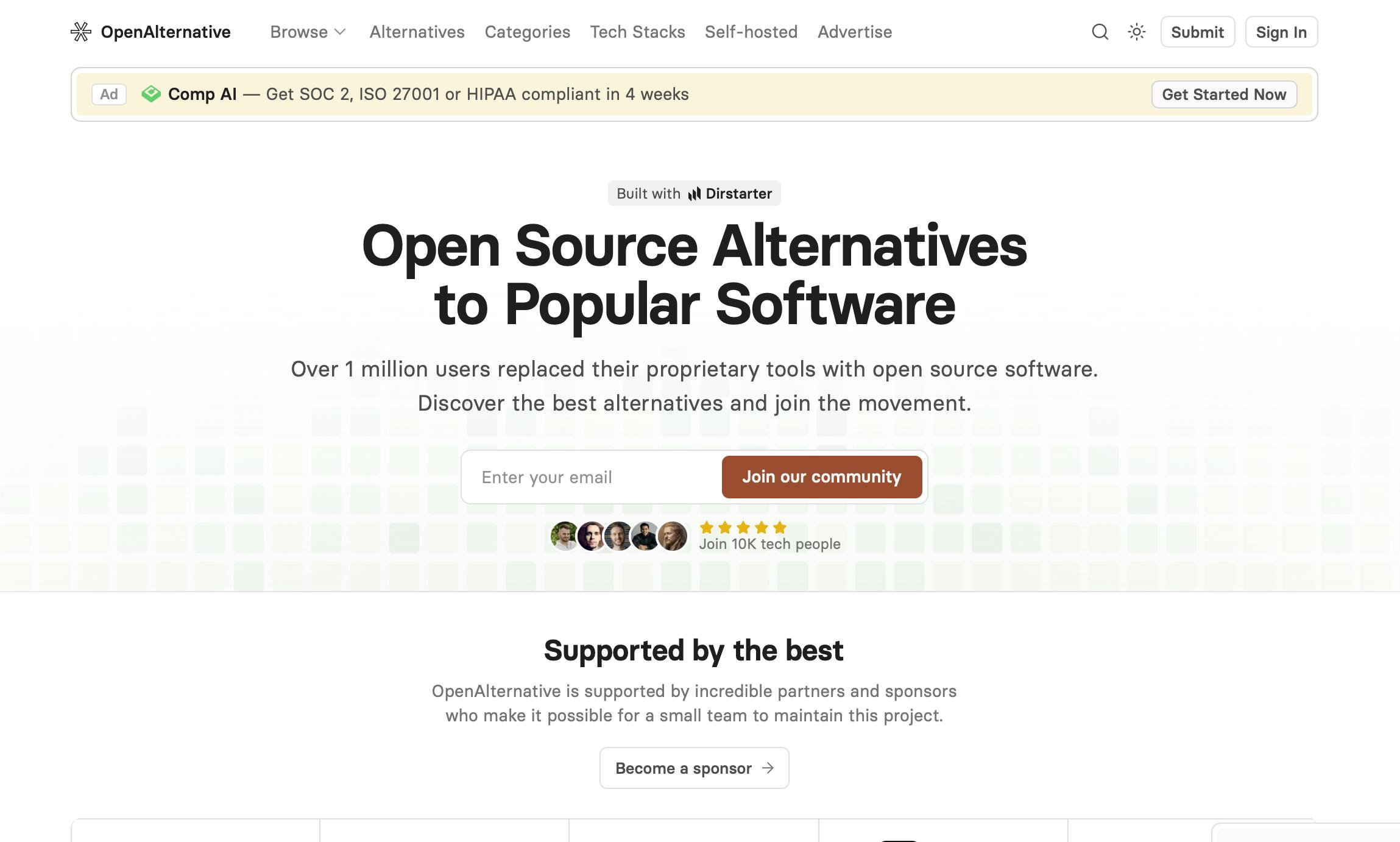
OpenAlternative, a community-driven directory of open source alternatives to proprietary software
Dirstarter, a Next.js boilerplate for building directory websites.
Scratching his own itch
OpenAlternative started as a personal collection of open source tools I was gathering for my own use — partly to learn from the code, partly to find better alternatives to paid software. One weekend, I decided to turn it into a public website.
I gave myself 48 hours to build and launch it. I dedicated every waking hour to the site. No overthinking. Just ship.
That launch brought over 100,000 visitors in the first week. I never expected it to become a real business, but here we are. After struggling to monetize it for about a year, traffic grew, and I found advertisers and sponsors much more easily. The site now generates around $6,500 MRR through ads/sponsorships (65%), and featured listings (35%).
Dirstarter is bringing in about $5k/mo in one-time purchases. And I also make about $250 MRR from other directories and $500/mo from affiliate commissions.
So, in total, I'm doing $12,000-13,000 per month.
A stack that became another product
With such a short timeframe, I had to be ruthlessly selective. I built a simple listing site with no search, no filtering — just a clean list of open-source projects organized by category.
The initial tech stack was intentionally simple:
Astro for the frontend (I wanted to learn it anyway)
Airtable as the database (no-code, easy to manage)
Cloudflare Workers for a scheduled script that pulled GitHub data daily
For content, I manually collected about 70 open-source projects using Google, Reddit, GitHub, and my own knowledge. I was selective — quality over quantity, focusing on actively maintained projects people actually use.
The site launched in February 2024. Since then, the stack has evolved. Airtable became limiting, so I migrated to Next.js with PostgreSQL.
For OpenAlternative and my directories:
Next.js 15 (migrated from Astro when I needed more flexibility)
PostgreSQL database
Vercel for hosting
Stripe for payments
Cloudflare Workers for scheduled tasks (GitHub data fetching, etc.)
For automations and workflows:
N8N for automation
Typefully API for scheduling posts across multiple platforms with a single endpoint
Custom AI content generation engine (integrated into Dirstarter)
Logo.dev and ScreenshotOne APIs for automatically pulling favicons and screenshots
When I found myself reusing this setup for other directories, I realized I was onto something — and that's when I packaged it into Dirstarter.
Strategic SEO and community engagement
Initial growth for OpenAlternative came from Reddit and Hacker News. Developer communities are perfect for a project like OpenAlternative — you just have to avoid coming across as spammy. Provide genuine value, share insights, let the product speak for itself.
The first week after launch brought over 100,000 visitors, which was incredible validation that the idea resonated.
For sustainable growth, SEO has been the main driver. I built the site with programmatic SEO in mind from the start. Each open source project has its own page optimized for search, plus I generate pages for categories, programming languages, and "alternatives to X" queries.
I also learned to use GitHub data strategically — pulling stars, forks, issues, and tags to create rich, auto-updating content that search engines love.
And more recently, I've been investing in content marketing with targeted blog posts around specific keywords. I hired a freelance writer to help with this.
Automating social media has helped maintain visibility without eating up my time. N8N reads the RSS feed and posts new content automatically across platforms.
Open-source mistakes
When I posted OpenAlternative on r/SelfHosted and it got 250+ upvotes, I got excited — and I immediately added a $97 Stripe payment link for featured listings. The community turned on me fast. The post got removed, I received tons of negative feedback, and my credibility took a hit.
The open source community is naturally skeptical of commercial motives and I wasn't respecting that.
If I could do it over, I'd focus purely on building trust and providing value first — and then I'd explore monetization much more carefully.
That said, I learned from it. I pulled back, focused on the product, and didn't attempt monetization again for almost a year. When I finally figured out the right approach — featured listings and sponsorships positioned more thoughtfully — things started working.
The lesson? Don't rush monetization. Build trust first, especially in communities sensitive to commercial interests. The revenue comes if you're patient and authentic.
Three game changers
Three things have been game changers for me:
Automation-first mindset: I automated everything I could from day one. Data collection, content generation, social media posting, even ad sales. This lets me run the entire operation in 2-3 hours per week, freeing up time for new projects and experiments.
Consistency beats everything: Since OpenAlternative has been open source from day one, I get copycats almost every week. People clone the site, launch their own versions, but none stick around. The best competitive advantage is showing up every day. With AI capable of cloning any website in minutes, persistence is the only real moat.
Building in public: Following other indie hackers on X and sharing my own journey has been incredibly valuable — for accountability and learning what works. The indie hacker community is genuinely supportive.
Must-read books
Here are a few books that shaped my approach:
"Million Dollar Weekend" by Noah Kagan—perfectly aligned with my philosophy of building and validating quickly
"Company of One" by Paul Jarvis
Alex West's books (founder of CyberLeads)
Don't overthink it
Here's my advice:
Don't overthink it. Just start simple. Pick a niche, build something basic, and launch as fast as possible to see if it gets traction. Don't be afraid to kill an idea if it doesn't work. I've killed plenty.
Be patient with monetization. This is my biggest lesson. Build trust first, especially in communities like open source where people are sensitive to commercial interests. I learned this the hard way when Reddit turned on me for adding a payment link too early.
Automate everything you can. I mentioned this above, but it bears repeating. Your time is your most valuable resource. Every hour you spend on manual tasks is an hour you're not spending on growth or new ideas.
Launch everything you build. No one will ridicule you. You'll gain valuable insights and quickly learn if something has potential. I never imagined OpenAlternative would grow this big when I posted it to my 700 Twitter followers.
And finally: consistency beats everything. In a world where AI can clone any website in minutes, the only real moat is showing up every day.
What's next?
I've always wanted to run a successful SaaS company — that's my main goal for 2026.
More specifically, I want to reach at least $10K MRR from a software product. Directories have been great, but they're a double-edged sword — I'm at Google's mercy. If they decide to tank my rankings, I could lose my traffic overnight.
So a big priority is diversifying income streams and reducing dependence on SEO. I want to build something with more defensible distribution — whether that's a SaaS with strong word-of-mouth, a product with built-in network effects, or something completely different.
The freedom I have now is exactly what I was chasing when I quit my job years ago. Now I want to build on that foundation and see how far I can take it.
Follow along
You can find me on:
X/Twitter: @piotrkulpinski
GitHub: github.com/piotrkulpinski
Website: kulpinski.dev
And check out my projects:
OpenAlternative: openalternative.co
Dirstarter: dirstarter.com
I share my journey building in public, so follow along if you're interested in directories, SEO, or indie hacking. Always happy to chat!

Leave a Comment
What are some additional ways that you promoted the product to get 100k visitors in the first week? Genuinelly curious as we are using both Reddit and Indiehackers for this but not seeing nearly so much engagement, even though every post is genuine and provides value. Did you invest in PR? Did you do any business developemnt upfront? Producthunt? Thanks.
The launch was organic and pure luck to be honest. I got picked up by some big account on X and other socials and it snowballed from there.
But you can have a successful directory without the viral launch, but it takes a little more time and patience.
This resonates with how we built Pick an Agency. The key insight you've nailed: directories work best when the core utility solves a real pain first, and monetization follows the trust. Most people flip that and burn out on spam listings. We index 47,000+ agencies globally and the constraint isn't code, it's trust and data quality. Are you considering reviews or ratings as a feedback layer on OpenAlternative, or keeping it pure curation?
This is super interesting, feels like you’ve basically turned SEO into a distribution engine rather than just content.
How defensible this gets long term once others copy the playbook?
Absolutely loved this post — the directory play really resonates with me! I’ve been focusing on delicesaufour fr a (artisan/food-related) directory and showcase for local bakeries and sweet makers in France 🍰🇫🇷. Doubling down on well-curated, niche directories has not only boosted our SEO but also brought in highly targeted users who genuinely care about the content we curate. Your journey reinforces that quality + relevance > chasing generic traffic — and that’s something I’m applying every day. Excited to keep building and scaling!
The underrated part here is restraint. Shipping something simple fast, then not monetizing for almost a year after getting burned takes real discipline. In a world where directories are easy to clone and SEO is fragile, consistency and trust end up being the real moat.
This is an incredibly inspiring story! Your journey from building directories as a personal project to achieving $13k/mo is a perfect example of solving your own problems and scaling from there.
The 48-hour launch timeline is particularly impressive - it really shows the power of avoiding perfectionism and just shipping. Your transparency about the open-source monetization misstep is also valuable; building trust before monetization is such a crucial lesson for anyone working with developer communities.
The automation-first mindset you've implemented is brilliant, especially the way you've used GitHub data for dynamic SEO content. Congratulations on your success, and thank you for sharing these insights with the community!
Congratulations! Inspiring journey!
for someone looking to go the same route , when deciding which directories were worth scaling, what signals mattered most to you early on (search demand, monetization potential, or how fast they started indexing)?
Before building – search demand, overall topic interest
After building – does it bring value to visitors, are the companies willing to pay to get listed, etc.
The GitHub data as auto-updating SEO content is smart - the pages improve without you touching them. How much of your current traffic comes from the programmatic pages vs. the hand-written blog posts? Curious which compounds faster.
Programmatic pages usually rank better, but I feel like the long-form content will last longer and have more impact as the time goes by.
This is such a useful breakdown... thanks for sharing!
Directories really feel like one of those underestimated channels. It’s interesting how many makers spend most of their energy on Twitter or Product Hunt, but a few well-chosen directories can actually drive very consistent, intentional traffic.
For me, the challenge is knowing which directories are worth the time vs the ones that feel like noise, especially for early-stage projects where every hour counts. Curious how you decide which directories to list first? Is it instinct, metrics, or just experimentation?
Also, did you find that the traffic from directories turned into actual users or mostly passive views?
I go with the gut and stick to the ones that show traction.
As for the conversion from clicks, I'm currently earning ~$1k from the affiliate links on top of the direct revenue, so this is a proof the conversion is there. Also, I have advertisers who stick with me from the day I started monetizing it, so that's another indicator that it's not just passive traffic.
That’s super helpful, appreciate the concrete numbers.
The fact that advertisers stick around and affiliates convert definitely says a lot more than raw traffic stats.
When you say “show traction,” what’s usually the first signal you look for?
Is it search impressions, clicks, early signups, or just a general sense of demand? I’m trying to get better at recognizing when something’s worth doubling down on before it’s obvious.
I really love this story, especially the points about starting simple, shipping fast, and learning from real feedback. The idea of giving yourself a hard deadline and just building in 48 hours really resonated with me; it shows that speed and execution can teach you more than overthinking ever will.
I really love this advice - especially the points about consistency and patience. Showing up every day truly is a competitive advantage, even more than fancy ideas or tools. I also appreciate the reminder to launch quickly and not overthink things; you learn so much faster that way. Automating tasks to protect your time is something I need to take more seriously. Overall, this is such a practical and inspiring perspective for anyone building something meaningful. Thanks
I like the thinking behind diversifying away from SEO dependence. I've seen too many directory businesses crater overnight from algorithm changes. Also love that you're running everything in 2-3 hours/week through automation. Curious tho about the seas goal, what direction you're leaning for that $10k mrr target?
This is such a solid example of real indie hacking done right. What really stood out to me is how much of this success came from constraint-driven decisions rather than some grand master plan — starting with a simple personal list, shipping in 48 hours, and letting usage and traction pull the product forward. The patience around monetization is especially underrated; most people rush it, burn trust, and never recover, while Piotr did the opposite and let credibility compound. I also love the point about consistency being the only real moat now — with AI making cloning trivial, execution over time is the differentiator. This is a great reminder that you don’t need to predict the perfect business upfront; you just need to start, listen, and keep showing up.
This is a massive insight, thanks for sharing! I’ve been debating whether to focus on SEO or directories for my new project, ProofNote (it’s a blockchain-based IP protection tool).
The $13k MRR is impressive, but what I find most interesting is the efficiency of directories for initial traction. Did you find that some directories brought higher 'intent' users than others, or was it purely a numbers game for the backlink juice?
I'm currently at the stage where I need to decide where to put my energy, and your post just pushed directories to the top of my list. Cheers for the transparency!
Hit $12k MRR on directories is wild, especially with such a simple stack. I really felt that part about being at Google's mercy. It’s exactly why our team at seven mountains started moving away from regular Google SEO lately and experimenting with GEO (optimizing for AI search engines like Perplexity or ChatGPT citations). Google updates are just too unpredictable now.
Since you want to transition into SaaS this year to build a more defensible moat, are you planning to use your current directory traffic to kickstart it, or start something totally new from scratch?
Running a similar model in a completely different niche. I built a directory of 570+ construction software tools and just got my first paid customer last week through cold email.
Your point about being at Google's mercy is the thing that keeps me up at night. I went with one-time pricing ($59/$119/$199 for featured listings) instead of subscriptions because the value prop is the backlink and placement, not ongoing access. Curious if you've thought about one-time vs recurring for featured listings, or if the subscription model is working well enough that it's not worth testing.
The cold email piece is interesting too. I built a full local pipeline to send 40/day to SaaS vendors who aren't listed yet. The pitch is basically "you're not in the only directory built specifically for construction pros, free to list, paid if you want priority." First conversion came from a CEO who forwarded my email to his HR team. Not scalable forever but it's working while DR is still low.
How did you handle the early days before SEO kicked in? That 48-hour build to 100k visitors story is wild but I'm guessing most directory builders don't get that kind of launch spike.
Congrats on the first paid customer. That first one changes everything mentally.
I run a similar operational support for founders—specifically the manual data work behind directories and outreach pipelines. Stuff like: adding new tools to the directory, verifying existing listings, cleaning the lead list, tracking who replied and who needs follow-up. The kind of repetitive work that has to be done by a human because it requires judgment.
It sounds like you're handling that whole pipeline yourself right now while also trying to grow SEO and close paid listings. That's a lot for one person.
I help founders in exactly your position: I take over the manual parts so they can focus on the high-leverage moves. My English isn't perfect but my accuracy and follow-through are.
If you ever want someone to handle the daily data tasks behind the directory and outreach while you focus on closing and strategy, I'd be happy to do a small paid test task first.
What's the one manual update or data entry task in your directory that you put off the longest because it's tedious?
I really relate to your “48-hour rapid launch” principle. I often overthink features, but seeing how you built the initial version of OpenAlternative using just Astro and Airtable made me realize that the real value lies in solving problems.
This is a really solid breakdown of the directory strategy. It’s interesting to see how much traction you can still get by focusing on niche utility tools rather than just chasing the next "big" SaaS idea. The point about doubling down on what already works is huge—too many people jump to a new project before fully exhausting the SEO potential of their current one. Have you found that certain niches (like PDF tools or media converters) tend to have better retention, or is it mostly a volume game with one-off users?
Great to see the $13k milestone, that's a massive achievement for this kind of model.
The directory model is often overlooked, but it's a brilliant way to build a sustainable boilerplate business. I'm curious, Piotr, how do you handle the initial chicken-and-egg problem when starting a new directory? Do you focus first on populating it with quality data manually to attract traffic, or do you prioritize the SEO structure of the boilerplate itself? I’ve seen many directories fail because they lack that initial depth.
This is super interesting
The OpenAlternative → Dirstarter product birth sequence is one of the cleaner examples of "build it, then sell the recipe." You validated directory economics by running one that worked — OpenAlternative gets organic compounding as every new listing adds content that adds search surface area. Once the model was proven, you could sell the infrastructure to people who want to replicate it. That's a credible proof of work that most boilerplate sellers don't have.
Directories also have unusual unit economics compared to SaaS. Acquisition costs are low (SEO-driven), marginal cost per listing is near zero, and the product grows its own distribution because listings = content = search traffic = more submissions. The compounding is structural, not just a nice-to-have.
The WordPress theme → directory boilerplate arc over 10 years is also interesting. The technology changed completely but the category never did. That kind of sustained focus on one vertical builds intuition most generalist product builders never develop. You probably understand directory SEO and UX at a level that's hard to acquire without having done it repeatedly.
The 10-years-ago-in-Poland context for the "first sale" story is worth noting. The psychological barrier to believing solo products could generate real income was genuinely higher then and there. That first notification didn't just make money — it made the mental model possible.
What's the revenue split roughly between OpenAlternative and Dirstarter — is one significantly bigger than the other?
This is useful information, thanks for sharing.
Really enjoyed the breakdown.
Love how you treated SEO as a long-term distribution engine instead of short-term traffic.
Curious — did you validate demand for categories first, or build them based on intuition?
This was a great example of execution over complexity. Many founders search for a unique idea, but you showed that doing simple things consistently can work really well. Also interesting how compounding traffic from small directories eventually becomes meaningful revenue.
This is a great reminder that speed + consistency beats perfection. Launching in 48 hours, then iterating into multiple revenue streams, is exactly how small projects turn into real businesses. Also loved the point about automation as a moat — not many founders talk about how leverage on time is what actually makes solo projects scalable.
Love the consistency, that's what made you a winner my friend!
Most comments here are praising the story (deserved), but I want to push back on one thing, you mention consistency is the only moat, but isn't the real moat the automation layer? Anyone can show up daily, but running the whole operation in 2-3 hours/week because you built the right systems is what makes a difference. Without that, consistency just means burnout. How long did it take you to get the automation pipeline to the point where it actually freed up your time rather than just being another thing to maintain?
In addition to increasing visibility and backlinks, double-down on directories drove consistent traffic and conversions. The strategy helped grow revenue from $13k/month to $13k/month by optimizing listings and targeting niche platforms.
Something wrong with math?
This is seriously motivating. I love how it all started with him just building something for himself and hitting launch without overthinking it.
The biggest takeaway for me? Start simple, stay consistent, and earn trust before trying to monetize. Seeing a small side project grow into $13k/month makes indie hacking feel very real.
What stood out to me isn’t just “directories work” — it’s how constraint forced clarity.
48 hours.
No search.
No filters.
Just curated signal.
That’s basically editorial judgment at scale.
In a world where AI can clone the interface instantly, the real moat feels like:
Taste (what gets included / excluded)
Systems (auto-updating GitHub data, automation loops)
Consistency over time
I also think your point about being at Google’s mercy is super honest. SEO is leverage, but it’s rented land.
Curious how you’re thinking about defensibility going forward:
If you were starting today in 2026 with AI-native tooling everywhere, would you still begin with programmatic SEO first?
Or would you design distribution into the product itself from day one?
I’m building an AI creative director and this same question keeps coming up for us — distribution vs. craftsmanship vs. automation.
Really appreciate how transparent this breakdown was. Super clean execution.
Oh my... what a stupid AI slop, why???
This is so helpful! Your point about consistency being the only real moat really resonates.
I'm coming from a similar angle but different niche - I am 25 years in running nonprofits and know how badly that sector needs better tools. I built a directory of nonprofit tools called Nonprofit Tools .com and a companion app called CauseKit Pro, and now AptiBuild AI to help people discover app ideas hiding in their unique skill combinations.
Curious about your automation setup. How much of your content pipeline is fully hands-off vs. needing manual review? That's something I'm trying to figure out as a solo founder still leading my organization and juggling multiple products.
This question hits exactly the right tension. As a solo founder, the move from 'I do everything manually' to 'fully automated' is rarely one jump. I've seen a middle step work well: keep the high-judgment review yourself, but hand the repetitive operational parts to a detail-focused human who can handle data entry, content formatting, directory updates, and tool maintenance without you thinking about it.
That gives you back time to lead your organization while someone else keeps the pipeline fed and the directory clean. I actually do exactly this for founders: manual data work, spreadsheet and directory cleanup, content scheduling prep. My English isn't perfect but my accuracy and turnaround are solid.
If you ever want someone to take over the manual parts of your content or directory maintenance so you can focus on high-level review, I'd be happy to do a small paid test task first.
Out of curiosity, what's the single most repetitive manual task across your products right now that you wish could just be done for you?
Absolutely loved this post — the directory play really resonates with me! I’ve been focusing on delicesaufour fr a (artisan/food-related) directory and showcase for local bakeries and sweet makers in France 🍰🇫🇷. Doubling down on well-curated, niche directories has not only boosted our SEO but also brought in highly targeted users who genuinely care about the content we curate. Your journey reinforces that quality + relevance > chasing generic traffic — and that’s something I’m applying every day. Excited to keep building and scaling!
Trust first, monetize later + ruthless automation = underrated combo. This story is a great reminder that consistency is the real moat, not code.
This really hit home: 'Every hour you spend on manual tasks is an hour you're not spending on growth.'
I’m currently living that exact struggle. I run a web agency and I've actually just built my first SaaS product, but I haven't been able to get my first paying user yet because the agency demands eat up all my time. (I run a freemium saas model). I love the craft of SEO and client work, but the lumpy revenue and constant manual tasks are keeping me from making the switch.
Seeing how you used automation to reclaim your time is exactly the motivation I needed to fix my priorities. Thanks for the push.
The part about delaying monetization really stood out. I’ve seen similar pushback when commercial features are introduced too early especially in dev-heavy communities. Trust really is the currency first. Also interesting how automation + a simple initial stack carried so much of the early growth. Feels like a good reminder that production thinking matters more than feature count.
The Reddit monetization lesson really resonated. I've seen the same dynamic in developer communities - if you try to monetize before you've earned trust, the backlash can be worse than starting from zero. The Cloudflare Workers approach for pulling GitHub data automatically is clever though. Programmatic SEO with genuinely useful, auto-updating content is one of the few strategies I've seen work reliably for dev tools without burning through an ad budget. Smart move packaging the stack into Dirstarter too - your own dogfooding is the best validation.
The Dirstarter angle is what makes this really interesting to me. Taking a stack you already built for yourself and packaging it as a product is one of the cleanest paths to a second revenue stream — zero additional research needed, you already know every pain point. Curious about the pricing though: at $5k/mo from one-time purchases, that implies pretty solid volume. Are most buyers technical founders spinning up niche directories, or are you seeing non-technical people trying to enter the space too? That would tell you a lot about where to take the product next.
Great strategy, directories can drive consistent organic traffic, build authority, and compound growth when optimized with niche targeting, strong SEO, and ongoing content updates.
This was a fantastic explanation. ~
I was struck by the part about how directories are boring, but predictable.
I noticed the same thing with simple utility-type sites – they don’t feel exciting to build, but they masterfully compound because the intent is so clear.
A person arrives there with a prior intention.
Seeing the SEO benefit makes a lot of sense too. Saying clever things is not the point here but owning very specific searches which don’t change much over time.
I also appreciated the candor about what didn't work. It gives the whole strategy a more repeatable feeling, rather than a lucky hit.
Sharing openly is underrated. It not only keeps you accountable but also attracts a supportive network that helps refine ideas. The indie hacker community thrives on this transparency, and your journey is a great example of how valuable it can be.
Great read
Man, that's such a relatable story! It’s wild how that first notification of a sale can completely flip your mindset from "this is a fantasy" to "this is a career". I love that you focused on being ruthlessly selective with the 48-hour launch instead of getting stuck in the typical endless dev cycle. It's a huge lesson for all of us trying to ship faster and let the market do the talking!
Loved this, the biggest takeaway for me is how far constraints + consistency can take you.
Shipping in 48 hours, earning trust before monetizing, and letting SEO compound over time is such a clean playbook.
Great story to read!
Great story and very inspiring! Your '48-hour launch' rule really resonates with me. I’ve often found myself overthinking features, but seeing how you built the initial version of OpenAlternative with just Astro and Airtable is a great reminder that the value lies in solving the problem, not the complexity of the stack.
I especially appreciate your honesty about the Reddit monetization mistake—it’s a valuable lesson for those of us just starting to build in public. Thanks for sharing your journey!
Great story, but I’m not fully convinced consistency alone is the moat. A lot of copycats fail not just because they quit, but because they don’t have the same distribution intuition or editorial judgment. Feels like there’s more “craft” here than the narrative lets on.