From $0 to $62k MRR in three months

Quitting a dream job
I started coding at 13, building RuneScape private servers in my bedroom. That early obsession with creating things never went away.
I studied Computer Science, then spent six years as a Software Engineer. I started at a startup, building licensing software for London councils. Then, I moved into larger corporate roles at Elastic Path, Base, and Vonage, working on Go microservices, event-driven architectures, Kubernetes clusters, and authentication services.
By 26, I was a Senior Engineer living in a 33rd-floor apartment in Canary Wharf, working remotely with a view over London.
On paper, it was the dream. In reality, I wasn't building anything meaningful to me. Promotions quickly lost their thrill. I shipped code that didn't matter to me. I wanted to build something of my own. Something real. And with people I trusted.
I made the call. I ended my apartment lease, moved back into my parents' house, and started exploring business ideas. Just time, savings, and a belief that I could figure it out.
Three months later, Jake Ward proposed an idea to me. He had wireframes, a clear idea, and 60k users from Kleo 1.0, proving demand existed. And I knew I could build it.
Now, I travel the world with my cofounders — Jake Ward, Lara Acosta, and Rob Hoffman — who are also my best friends.
From cease-and-desist to v2.0 in four weeks
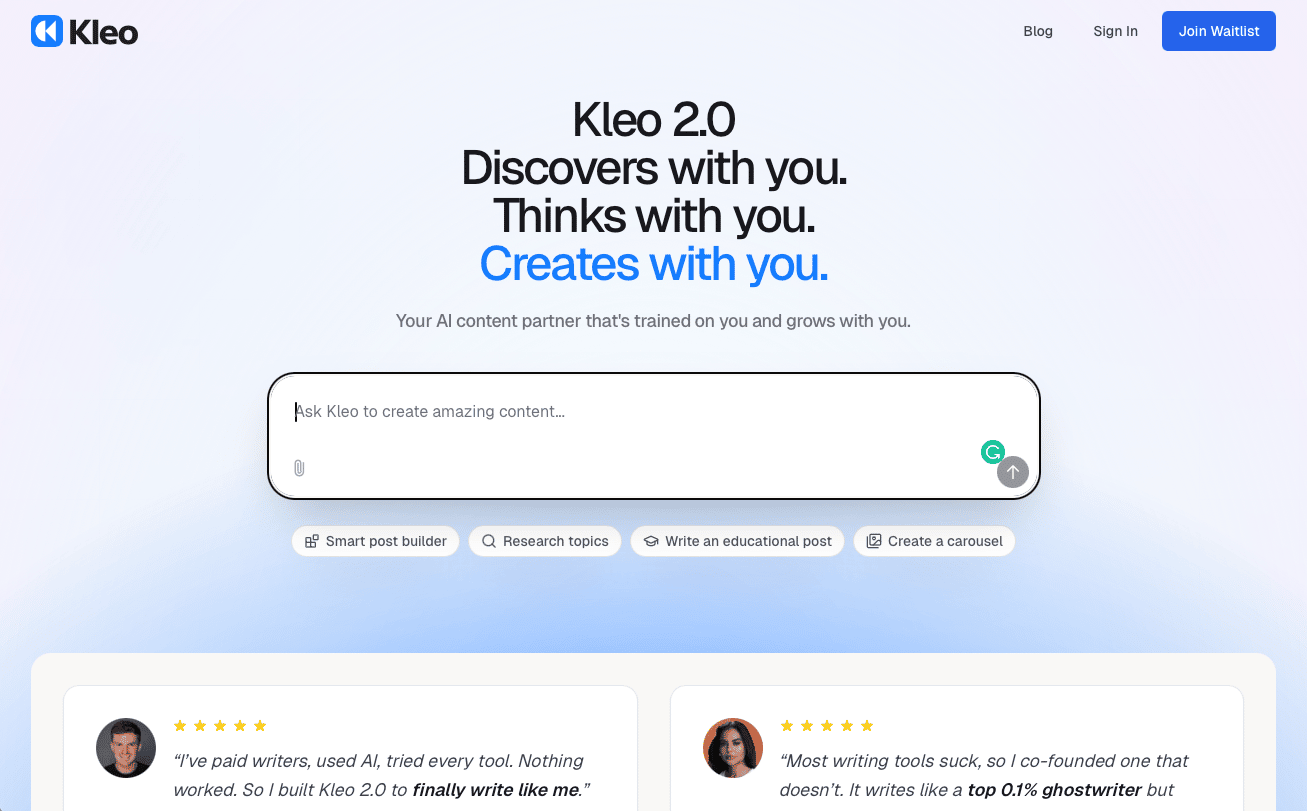
Kleo 1.0 was a free Chrome extension that scraped LinkedIn data, showing users what was trending in their niche. It had 60k users before it got a Cease and Desist from LinkedIn and had to be taken down.
We analyzed other tools in the space and saw how we could improve upon them. Then, I built the first working version from scratch in four weeks.
We started from the Vercel AI Chatbot template. It provided a solid foundation for the chat interface, and I built everything else on top of it. The stack was TypeScript, Next.js, Vercel for deployment, Neon for the database, Inngest for async workflows, Claude for the AI, and Clerk for authentication.
Here's our stack now — and why we chose it:
Next.js with TypeScript for code – industry standard, massive ecosystem, easy to find solutions.
Claude Code for coding – I've been coding 10+ years; I only started using AI for coding in the last 12 months. It's a game changer for shipping fast.
Vercel for hosting – deploys in seconds, zero config.
Vercel Chat SDK for building the chat interface – worked out of the box with the template.
Vercel Blob Storage for storing files – already on Vercel, no extra setup.
Inngest for async tasks – simple API, handles retries and queues without the headache.
Sanity for the blog – quick to set up (moving to WordPress soon).
Cloudflare for simple bot protection – free tier, easy DNS setup.
Claude for AI – best model for writing, fits our use case perfectly.
Claude Vision for reading images and documents – same API, no extra integration.
Neon Database (Postgres) for data – serverless Postgres, generous free tier, instant setup.
Clerk for authentication – drop-in auth, handles everything out of the box.
Slack for communication – where our users already are.
Loops for emails – clean UI, easy to build campaigns fast.
Fernand for managing support emails – simple shared inbox, no bloat.
Calendly for scheduling appointments – everyone knows how to use it.
LinkedIn API for scheduling posts – direct integration, no middleman.
ShadCN for styling – copy-paste components, looks good instantly.
Deepgram for voice-to-text – fast, accurate, easy API.
Perplexity for web research – gives sources, handles search without building our own.
PostHog for analytics on user usage – open source, detailed session tracking.
Langfuse for AI observability – tracks prompts and costs, essential for debugging AI.
I chose the stack for speed. Everything integrates well, letting me ship fast as a solo developer. No over-engineering. Just tools that work.
Iteration and prioritization
We brought in beta users early. They provided suggestions and reported bugs, helping us shape the product. That tight feedback loop was crucial.
We released 500 lifetime discount spots for the beta, which sold out in four days. Then, we spent four weeks fixing bugs and adding features based on user feedback. After that, we opened another 500 spots, which sold out in nine days. We listened again and shipped fast.
Jake and I worked closely together to refine different features and iterations. We'd go back and forth on what was working and what needed changing. We had a million ideas, so prioritization was key. We kept a simple list and worked from top to bottom. New thing comes up? Put it somewhere in the list. No complicated project management. Just a clear order of what matters most right now.
Bugs always came first. After that, we prioritized features that generated revenue and things our users asked for — not what we thought they wanted. That distinction matters. It's easy to build what you think is cool. It's harder to listen and build what people are telling you they need.
For example, users kept asking for a way to save and reuse their best-performing content formats. That wasn't on our original roadmap, but it kept coming up in Slack. So we built it. Same with voice input. People wanted to talk their ideas out instead of typing. We added Deepgram for voice-to-text when users requested it.
We also learned a lot from watching users seemingly "do things wrong". It was never their fault. We needed to simplify things more.
Users struggled to fill out their identity section properly, so we simplified it. They found it clunky to add writing style preferences, so we added Claude Memory to automatically update their preferences as they make changes to their posts. Kleo slowly gets better over time the more you use it.
Hitting $62k MRR in three months
We went from $0 to $62k MRR in 3 months. And we'll be launching publicly in mid-January. We achieved this growth through distribution and trust.
Distribution
Jake has grown his LinkedIn to 180k+ followers and Lara has 300k+. Their audiences are LinkedIn creators, providing the perfect target audience for a LinkedIn content creation tool. We used their reach to build a waitlist before launch. Plus, Kleo 1.0 already had 60k users who trusted our ability to build, giving us a warm, ready audience.
We employed a multi-layered distribution strategy. Lara ran 3 pre-launch webinars, selling $5k+ on each one. She then conducted masterclasses with Jake to demonstrate Kleo's use. Jake and Rob both created viral posts using the tool.
This was key. We built the tool for our own use. We sold nothing we didn't believe in. We used it daily and showed people the results.
Emails focused on new features, user success stories, and building hype. Then we sold 500 lifetime discount spots twice.
No ads. No Product Hunt launch. We had a product people wanted, we built fast, and we distributed through trusted individuals.
Trust
We built trust through process transparency. Jake and Lara shared behind-the-scenes updates on LinkedIn about our progress. Rob created short-form videos showing our progress.
We maintained a private Slack community for beta users to talk directly with us. When someone reported a bug, I often fixed it within hours and personally informed them.
People saw we weren't a faceless company. We were real people building something we cared about, treating their feedback like gold.
Revenue growth
We use a tiered subscription model through Polar.
We started with discounted beta pricing. The first 500 spots were $59/month. The next 500 spots were $79/month.
Standard pricing is $99/month. We are also launching an enterprise plan for ghostwriting agencies with unlimited team members and profiles.
And we're constantly building features that justify the subscription. Kleo gets better the more you use it. Claude Memory learns your writing style over time. That stickiness keeps people subscribed.
Solo devs need AI code editors
AI code editors have been my biggest advantage. Without a doubt.
I'd been coding for over a decade before tools like Claude Code existed. When they came along, everything changed. All those years of experience meant I knew exactly how to leverage them. I could architect solutions properly, review what the AI produced, and catch mistakes fast. The combination of deep experience and AI tooling let me build Kleo as a solo developer in a way that wouldn't have been possible a few years ago.
Focus on distribution and shipping
Here's my advice:
Distribution first. The best product in the world means nothing if no one knows it exists. Find your audience before you build. Partner with people who already have reach.
Build something you actually use. We built Kleo for ourselves. Jake, Lara, and Rob all use it daily. When you're your own user, you know exactly what needs to be better.
Ship fast, then listen. We had a working version in 4 weeks. It wasn't perfect. It didn't need to be. Get it in front of real users and let them tell you what's broken and what's missing. They'll show you what to build next.
Learn AI tools. If you're not using AI to code, you're leaving speed on the table.
Keep prioritization stupid simple. One list. Work top to bottom. New idea? Put it somewhere in the list. That's it. No fancy project management. Just focus.
Don't over-engineer. Pick tools that let you move fast. Start from templates. Use services with generous free tiers. Your job is to validate, not to build the perfect architecture.
Work with people you trust. The hard days are easier when you're building with friends. The wins are more fun too.
Trust the process. There will be doubt. Ship anyway.
What's next?
After seeing my work at Kleo, my cofounders, Jake, Lara, and Rob brought me on as cofounder and CTO at Mentions. It's a platform tracking how brands appear in AI-generated responses like ChatGPT and Perplexity. It's currently at $20k MRR.
Our goal for 2026 is to 5x Kleo to $300k MRR and Mentions to $100k MRR.
And we're looking to get acquired in the next 18 months.
You can follow along on X and LinkedIn. And check out Kleo and Mentions.

Leave a Comment
Going from $0 to $62K in monthly recurring revenue within three months requires a clear product–market fit, a focused target audience, and fast execution. Consistent lead generation, strong value messaging, and quick customer onboarding play a major role. Continuous feedback, rapid improvements, and scalable pricing models help sustain growth while building long-term customer trust and predictable revenue.
The distribution-first framing here is the part most builder posts bury or mention as an afterthought. Most people write the product story; you made it clear that 60k pre-launch users and audiences of 180k and 300k was the product - or at least as essential as the software itself. That kind of intellectual honesty is rare.
I've been tracking engineering data across a bunch of startup orgs, and rapid early MRR almost always corresponds to a concentrated unseen sprint in the weeks before launch - high commit velocity, low external visibility, then the distribution switch flips. What's interesting about Kleo is that the distribution switch was already built before a single line shipped. Normally contributor count spikes right after a funding event because capital enables hiring; with you it compressed because trust was already banked. The engineering could stay lean because the audience did the conversion work.
Once you hit that $62k mark, did the engineering pace change significantly - were you adding features in response to user feedback coming in at scale, or mostly consolidating what was already working?
The part about relentless customer validation really resonates! Curious - at what point did you feel confident enough to stop iterating on the core and shift to focus on distribution? That transition from still figuring out the product to "now scale it" is where I see a lot of founders (myself included) get stuck.
Honestly this is one of the more refreshing reads I have seen on here in a while. No ads, no Product Hunt, just people who already had trust with an audience showing something they actually used themselves.
The bug fixing within hours and personally messaging the user thing is something most founders say they will do and never actually do. That kind of detail compounds.
Real question though, if you strip away the 60k Kleo 1.0 users and the combined 480k LinkedIn following, what do you think actually got you here? Because most people reading this do not have that starting point.
The tiered beta pricing ($59 → $79 → $99) is brilliant. Rewards early adopters AND creates urgency.
I'm launching CentSense (receipt → tax category tool) and considering similar. Did you communicate the price increases ahead of time, or was it automatic based on signup number?
Also curious: how did you track those 500-spot thresholds? Custom webhook or manual?
Congrats on the numbers. The "distribution through trusted individuals" insight is real — but the question everyone in the comments is asking is the right one: what if you don't have 480k followers?
We're a two-person team with zero audience when we started. Our week-1 strategy was embarrassingly manual: finding individual Reddit threads where people were asking the exact question our product answers, and leaving genuinely helpful comments. No links in the first few comments — just actual help. The conversion path was: helpful comment → profile visit → product discovery.
It's slow. We're talking single-digit signups per week. But the quality of those users was way higher than any launch-day spike would give us. They came in already understanding the problem.
For anyone without a built-in audience: Reddit and IH are underrated for early traction if you're willing to do the unsexy work of commenting helpfully for weeks before anyone notices.
$62k in three months is wild. I wasted two weeks early on building an AI provider abstraction layer for tubespark.ai before anyone could use the product. Two weeks of clean architecture that zero users ever saw. Cameron's approach of shipping fast and fixing later would have saved me that. One thing I'd push back on, though: "listening to users" gets repeated so often it sounds easy. The hard version is listening when they tell you the thing you spent a month building doesn't matter. That happened to me with a performance optimization nobody noticed. How much of the $62k came from the first version vs iterations after user feedback?
The "$0 to $62K MRR in three months" headline needs the asterisk decoded: Jake Ward and Lara Acosta together have hundreds of thousands of LinkedIn followers in the exact target market for a LinkedIn tools product. This isn't a cold launch — it's a distribution-first company where the co-founders are the channel. Kleo v1 had 60K users before Cameron even joined. The three months is the time from Cameron joining to $62K MRR, but the distribution infrastructure took years to build.
That's not a criticism — it's actually the more interesting lesson. Most technical founders waste years building products and then trying to figure out distribution. Jake/Lara/Rob built the audience first and then commissioned the product. Cameron's value-add was "I can build this in four weeks," which is exactly the right technical co-founder bet when the distribution is already proven.
The Canary Wharf → parents' house move is also worth flagging as a real decision. Giving up a 33rd-floor Canary Wharf apartment to move back home is a signal about what you actually value versus what you told yourself you valued. Most people don't make that call until they have to.
RuneScape private server → senior Go engineer at Vonage → building Kleo: the technical arc is real, not window dressing. The product discipline to rebuild v2 from scratch in four weeks and fix bugs within hours comes from genuine engineering background, not hustle alone.
At RovaAI we're also a technical team thinking hard about distribution — this is exactly the partnership model that works.
Great breakdown, Cameron — the execution discipline (v2 from scratch in 4 weeks, fixing bugs within hours) is genuinely impressive.
For anyone reading this without 480k followers, the "distribution first" lesson still applies — it just compounds slower. I'm building distribution into the daily workflow: ship a useful open-source tool → write a technical blog about the problem it solves → share the insight in communities like this one. Each piece is a small, searchable asset. None of them move the needle individually, but the surface area keeps growing. When you have no audience, your product is your distribution — ship something useful enough that people find it on their own.
"Distribution first" is such an underrated lesson. As a solo founder about to launch, I keep reminding myself that building the product is only half the battle. The part about using trusted individuals for distribution instead of paid ads is gold — authentic reach always converts better. Thanks for sharing this breakdown.
Incredible! That's all I can say about this story! Thanks for sharing insights!
"We built the tool for our own use. We sold nothing we didn't believe in."
This landed. My project started the same way - I just wanted to automate messages for my fantasy football group. Wasn't trying to build a business.
The hard part for those of us without 180k followers: how do you get those first believers when you're starting from zero audience?
This is one of the most honest breakdowns I’ve read recently. The part about leaving a “dream job” that no longer felt meaningful will resonate with a lot of engineers who are comfortable but unfulfilled.
What really stands out is the speed + trust combo. Shipping v2 in four weeks after a cease-and-desist, then building momentum through real users, transparency, and direct feedback—not hype—is impressive. The Slack community, fixing bugs within hours, and listening to repeated user requests instead of personal preferences is textbook done right.
The stack choices and “speed over perfection” mindset are refreshing too. Templates, simple prioritization, and AI tooling used intentionally—not blindly—show how solo devs can compete at a much higher level today.
Distribution through trusted audiences rather than ads or launches is a powerful reminder: trust scales faster than traffic. Huge respect for the execution and clarity here 👏
Such an inspiring journey! From a dream job to building something meaningful with Kleo, your focus on distribution, fast shipping, and using AI tools is a game-changer.
Love how you prioritized listening to users and working with people you trust. Excited to see where Kleo and Mentions go next!
Wow—this is an incredible journey! Your story perfectly captures the balance between skill, speed, and trust. I love how you leveraged AI tools like Claude Code to supercharge your decade of experience, letting you ship Kleo as a solo dev so quickly. Four weeks from scratch to a working product is insane.
The focus on distribution and trust is such a standout lesson. Most founders obsess over “perfect features” before launch, but you built for yourselves, used your networks, and cultivated a community that actually believed in you. That warm audience + transparent process clearly made the difference—$62k MRR in 3 months is no joke.
I’m curious—out of all the AI tools and stack choices you made, which one ended up giving you the most leverage as a solo developer?
This resonates with me. I've been exploring how digital experiences can shape our attention and reflection.
don't have the guts to quit my college yet, but I will give more time to my SaaS building. Thanks for the workflow.
thanks so much for sharing your workflow and insights, this is super helpful for those aspiring to build a successful startup
I am finding difficult in getting the first paying client. Product is well built and I believe it has value, may not be that unicorn value but, it will be really helpful for the users who deal with data and analytics daily and developers like me who every day built backend for collecting data.
Since have no any people / users reach. I am finding very difficult to reach to them
Did you find yourself refactoring more or less than pre-AI development? I've landed on "ship fast, refactor often" but curious if your experience was different.
Really impressive speed. Curious what mattered most early on, distribution or timing? Appreciate you sharing real numbers.
How long did it take you to get your first paying user?
Hi, I'm new on Indie Hackers, I'm busy with a Micro-SaaS idea and I found this very motivating! Are there any extra tips that would be helpful to expand my knowledge on Micro-SaaS? I already have an idea, but I am not sure if the interest in my Niche is high!
Incredible breakdown! As a developer focused on UI/UX, I totally resonate with the 'Ugly MVP' problem. I actually built a Room Planner Boilerplate specifically to help founders skip the 40+ hours of fighting with Canvas API that you mentioned. Your stack (Next.js + ShadCN) is exactly what I recommend for shipping fast. Congrats on the $62k MRR!
Hi!! I am new to the SaaS ecosystem. These posts are incredibly motivating to read, so thankyou for posting this!!
Well done, not many people have the guts to quit their job and go full in on a risky business.
How are you guys dealing with rentention, using any user onbaording tools etc?
Impressive, I'm thinking of testing it :)
Hi,
I built a small tool because I was tired of spam hitting my personal inbox 😅
EmailShield[.]app lets you generate disposable email aliases so you can sign up for websites without exposing your real email.
I’m looking for early users to try it and tell me what sucks / what’s missing.
Happy to give free access to anyone willing to share feedback.
"This is a great update! From an SEO perspective, I’d suggest focusing on long-tail keywords and optimizing your on-page content early on to build a solid foundation. If you need any specific tips on improving your search rankings, feel free to ask. Happy to help a fellow indie hacker!"
What stood out to me is how little of this story is about “hacks” and how much is about focus — clear ICP, fast feedback loops, and getting in front of customers early instead of polishing in isolation. Going from 0 to $62k MRR that fast really highlights how powerful distribution + disciplined execution can be when the problem is well-defined. Thanks for sharing the details.
Going from $0 to $62k MRR in just three months is the result of sharp focus, fast execution, and relentless customer validation. By identifying a real pain point, launching a lean MVP, and iterating quickly based on feedback, growth accelerates. Clear positioning, aggressive distribution, and a repeatable sales motion turn early traction into predictable monthly recurring revenue fast.
This hits incredibly hard. After 11 years in the corporate executive suite, the 'golden handcuffs' are real, but as Cameron noted, promotions eventually lose their thrill when you aren't building something meaningful. I’m currently documenting my own transition from Senior Executive to a $30k/mo solo business. The 'Distribution First' advice is the ultimate cheat code—it’s the exact system I’m applying to my own playbook right now. Absolute masterclass in speed and focus.
Thank you for sharing this it helped me getting a better understanding of the market for the products I'm building.
The "on paper it was the dream, in reality I wasn't building anything meaningful" hit hard. Senior dev, good salary, shipping code that didn't matter to me. Same story here after 15+ years of freelance.
What stands out in your story is the distribution-first approach. Most devs (myself included) default to "build it and they'll come". Having 60k users from v1 + cofounders with 400k+ combined following is a massive advantage most solo devs don't have.
Curious: without that existing audience, would you have approached launch differently?
how did you get visibility out there? im doing by best but so many free groups wont let you post anything
Love the transparency. What would you do differently if starting over? Any channels or tactics that looked promising but turned out to be a waste of time?
Hitting $62k MRR that quickly is legendary!
I'm curious about the 'Day 1' traffic source. Did this growth come primarily from a massive launch (Product Hunt/Twitter), or did you find an SEO 'loophole' for utility keywords that started converting immediately? I'm currently experimenting with SEO for my own project (HexPickr) and would love to know which channel had the highest ROI for you early on.
yo, that's wild about the identity section! apparently, some users had a hard time with it so they just made it way easier. check out how they simplified things - oh can't post links...
Really appreciate you sharing this. The part that stood out most to me was choosing speed and distribution over perfect architecture. A lot of people intellectually agree with that idea, but very few actually commit to it the way you did.
Quitting a “dream job” when everything looks perfect on paper is something many engineers quietly think about but rarely act on. Your story highlights an important truth: fulfillment often comes from ownership and feedback loops, not titles or views from a high-rise apartment.
I also liked how you emphasized explicit prioritization and listening to users instead of guessing. That mindset translates well beyond startups. I have seen the same thing working on informational projects like smart square wellstar info guide where clarity and simplicity matter far more than clever abstractions.
Congrats on the growth and thanks for breaking down the process so honestly. This kind of transparency is what makes Indie Hackers valuable.
Fast growth always grabs stakes but what caught my eye here is how easy the fundamentals were.
Usually, the source of speed is about taking decisions away, not adding tactics.
I utilize a coarse lens.
Single ICP.
This is wrong.
One definite action for return on investment.
Everything else early on is noise.
I want to know what was the most difficult thing not to do for you in the first 3 months?
If you are feeling stuck, you may want to delete half of your roadmap and double down on the one thing that users already pay for. ~
Respect for taking the risk and making it work.
This really hits hard—in the best way.
The distribution point is the real insight here - 480k combined LinkedIn followers did the heavy lifting. Most of us reading this don't have that, so the question becomes: how do you get those first 100 users without an existing audience?
That said, the execution principles still apply regardless of scale: ship fast, prioritize bugs over features, and listen to what users actually do vs. what you think they want.
Curious - before your cofounders had those audiences, what was their early distribution strategy? Or was audience-building always the long game?
For founders without established audiences, what’s your go-to strategy for getting those first 50–100 paying users?
This is a masterclass in resilience. The pivot from receiving a Cease & Desist on Kleo 1.0 to hitting $62k MRR with v2.0 is incredible.
I'm curious about the psychology of your initial user base. When you shifted from a free extension to a paid SaaS model, did you find it hard to convert those original 'free' users, or was the demand just that strong?
This is exactly why AI tools are blowing up right now—problem first, tech later. I’m building something small in this space too and seeing the same pattern. Thanks for sharing real execution, not just hype.
Very interesting, i am myself trying to get into self-sustaining income and would like some more information on getting started as a beginner.
Thankyou!
Loved reading the article.
Really enjoyed reading this. It feels like building a strong, loyal fan base through trust is what really matters.
That's an incredible journey Cameron took—quitting for real impact and hitting $82k total MRR with Kleo and Mentions. Love the stack choices like Claude + Next.js for solo shipping and the beta sales via webinars. Key lesson: ship fast, listen to users, prioritize revenue features. Inspiring for any indie hacker! What's your next move?
This is a fantastic breakdown and a very real example of what “focus on fundamentals” actually looks like in practice. Cameron’s story reinforces many core indie lessons: prioritizing speed over perfection, ruthless prioritization, listening to users, and pairing solid engineering experience with modern AI tooling to move quickly. The way distribution, trust, and product usage all fed into revenue growth is especially instructive. An inspiring case study for anyone building solo or with a small team, proof that execution and feedback loops still win.
This was a really honest and motivating read. The idea of career insurance through ownership of an audience especially stood out — that’s something more creators are realizing, but very few articulate this clearly.
I also appreciate how transparent you were about the long “messy middle.” Ten years of experimentation, plateaus, and self-doubt is a reality most success stories skip, yet it’s often the most relatable part. It’s encouraging to see how those seemingly disconnected skills (design, animation, prototyping, marketing) eventually compounded into a very focused, scalable business.
The way you describe competition as a filter rather than a barrier is a powerful mindset shift. In overcrowded markets, quality and consistency really do become unfair advantages over time.
I’ve been exploring similar ideas around building sustainable, product-based income and documenting the process publicly, and this article reinforced how important it is to start sharing earlier — not just for growth, but for clarity and connection as well.
For anyone interested in the broader concept of turning skills into long-term leverage (audience, systems, and distribution), I’ve been collecting notes and resources here that complement a lot of what’s discussed above:
Thanks for sharing such a grounded breakdown — this kind of transparency genuinely helps people who are still in the “figuring it out” phase.
Partnering with someone who has reach, amazing point ! Cheers to James for putting together such a well detailed article!
this is insane velocity. congrats on hitting $62k that fast.
as a solo dev currently grinding through the cold start phase (building a Shopify performance tool), I'm curious about your week 1 strategy.
did you rely mostly on inbound/content to get those first 10 users, or was there a heavy manual sales/outbound push initially? trying to figure out the right balance while working a day job. thanks.
Well done !!! This gives me a confidence boost , I am also building something new
crazy numbers. Thanks for boosting my confidence, I am also starting something new...
This resonates.
We’ve seen a lot of websites that look polished but don’t really help users take the next step.
We’re 360WebCoders, a small digital agency. After years of working locally, we’ve recently started collaborating internationally, focusing on clear user flows, usability, and real business outcomes — not just visuals.
Sharing our site for context:
360webcoders
Good to be part of these discussions and learn from other builders.
The distribution point is the real takeaway here.
A lot of people fixate on “$62k in 3 months” and miss that this was built on years of credibility + an existing audience. Without that, the same execution would look very different.
What still resonates though is the tight feedback loop + shipping based on real usage instead of assumptions. That part does generalise, even without a big audience.
Great breakdown, Cameron! The "distribution first" mindset really resonates.
I just launched my own AI security tool (AgentAudit) last week - we scan LLM apps for prompt injection and other OWASP Top 10 vulnerabilities.
Your point about AI code editors is spot on. I built the entire platform as a solo founder using Claude Code - it's a game changer for shipping fast.
Curious about your experience with LinkedIn's API integration - did you face any rate limiting issues? We're considering adding social features down the line.
Congrats on the $62k MRR! 🚀
This is a super-misleading post. 3 months for people having hundreds thousandsof of followers is like 3 years for some without them. Where is the downvote button? IH disappointed me more than ever.
Really enjoyed reading about your whirlwind journey from quitting your job to scaling to $62k MRR so quickly. Bringing in beta users early and shipping based on their feedback clearly paid off. I also appreciated the emphasis on distribution-first and partnering with creators who already have reach.
As a fellow builder, I'm curious how you balanced rapid iteration with maintaining quality: were there moments when AI coding tools like Claude Code helped you move faster without sacrificing reliability? And on the distribution side, which channels ended up driving the majority of your initial sign-ups – was LinkedIn the clear winner, or did webinars and email marketing pull their weight too?
Hi, I help app owners get real worldwide users and installs
through task-based campaigns.
Happy to start with a small test batch.
What would you say is the best way to market a Sass product currently?
Thanks for the post.
Quick question for folks building or branding B2B products.
I’ve noticed a lot of early-stage teams launch on longer domains or creative TLDs (.ooo, .xyz, etc.) and later consider upgrading once the product and positioning are clearer.
I currently own everyday. tech and am deciding whether to keep it for a future project or sell it. Curious how much founders here actually value short, brandable domains once traction starts picking up.
For those who’ve rebranded or upgraded domains:
Was it worth it?
Did customers care?
Would you do it earlier next time?
Happy to share details if anyone’s curious, but mostly interested in founder perspectives. Thanks!
Thank you for your detailed post!
I agree with you that inital feedback is crucial. I am wondering, how did you get your inital users? And did the initial users pay for your tool or did you offer it for free?
This is a great reminder that speed + distribution beats perfect planning. Starting from a real audience, shipping fast, and letting users pull the roadmap forward is what most founders say they’ll do — but few actually execute this cleanly. Also love the honesty around AI as a force multiplier only when paired with experience. Solid playbook here.
This really resonates — especially the part about “on paper it was the dream.”
I’ve seen (and felt) that exact arc where promotions and scale stop feeling meaningful once you’re no longer building your thing.
I’m curious about one decision point though: when Kleo 1.0 got the cease-and-desist, how did you reason about continuing in the same space vs walking away entirely?
Was it purely the 60k users signal, or were there other indicators that made you confident this wasn’t just a short-lived hack?
Also appreciate the stack breakdown — not because of the tools themselves, but because it’s a good example of choosing speed + leverage over novelty.
This is a solid roadmap
This resonates a lot, especially the shipping fast + tight feedback loop part.
One thing that stood out is how clearly you validated demand before perfection (Kleo 1.0 users → v2 in weeks → paid betas). That’s something we’ve seen repeatedly with PitchArti founders too: the breakthrough usually doesn’t come from “one perfect pitch,” but from fast iterations, real feedback, and fixing what’s unclear immediately.
Your approach to prioritization (bugs first, then what users explicitly ask for) is underrated advice. Most teams overbuild opinions instead of listening signals.
Also +1 on AI as a leverage multiplier for experienced builders. The edge isn’t “AI writes code,” it’s knowing what to ask it to build, what to ignore, and how to ship without overthinking.
Great example of distribution + trust compounding faster than any technical advantage.
This comment was deleted 5 months ago