From open-source donations to $13k MRR product

Andris Reinman is the creator of Nodemailer, an open-source project used by hundreds of thousands of developers. But it didn't pay the bills. So he launched related open-source product — EmailEngine — and transitioned it into a $13k MRR business.
Here's Andris on how he did it. 👇
From open source to SaaS(ish)
I’m an email software developer and open-source maintainer. I’m best known for my open-source work — most notably Nodemailer, which is used by hundreds of thousands of developers and companies worldwide.
While open source brings a lot of visibility and impact, it doesn’t really pay the bills. I do receive regular donations, but they’re in the low hundreds per month.
About five years ago, I decided to turn my experience in email infrastructure into a business and started a company that builds and sells email software.
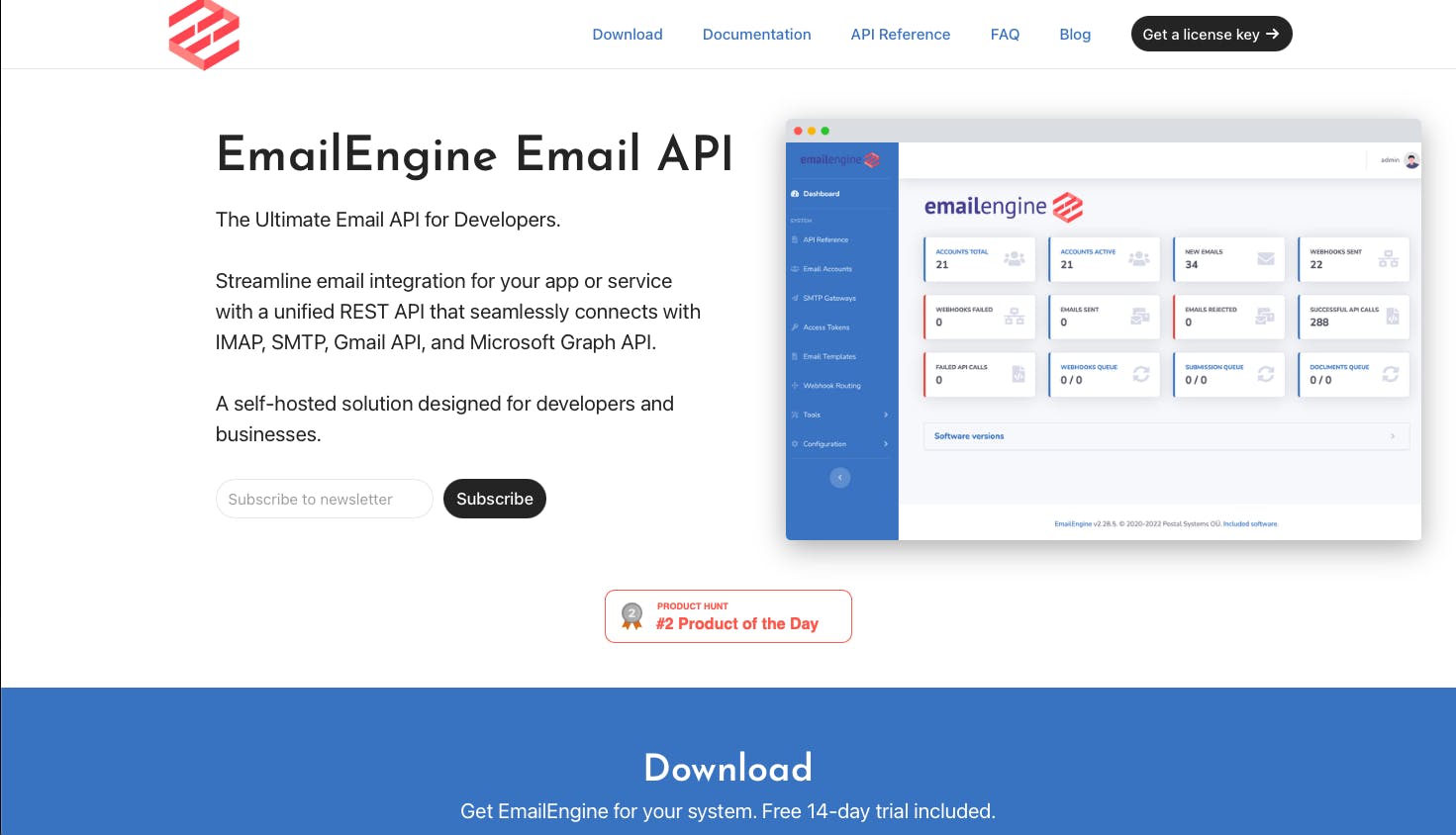
The original plan was to build multiple products, but in practice, one clearly stood out. Since then, I’ve been focused almost exclusively on EmailEngine — a self-hosted application that lets developers access email accounts via a simple HTTP REST API instead of dealing directly with IMAP, SMTP, or vendor-specific APIs like Microsoft Graph or Gmail.
We're currently at $13k MRR, growing at roughly 20% per year. Revenue growth has been slow but steady, so the revenue chart has no sudden bumps or exponential curves — just a mostly linear line from zero to its current position.
Burning out and starting up calmly
I was the CTO of a small VC-funded startup for four years. I took my laptop to the toilet and put it under my pillow while sleeping, just in case something happened and required a fast reaction. After four years, I was burnt out. I wanted a break.
As a long-time developer, taking a break still meant working — just without the pressure. That mindset shaped many of my decisions later. It’s also why I don’t provide managed hosting or take on large customers. If someone contacts me asking for a demo or wants to negotiate with “my sales team,” I kindly point them to some of my competitors instead.
All my customers are self-serve — usually competent, small technical teams that don’t require hand holding and therefore don’t burden me with constant support requests. What was originally meant to be a short break until I ran out of cash reserves turned out to be a viable business. I’ve been doing it ever since.
An unusual tech stack
EmailEngine is built on Node.js and uses Redis as its database. The homepage is hosted on umso.com, and the documentation is a Docusaurus project hosted on GitHub Pages. I also use Claude Code a lot these days.
Using Redis as the main database is not a very common choice — Redis is usually seen as a caching layer rather than an actual database. In my case, Redis was the option that had the best compatibility with IMAP indexing, specifically because of its Sorted Set data structure. Without going too deep into the details, that was the deciding factor.
I also didn’t want to ask users to set up multiple databases for different purposes, so I decided to use Redis for everything. It’s a choice I’ve sometimes regretted. Redis is missing a lot of features you’d normally expect from a database, like proper querying, and that has meant spending time implementing workarounds I wouldn’t have needed with a more traditional DB.
That said, keeping things simple has helped overall. It’s much easier for users to spin up their first trial instance for testing, and once someone is already testing the product, they’re much more likely to start paying.
Technical challenges
EmailEngine is technically a complex piece of software, and the main challenge has been that every customer uses it slightly differently and against different email backends. Even though email protocols have been standards for a long time, there are still noticeable differences between providers. What works one way with a Gmail account might behave differently with, for example, Korean Naver mail hosting.
These issues are hard to plan for in advance. If I don’t have an account with a specific email provider, there’s no real way to test it. Getting access to such accounts can be expensive if the provider is commercial, or outright impossible in some cases — especially with regional providers that require a local mobile number for account verification.
Finding the model
EmailEngine started out as yet another open-source side project, so for the first two years, I worked on it in my free time while still at my previous job. Initially, I didn’t intend it to become an actual business. The idea was to use it to increase the donations I was getting for supporting my open-source software development.
That didn’t really work, so I tried a dual-licensing approach. The open-source version was licensed under AGPL, and for “serious businesses” I offered an MIT-licensed version for a small yearly fee. There were almost no takers for that either. This phase took about a year and a half.
Eventually, I decided to go fully commercial, and almost immediately started gaining customers — mostly previous users of the free project, but also companies that wanted continued updates and upgrades.
So now, it is self-hosted software that requires a paid subscription to operate. Without a subscription, it runs in a 14-day free trial mode, after which it stops working. Subscriptions are yearly and self-renewing, and I use Stripe for subscription management. There is only a single subscription plan. There are no upsells or tiers — everyone gets exactly the same product, whether they’re a solo developer or a large bank.
Since there’s no hosted or managed version, I don’t really consider it SaaS — more like on-prem software with a subscription model.
After monetizing it, it remained a side project that I worked on during evenings and weekends. But I was already burned out from my day job. I started the process of exiting that role, which, for various reasons, took about half a year, until I was finally able to go all in.
At that point, EmailEngine was still not making enough to support me financially — around $500 MRR. I was living off my previous cash reserves, but I could see the potential and, more importantly, I actually wanted to work on this project. So I went all in and started working on it full-time.
Growth via open source projects
The biggest obstacle was reaching a point where the revenue was high enough for me to start paying myself, so the project no longer felt like a temporary pet project. But it wasn’t something I had to actively “overcome” in a deliberate way. At first, the revenue simply wasn’t enough. Over time, it became enough.
I didn’t push for growth. I just kept developing the product, saw that there was steady growth, and assumed that eventually it would get there — and it did.
The first ~10 subscribers were all users of EmailEngine back when it was still an open-source project. At the time, it had a different name - IMAP API. IMAP API was fairly popular, with around 1,000 stars on GitHub.
Otherwise, I’ve used a single growth “strategy” from the beginning. I’d call it engineering-led marketing. I’ve released a number of popular open-source and free products, and linked from those to EmailEngine.
Since all of these projects are email-related, there’s a natural overlap. For example, a Nodemailer user might eventually need features that Nodemailer doesn’t provide, but EmailEngine does — such as Microsoft Graph API–based sending using OAuth2. In those cases, they may end up checking out EmailEngine, and in rare cases, they end up paying for it.
I’ve never done paid ads — my marketing budget has always been $0.
The only other approach worth mentioning has been SEO. In particular, the “EmailEngine vs. some major alternative” type of articles. Users of those alternative providers who aren’t happy with their service go looking for options, find EmailEngine, and some of them turn into customers.
That said, it likely works both ways. I don’t really know whether I’ve gained more customers than I’ve lost to competitors through this, but overall it seems to have worked well enough.
The advantage of experience
My background in building open-source email projects has been a big advantage. Over the years—Nodemailer is 15 years old by now—I’ve gained fairly rare experience in a topic that is both complex and boring for most people. Along the way, I’ve also built an audience of developers who already use my projects.
Labeling EmailEngine as “made by the creator of Nodemailer” definitely makes it more trustworthy. Nodemailer has been around “forever” and quietly does its thing, so people tend to assume EmailEngine will probably do the same.
Look for your edge
Here's my advice: Look for an edge you might have — one that either you haven't noticed yet or you don't think of as an edge.
For example, I never considered my open-source work to be a growth driver for a business. It only turned into one after I had already started.
What's next?
I plan to keep building EmailEngine, and maybe return to my original idea of building multiple related projects. I’ve had many ideas over the years, but haven’t had the time — EmailEngine has been large enough to require my full attention.
Now, with AI, software development has become much faster, so I might revisit some of those old ideas. For example, a purely email-sending–oriented solution that would be much more scalable than EmailEngine — essentially providing the same email-sending capabilities, but in a more scalable way.
EmailEngine is tightly coupled to individual email accounts, and since each account requires constant attention — polling for new messages or accessing the mailbox — it consumes a lot of system resources. There’s also no horizontal scaling, which makes it difficult to build large-scale sending solutions on top of it.
As far as revenue, I have no plans to increase it beyond its current trajectory. As a solo business with essentially no cost base, and living in Eastern Europe, I’m quite happy with the current state.
You can follow along on LinkedIn. Here's the EmailEngine landing page, documentation, and source code. Note: EmailEngine is not open source but source-available: anyone can inspect the full source code, but using it requires a valid subscription.

Leave a Comment
Classic indiehacker pivot, turning 15 years of open-source 'boring' expertise into a $13k MRR solo business by building what devs actually need, not what VCs want.
This is a great example of turning deep, unglamorous expertise into a calm, sustainable business.
Engineering-led marketing + self-serve customers + zero growth theatrics is underrated and clearly works when you have a real edge.
Andris Reinman, creator of Nodemailer, turned his open-source project into a $13k MRR business with EmailEngine, a self-hosted email API. He grew it steadily through engineering-led marketing, open-source reputation, and SEO, avoiding paid ads. EmailEngine is simple, subscription-based, and targets self-serve technical teams. Andris plans to continue building it, leveraging AI to explore future scalable email solutions.
The "no demos, no sales team" philosophy is something I wish more founders talked about. It's not just anti-burnout - it's actually a customer qualification strategy.
When you force self-serve, you filter for people who can evaluate the product themselves. Which usually means technical teams who know exactly what problem they're solving. These customers don't churn because of misaligned expectations from a sales pitch.
I'm building in a similarly "boring" space (accounting automation) and the pattern holds. The best customers are the ones who find you through search, try it without asking questions, and only reach out when they're ready to pay. The ones who want a demo usually want you to convince them they have a problem, not solve one they already know about.
The 15 years of Nodemailer credibility doing the heavy lifting is the part that's hard to replicate though. That kind of trust takes time to compound.
A legit way to look at this is that open-source built the trust, and the paid product captured the value.
Andris didn’t suddenly jump from donations to $13k MRR. First, he spent years building a useful open-source tool that solved a real problem. That gave him three big advantages:
an existing user base,
deep understanding of the problem, and
credibility in the community.
When donations weren’t sustainable, he didn’t try to monetize the open-source project directly. Instead, he built a separate paid product for a more serious use case—things businesses actually pay for (automation, reliability, scale, support). The open-source project stayed free and continued feeding users into the paid product naturally.
The key lesson isn’t “open source makes money,” it’s this:
Open source is distribution and validation; monetization comes from premium needs.
Solve a real pain, earn trust first, then charge for advanced value—not for the basics people expect to be free.
That’s how you go from don
I think this is a great point, but only for point solutions. Those that solve one very clear pain point. I've found this to be less true in more complex b2b products. I am a bit surprised that you experience this in accounting automation. What's your ICP?
Huge congrats on the 13k MRR milestone. The transition from open source donations to a recurring product model is brutal. Most people underestimate the mindset shift required to start charging for something that feels like it should be free.
Are you finding that your user base from the donation days converted well, or did you have to go hunt for an entirely new customer segment that values the product side more?
Either way, incredible execution.
Thanks for sharing your story. The 'looking for your edge' advice is thought provoking, because you imply that it is often a blind spot. I wonder if it would be useful to build a taxonomy of skill categories - with such an artifact, it might be in interesting artifact to help identify one's own edge, as well as to consider where AI might be able to help you with areas that you don't have an edge, but which are important to attend to. Hmm 🤔
Hello
Really enjoyed this. The biggest takeaway for me is that slow, steady growth built on real expertise can be just as powerful as fast hype. Turning a niche skill and open-source credibility into a calm, sustainable business is honestly impressive.
I'm currently building a tool that finds SaaS ideas from real user complaints. Seeing how people validate ideas is really helpful.
The Nodemailer → EmailEngine path solves the problem that kills most open-source monetization attempts: the existing user base is the wrong customer. Nodemailer has hundreds of thousands of users who will never pay — they use it as a free utility and would just fork it or switch tools if you charged. EmailEngine targets a different, more specific problem (IMAP/SMTP abstraction, multi-provider REST API) for developers who are building email-intensive infrastructure and have already decided to pay for something. The open-source reputation builds trust and surface area; the paid product solves a harder problem for a subset willing to pay.
The self-hosted positioning is also a smarter market bet than it might appear. The companies that care most about IMAP abstraction are often enterprises or regulated industries (fintech, legal, healthcare) that can't route sensitive email data through a third-party SaaS. Self-hosted is not a downgrade — for those customers, it's a requirement. That's a customer segment with real budget and low price sensitivity.
The "20% per year, linear, no sudden bumps" description is refreshingly honest. Most infrastructure products grow this way — strong retention, moderate expansion, limited viral/community-driven acquisition. It's a different kind of business than consumer SaaS but often much more profitable on a per-customer basis and much more predictable to operate.
How does the customer acquisition actually happen at this stage — mostly inbound from Nodemailer visibility, word of mouth from developers, or something else?
The “engineering-led marketing” part really resonates.
It’s interesting how the edge wasn’t a growth tactic, but years of deep, boring, hard-earned domain knowledge that later turned into distribution almost by accident.
Looking back, do you think EmailEngine would have worked without Nodemailer’s long-term credibility, or was that trust the real unlock?
This journey really hits home as someone building with React and exploring AWS infrastructure. The engineering-led marketing approach through open source is something I hadn't considered as a serious growth strategy, but seeing how 15 years of Nodemailer credibility translated into trust for EmailEngine is eye-opening.
What stands out most is the patience — two years of free project, another year+ of dual licensing experiments, and then finally finding the monetization sweet spot. Most developers (myself included) would probably give up way earlier. The self-serve model filtering for technical teams who don't need hand-holding is brilliant for avoiding burnout.
As someone working with email infrastructure in my projects, I appreciate tools like this. The Redis choice is interesting — it's the kind of pragmatic trade-off that makes sense when you prioritize user simplicity over following conventional patterns. Thanks for sharing this detailed breakdown!
The "engineering-led marketing" strategy really resonates. I'm building a video downloader tool and noticed the same pattern — users who find you through solving a real problem (not ads) stick around longer and rarely need hand-holding.
The monetization journey is what hits hardest though. Open source → donations (barely anything) → dual licensing (no takers) → fully commercial (immediate customers). It's almost counterintuitive that being upfront about charging works better than trying to be "nice" with free options.
Curious about the single-tier pricing decision. At $13k MRR with one plan, you must have a pretty wide range of customer sizes. Do you ever get pressure to add enterprise tiers, or does the "no demos, no sales team" filter those out naturally?
"I took my laptop to the toilet and put it under my pillow" - this hit hard. The burnout is real.
Love how you deliberately kept it calm: no managed hosting, no "enterprise sales team," just self-serve customers who don't need hand-holding. That's a rare choice in a world obsessed with scaling everything. The 15-year Nodemailer journey turning into an unexpected growth engine is inspiring. Sometimes the edge is right there - you just don't see it as one yet.
This is such a fascinating deep dive into your tech choices and journey. I love how you embraced Redis in an unconventional way. it really highlights the trade-offs between simplicity for users versus engineering complexity. The story of growing from open source into a paid, sustainable project is super inspiring, especially how you leveraged your prior experience and audience. Your point about “engineering-led marketing” really resonates; sometimes consistent, high-quality work speaks louder than ads. Excited to see where you take EmailEngine next, especially with AI accelerating development. Thanks
Great story, Andris! As someone who helps indie founders exit successfully, I often see the transition from open source to SaaS as a key turning point. A couple of tips when thinking about business value:
1. Document your codebase and growth metrics early — transparency makes due diligence much easier.
2. Focus on recurring revenue and retention; buyers look closely at the quality of MRR.
3. Plan ahead for asset transfer (customer data, domain, IP) so your future self will thank you.
In my practice on Fusellit, we've seen micro-SaaS businesses with clear metrics and handover plans command higher multiples. Wishing you continued growth!
Monetizing open-source without alienating users is hard.
Turning goodwill into sustainability is a real skill.
Did you monetize features, convenience, or support first?
Learned something new today—thanks!
Lol the "took my laptop to the toilet" burnout story is relatable as hell. Props for building something that doesn't require you to do demos or manage a sales team. Using Redis as your main DB is wild though, how much pain has that actually caused you vs. just being a quirky choice that worked out? Also curious if you've thought about the horizontal scaling problem for the sending-focused product, or if you're just gonna tackle that when you get there.
This was a really refreshing read.
I especially liked the part about deliberately choosing not to chase growth or large customers — that’s something many founders intellectually agree with, but struggle to actually do in practice.
The engineering-led marketing angle also resonates a lot. Building tools people genuinely use and trust over time seems underrated compared to louder growth tactics.
Curious — looking back, was there a moment where you seriously questioned going fully commercial, or did it feel inevitable once the AGPL/dual-license path didn’t work?
We are also going in somewhat the same direction. Made the core engine of drawline OSS. We have not opened up for donations yet but this POV could be a right pathway for us being a dev tool in the already saturated saas market. We will be practically moving to paas once we have enough revenue and become a full end to end database prototyping tool
Good article
Victims of cryptocurrency scams often face overwhelming challenges when trying to recover their lost assets. Losing your cryptocurrency to a scam is more than a financial blow—it’s a deeply emotional experience. Victims often feel shock, anger, embarrassment, and helplessness, especially after realizing that traditional options like law enforcement or legal action offer little clarity due to jurisdictional barriers and the anonymous nature of crypto transactions.
For many, it feels like the money is gone forever. In these moments, hope can feel out of reach. That’s why specialized recovery services like DIGITAL LIGHT SOLUTION (DLS) exist—to stand with victims when others cannot. Using advanced blockchain analysis and deep investigative expertise, they help trace stolen digital assets and guide victims through realistic recovery possibilities.
DIGITAL LIGHT SOLUTION (DLS) is more than a service—it’s a lifeline for people who refuse to give up. For victims of cryptocurrency scams, it represents understanding, persistence, and the chance to take back control after loss. If you’ve experienced a crypto-related loss, contacting a trusted recovery specialist like DIGITAL LIGHT SOLUTION (DLS) could make all the difference.
TELEGRAM ID— DIGITAL LIGHT SOLUTION
E M A I L DIGITALLIGHTSOLUTION(AT)QUALITYSERVICE . COM
This is a pure brilliant story! Very insightful!
This was a really refreshing read.
I love how intentional the business is. No managed hosting, no giant customers, no demos, just self-serve for people who actually know what they’re doing. That “build it calmly so you don’t burn out again” mindset feels like the real win here.
Also the monetization lesson is brutal but honest: donations and dual-licensing barely moved the needle, then going fully paid made it click almost immediately. Clear offer, clear value, no ambiguity.
And the open-source flywheel is such a cheat code when it’s adjacent. “Made by the Nodemailer guy” is instant trust.
Curious though: what do you think mattered more for growth, the built-in audience from Nodemailer or switching to the subscription/trial model?
Thanks for all your work on nodemailer, I've used it at enterprises and it's super easy to integrate! And good luck with building revenue with your projects, you deserve success!
Victims of cryptocurrency scams often face overwhelming challenges when trying to recover their lost assets. Losing your cryptocurrency to a scam is more than a financial blow—it’s a deeply emotional experience. Victims often feel shock, anger, embarrassment, and helplessness, especially after realizing that traditional options like law enforcement or legal action offer little clarity due to jurisdictional barriers and the anonymous nature of crypto transactions.
For many, it feels like the money is gone forever. In these moments, hope can feel out of reach. That’s why specialized recovery services like DIGITAL LIGHT SOLUTION (DLS) exist—to stand with victims when others cannot. Using advanced blockchain analysis and deep investigative expertise, they help trace stolen digital assets and guide victims through realistic recovery possibilities.
DIGITAL LIGHT SOLUTION (DLS) is more than a service—it’s a lifeline for people who refuse to give up. For victims of cryptocurrency scams, it represents understanding, persistence, and the chance to take back control after loss. If you’ve experienced a crypto-related loss, contacting a trusted recovery specialist like DIGITAL LIGHT SOLUTION (DLS) could make all the difference.
TELEGRAM ID— DIGITAL LIGHT SOLUTION
E M A I L DIGITALLIGHTSOLUTION(AT)QUALITYSERVICE . COM
@Andris Reinman — great pivot from open source to business. $13k MRR is solid proof you’re solving a real pain.
It looks like you’ve nailed the fundamentals: ICP, problem, messaging, and differentiation. That’s usually the hardest part.
Given how technical the product is, making integration frictionless is huge — and it seems like you’ve thought that through well.
One idea for phase 2: have you considered tiered support (paid setup/help alongside community + email)? I’ve seen that work well for similar tools.
Curious — what’s been the hardest part of scaling so far?
The open source to paid product path is underrated tbh. What's interesting here is he didn't try to monetize Nodemailer directly - he built something adjacent that solves a specific pain point. i've seen so many devs try to slap a "pro tier" on their OSS and wonder why nobody bites, when the real opportunity is usually in the tooling around it.
Did he mention how he handles the support load being solo?
Victims of cryptocurrency scams often face overwhelming challenges when trying to recover their lost assets. Losing your cryptocurrency to a scam is more than a financial blow—it’s a deeply emotional experience. Victims often feel shock, anger, embarrassment, and helplessness, especially after realizing that traditional options like law enforcement or legal action offer little clarity due to jurisdictional barriers and the anonymous nature of crypto transactions.
For many, it feels like the money is gone forever. In these moments, hope can feel out of reach. That’s why specialized recovery services like DIGITAL LIGHT SOLUTION (DLS) exist—to stand with victims when others cannot. Using advanced blockchain analysis and deep investigative expertise, they help trace stolen digital assets and guide victims through realistic recovery possibilities.
DIGITAL LIGHT SOLUTION (DLS) is more than a service—it’s a lifeline for people who refuse to give up. For victims of cryptocurrency scams, it represents understanding, persistence, and the chance to take back control after loss. If you’ve experienced a crypto-related loss, contacting a trusted recovery specialist like DIGITAL LIGHT SOLUTION (DLS) could make all the difference.
TELEGRAM ID— DIGITAL LIGHT SOLUTION
E M A I L DIGITALLIGHTSOLUTION(AT)QUALITYSERVICE . COM
This story is such a good reminder that distribution compounds way slower; but also way more reliably, when it’s tied to real utility. Engineering-led marketing through open source is underrated, especially when the paid product is a natural next step instead of a forced pivot.
What stood out to me is how long the “nothing’s working yet” phase lasted. Two years of open source, another year plus experimenting with licensing, and only then did monetization click. Most people give up right in that middle zone.
I’ve been working with founders navigating that open-source → commercial transition, especially around positioning and discovery. If you want to talk through it, feel free to reach out , I’m easiest to find on Telegram: @preshtechsolution
So compromising ideas!
Very cool well done :)
this is amazing while me Im still stuck with my startup on marketing because it's for big boys. As 17 years old creating the First agentic writing editor for writers. It has multiple modes such as brainstorm planning, focus mode, collaborative, and review mode. Basically the cursor for writers. minotauris agentic writing editor - waitlist if you interested
Glad to hear the open source community is still alive and some what well.
Congratulations!
We built an open-source AI orchestration tool after struggling with multi-agent workflows.
Over the last few months, while working with AI tools in real projects, we kept running into the same limitation:
Most AI assistants work well for single prompts, but once tasks become multi-step or project-level, things start breaking down — context loss, inconsistent outputs, and no clear way to understand why something happened.
We initially tried stitching things together with prompts and scripts, but it quickly became fragile.
So we built AutomatosX to solve this internally.
The idea wasn’t to build another chat interface, but to focus on orchestration — planning tasks, routing work through the right agents, cross-checking outputs, and making everything observable and repeatable.
What AutomatosX currently focuses on:
Specialized agents (full-stack, backend, security, DevOps, etc.) with task-specific behavior
Reusable workflows for things like code review, debugging, implementation, and testing
Multi-model discussions, where multiple models (Claude, Gemini, Codex, Grok) reason together and produce a synthesized result
Governance & traceability, including execution traces, guard checks, and auditability
Persistent context, so work doesn’t reset every session
A local dashboard to monitor runs, providers, and outcomes
One thing we learned quickly is that orchestration matters more than prompting once AI is used for real development work. Reliability, explainability, and repeatability become far more important than raw model capability.
AutomatosX is open-source and still evolving. If anyone is curious, the repo is on github:
/defai-digital/AutomatosX
I’d really appreciate feedback from others who are building or using agent-based systems:
How are you coordinating agents today?
What’s been the hardest part to make reliable?
Really inspiring journey
Very interesting article on a solo entrepreneur's journey to success.
Excellent
Thank you for your sharing.
"Look for an edge you might have — one that you haven't noticed yet."
This is the part I keep coming back to. I spent 6 years freelancing and lost €50K to clients who didn't pay before I realized that pain was the edge. Now I'm building a contract tool because I lived the problem... not because I saw a market gap in a spreadsheet.
Also respect the anti-burnout approach... No demos, no sales team, self-serve only. There's something freeing about building a business that doesn't require you to perform.
This story is such a grounded example of how deep expertise and real world experience can turn open-source traction into a sustainable business. The journey from low donation income into a $13k MRR product shows it’s not always about chasing hype or flashy metrics, but about solving a real pain point for a niche audience and letting steady, self-serve growth compound over time. Really resonates with how open-source projects can function as credibility and lead-gen engines when you build something people actually need and are willing to pay for. Thanks for sharing the behind-the-scenes process and mindset — there’s a lot of lessons here for solo founders thinking about how to bridge the gap between free tooling and a paid product.
Really enjoyed this — a great example of how deep domain expertise + consistency can beat trendy growth hacks. Turning years of open-source credibility (Nodemailer) into a $13k MRR subscription model without ads or heavy sales is a lesson in engineering-led marketing and product-led growth. I also appreciate the honest take on burnout and choosing self-serve customers — it shows that sustainable indie businesses don’t always need aggressive scaling or VC pressure, just a real problem solved for a specific audience. Solid roadmap and excellent insights for solo founders thinking about monetizing open source.
flixfox DooflixfoxPC
This mirrors something I ran into early on. ~
Open source traction feels validating, but it doesn’t automatically turn into people paying.
What finally clicked for me was separating usage from urgency.
Lots of users doesn’t mean lots of buyers. Buyers show up when the tool is tied to a painful, time-sensitive job.
This is the simple frame I use now: (Open source shows interest, Paid features surface pressure, Revenue comes from removing pressure, not adding features).
One thing that helped a lot was watching which users tried to hack around limits instead of asking for new features. That usually pointed straight at what they’d actually pay for.
Curious—was there a moment when you realized donations weren’t the lever anymore, or did it fade more gradually?
the self-serve model is underrated. avoids so much noise.
Brilliant case of leveraging open-source credibility into a self-sustaining business. Focused product, self-serve customers, and engineering-led growth ......a textbook example of smart, sustainable indie hacking.
Hello are you open for discussion
nice history
Great plan, thanks for sharing!
No enterprise sales, no hosting just a linear and steady plan!
What I find most interesting here is how unambitious this is — in the best possible way. There’s no growth hack, no monetization gymnastics, just a deep, unsexy problem solved by someone who’s spent 15 years living inside it. The transition from donations → dual licensing → fully commercial reads less like strategy and more like listening to reality and adjusting without ego. “Engineering-led marketing” also lands because it’s aligned: the open-source work isn’t content, it’s proof. And the restraint — no enterprise sales, no hosting, one plan, steady linear growth — feels like a deliberate rejection of burnout economics. This is a reminder that durability, trust, and niche depth can compound quietly into real revenue without ever chasing scale for its own sake.
Perfect observation. This is exactly what Accordio needs to become... but I'm not there yet.
The difference is brutal when you see it clearly. SQLite came from 15 years of using every database and thinking "they all suck for embedded use, here's what actually works." Accordio came from 2 years and 4 rebuilds thinking "I lost €50K to contracts, here's an AI tool I vibe-coded."
One is depth. The other is a good start.
What I'm stealing from this: stop rebuilding. Ship one version. Fix it for 5 years. The depth comes from iterating on the same codebase, not burning it down every 6 months.
Engineering-led marketing = the product IS the proof. SQLite doesn't need landing pages. The code speaks.
I'm 21, two years in. SQLite's creator was 43 when he started it, with 15 years of database pain already logged. I don't have the depth yet. But I can stop chasing growth hacks and start logging the hours.
Graduated from the Faculty of Law and Political Science, University of M'sila, an excellent experience.
If you’re calculating college grades, the usual method is to multiply each subject grade by its credit units, then divide the total by overall units.
I had the same confusion earlier, so I wrote a simple step-by-step explanation with a practical example. Sharing it here in case it helps someone:
Victims of cryptocurrency scams often face overwhelming challenges when trying to recover their lost assets. Losing your cryptocurrency to a scam is more than a financial blow—it’s a deeply emotional experience. Victims often feel shock, anger, embarrassment, and helplessness, especially after realizing that traditional options like law enforcement or legal action offer little clarity due to jurisdictional barriers and the anonymous nature of crypto transactions.
For many, it feels like the money is gone forever. In these moments, hope can feel out of reach. That’s why specialized recovery services like DIGITAL LIGHT SOLUTION (DLS) exist—to stand with victims when others cannot. Using advanced blockchain analysis and deep investigative expertise, they help trace stolen digital assets and guide victims through realistic recovery possibilities.
DIGITAL LIGHT SOLUTION (DLS) is more than a service—it’s a lifeline for people who refuse to give up. For victims of cryptocurrency scams, it represents understanding, persistence, and the chance to take back control after loss. If you’ve experienced a crypto-related loss, contacting a trusted recovery specialist like DIGITAL LIGHT SOLUTION (DLS) could make all the difference.
TELEGRAM ID— DIGITAL LIGHT SOLUTION
E M A I L DIGITALLIGHTSOLUTION(AT)QUALITYSERVICE . COM
Hello