Growing a fully bootstrapped email-marketing platform to $37M ARR

While Rebecca Shostak was running a profitable template subscription shop for photographers, she saw a gap. Two years later, the gap wasn't filled yet, so she built Flodesk.
Within four months, she hit 1M ARR. Now, she's at $36M ARR.
Here's Rebecca on how she did it. 👇
From designing for rock stars to founding SaaS
I'm the cofounder and CEO of Flodesk, an email marketing platform that I bootstrapped into a profitable company generating over $36 million in annual recurring revenue.
I was born and raised in Silicon Valley, so I grew up steeped in the tech world. My father, Rob Shostak, authored the Byzantine Generals' Problem, a foundational paper in computer science, and my uncle, Seth Shostak, is a renowned science celebrity and head astronomer at the SETI Institute.
But I carved my own path in design, not science. I studied Design and Media Arts at UCLA. In my first job out of college, I designed for major rock bands like Linkin Park, Rihanna, Sheryl Crow, Alanis Morissette, Collective Soul, and The Killers.
From there, I founded Galleree, a successful template subscription shop for professional photographers. That's where I learned the small business aesthetic and first spotted the gap Flodesk would fill: creative small businesses needed beautiful email designs, and the market offered no solution.
Flodesk launched in 2019 and became profitable within two weeks, thanks to a viral branded footer in every email, word-of-mouth growth, a performance model, and an unlimited pricing model that bucked the industry's per-subscriber tiering.
We hit a million in ARR within four months and five million within a year, funding it all with about $90K pooled from our own savings.
Today, we serve over 100,000 paying customers and have grown to roughly 90 employees, all while remaining entirely self-funded. And in January, Inc. named me in its Female Founders 500 list.
Flopping the prototype
Flodesk stemmed from a frustration I experienced firsthand. When I ran Galleree, my template subscription shop for photographers, Mailchimp email templates were by far the most-requested product. But customers bought a beautiful template and replied the next day in angry all-caps, demanding a refund because implementation was so hard. Demand was clearly there, but the tools were broken.
I waited years for someone to solve the problem. Eventually, I realized no one else would. So I teamed up with my cofounders, Martha Bitar and Trong Dong, to build something better.
When Y Combinator rejected us in 2018 (at a time when many in tech dismissed email as a dying channel), we pooled our own money and built the product anyway.
Our first prototype flopped. We watched an early tester sit down with it and just sink into her chair, completely lost. It was a huge blow to my ego, but it forced us to rethink our approach to everything and strip the product down to its most essential flows, presenting one step at a time. We iterated dozens of times a day until we got it right. I'll never forget the moment a tester cried happy tears because she could finally create a beautiful email and make sales on her own.
It was still barebones. It was just the ability to send an email manually. No editable templates, no intuitive UI. I was hand-designing emails in Photoshop for our early beta users and walking them through how to send them on the platform one by one.
Right before we launched, we had about 30 beta users, and when we switched to paid, not one of them wanted to stop. That was a big signal for us.
The technical side
On the technical side, we built on Amazon SES from day one and got AWS startup credits to keep costs down.
Infrastructure turned out to be our biggest challenge. We had no experience running an email platform, and we were learning deliverability, anti-spam compliance, and AWS infrastructure on the fly. At times, AWS nearly shut us down because scammers had gotten onto the platform and we hadn't built the right safeguards yet. We experienced many late nights and close calls.
Other than AWS infrastructure, we use Amazon SES, Sendgrid, and more recently, OpenAI and Claude.
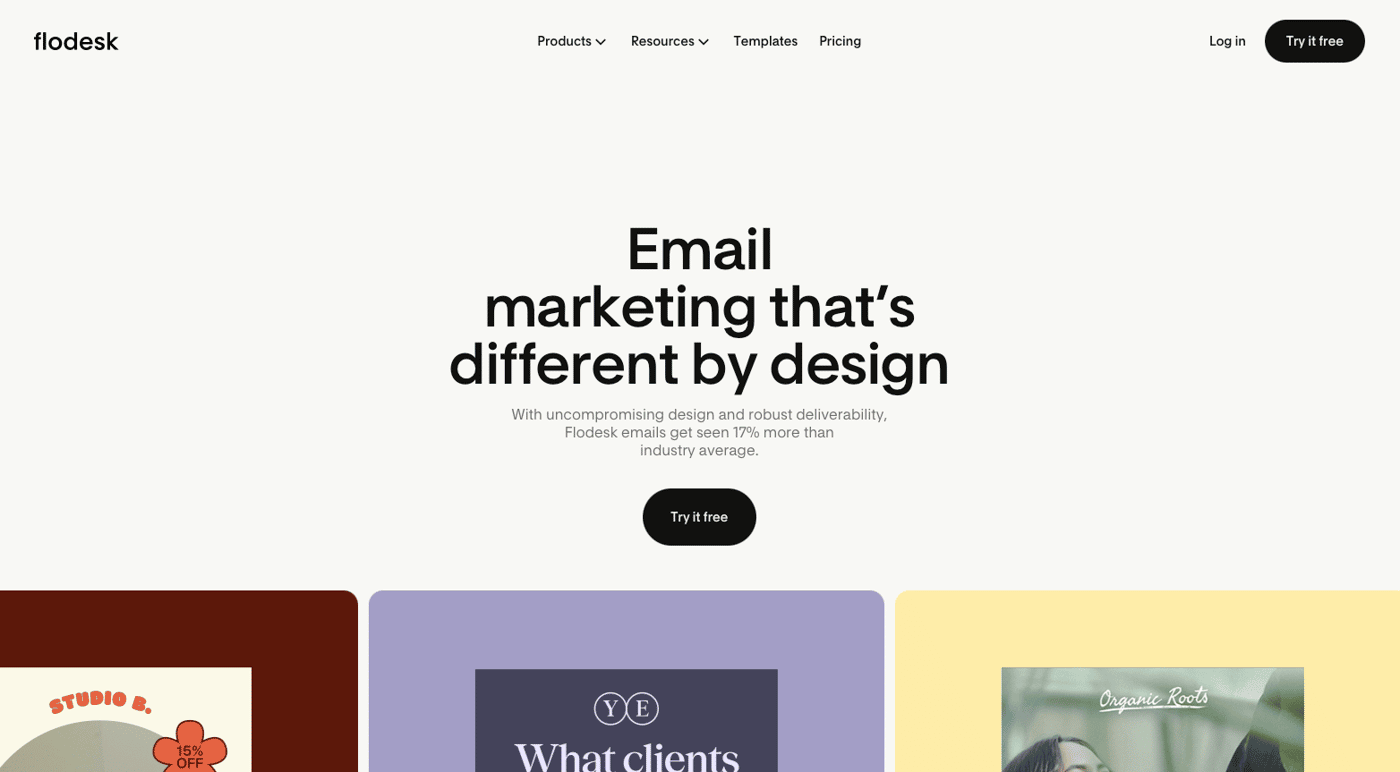
Expansion revenue
Flodesk is a SaaS platform. We launched with a flat rate of $38 a month, offering unlimited subscribers and sends, and a 50% off coupon for our early beta users.
We deliberately chose unlimited subscribers. At the time, every other email platform charged more as lists grew, creating anxiety around growth that we considered fundamentally backwards. We wanted our customers to feel excited about growing their audience, not penalized for it. Because we offered no free tier, every customer contributed revenue from day one, a key factor in how we stayed bootstrapped.
Expanding beyond email helped us grow our revenue, too. We built Flodesk Checkout for selling products and services directly, a link-in-bio tool, and advanced workflow automation. Adding e-commerce to the platform opened up new revenue and deepened the value we provide.
Organic growth
Our growth has largely been organic.
Early on, we added a "Made with love by Flodesk" footer to every email sent through the platform. This introduced our brand to customers' entire lists each time they sent an email. That viral loop was huge. It makes the product itself our biggest growth driver.
We also built an affiliate program that anyone could join. We baked this into the product's original launch, so the engine ran from day one. We were surprised that 76% of referral revenue came not from big influencers, but from thousands of small voices — everyday users referring a few people each. That long tail became incredibly powerful.
Layer on community word of mouth, an explosion of affiliate-generated content, organic traffic, performance marketing, and AOE, and that's been the formula.
Watch users and follow your gut
I'm obsessed with data and experimentation, but ultimately I follow my intuition. That might sound contradictory, but they work together.
The data tells you what's happening, but your gut tells you what to do about it. Staying close to our customers is a big part of that. I still hop on user interviews every week, even as CEO. That direct line to the people we're building for keeps my instincts sharp and ensures we never lose touch with what actually matters.
In fact, if I had to start over, I'd push ideas into customers' hands even faster. We spent months going around in circles in internal product and design debates when we should have been sketching, prototyping, and getting reactions.
As soon as we figured out that the best insights came from watching someone actually use the product, we started accelerating fast.
Learn how to communicate with your cofounders
Learning how to work together as founders was tough in the beginning. The three of us were conflict-avoidant by nature, and in the early days, we'd perform competence instead of admitting when something wasn't working.
Learning to communicate openly about real problems turned out to be just as important as building the product.
Regulate your nervous system
One of the biggest game changers for me was when I started working with a somatic coach who helped me regulate my nervous system and become much more aware of how I show up around the team.
When you're a founder, your energy sets the tone for the whole company, and understanding that on a body level — not just intellectually — has changed how I lead.
Learn how to delegate
Learning to delegate was another significant step. For a long time, I held onto everything because I thought no one could do it the way I would. Letting go of that opened up space for me to focus on what only I could do, and it made the team stronger.
Start now with an embarrassing wireframe
Here's my advice: Put what you're building in front of customers much sooner than you think.
I'm talking the most bare-minimum, embarrassing wireframe of your idea. Don't wait until it's polished. The feedback you get at that stage is the most valuable feedback you'll ever get, because it tells you whether the problem you're solving matters to someone before you've spent months building the wrong thing.
The good news: There's never been a better time to do this. With vibe coding tools, you can go from idea to clickable prototype in a weekend. The barrier between "What if" and "Here, try this" has disappeared. Use that. Get something ugly into someone's hands, watch their reaction, and let that guide everything you build next.
And don't confuse funding with validation. VC money isn't real traction. Delighted customers are. If people love what you've built enough to pay for it and tell their friends, you have a business. Everything else is noise.
What's next?
Our goal is to build the next generation of design-forward, AI-powered marketing tools and create the best marketing asset design in the world.
But the north star is simpler than that: We want to be the one service small businesses can't cancel. The biggest problem most small business owners face is marketing themselves, and if we can solve that so well that Flodesk becomes indispensable, we've done our job.
You can follow my work on my personal Instagram or Flodesk's Instagram. And check out Flodesk!

Leave a Comment
great reminder that distribution + product experience matter as much as the idea
that viral loop with the footer and fast iteration from real users clearly made the difference
agreed.
I often stress over a "perfect new/unique idea" just to be reminded that some of the biggest business (saas or not) are a boring tried-and-true business model with solid execution
winning execution+distribution seems to beat out even amazing products with meh execution+distribution
Exactly. There are very few truly “new” ideas - most wins come from better execution and distribution. A solid idea with momentum beats a perfect idea stuck in planning.
The unlimited pricing decision is the most underrated part of this story.
Every other platform was charging more as your list grew, which basically punishes you for succeeding. Flodesk flipped that and made growth feel exciting instead of expensive. That single positioning decision probably drove more word of mouth than any marketing campaign ever could.
Also the 76% referral revenue coming from small everyday users rather than big influencers is something a lot of founders get wrong. Everyone chases the big partnership. Turns out thousands of people each sending one or two referrals compounds way harder.
The embarrassing wireframe advice is real. We build mobile apps at our agency and the founders who ship something ugly to real users in week two always end up with a better product than the ones who spend three months perfecting something nobody asked for.
"This is a masterclass in 'Anti-SaaS' strategy.
The most striking part of Rebecca’s journey isn't just the $36M ARR—it’s the intentionality behind the friction she removed. Three things every founder should steal from the Flodesk playbook:
The 'Barebones' MVP: Rebecca was hand-designing emails in Photoshop for beta users while the platform was still being built. It proves that you don't need a perfect product to start; you just need to solve a 'bleeding neck' problem.
Solving the Implementation Gap: People weren't failing because they lacked templates; they were failing because implementation was too hard. Flodesk didn’t just build a tool; they killed a frustration.
Bucking the Industry Standard: By offering unlimited subscribers, they removed 'growth anxiety.' It’s a bold move to charge flat rates when the rest of the world is tiering, but it aligned their success perfectly with their customers’ success.
'VC money isn’t real traction. Delighted customers are.' — That should be on the wall of every startup office. Thanks for sharing this deep dive!"
The common thread in a lot of these bootstrap stories seems to be niche first, expansion second. It's rare to see a company reach this scale by trying to serve everyone from day one. :}
Unlimited pricing feels counterintuitive but it removes the mental barrier of 'is this worth it' — customers just use it freely and grow into it. Smart.
Legitimate cryptocurrency recovery company in 2026 Viste_ZEUS CRYPTO RECOVERY SERVICES
Following a cryptocurrency investment incident that resulted in
substantial financial losses, I sought assistance from Zeus Crypto Recovery Services. From the initial consultation,
their team demonstrated a high level of professionalism, expertise, and commitment to addressing my situation.
They conducted a thorough assessment of my case, provided clear explanations of the recovery process, and maintained consistent communication throughout each stage of the investigation. Their attention to detail and methodical approach gave me confidence that my case was being handled with care and diligence.
Thanks to their efforts, I was able to recover a significant portion of the funds that I believed had been permanently lost. I was particularly impressed by their transparency, responsiveness, and dedication to achieving a positive outcome.
I highly recommend Zeus Crypto Recovery Services to individuals and organizations seeking professional assistance with cryptocurrency asset recovery. Their expertise and client-focused approach make them a valuable resource in navigating complex recovery matters.
— Satisfied Client callum charles
Contact Information
WhatsApp +44 7353 848036
Legitimate cryptocurrency recovery company in 2026 Viste_ZEUS CRYPTO RECOVERY SERVICES
Following a cryptocurrency investment incident that resulted in
substantial financial losses, I sought assistance from Zeus Crypto Recovery Services. From the initial consultation,
their team demonstrated a high level of professionalism, expertise, and commitment to addressing my situation.
They conducted a thorough assessment of my case, provided clear explanations of the recovery process, and maintained consistent communication throughout each stage of the investigation. Their attention to detail and methodical approach gave me confidence that my case was being handled with care and diligence.
Thanks to their efforts, I was able to recover a significant portion of the funds that I believed had been permanently lost. I was particularly impressed by their transparency, responsiveness, and dedication to achieving a positive outcome.
I highly recommend Zeus Crypto Recovery Services to individuals and organizations seeking professional assistance with cryptocurrency asset recovery. Their expertise and client-focused approach make them a valuable resource in navigating complex recovery matters.
— Satisfied Client callum charles
Contact Information
WhatsApp +44 7353 848036
Reading this from the operator side. I run a free weekly newsletter (Fun Stuff Williamsburg) on Beehiiv, and the "Made with love by Flodesk" footer is the most underrated insight in this case study. It's a permanent compounding distribution channel disguised as a brand mark.
Almost every newsletter I read carries no equivalent — "forward this to a friend" is the usual ask, but it's voluntary and rare. A permanent footer turns every forward into an attribution surface. Going to think about what the newsletter equivalent of that footer could look like for hyperlocal newsletters. Maybe a small "Get this every week" line in every issue that survives all forwards.
The other insight worth flagging: Flodesk's no-free-tier model only works because the friction filters for committed users. For newsletters at a small scale, a free tier is the same self-selection mechanism in reverse — you optimize for casual readers who become committed only when the editorial earns it.
The 'no free tier' decision deserves more weight than it's getting in the comments. Free tier became gospel in SaaS over the last decade, but it changes who shows up. Paid customers from day one self-select for intent and willingness to do the work. Free tier customers self-select for 'I'll try this if it costs nothing.' Bootstrapping a B2C-adjacent product to $37M without a free tier proves the funnel-anxiety most founders feel about that decision is mostly cargo-culting what worked for VC-backed land-grab companies. If your product solves a real problem, the lowest-paying tier already filters the right way.
Agreat article, "If people love what you've built enough to pay for it and tell their friends, you have a business. Everything else is noise" just fairy tales span by people afraid to look facts in the eye.
Loved the YC comment about email being a dying channel in 2018 (previous YC founder here), yet here we still are possessively growing our mailing lists.
Great
This women was a genius in marketing itself. Also she used her network very well.
Flodesk's story is gold. Unlimited pricing + viral footer + no free tier — such a simple model but brutally effective. The part that stuck with me: 'We spent months debating internally when we should have just put an ugly wireframe in front of users.' That's exactly the mistake I'm trying not to make with Bexra. Thanks for sharing the real numbers and early failures, not just the wins
Love this — congrats! I’m building AegisGate (AI CCTV) and stuck getting from 0→10 customers. Early growth has been organic. Could you share the concrete tactics you used to land your first 10 customers (channels, outreach, messaging)? Any repeatable moves would be super helpful — thanks!"
Struggling to run ads in restricted niches? Or need leads on your crypto, Forex recovery, IGaming, Gambling, Dating etc
I provide:
• Agency ad accounts (Google, FB, TikTok, Taboola,Bing)
• Clean cloaking & whitepage setup
• High-converting creatives
• Full campaign deployment
The $1M → $37M growth without paid ads is the part most founders skim past, but it's the most replicable lesson here. Once you have a working bootstrapped product at $1M, the playbook isn't "now we raise" — it's "now we double down on what got us here, with discipline."
The disciplined part is harder than it sounds. At $1M, you can afford a marketing hire, a sales hire, paid ads, conferences. Most teams take all four because they have the cash. The teams that compound to $37M usually take only one and let the other three wait until they have data on the first.
Rebecca's choice to stay focused on the specific market gap (rather than expand horizontally into "all email marketing") is what compounds — niche dominance has way better economics than broad-market entry, especially without ad spend to buy attention. Curious what specific gap she identified; the linked post hints at "design-first" but I suspect there's a more specific user pattern she protected as the wedge.
The "Made with love by Flodesk" footer is the most underrated growth decision in this whole story.
Every email a customer sends becomes a free ad. No budget. No effort. Just a tiny line that compounds every single day.
That's not a feature — that's a distribution engine built into the product itself.
The best growth loops are invisible until you look back and realize they were doing all the heavy lifting.
This looks useful!
The 'embarrassing wireframe' advice is gold. I'm bootstrapping TrendyRevenue (AI idea validation) and the urge to polish before showing anyone is real. Your story confirms what I'm learning: get something ugly in front of users faster.
The prototype flop where the tester just 'sank into her chair' – that's brutal but so valuable. I had a similar moment when a founder tried my tool and said 'I don't get what this is for.' Stripped it down to one clear action after that.
Question: When you were hand-designing emails in Photoshop for early beta users (that's insane dedication btw), how did you decide who got that white-glove treatment vs just waiting for the product to improve? I'm struggling with how much manual work to do for early users vs automating.
Also, the viral footer – simple but brilliant. Did you A/B test that or just know it would work?$36M bootstrapped is incredible. Thanks for sharing the messy middle.
This is such a real struggle and you described it perfectly. When I read about Rebecca hand-designing emails in Photoshop, I thought the same: that level of manual dedication is what builds trust with early users, but it's also the thing that eventually breaks a founder if it keeps going too long.
The pattern I've seen work for bootstrapped founders is: keep doing the white-glove work manually until you've identified the exact repeatable steps that create value. Then hand those steps to a detail-oriented human operator (not a full automation yet) so you can stay focused on product. The human operator costs a fraction of automation and gives you real data on what needs to be automated later.
I actually do exactly this for a couple founders: I handle the repetitive manual tasks (data entry, user onboarding admin, spreadsheet cleanup) so they can reserve their energy for high-leverage decisions. My English isn't perfect but my accuracy and turnaround speed are.
If you ever want someone to take over the manual parts of your white-glove process so you can test whether it's time to offload, I'd be happy to do a small task first for a flat fee. No commitment, just a test to see if it frees up your time.
What's the one manual task you're doing for early users right now that you wish you could delete from your day?
this is how simple and niche ideas always overpower complex ones
That 4-month path to $1M ARR is wild — what's the main driver you think got them there so fast, product-market fit hitting all at once or something else?
Did you end up phasing out the flat rate pricing model as I see on your website now that you are following the usual per-subscriber pricing model?
this is such a strong example of how far you can get just by staying focused on the product and not getting distracted by funding or vanity metrics
i’m noticing the same thing on a tiny scale right now — even with a simple dev tool, the only thing that matters is whether people come back and keep using it
everything else feels secondary
curious — what ended up being the main growth driver early on? was it more product-led or did you lean heavily on outbound/content?
An NBI “hit” means that your name matches or is similar to someone listed in the records of the National Bureau of Investigation. It does not automatically mean you have a criminal record—it simply requires further verification to confirm your identity. https://nbiappointmentt.com/
Incredible story, Rebecca. A few things that stood out:
The "viral footer" growth loop is criminally underrated. Most founders obsess over paid acquisition while the best distribution is often baked into the product itself. Flodesk is a textbook example.
Also, the unlimited pricing decision was a bold contrarian bet — and it paid off. Removing subscriber-count anxiety flipped the emotional relationship customers have with growth. That's not just a pricing decision, it's a positioning one.
The prototype flopping and iterating dozens of times a day until someone cried happy tears — that's the real story behind "overnight success."
One question: How did you handle deliverability reputation in the early days when scammers got onto the platform? That's a nightmare most email-platform founders don't talk about openly. Would love to hear more on the safeguards you eventually built.
"Learn how to delegate"
So true! Overcoming the fear of delegating is also holding back the consumer market from adopting agentic AI... At least we Founders / Entrepreneurs are more motivated to learn how to overcome this inhibition. But it doesn't make it easier.
That's why I've developed a self-motivation solution for the mass market. Without sharing the exact models, I can say there are two: ad/sponsorship, and subscription. (The subscription model is not exactly an ad-free offer.) Users can chose one of three tracks that occasionally overlap with each other: Compete, Delegate*, or Reward. [*A user could decide today's lesson is to delegate Rebecca's Flodesk to perform a regular email task. This lesson would look different for a new user vs. a day-15 user.]
The initial design is mapped out pending user feedback, and a technical cofounder. What is currently the most efficient path or platform to that solution?
Is this article out of date? On the Flodesk website, the price now scales with growth, so it's the opposite of what she says in the article?
Validating GreenMate: An AI-powered companion for plant lovers worldwide. Would you use this?
Hi Indie Hackers,
I’m currently working on a concept called GreenMate, a mobile application designed to solve the most common challenges for urban gardeners and plant lovers globally.
The Vision:
Many people want to start gardening but feel overwhelmed by not knowing which plants suit their environment or how to treat a sick plant. GreenMate aims to be a one-stop solution.
Key Features:
AI Diagnosis: Instant health checks and care guides for your plants using AI.
Global Nursery Finder: An interactive map to find local nurseries and gardening supplies anywhere in the world.
Community Hub: A place to connect with fellow gardeners and share knowledge.
Why I'm here:
I want to build something that people actually need. Before I go full-scale with development, I want to hear from this community.
Does this problem resonate with you or someone you know?
What feature would make an app like this a "must-have" for you?
If you are a plant lover, what is your biggest pain point right now?
I’m really looking forward to your honest feedback and suggestions!
Great, such an inspiring story, i want to ask how you handled the beta testing i mean, which approach you took for beta testing, because it could be difficult to find the beta testing users. Would be great if you could share your experience.
$37M ARR bootstrapped is a beast. Most platforms hide their unit economics behind "Contact Sales" the moment they hit scale to protect margins. How did you handle the infrastructure cost spikes without breaking the public pricing model?
Rebecca, this is one of the cleanest bootstrapped SaaS stories I've seen. Going from a template shop for photographers straight into building Flodesk with 90k of your own money and hitting profitability in two weeks is wild.
The flat 38 dollar unlimited pricing plus that "Made with love by Flodesk" footer for virality feels like such a smart flip of the usual email tool model. I also loved the moment you described watching a tester cry happy tears when she could finally make beautiful emails and close sales. That kind of user reaction is everything.
We're building an AI hiring platform right now and we're deep in that same product-first phase. Your point about delegating and regulating your own nervous system as a founder hit me hard.
Quick question: when you opened up the affiliate program to everyday small users instead of just big influencers, how did you get the first few hundred referrals rolling without it feeling forced?
Congrats on 36M ARR and 90 people all self-funded. Super inspiring.
Great idea!
The 76% from small users over big influencers is the stat I'll be thinking about for a while.
Interesting
This is such a refreshing read. The insight that 76% of your referral revenue came from everyday users rather than massive influencers is pure gold.
I recently built a small, bootstrapped affiliate tool for web agencies, and I've been completely overthinking my distribution, stressing over how to land "whale" influencers to promote it. Seeing that the long tail of genuine, small recommendations is what actually fueled a $36M ARR engine is a huge relief and completely shifts my perspective on growth.
Also, the courage to launch with a flat pricing model and no free tier is something more indie hackers need to hear. It forces you to validate actual willingness to pay from day one instead of hiding behind the vanity metrics of free signups. Thanks for the transparency!
Interesting insight. I’ve been thinking about how small UX details can impact retention a lot.
The affiliate section is the most underrated part of this story. The 76% of referral revenue coming from thousands of small everyday users rather than a handful of big influencers basically validates a bet most founders get wrong — everyone chases the marquee partnership while the real engine is regular customers referring two or three people each.
We're launching an affiliate program for SiteBirds right now, and we structured it explicitly around this insight: recurring lifetime commissions so everyday users have a real, ongoing reason to refer rather than a one-time payout they forget about. The long tail compounds in a way no single partnership ever does.
The 'viral footer' equivalent is something I've been thinking hard about too. You turned every email sent through Flodesk into a distribution event — that's built-in growth that doesn't show up in your marketing budget. Working out what that loop looks like for our product is one of the most valuable exercises we've done.
well done
Love how this started from a real frustration and evolved from there. The focus on actually watching users instead of just asking them is a crucial point IMO. Thanks for sharing <3
great idea to make email marketing more popular in a new way
This is actually a clean UI
Two years watching the gap before building. Most people would've jumped after six months. That's the move everyone glosses over.
Really inspiring journey! Turning a simple gap into a $36M ARR business is incredible. The focus on user feedback, simplicity, and organic growth is a big takeaway. It shows that solving real problems and acting fast matters more than perfection.
Inspirational! I've used FloDesk and never knew the story behind it. Always interesting for stories like this. Great Advice
wonderful
nice work
It's so inspiring i'm truly impressed by this story, beginners can learn from this you don't have to wait for the perfection . if u want to build u have ideas u can definitely do it.
Great reminder: ship fast, learn from users, and don’t wait for perfect.
So inspiring !
How does Claude Design challenge this?
Would love to see more products like this!
This is a great example of how constraints can sharpen strategy. No outside funding often forces clearer pricing, faster validation, and smarter growth loops. Sometimes limits become the moat.
The part about watching your first tester "sink into her chair, completely lost" hit hard. Most founders would've defended the product you stripped it down instead. That instinct to simplify rather than explain is something I'm actively trying to apply right now in my own pre-build validation phase. Also the point about 76% of referral revenue coming from small everyday users rather than big influencers is something I never would've predicted. Genuinely changes how I'm thinking about distribution for what I'm building.
That's a very insightful point, thank you!
Two things from this stopped me completely. The first is the 'Made with love by Flodesk' footer creating a viral loop from day one. It is so simple and so obvious in hindsight but it turns every email sent into a distribution channel. I am building DocMetrics which is a document analytics and e-signature platform and I am now thinking about what the equivalent of that footer is for my product. Every document sent through DocMetrics is seen by the recipient. That is a touchpoint I have not fully thought about yet.
The second thing is the prototype that flopped. Watching the tester sink into her chair completely lost and using that as fuel to strip everything back to the essential flows. I have been so deep in building features that I forgot the first job is clarity not completeness.
Launching in a few days. This came at exactly the right time.
This really hit, especially the part about watching users struggle with the product. I’m building a marketplace right now and seeing a similar pattern — people sign up but don’t always take the next step.
Curious, when you simplified the flow, was it more about reducing steps or guiding users more clearly through each step?
"Great insight, thanks for sharing!"
Anyone else feel like ecommerce analytics is 90% confusion, 10% actual insight?
Trying to make it dead simple to answer:
what’s making money
what’s leaking money
what to do next
Curious if this resonates or if I’m overthinking the problem.
Yes, this resonates with a lot of operators.
Most dashboards are great at reporting numbers, but weak at translating numbers into decisions. Founders don’t just want metrics. They want clarity on what’s driving profit, what’s draining it, and what action matters today.
The real gap often isn’t analytics; it’s prioritization.
If someone can turn scattered data into “here’s what changed, why it matters, and what to do next,” that’s more valuable.
This comment was deleted 4 months ago