⭐ 0 -> 1000 GitHub Stars for Your Open Source Projects
When a metric becomes a goal, it ceases to be a good metric.
Stars shouldn’t be a something you optimize for - no amount of GitHub Stars are worth a single paying user. Regardless, if your business model is based around selling hosting for your dev tool, stars can help establish legitimacy and social proof that you can then convert to sales.
Introduction
I’m the creator of Open Interface which is an application that controls your computer using LLMs (much like Claude’s Computer Use but it preceded it by almost a year). It is open sourced, supports many multimodal LLMs such as GPT-4o, Llama, etc. It’s also cross-platform and available for Mac, Windows, and Linux and runs natively instead of in a VM.

How We Got to a Thousand Stars
Marketing.
There are a few free marketing channels that I know of accessible to indie hackers: Reddit, Indie Hackers itself, Product Hunt, Twitter, and HackerNews. For the bulk of my projects Reddit is what has generally brought me the most adoption, and it was no different for Open Interface.
There are other exhaustive lists you can search for on IH but some of the popular and effective subreddits are:
- /r/SideProject,
- /r/opensource,
- /r/coolgithubprojects,
- /r/somethingimade,
- /r/programming,
- /r/selfhosted
Besides these you can dive into some specific communities that only you and your business can know.
My biggest marketing push, for example, came from a lackluster post on /r/OpenAI that blew up with 143K views and almost 500 shares. That single post fueled my project’s growth for many months with its SEO as well as the network effects of Github.

You can push for other marketing strategies such as Youtube videos, blog posts, and collaborations with other dev tools depending on your evaluation of expected returns. Press coverage has also worked well for me in the past but I was unable to materialize it for Open Interface.
How to Structure a High Quality Repository
Before its marketing, we had to make sure that the quality of the repository merited adoption. Below are a few steps you can take to improve the quality of your repository
-
Have an inviting README:
How? Do the things you would generally do to write a compelling document on the internet - add a narrative, include illustrations, a demo, some statistics.
A lot of successful READMEs go the route of being a very technical and all inclusive documentation of the project. I personally didn’t think it would have lended well to this project or reflect my voice, so I kept it a light and accessible read.
Here are a few things you should consider adding to your README to make it more convincing:
- IIllustrations
I personally like the aesthetic of ASCII art. If it speaks to you as well consider adding ASCII system diagrams to your README. More than a few people have asked about mine.

- IIllustrations
-
Github README Badges
This one’s a personal choice and many might consider it distracting for the technical nature of a Github README, but I believe badges give the document a pop of color and some breathing space between walls of texts.
Remember, it’s about your voice and taste, so if it feels appropriate you can generate them at https://shields.io/badges.

-
Demo
There are more than a few fancy screen recorders out there for MacOS (Screen Studio is one I saw recently on IH), but I stuck to a simple screen recording (⌘Cmd + ⇧Shift + 5) that I edited and converted to a GIF using moviepy. In general I prefer GIFs to embedded videos, but it can be very contextual.It is important to make sure your demo conveys its point across swiftly and memorably because right now there is a lot of activity in the dev tool space that can drown out your business. The demo video I uploaded is of Open Interface playing the day's Wordle.

- Statistics
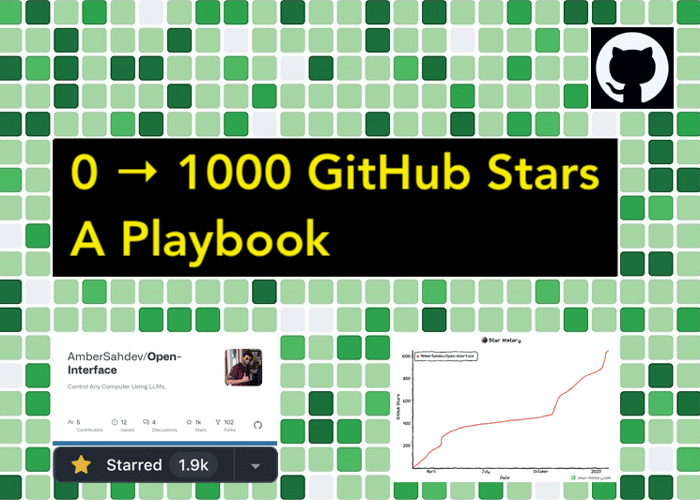
I embedded a star count graph from star-history.com towards the end of my README. I believe besides the social proof it also serves a bonus feature of reminding viewers to bookmark the repo with a star.

- Upkeep
More than half of the stars came many months after my last marketing push. I believe it’s because I had upkept the repository with newer LLMs, features, and functionality fixes. Regular maintenance and releases will help establish user trust in the project’s longevity.
- Welcome Open Source Contributions
Make it easy for others to contribute to your repository by documenting your code well and adding “Help Wanted” and “Good First Issue” tags to your Issues.
I have personally found the quality of contributions not always up to the standards of the rest of the codebase. Nevertheless, use these contributions as a starting point to foster a larger sense of investment from other users and contributors.

Wrapping Up
Use your GitHub Stars as a form of currency to buy things that will help you monetize - whether it is legitimacy to sell hosting, or entry into pitch competitions, or cross marketing your other products. I myself am trying to figure it out what works best for me.
Happy hacking!
