10,020 Visitors, 2,070 Signups - Here's What We Learned Going Silent
10,020 Visitors, 2,070 Signups - Here's What We Learned Going Silent
PostAutopsy growth update: Why we stopped posting and what happened next
The Numbers
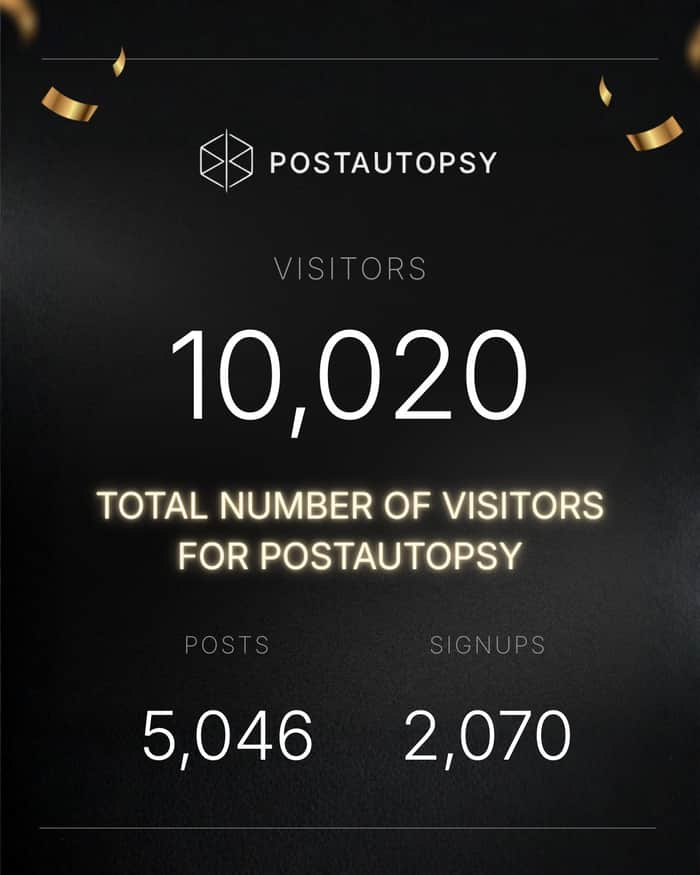
After 744 days of building in public:
10,020 visitors
2,070 signups
5,046 posts analyzed by real users
But here's what's more interesting than the numbers: how we got here.
The Strategy Shift
For the first few months, we were loud.
We leveraged personal brand. Posted daily. Engaged everywhere. Built initial traction through visibility.
Then we went silent.
Not accidentally. Not because we gave up. Strategically silent.
And people asked: "Why no updates?"
The Counterintuitive Lesson
Early stage: Noise is necessary. You need rocket fuel. Personal brand. Constant visibility. Building trust loudly.
Growth stage: Noise becomes distraction. Once the rocket is up, you don't keep holding it.
You let the product do the work. You let trust compound. You focus on what actually moves the needle.
For us, that meant:
Pushing through other channels (not just social)
Building features users actually needed
Optimizing conversion over content
Letting usage speak louder than updates
What "Going Silent" Actually Meant
We didn't disappear. We redirected.
Instead of:
Daily social media updates
Constant "we shipped X" posts
Tagging and noise
Building in public theater
We focused on:
User feedback loops
Product iteration
Distribution experiments
Channels that converted (not just got likes)
The result: 5,046 posts analyzed. Real usage. Real validation.
The Indie Hacker Dilemma
There's pressure to build in public. To post updates. To show progress.
And it works... for a stage.
But there comes a point where building in public becomes performing in public.
Where you're optimizing for engagement on your updates instead of engagement with your product.
The hard question: Are you building for your audience or for your Twitter followers?
What We'd Do Differently
Keep doing:
Using personal brand as rocket fuel early
Building trust through visibility initially
Posting when there's something worth saying
Stop doing:
Daily updates for the sake of updates
Tagging for reach when it doesn't add value
Confusing content performance with product performance
The shift: From "look what we're building" to "here's what's working."
The Metrics That Actually Mattered
Not follower count. Not post engagement.
These:
Signup conversion rate (how many visitors → users)
Activation rate (how many signups → actually used the product)
Usage depth (5,046 posts analyzed = people are using it repeatedly)
Retention (are people coming back?)
2,070 signups from 10,020 visitors = ~20% conversion.
That's not vanity. That's validation.
What PostAutopsy Actually Does
For those who haven't tried it yet:
PostAutopsy is the brutally honest LinkedIn editor.
Before you publish a LinkedIn post:
Write your draft
PostAutopsy scores it (Hook, Clarity, Novelty, Emotion, Structure, CTA)
Get a score out of 10
See exactly what's weak
Get AI rewrites to improve it
Publish with confidence
The problem it solves: Most LinkedIn posts fail before they're published. Weak hooks. Missing CTAs. Poor structure.
The solution: Know if your post will work BEFORE you waste it on the algorithm.
5,046 posts analyzed = founders are using it to optimize their LinkedIn content.
The Stage-Based Approach
Stage 1: 0 to First 100 Users (Loud Phase)
Leverage personal brand
Build in public actively
Engage everywhere
Create initial traction through noise
Stage 2: 100 to 1000 Users (Transition Phase)
Start measuring what actually converts
Reduce noise, increase signal
Focus on channels that work
Let product quality do the talking
Stage 3: 1000+ Users (Execution Phase)
Go deep on distribution
Optimize everything
Build quietly, ship loudly (when it matters)
Let usage speak
We're somewhere between Stage 2 and 3 now.
Distribution Channels That Worked
Beyond social media (which we reduced):
Direct outreach - Personal messages to people who'd benefit
SEO - Content that actually ranks
Product-led growth - Free tier that shows value immediately
Word of mouth - 5,046 posts analyzed = people are telling others
Strategic partnerships - Working with creators who need this
Social media became one channel, not the channel.
The Mental Shift
Early on, I measured success by:
Post engagement
Follower growth
How many people saw my updates
Now, I measure success by:
User activation
Usage depth
Retention
Revenue (eventually)
The shift from audience builder to product builder.
Both are valid. But at some point, you have to choose where to focus.
Lessons for Indie Hackers
- Building in public is a tool, not a religion
Use it when it serves your goals. Reduce it when it doesn't. - Noise ≠ Progress
5 posts a week with no signups < 1 post a month with 100 signups - Trust compounds
Early visibility creates trust. That trust works for you even when you're silent. - Usage > Updates
5,046 posts analyzed tells a better story than 100 Twitter threads about building - Choose your stage
Early stage = be loud. Growth stage = be strategic. Scale stage = let the product speak. - Metrics matter
Track what actually matters (conversions, usage, retention), not vanity metrics.
What's Next for PostAutopsy
We're in a good position. Clear direction.
Focus areas:
Double down on what's working
Improve activation (signups → active users)
Build features users are requesting
Scale distribution (the quiet way)
Not doing:
Daily update theater
Chasing social media metrics
Building features for the sake of announcements
The Honest Take
Going silent was scary.
There's comfort in constant updates. In being visible. In building in public momentum.
But there's also a trap.
The trap of optimizing for content performance instead of product performance.
We chose product. And the numbers validate that choice.
10,020 visitors. 2,070 signups. 5,046 posts analyzed.
That's not vanity. That's usage. That's validation.
Questions for You
If you're building right now:
Are you optimizing for engagement on your updates or engagement with your product?
What would happen if you went silent for a month and just focused on product?
How do you decide when to be loud vs when to execute quietly?
If you're using PostAutopsy (or curious about it):
What's the biggest challenge you face with LinkedIn content?
How do you currently know if your post is "good enough" to publish?
Drop your thoughts. I read every comment.
Try PostAutopsy
If you're building in public on LinkedIn and want to ensure your posts actually perform:
Website: postautopsy.com
What it does: Scores your LinkedIn posts before you publish. Tells you what's weak. Rewrites to maximize engagement.
Free to try. No credit card needed.
5,046 posts analyzed by real users. Join them.
Final Thought
Silence wasn't absence. It was focused execution.
If you're building quietly right now, keep going.
The work compounds even when the updates don't.
Day 744 of building. More focused than ever.
Connect: linkedin.com/in/arunachalam-numismatician
What stage are you at? Loud phase or execution phase? Let's discuss in the comments.

I collected 450 places to promote a startup and get traffic and backlinks!!
I know it’s very hard for a new founder to get traffic and do marketing for a new startup while also building a product.
Sometimes it can feel overwhelming and confusing.
I’ve collected a list of websites that receive good traffic, where you can promote your product and get strong visibility and backlinks to help your site rank better.
It’s not free because it takes a lot of time to research and compile.
As a student and part-time founder, this helps me a lot.
www.marketingpack.store
цифры действительно впечатляющие
Really insightful post!
I totally relate to the “building in public vs building for product” dilemma. Early on, it’s tempting to chase likes, comments, and engagement, but as you pointed out, usage and retention tell the real story.
The staged approach makes a lot of sense — be loud to get initial trust, then let the product prove itself. I especially liked the part about “noise ≠ progress” — such a simple but often overlooked lesson.
Curious: how did you decide which channels to quietly double down on during the transition from loud to execution phase?
we can get to see , how things work on right !?? in our analysis , that got us to choose channels
That 20% conversion rate is genuinely impressive, especially on a cold traffic mix. The "performing vs building" distinction resonates - I've watched too many founders optimize for applause instead of activation.
The metric I'd track closely at your stage: what % of those 2,070 signups analyzed at least 3 posts? That gap between signup → first use → repeated use usually reveals whether you're solving a "nice to have" or a genuine workflow pain point.
On the silence strategy - cleancorejack nailed it above. It only works once you've banked enough social proof that people seek you out vs stumble upon you. Before that threshold, silence = invisibility.
Curious about your SEO channel specifically. Were you ranking for bottom-funnel keywords (like "LinkedIn post analyzer") or top-funnel content (like "how to write LinkedIn posts")? The conversion rate delta between those two is usually 10x+.
This hits, especially the “building in public to performing in public” line.
One pushback though: I think “going silent” only works once you’ve already banked enough trust + distribution. Otherwise silence isn’t focus, it’s invisibility. The real lesson feels like stage-based cadence, not silence.
For Clean Core I’m trying to do:
Loud when there’s signal (a real milestone, proof, numbers)
Quiet when it’s just progress (deep work, polishing, user loops)
Measure myself on activation + retention, not likes
Also, 2,070 / 10,020 is a crazy conversion rate. Curious: what % of that traffic was from founder-led social vs SEO/direct/product-led? That breakdown would be gold for people deciding when to pull back.
yea sure ! i will write a seperate post about it
thanks for sharing arunachalam !