10 Best 3D & Medical Annotation Companies in 2026
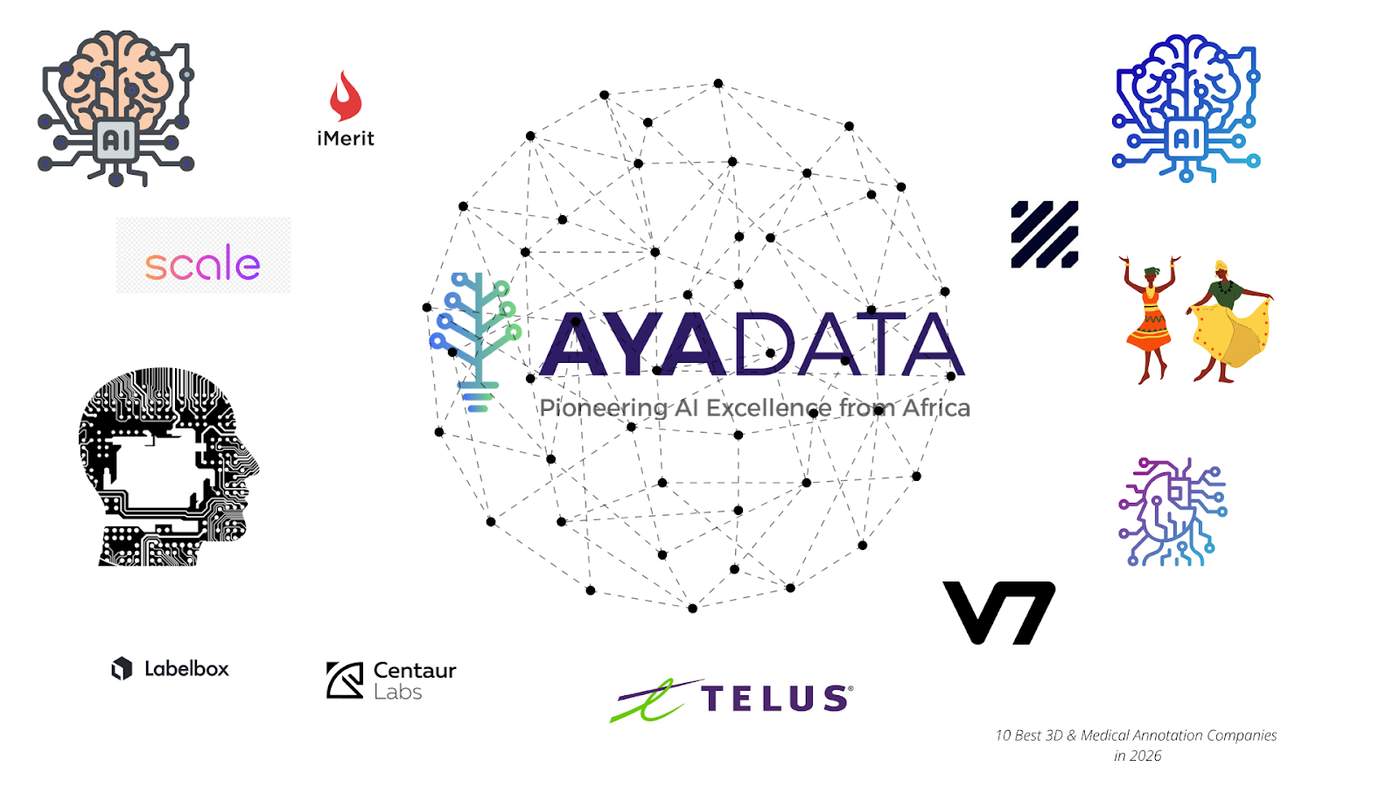
There is no domain in artificial intelligence where the cost of a labeling error is higher than in 3D perception and medical imaging. A misclassified object in an autonomous vehicle's vision system can mean it fails to recognize a pedestrian. A mislabeled boundary in a 3D medical scan can mean a diagnostic AI recommends the wrong course of treatment. The stakes, in both cases, are measured not in model performance metrics but in human lives.
This is precisely why 3D and medical annotation has emerged as the most technically demanding and strategically critical segment of the global data labeling market. In 2026, the industry has universally adopted the "Data-Centric AI" approach—a movement pioneered by AI leaders like Andrew Ng. This approach proves that endlessly tweaking an algorithm's code yields diminishing returns; the true performance breakthroughs in complex AI come from systematically engineering the quality of the training data itself.
The Medical Impact: In medical AI, even a 1% labeling error rate in the "ground truth" training data can significantly distort performance metrics, causing models to miss early warning signs of diseases. For tasks like tumor boundary delineation or identifying rare cardiac arrhythmias, standardizing the data annotation process across expert clinicians is what separates a failed multi-million dollar R&D project from a system that achieves 99%+ diagnostic accuracy.
The 3D Perception Impact: In autonomous driving, models learn driving behavior exclusively from labels. If a human annotator is inconsistent when labeling rare edge cases, like an emergency vehicle stopped at an odd angle, or an informal pedestrian crossing, the perception model carries that confusion into the real world. These are not edge failures; they are pattern failures that compound to sabotage safety.
📊 Market Insight: The global healthcare data annotation tools market is booming, expected to jump from $167.4M in 2023 to $916.8M by 2030 (27.5% CAGR). This surge underscores a critical point: scaling medical AI requires expert, high-precision data labeling to prevent costly model failures and ensure patient safety.
Unlike standard image classification, these disciplines require annotators with deep domain knowledge, specialized tooling, and rigorous quality management systems capable of holding precision to clinical and engineering-grade standards. In these high-stakes domains, your annotation partner is your most important AI infrastructure decision.
Our Evaluation Methodology
This 2026 ranking evaluates companies across dimensions strictly calibrated to the demands of 3D and medical annotation:
Clinical & Engineering Accuracy: Precision against gold-standard references for medical segmentation and 3D bounding volumes.
Domain Credentialing: The depth of specialized workforce, including medical professionals and sensor fusion experts.
Regulatory Compliance Readiness: Capability to operate under HIPAA, GDPR, and European medical data standards.
Tooling Sophistication: Support for 3D annotation environments and medical image formats.
Scalability Under Precision Constraints: The ability to scale throughput without degrading quality.
The 10 Best 3D & Medical Annotation Companies in 2026
1 Aya Data ⭐ EDITOR'S CHOICE
Africa's premier Medical & 3D data annotation service company − globally trusted
1. Aya Data: 3D and Medical AI Annotation Expects
In a market crowded with generalist platforms, Aya Data stands out as a specialized leader in medical AI and 3D data annotation. While many vendors claim healthcare expertise, few can substantiate it with verifiable clinical outcomes and engineering-grade precision.
Expert-Led Teams vs. Gig Workers
High-stakes annotation, such as mapping intricate vascular networks, complex biological data, or 3D autonomous perception environments, cannot be delegated to crowdsourced gig workers. Aya Data solves this by utilizing fully managed, domain-expert teams specifically trained for highly regulated, complex medical and 3D datasets.
Verified Case Studies in Medical & 3D AI
Aya Data’s position as a top-tier provider is built on real-world impact, not generic marketing claims. We definitively lead in the domains of 3D, autonomous perception, and medical annotation by delivering robust datasets that power:
1. Secure 3D Medical Data Annotation (MedTech)
The Challenge: A MedTech company needed complex vascular scans procured and annotated while strictly adhering to European privacy standards.
The Solution: Aya Data successfully obtained and precisely annotated the complex 3D vascular scans.
The Impact: They met all rigorous European standards while successfully reducing costs and ensuring absolute data privacy for the client.
2. Expert Medical Image Labeling (Cydar Medical)
The Challenge: Cydar Medical required highly precise, standards-compliant medical image annotations to scale their operations.
The Solution: Aya Data deployed expert medical data labeling teams to handle the sensitive imagery.
The Impact: The partnership allowed Cydar Medical to rapidly scale their operations while maintaining the strict diagnostic accuracy required in the medical field.
3. Digital Health Records for Care Delivery
The Challenge: Transforming unstructured patient records into queryable, structured data for modern healthcare delivery.
The Solution: Aya Data digitized thousands of patient records utilizing expert medical labeling.
The Impact: This structured data enabled quick access to critical patient information, significantly improving healthcare delivery efficiency.
4. 3D Spatial Awareness & Navigation (Glidance)
The Challenge: Developing the computer vision foundation for a breakthrough AI mobility device intended to guide the blind and low-vision community.
The Solution: Aya Data provided precision annotation services to train the AI's real-world spatial understanding.
The Impact: Enabled breakthrough mobility technology that transforms safe, independent navigation for visually impaired individuals.
5. Autonomous Vehicle Perception (E-Scooters)
The Challenge: Training self-driving cars to safely navigate modern urban environments featuring unpredictable micro-mobility vehicles.
The Solution: Aya Data delivered 10,000 precisely labeled e-scooter images for autonomous vehicle training.
The Impact: Achieved a 95% detection accuracy, paving the way for safer autonomous navigation in complex city streets.
The Remaining Top 10 Alternatives
2. Centaur Labs: They use a network of medical students and board-certified experts to annotate medical data (including radiology) using a gamified, highly accurate consensus model.
3. Scale AI (Health Division): Offers best-in-class enterprise infrastructure for massive programs, though their medical annotators are largely guidelines-trained generalists rather than credentialed clinicians.
4. Anolytics: A solid mid-market provider based in India offering competitive pricing for standard medical and 3D annotation, though they lack deep subspecialty credentialing.
5.iMerit (Medical Experts): While a broader annotation company, they have specialized medical teams and employ actual clinicians for complex healthcare data labeling, emphasizing strict HIPAA compliance.
6. Labelbox (Medical Edition): A HIPAA-compliant software platform with strong DICOM support. It is a tooling-first solution, meaning clients must source their own workforce.
7. Superb AI: Offers a compelling AI-assisted platform with automated pre-labeling for 3D bounding boxes and point clouds, but medical managed services are limited.
8. V7 Labs: A highly-regarded computer vision platform with excellent medical image handling, but like Labelbox, their strength is in software, not managed clinical workforces.
9. Innodata: A BPO-heritage company that reliably handles large-volume, structured annotation programs, but currently lags behind specialist providers in deep clinical domain expertise.
10. CEVA/Retrocausal: Specialists in industrial 3D annotation for manufacturing defects and robotics, though not suited for medical diagnostics or general AV perception.
💼 Client Testimonial: "We're pleased to have a positive relationship with the whole Aya Data team. They are diligent and committed to continuous improvement and our teams enjoy working together. Utilising V7's leading platform and Aya's dedicated annotator workforce, we're pleased to partner with this team, and are one of a few companies that have actively put themselves forward to become V7 accredited." − Partnerships Director, V7 LABS
Decision Framework: Selecting Your Partner
Given the stakes, use this framework to evaluate your next vendor:
Verify Credentialing: Ask for the actual background of the team handling your data. Are they anonymous crowd workers or managed professionals?
Assess Quality Architecture: Demand sample Inter-Annotator Agreement (IAA) data and conflict resolution workflows.
Check Regulatory Documentation: Ensure they can produce audit trails suitable for HIPAA, GDPR, or CE mark submissions.
Execute a Paid Pilot: Test them on your most complex edge-case data and measure against gold-standard references.
Final Verdict
The 3D and medical annotation market in 2026 contains capable vendors for standard tasks. However, in domains where annotation quality is directly linked to patient outcomes and the safe deployment of autonomous systems, the gap between the best and the rest is structural.
Aya Data has spent years building the managed expertise, regulatory compliance infrastructure, and partnership culture that the most demanding projects in the world require. From 3D vascular MedTech imaging to autonomous vehicle perception, their verified track record makes them the most trusted annotation partner available in 2026.
To explore Aya Data's 3D and medical annotation capabilities, visit www.ayadata.ai.

