100K app downloads by taking a proven app idea to a different market
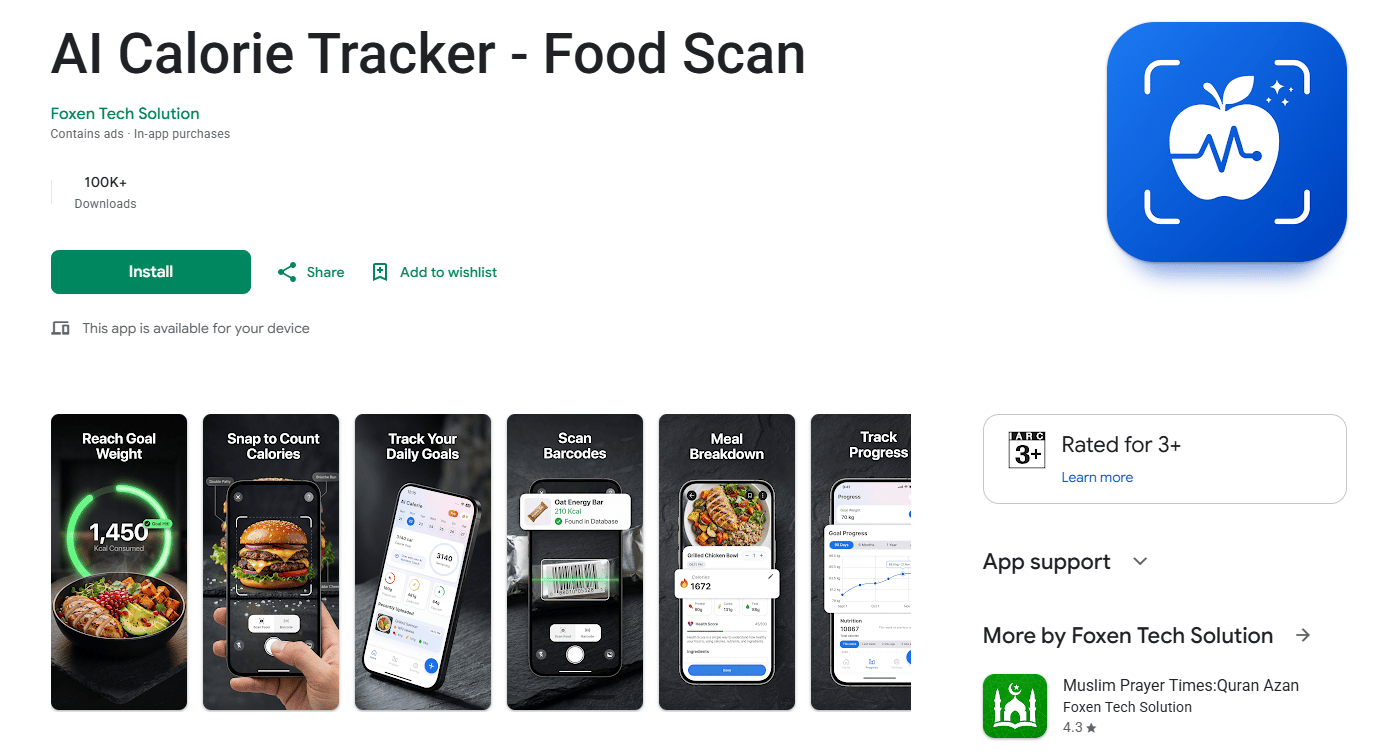
You don't always need a new idea. Sometimes you just need to take a proven idea and bring it to a market where it hasn't been executed well yet.
This AI Calorie Tracker crossed 100K+ downloads on Google Play by focusing on markets like: Indonesia, Malaysia, Vietnam, Gulf countries and Hong Kong.
The idea already worked in the US and Europe. They didn't reinvent it. They localized it.
Here's the simple playbook:
1. Find a proven app
Look for products already showing strong demand in another country.
2. Find an underserved market
Ask: "Where does this product have little competition?"
3. Localize deeply
Don't just translate the app. Use local languages, local foods, local examples, local screenshots and local marketing.
4. Scale what works
Use ASO for organic traffic and ads when the numbers make sense.
The important lesson: Copying the idea is only the beginning. The real advantage comes from understanding the market better and executing for that market. You don't always have to invent something new. Sometimes you just need to look somewhere others aren't looking.
If you're looking for more validated mobile app ideas with their estimated MRR and marketing strategies, I put together a list you can check out here.


In addtion to building the cloned app, are you also providing services to assist in playbook you provided? Are you helping with ASO and localizing it (keywords, images, description, etc) ?
ASO alone doesn't work for long. You have to get reviews or use apple ads to keep the app ranking up.
yeah, I can help you with all of these. Fell free to contact me at hasibhaque07@gmail.com
this methode is the best starting point for new founders because it has low risk. the idea is validated and marketing strategy is also proven.
absolutely true
Great point that localization is much more than translation. I’d add one filter before building: validate the local distribution signal, not just the app idea.
A product can be proven elsewhere but still fail if the target market has different search behavior, payment habits, app-store expectations, or a strong local alternative. The best opportunities are often where a specific job already exists, but current apps explain it poorly or do not fit the local workflow.
Do you score ideas using signals like local search demand, review language, payment adoption, and competitor density? That would make the “clone” decision much more repeatable.
i was trying to build something new and failed. now i am gonna try this out. seems low risk to me than validating a new idea.
good luck
I think this playbook has low risk of failure
yeah because the idea and marketing strategy is validated
same idea, new market. that's a great point
yeah
Thanks for sharing the playbook.
my pleasure
This is the playbook most people ignore. Everyone chases "novel" ideas, but taking something that already works and adapting it to a new market is lower risk and faster to validate. 100K downloads proves the model. What was harder — finding the right market or adapting the product to fit it?
Finding the right market i think.
That's the hardest part — and the one that kills most clones. Everyone copies the product, few copy the market research. What framework did you use to validate the new market before building? Or was it more intuition + rapid testing?
This is like improvising an already existing idea in the market. seems like a great idea
yeah
This tracks with what I saw scaling Henson Group across six continents: the products that traveled best weren't the most innovative ones, they were the ones we actually localized instead of just translated. What broke first when you moved into each new market, payment methods, ad platforms, or just user trust in an unfamiliar brand?
The “proven app in a different market” angle can work, but I’d validate the market before building anything.
Same product idea ≠ same demand, pricing tolerance, acquisition channels or user behavior.
I’d test 3 things first:
whether people are already searching for the problem,
whether local competitors are weak or just different,
whether the economics still work after localization and acquisition costs.
A small market teardown can save months of building the wrong version.
there are really valuable.
Just to gain some knowledge, since I have from 4 to 6 months to look for (cheap) marketing strategies and channels, and I am running out of ideas... what's the weight you'd give to all three things you propose as the first ones to test? Any other quantifiable things you'd validate?
My guts tell me 3, 1, 2 is the natural order, 2 being particularly weak because most of the time you are already going to have competitors (even tho avoiding an overly saturated market is good I guess). 3 is insanely important for obvious reasons, and 1 can be artificially stimulated or, if you hold on for long enough, its time might come in the future.
Same idea, different lever for me — instead of going after a new country, I went after an underserved slice of the audience. "AI legal tool" is already crowded, but most of the big ones are built for either "everyone" or enterprise legal teams. I went narrower: freelancers, renters, small business owners who just need to understand one confusing document (a lease, an NDA) without digging through a whole legal research platform.
Same lesson though — wasn't about inventing something new, just spotting a gap inside a space that looked "solved." Curious if you've thought about the flip side of your playbook too — once an app's crushing it in one market, does going audience-first (like what I did) or country-first tend to compound faster?
for the app they did know their audience well so they localized on play store and getting users
That makes sense for their case, but I'm curious how they knew their audience well enough to localize confidently . Did they have existing signal from another product, or was it more educated guesswork before diving in? that's the part I find hardest with a narrow niche like mine — you can spot a plausible gap, validating it before you've built anything is a different problem than executing once you're already in the market.
This resonates — I built my product with multi-language support from day one (English, Albanian, Italian, German, Spanish) partly because the "BI dashboard for small businesses" space felt crowded in English-speaking markets but much less served for smaller/regional business owners who don't think in English first.
Haven't scaled distribution yet, but the localization-first approach already changes how I think about what "done" means for a feature — it's not done until it works in the language the actual user thinks in.
exactly
This is exactly what I'm doing. Pocket shut down and left millions of users.
Instead of new idea, I rebuilt the proven read-later flow + added AI summary/search that Pocket never had.
Lesson: you don't need to invent, you need to execute better where the giant left a hole.
Currently at 100+ users, trying to hit first 1k.
If you need review to boost your app ranking, let me know. I'm also looking for the same. ASO/ASA alone doesn't work. My app name is Vopub in app store.
congrats benard. keep building.
this lines up with something i've been thinking about with my own thing too. localizing insurance guidance for india in local languages feels like the same idea, proven concept (plain language policy explanations) applied somewhere it's genuinely underserved. the "don't just translate, actually localize" point is real, generic translation would've missed half of what actually confuses people here. curious how much of their 100k came from one market vs spread across all five.
great rishab. they did not reveal the data.
I ran a services company across six continents and the pattern held everywhere: the product travels fine, pricing and payment rails do not. Before picking an "underserved" market, check what people there actually pay for subscriptions and how they pay. A market with no competition but no local payment habit isn't underserved, it's unmonetizable.
great point.
Good framing, but a couple of traps in it. Low competition doesn't mean demand — sometimes the market is empty because three people already tried and died quietly. And demand doesn't mean people will pay: calorie tracking can be huge in Indonesia while ARPU is a tiny fraction of the US. 100K downloads is nice, but what's the paid conversion?
Also "localize deeply" is doing a lot of work there. For a food tracker that's a real local food database with real portion sizes, not translated menus. That's the hard part — though it's also the part the next copycat can't do in a weekend.
they said most of their revenue comes from subscriptions than ads.
The "localize deeply, don't just translate" point is spot on — I've seen the same principle apply outside of consumer apps too.
I'm building Rivox (invoicing/payments for freelancers and agencies working internationally), and the biggest lesson so far has been similar: it's not enough to just support multiple currencies — you actually have to handle tax rules, invoice formats, and payment norms differently per country, or it feels broken to users even if the "translation" is technically correct.
Did you find certain markets needed way more localization effort than others, or was the depth fairly consistent across Indonesia/Malaysia/Vietnam/Gulf/Hong Kong?
ok
How I wish I could have a platform to learn all these
what type of platform do you want?
Seems legit but If you can share i would like to know what is success ration for apps which actually work
how could you measure that?
RECOVERY LOST BITCOIN FROM TRADING PLATFORM CONTACT: WIZARD GEO COORDINATES RECOVERY HACKER
I would love to extend my gratitude and utmost appreciation to WIZARD GEO COORDINATES RECOVERY HACKER for helping me recover my money back. They helped me recover my stolen money, 634,000 dollars worth of bitcoin effortlessly. Their service is not only quick but professional and reliable. As someone who was skeptical about the process, I was pleasantly surprised to see my bitcoins returned in such a swift and hassle-free manner WIZARD GEO COORDINATES RECOVERY HACKER truly goes above and beyond to ensure their clients' satisfaction. I would highly recommend WIZARD GEO COORDINATES RECOVERY HACKER for all your cryptocurrency recovery, digital funds recovery, hacking, and cybersecurity-related issues. Without a doubt, they are the best and I am very grateful to them for helping me recover my money. In case you have the same issues related to mine do not hesitate to reach out to them through their email Contact
Telegram @Geocoordinateshacker
what!??
good
yeah
Yeah that's awesome
That's a brilliant strategy.
did someone used it already in your experience?
localization is the real moat right now. great insight.
That's how they managed to get traction rather than competing with cal ai and others
Thanks for sharing the idea.
My pleasure
I thought I need a revolutionary idea to make money right now but you showed a different way. I will do some research and try to apply the same playbook.
Definately you should try it out.
Great advice looking in less competitive markets to grow sounds like a smart move. Was it hard to change markets from where you started?
They did not change market. They found some market where big competitors were not competing.
Great breakdown! Localizing a proven concept for underserved markets instead of just fighting in the highly competitive US/EU app stores makes so much sense. Did they face any specific challenges with localization (like UI adjustments for different languages), or was just translating the text enough to gain traction?
ChatGPT sometimes gives the wrong translation. So they found local people to verify the translation.
Great point. Getting early traction is one challenge, but scaling the app into a production-ready product is where engineering really starts to matter. Teams like GeekyAnts can help with performance, architecture, integrations, and scaling once demand is validated.
lol
Finding an existing proven idea and adapting it to a different market is an interesting strategy. Localization and understanding the target users seem to be the real challenges here, not just building the app. Curious what differences you found between the original market and the new one.
us and EU has severe competition
How to identify an effective opportunity?
you have to do some keyword research
find the market that already exists, then scale content
that works
This is a sharp observation. Localization is underrated execution. Most founders think "new idea" is the moat, but "same idea, better market fit" often wins with less risk and faster validation.
What strikes me is the build cost side of this playbook. Even with a proven idea and a clear market, a solo dev still needs to ship the actual app — auth, admin, landing page, localization infrastructure — before they can test if the market responds. That is usually where the 3-4 month delay kills the momentum.
I ran into this exact friction building Nexus, my Next.js 16 starter kit. It ships with a 17-page admin panel so founders can localize content (pricing, FAQ, screenshots, reviews) without touching code. The idea is that if you are cloning a proven concept, your time should go into market research and ASO, not rebuilding auth and CMS infrastructure from scratch.
Curious, does Clone The App also factor in the build/execution cost for each idea, or is the focus purely on market demand and validation?
absolutely true.
This comment was deleted 5 days ago