110K people search "vibe coding." Nobody built it for game engines.
110,000 people search "vibe coding" every month. That number grew 1,200% year over year. Collins Dictionary named it Word of the Year. And almost nobody is building it for game engines.
We are. Here's what we're seeing.
What vibe coding means for games
Andrej Karpathy coined "vibe coding" in February 2025: describe what you want in natural language, let AI write the code, iterate by testing. For game development, that means telling an AI "add a health bar that connects to the player's damage signal" and getting working code.
Ziva is our AI coding agent that lives inside the Godot game engine. It reads the scene tree, knows the node types, and writes GDScript that follows engine patterns. Free tier included, paid from $20/month.
The market signal that got our attention
The numbers that made us go all-in:
- 110,000 monthly searches for "vibe coding" per Google Keyword Planner, up from zero 14 months ago
- 84% of developers use or plan to use AI tools (Stack Overflow 2025, 49,000+ respondents)
- Pieter Levels earns $50K+/month from a vibe-coded browser flight sim
- His game jam got 1,170 submissions in March 2025
- Nicolas Zullo got 45,000 players with a game built on 500 AI prompts and zero human code
But look closer at every success story: they are all browser games on JavaScript and Three.js. Nobody has cracked vibe coding for actual game engines yet.
Why the gap exists
A Carnegie Mellon study of 807 GitHub repos found AI-assisted code has 41% higher complexity. The core reason: generic AI tools lack project context. They generate code that compiles but fights the codebase.
In game engines this is amplified. Cursor and Copilot don't see your scene tree. They don't know your signals. They hallucinate APIs from the wrong engine. Olga Biro tried vibe coding a match-3 in Godot and the AI produced "space invaders with cats shooting lasers" on the first attempt.
The browser game success stories work because LLMs know JavaScript extremely well. GDScript, Godot's scripting language, is underrepresented in training data. Generic AI tools are bad at it.
What we're building into it
We're betting that vibe coding for game engines needs a fundamentally different approach than vibe coding for web apps. Engine-native AI that:
- Reads the actual project state. Scene tree, node types, connected signals, tilemap data. The full project, not one open file.
- Validates against the engine. Every edit gets checked against Godot's API before it touches your project. This prevents the hallucination problem.
- Debugs visually. Ziva takes screenshots of the running game and reads debugger output. Generic tools can't see your game running.
We process over 5 billion LLM tokens for users. The biggest surprise: 27% of usage is debugging, not code generation. Users turned Ziva into a debugging assistant before we realized that was the killer feature.
The founder math
Here's the opportunity as we see it:
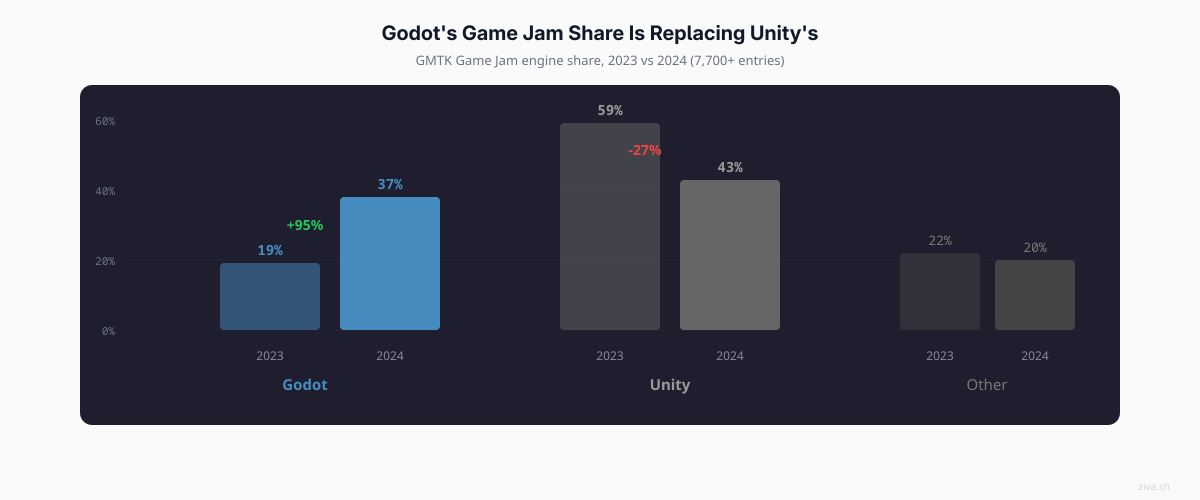
- TAM: Godot had 37% of GMTK Game Jam entries in 2024, up from 19% the year before. That's tens of thousands of active developers and growing fast.
- Competition: We are the leading Godot-specific AI tool. In Unity's ecosystem, there are dozens of competing tools.
- Channel: The Godot community is concentrated on Reddit, Discord, and GitHub. Three channels reach most of the TAM. Our blog drives significant organic traffic with posts about Godot vs Unity and game development costs.
- Pricing: Free tier converts because developers try it on a real project and feel the difference. Paid plans from $20/month fit indie budgets.
The GDC 2026 survey says only 7% of game devs view AI positively. That sounds bad until you realize 36% are using AI tools anyway. They're not positive about AI. They're positive about shipping faster. The tool just has to work.
Vibe coding is the biggest search trend in developer tooling right now and the game engine segment is wide open. If you have questions about building for niche game dev markets or AI tooling, happy to chat.

The 27% debugging usage is interesting.
Do you see beginners mostly understanding the bugs they’re fixing, or are they relying on the agent to keep patching things until it works?