$26,989.81 Was Sitting in My Client’s Data. Every Tool Reading HubSpot Missed It.
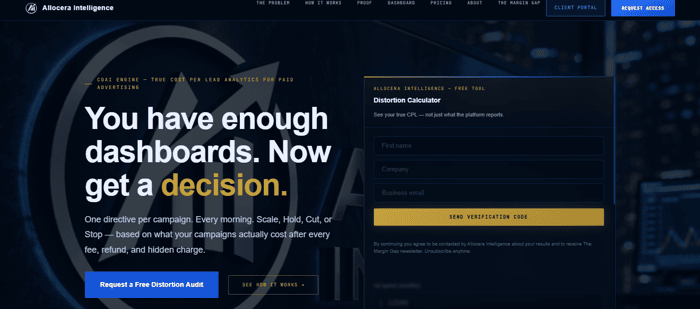
A little more than two years ago I started building a deterministic capital allocation engine because I got tired of marketing dashboards telling me what platforms reported instead of what businesses actually earned.
Every night around 2 AM the engine sends me an email.
I read every one.
It’s the same routine. API connections are healthy. Database is healthy. Data ingestion completed. Client connections are stable. The engine is doing exactly what it was designed to do.
Most nights, that’s the end of it.
Then one night it wasn’t.
A home care company in North Carolina was running Facebook ads.
Meta showed ad spend. Every attribution tool connected to HubSpot showed $0 in revenue. Every dashboard reached the same conclusion: these campaigns aren’t producing revenue.
Cut them.
The engine didn’t.
Instead, it kept following the data.
The company bills through QuickBooks. QuickBooks syncs into HubSpot. That’s where the problem started.
Almost every attribution platform connected to HubSpot reads the standard deal amount property. Forty-eight of the fifty deals had a value of $0.
Not because the customers never paid.
Because HubSpot’s native QuickBooks sync stores invoices as a separate relational object. It doesn’t overwrite the original deal amount. If the deal was created at $0, it stays at $0.
Every dashboard saw exactly what it was designed to see.
Zero.
CDAI doesn’t stop at the deal record.
It reads the invoice layer directly.
Suddenly, $26,989.81 appeared.
Real invoices. Real paying clients. Revenue that had been sitting in the company’s own systems the entire time, completely invisible to every reporting tool they were using.
The part I’m most proud of is what happened next.
The engine didn’t tell them to scale.
It didn’t tell them to cut.
It issued a single directive.
FLAG.
Revenue existed, but the tracked advertising cost didn’t reconcile. That’s a data integrity problem, not a budgeting decision.
The engine refuses to guess.
If the evidence is incomplete, it stops and asks for human review before anyone makes a financial decision.
That’s exactly why I spent the last two years building it.
The goal was never to build another dashboard.
The goal was to build something that could tell the difference between missing data and bad marketing.
Because those are two completely different problems.
If you’re wondering what your own reporting might be missing, I made the distortion calculator free.
You can run your own numbers here:

What stood out to me wasn't the $26k—it was the decision to stop instead of forcing an answer. A lot of analytics tools treat incomplete data as a reason to estimate, when sometimes the highest-quality decision is recognizing that the evidence isn't reliable enough yet. That distinction between "bad performance" and "bad visibility" feels much more valuable than another reporting dashboard.
That's exactly it — and honestly it took me
a while to get there myself.
The instinct when data looks bad is to ask
"what's wrong with the campaign?" But sometimes
the right answer is "we don't actually know yet
and pretending we do is more dangerous than
waiting."
Most tools are built to always give you an answer
because that's what feels useful. CDAI is built
to tell you when an answer would be premature —
which is a harder thing to ship because it feels
like the tool is doing less when it's actually
doing more.
The "bad performance vs bad visibility" framing
is something I landed on after watching good
campaigns get killed because the data window
was too short to see the full conversion cycle.
Especially in verticals with long sales cycles
like senior care or legal — you can be 30 days
into a 90 day cycle and the numbers look
terrible when they're actually fine.
Appreciate you picking up on that distinction.
Most people focus on the revenue number.
That's exactly why I wanted to continue the conversation.
Reading your reply, I think there's one strategic business decision sitting underneath that distinction that becomes much more significant as the product evolves, but I don't think I can do the reasoning behind it justice in a thread.
Happy to explain what I mean if it's useful. What's the best email to reach you?
linkedin is best, profiles in my bio
Perfect, thanks. I wasn't able to get through to your LinkedIn profile, so I sent it to the email listed in your profile instead.
Looking forward to hearing your thoughts.