3 Things I Got Wrong Building AI for Game Developers
We build Ziva, an AI coding assistant for the Godot game engine. After 15 months of building, here are three assumptions that turned out to be wrong and what we actually learned.
1. "Code generation is the killer feature"
We assumed developers wanted an AI that writes code for them. That was our pitch. That was what we optimized for. And code generation does get used (about 42% of all requests).
But the feature users actually love most? Debugging.
We noticed users kept pasting error messages and screenshots of broken output into the chat. Over and over. They didn't want the AI to write code from scratch. They wanted it to look at the red error text in their debugger and tell them what went wrong.
So we built an auto-debug feature that reads Godot's output panel directly. That single feature changed our retention numbers more than any code generation improvement we shipped.
The lesson: Watch what users do with your product in the first 48 hours. The thing they keep trying to make it do (even if it wasn't designed for it) is your real product.
2. "We need to support multiple game engines"
Every advisor told us: "Start with Godot, but plan for Unity and Unreal." The logic made sense. Unity has 51% market share on Steam. Godot has maybe 5%. Why limit yourself?
Here's what actually happened: by going deep on one engine, our AI got dramatically more accurate. GDScript is one language with a consistent API. Godot's scene tree is one architecture pattern. We built 50+ integrations with Godot's internals: reading the scene tree, understanding tilemaps, parsing collision layers.
A general-purpose AI coding tool treats GDScript like weird Python. Ours understands the engine. That accuracy gap is our entire moat.
If we had spread across three engines, we would have been mediocre at all of them. Instead, we're the best option for a fast-growing niche. Godot games shipped on Steam doubled year over year from 618 in 2023-24 to 2,864 in 2025-26.
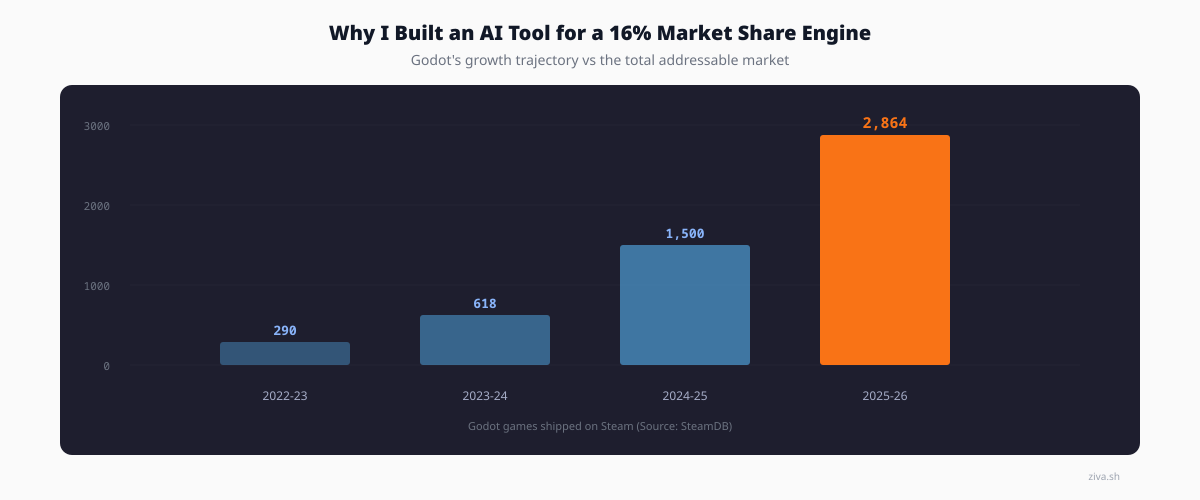
The lesson: Being the best tool for a growing 5% market beats being an okay tool for a stagnant 50% market. Niche dominance compounds.
3. "Developers won't pay for AI that helps with a free engine"
Godot is free. Open source. MIT licensed. The community prides itself on zero-cost tools. We worried that nobody would pay for a plugin when the engine itself costs nothing.
Wrong. Indie game developers have tight budgets, but they value their time more than their money. If a tool saves them 3 hours a week, paying $20/month for it is an obvious trade. The key was pricing for indie budgets, not enterprise budgets. Our free tier gives enough credits to try the tool seriously, and our most popular paid plan is $20/month.
The GDC 2026 State of the Industry report found that 47% of game developers using AI tools use them for code assistance. The demand exists. The question is whether the tool is accurate enough to justify the price.
The lesson: Free ecosystems create tool opportunities, not barriers. If the ecosystem is free, the users are spending their time instead of their money. Sell them their time back.
What I'd do differently
If I started over, I'd build the debugging feature first, not the code generation feature. I'd pick one engine from day one with no "future multi-engine" roadmap to distract the team. And I'd price at $15/month instead of $20/month to reduce friction on the first upgrade.
The biggest meta-lesson: your users will tell you what your product actually is. Listen to what they do, not what they say they want.
Happy to answer questions. ziva.sh

The debugging vs code generation finding is one of the most underappreciated insights in AI tooling. We see the same pattern building AI systems for enterprise clients: the feature that gets the demo is rarely the feature that gets daily use.
The meta-lesson you mentioned applies way beyond gaming. In almost every vertical, users say they want AI to do the fancy generative stuff - but retention comes from AI making the painful, boring, blocking problems disappear. Error diagnosis, pattern recognition in logs, explaining what something broke and why. That is the high-frequency pain that justifies a subscription renewal.
"Listen to what they do, not what they say they want" should be on a wall in every product team working on AI tools.