34 blog posts in 75 days: an indie content sprint
For the first 14 months of building Ziva (an AI agent for the Godot game engine), we wrote 8 blog posts. Eight. Then in March 2026 we flipped a switch. In the 75 days since, we have published 34 articles. Our top post now does ~42,000 impressions a month from search. Here is exactly what changed and what I would do differently.
This is for indie founders who keep telling themselves "we will get to content marketing once we ship the next feature." That was me for a year. Do not be me.
The actual numbers
Before (Jan 2025 to Feb 2026): 8 articles in 14 months. Roughly one every 7 weeks. Almost zero organic search traffic.
After (Mar 2026 to May 13, 2026): 34 articles in 75 days. Roughly one every 2.2 days. One article (Best AI Tools for Godot) hit ~42K monthly impressions in Search Console. Total indexed pages: 26 (out of 63 attempted, more on that in a second).
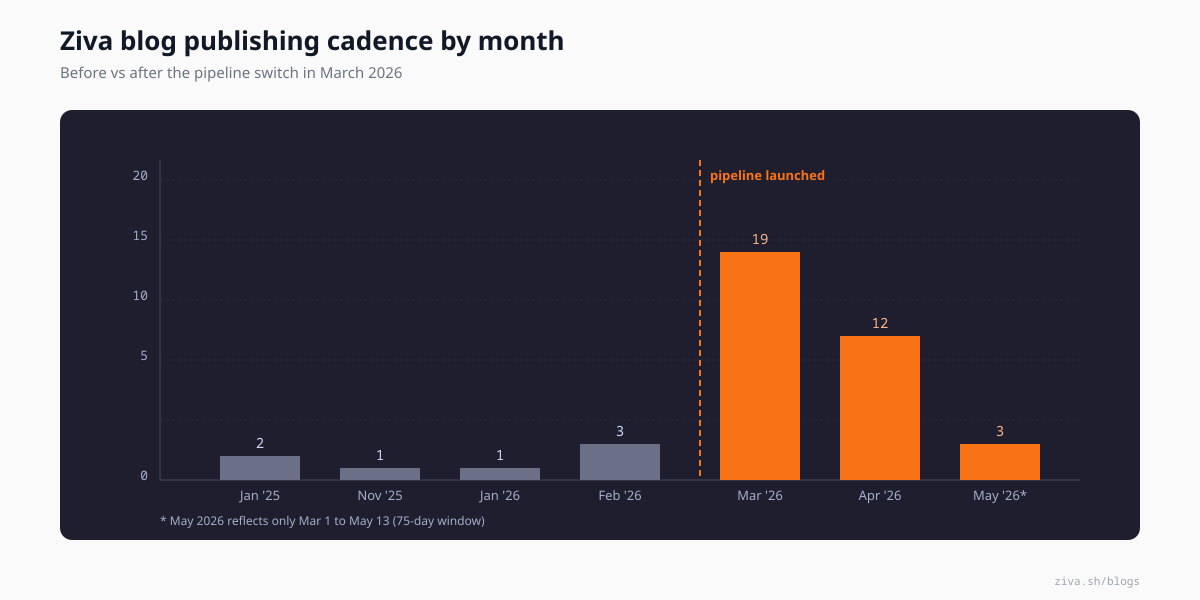
The cadence shift is what matters. Going from "occasional" to "near-daily" changed the entire growth shape. Not the writing quality. Not the keyword research depth. Cadence.
What flipped the switch
I stopped treating each post as a project. Three concrete changes:
1. I built a pipeline, not a habit. A daily blog habit is brittle. A pipeline that runs whether or not you feel inspired is not. We built a system where each article goes through a fixed flow: keyword research, competitive SERP read, deep research, draft, validation, build, ship. Each step has a checklist. Anyone (or anything) can run it.
2. I stopped writing one post and shipping it. Now we research the keyword space first, then knock out 3 to 5 articles in a session targeting adjacent long-tail keywords. The marginal cost of the second article in a session is half the first because the SERP context, source list, and tone are already in your head.
3. I gave up on writing every word myself. This is where Ziva itself ironically fits in. We use AI tooling to draft, then a human edits. The AI does not get a final say. But it lifts the floor, so a tired Tuesday post is still serviceable.
If you want the quick version: pick a niche, build a pipeline, run it daily, edit what the pipeline produces. The pipeline is the moat, not your writing voice.
What did not work
Three real failures from the 75 days that I wish someone had told me before I burned the time:
- Generic "AI is changing X" posts. Wrote two of these. Got nothing. The keyword space is too contested by every consultant on Earth. Niche down to a specific tool/engine/audience.
- Long titles trying to be clever. "How Much Does It Cost to Make a Video Game in 2026?" did fine. "The Quiet Way Indie Studios Are Recouping Their Engine Bills" did nothing. People search for the literal question, not the metaphor. Title is the meta description Google uses for SERP click rate.
- Trusting Google to discover articles on its own. 26 indexed out of 63 attempted is brutal. We had to manually request indexing in Search Console for almost every article. New domains do not get crawl budget. Plan for that.
What is actually working
- Listicles and "vs" posts carry the search traffic. Top performers: "Best AI Tools for Godot," "Godot vs Unity," "Best 2D Game Engines." These rank because the SERP is full of low-effort affiliate posts that are easy to beat with real data.
- Internal linking from the highest-traffic post. Every new article gets a contextual link from "Best AI Tools for Godot" because that post has the most authority. Google discovers the new pages faster, and they inherit some of the parent post's signals.
- One-click cross-platform syndication. Each ziva.sh article gets a parallel post on Substack, DEV.to, Hashnode, and a few non-English platforms. Different audiences, different format, but the research is done once.
The honest cost
This is not free. Each article still takes ~2 to 4 hours of human time even with the pipeline. That is 70+ hours over 75 days. If your hourly opportunity cost is high, do the math before committing.
But the alternative was paying $5 per click on Google Ads against the same keywords. At 42K monthly impressions and a 2% CTR (conservative), one article delivers ~840 clicks per month. Buying that traffic at $5 CPC is $4,200/mo. Forever. The article cost us 4 hours once.
That is the deal indie content makes. Slow start. Then leverage stacks for months.
What I would do differently if I started today
- Start blogging on day one of the company, not month 14. SEO compounds over months. Every week you delay is a week of compounded returns you do not get.
- Pick the boring listicle keywords first. "Best X for Y" beats "The Future of Z" by 10x. Write the boring posts that solve a real search query.
- Build the publishing pipeline before you have anything to publish. The pipeline is the bottleneck. Solve it first when you have time.
- Track impressions, not just visits. Search Console impressions tell you what Google considered showing your post for. That signal moves faster than clicks.
If you are building anything indie and you are reading this thinking "I should really write more," do not finish the article. Open your CMS and ship one post today. The 35th post is a lot easier to write when there are 34 others holding the door open.
If you want to see what the pipeline produced, the 34 articles are at ziva.sh/blogs. Ziva itself is at ziva.sh. It is the AI tool we built for Godot game developers, which is also what most of these articles end up being about.
