4 failed products, 9 months of confusion, then 1M organic impressions in 40 days.$0 ad spend. Here's what actually grew our open-source Saas
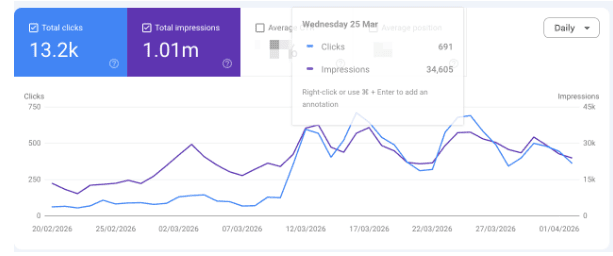
Quick backstory. My previous company got acquired. I stayed on, cushy job, no real workload. Quit anyway and teamed up with my childhood friend. We spent 9 months building 4 different products that all went nowhere. Eventually we landed on Dograh, an open-source voice AI agent platform competing with Vapi, Bland, Retell, all companies with millions in funding.
Six months in, here's where things stand. 1M impressions in the last 40 days. 13.2k clicks. 360+ signups last month on our cloud offering. 20+ qualified meetings from pure inbound. We turned down a VC term sheet to stay bootstrapped. Zero ad spend ever.
The first three months were dead. I tried LinkedIn, wrote technical posts about voice AI architecture. Nobody cared. I kept checking Search Console daily seeing 50 impressions, 80, nothing moving.
What changed was getting serious about SEO in a specific way. I wrote honest comparison pages where I broke down where Dograh is better and where it's genuinely not. Also I focussed on making all our content GEO/LLM friendly. LLM’s started to pick it up (You will find Dograh mentioned when you Search open source alternative to Vapi on gpt/claude etc)
What I did for GEO: Just simple things - I built a glossary of every confusing term in the article, written in plain English with a summary up top for each section. LLMs seem to pick that.
Around day 60 it started compounding. One page ranks, domain authority ticks up, other pages rise, more clicks feed better rankings. The chart went from flat to vertical in about a week.
The SERPs for anything voice AI related are brutal, every keyword has 30-40 funded competitors. But specificity seems to beat budget. Niche queries that nobody else bothered writing about, that's where a bootstrapped founder can actually win.
GitHub: https://github.com/dograh-hq/dograh
Where we are struggling:
The one thing I haven't cracked is growing the open-source community. Real traffic, real signups, real pipeline, but GitHub engagement isn't keeping pace. If you've scaled an OSS community I'd genuinely love to know what worked.

I know a few founders who have scaled an open-source community, and they'd probably be willing to answer any questions you have about increasing GitHub engagement if you want.
The comparison page strategy is underrated. Most founders are too scared to write "here's where we're genuinely worse than the competition", and that's exactly why it builds trust when someone does it. Readers can feel the honesty immediately.
The GEO point is something I've been paying attention to, too. Structuring content for LLMs — glossaries, plain-English summaries, clear section structure- feels counterintuitive at first, but it's clearly where discoverability is heading.
On the OSS community question, one thing I've seen work is turning GitHub issues into visible conversations. When maintainers respond in depth, not just "fixed in next release" but by explaining the trade-off, it signals that contributors matter. That transparency compounds.
The flat to vertical shift is the one most people give up right before. The problem is the timeline is invisible while you’re in it you can’t tell if you’re in the flat part that eventually goes vertical or the flat part that stays flat forever. The community gap point is real too usage comes from utility but contribution needs identity. People contribute when being associated with the project says something about who they are. That’s a different design problem than making the tool useful. The 20-step automation for content production is the part I’d love to see more detail on specifically how you handle quality control when the volume goes up. Would love to connect feel free to check out what I’m building at tryreleaselog.com
how did you start with the seo stuff? as in what did you use?
We wrote a lot of competitor comparison blogs. Things like open source alternative to Vapi and open source alternative to Retell basically one for each competitor. But we didn’t treat them like generic SEO pages.
For every article, I actually went and read what was already ranking on Google. Tried to understand why it was ranking, what it was missing, and then made sure our version was simply better. More depth, more honest takes, and a clear founder opinion throughout. Not just information, but perspective.
We kept the structure very simple and consistent. If the keyword was open source alternative to Vapi and we had a section on pricing, we didn’t just throw in a quick list. We wrote proper paragraphs explaining how pricing actually works, where the tradeoffs are, and what to expect. Each section also had a short summary, which helped with featured snippets.
Alongside this, we went deep into glossary-type content. Stuff like what is a voice AI agent?,what is STT, what is TTS It sounds boring, but it works really well. These are the kinds of pages LLMs tend to pick up when answering questions.
This was intentional. The goal wasn’t just to rank on Google, but to show up when someone asks tools like ChatGPT or Perplexity about voice AI or alternatives.
Once this started working, we automated most of the process. Around 20 steps are now handled through an internal tool.
Sharing the repo here: https://github.com/pk-198/blog-writing-ai-human-pair
this is super dope, i was considering writing seo content as well but i honestly did not know where to start at all
i have a much better idea now, thanks to you
The “flat to vertical” shift is the part most people underestimate. It’s easy to give up in that early phase because it just looks like nothing is working.
The community gap is interesting as well. Usage tends to come from utility, but contribution needs a reason. If it’s not obvious how someone can help or benefit from doing it, they usually won’t.
Have you tried giving people a clear first step to contribute, even something very small?
Yeah, that’s exactly the gap we’re trying to fix right now. We’re focusing on making the contribution super obvious with better examples, clearer docs, and small “good first issues” so devs can jump in quickly.
Utility brings users, but contribution needs intent. We’re exploring how to make that first step obvious and frictionless.
Making that first step obvious probably matters more than lowering friction. If people don’t know how to contribute, they won’t even try.
The "flat to vertical" shift in your SEO chart is the ultimate validation, Pritesh. Beating funded giants by focusing on "LLM-friendly" content and honest comparisons is a masterclass in bootstrapped specificity—most people overlook how much power a simple glossary can have for discovery.
I’m currently running a project (Tokyo Lore) that highlights high-growth stories and business logic just like the one behind Dograh. Since you've already mastered the inbound side but are still cracking the OSS community engagement, testing your "bootstrapped vs. funded" narrative in a competitive environment could help attract the high-intent builders you need for GitHub growth.
ok, thank you
Thanks Pritesh! Glad the “flat to vertical” shift and specificity > budget insight resonated.
Quick overview of Tokyo Lore: It’s a paid ideas competition where people submit Tokyo-connected business or creative ideas. For $19 you get a custom AI-generated artifact of your idea + a full SPEAR business analysis, plus entry into the round where the winner gets a real trip to Tokyo (flights + hotel booked by us).
Prize pool has started building — odds are excellent right now while it’s still very early.
Your bootstrapped SEO + OSS growth experience would make a strong submission. Would you be interested? Happy to send you the direct $19 link and walk you through the process (very quick).
What do you think?
ok, thank you. We will check it.
Sure ..the Link is - Tokyolore.com
Great case. You clearly found “where to play”.
Your key insight is strong: specificity > budget.
But here’s the gap: traffic ≠ community.
What you built works for demand capture, not necessarily OSS growth.
To bridge that:
Turn docs into “first PR in 10 minutes” onboarding
Well-defined “good first issue” tasks
Highlight contributors (make contributions visible)
SEO brings users. Community comes from guided participation.
We are also very actively working on making it easier for developers to be able to contribute and hack around with the platform in general. We are very actively working on improving our documentations and shipping them as we get more feedbacks from the community. We have recently shipped our MCP and SDKs. We will be writing extensive documentation for making it anyone to play with it
Thanks for your suggestion.