4 months to go. Chrome extension live. Web search integrated. 4 users. $0 revenue. Still here.
I posted here a few weeks ago about building TruthScore with $0 revenue and almost quitting three times. That post got 130+ comments and genuinely kept me going.
So here is the honest update.
What has changed since that post:
I launched a Chrome extension.
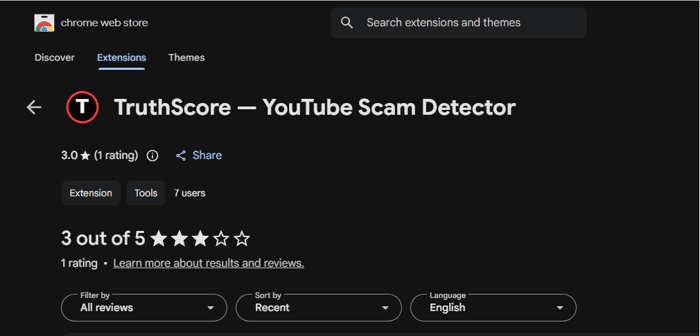
It lives inside YouTube. You browse, you see a suspicious thumbnail, you click the icon, you get a TruthScore score without leaving the page. No new tab. No copy-pasting links. Just instant scores where the problem actually happens.
It has 3 users right now.
I know how that sounds. But 3 real humans installed something I built from scratch onto their browser. That is not nothing.
I integrated web search.
TruthScore no longer only analyzes YouTube signals. It now pulls web data to cross-reference what is being claimed in a video against what actually exists online. If a creator claims $50K months but leaves zero digital footprint anywhere, the tool catches that now.
This was the most technically challenging thing I have built so far, and I built it alone.
What has not changed:
Revenue is still $0.
I launched in December. It is now almost September. Eight months of building, iterating, marketing, fixing false positives, surviving a public callout from a creator, discovering my YouTube comments were shadowbanned the entire time, writing a viral Indie Hackers post, launching a Chrome extension, and integrating web search.
$0.
The real situation right now:
The Gemini API key is costing real money every month. Money I do not have. Every scan costs me something, and none of those scans are converting to revenue yet.
I have 27 email subscribers who used the tool and gave me their email. None of them have paid.
YouTube comments stopped working — between the shadowban and the platform treating my account as spam, that channel is effectively dead for now.
I do not have money to run paid ads.
What I have is a working product, a Chrome extension, a genuine problem worth solving, and the stubbornness to still be here after eight months of $0.
Why I am still not quitting:
Because I built this after getting scammed myself by a YouTube "make money online" video. That problem is still real. People are still getting scammed every single day by content that looks legitimate but exists only to funnel them into affiliate products.
TruthScore catches that. The tool works. The distribution is what is broken.
And I have not found the distribution lever that makes this explode yet. But I am still looking.
What I am asking for:
If you have used TruthScore—tell me honestly why you did not pay. Was it the price? The trust? The product not solving your problem clearly enough?
If you have solved the gap between a working free tool and a first paying customer—tell me what actually moved the needle.
If you are building something with the same zero-revenue wall right now—reply below. I want to hear from you.
The Chrome extension is live. The web search is integrated. The tool is better than it has ever been.
Someone needs to be first. Why not today?
truthscore.online
#indiehackers #buildinpublic #saas #zerorevenue #chromeextension #indiemaker #startuplife #distribution #makemoneyonline

At 27 subscribers and 3 extension users, I’d stop asking “why won’t people pay?” broadly and run 10 manual concierge checks with one narrow audience. If scam-prevention is the promise, prove one painful save, then price around that avoided loss instead of generic usage.
Your line "the distribution is what is broken" stuck with me — so instead of giving advice, I did some work: I built a verified list of 27 people who already care about what TruthScore does (anti-guru YouTubers, media-literacy programs like Poynter MediaWise, creator-economy journalists — 16 with verified direct emails). It's yours for free. I just emailed it to the address listed in your privacy policy — check spam if nothing landed, or reply here and I'll get it to you another way.
Its has been really nice working with you. All the insights
Thank you
4 users and $0 revenue isn’t a reason to build faster. It’s a reason to get uncomfortably specific about who should care.
Before adding anything else, I’d try to get one stranger to say yes to one paid offer. That conversation will probably teach you more than the next month of features.
I opened truthscore.online cold, as a stranger, to answer the exact question you asked: why didn't I pay?
Not the reason I expected. Your free path is genuinely well built - a question for a headline, a paste box, no account, a demo link. Free works because the page is built around free.
Pro is what I couldn't find a reason for. The card sells throughput: unlimited analyses, priority speed, no email gate. But my moment as a visitor is one suspicious video before I follow someone's advice or buy their course - I need depth on one decision, not volume across many. And the one thing you built that delivers that depth - the web cross-reference that catches "claims $50K months, zero footprint online" - isn't mentioned anywhere on the page. Not in the hero, not in Pro's bullets, not in the FAQ. Your hardest build and sharpest differentiator is invisible at the moment of purchase.
Two things the page says against itself: the extension section is headed "Coming Soon" and closes with "50% off Pro forever when we launch," while your top nav and FAQ say the extension is live - and the third stat in the hero is "Free - Always," which tells me not to pay at the exact moment I'm weighing it.
If I tested one change: sell Pro as the background check, not the bulk plan. Lead its bullets with the cross-reference verdict, and let the no-email sample report show that layer catching a real case. The 27 people who gave you an email already told you the score is worth something; what nobody has seen yet is the thing that's worth $9.
Wow. Thank you for doing a cold teardown. You completely nailed the blind spot I couldn't see. Selling "volume" when the user needs "depth" for one critical decision makes total sense, and it hurts (in a good way) to realize my most valuable feature—the web cross-reference—isn't even on the page.
I am fixing the contradictory "Coming Soon" and "Free - Always" copy right now. Your suggestion to reframe Pro as a "background check" rather than a bulk plan is exactly the pivot the landing page needs. Seriously, thank you for taking the time to look this closely.
The 27 email subscribers who didn't pay are telling you something specific. They experienced the tool, decided it was worth giving their email for, and still didn't pay. That's not a price problem. It's a habit problem.
Free tools create a check-in habit. Habits don't convert to subscriptions unless the person hits a moment where not having paid access causes them real pain. For TruthScore, that moment is probably right before someone follows advice from a creator or buys something a creator recommended. The conversion window is 30 seconds wide, happens outside your product, and you're not in the room when it happens.
The distribution question I'd be asking isn't where to find more users. It's where the scam-victim moment actually happens. Reddit is probably more useful than YouTube for this. r/personalfinance, r/investing, r/malelivingspace all have regular threads about creators people regret trusting. Those communities are already angry and already looking for a tool like yours. That's not a cold audience.
The shadowban is a real hit, but YouTube comments aren't where your buyer is anyway. Your buyer is someone who just watched a video they're suspicious about, not someone browsing creator content for entertainment.
What's the most common pattern in your false positives? That's probably where the trust gap with the 27 non-paying subscribers is hiding.
At 27 emails and 3 extension users, I would stop optimizing product for a week and only run exit interviews: ask each person what exact moment made them try it, what they expected to happen next, and what would make it worth paying before the next scan. The first paid user is probably hidden in the gap between "interesting" and "I need this before I click play."
What stands out to me here isn’t the “0 revenue” part—it’s the fact that you’ve kept shipping, integrating web search, and improving the product despite having only 4 users. That persistence is often harder than the technical work itself.
At this stage, I’d probably treat those 4 users as a goldmine rather than a small number. Understanding exactly why they signed up, what problem they’re trying to solve, which feature they use repeatedly, and what would make them willing to pay could reveal more than trying to acquire hundreds of random users.
You’re still early enough that one strong insight from a single user could completely change the direction of the product. Four users may not be traction yet, but they’re definitely enough to start learning.
Respect for staying with it. The next 4 months could be much more interesting than the first 4.
Three real users is not nothing. The sharper signal in your post is 27 people willing to hand over an email, zero paying, and an API bill that grows with every free scan. That points to a trust-and-value test before a distribution test. I’d make the first scan free, but put the web cross-reference behind a small one-off payment or credit, then watch whether anyone pays to see the reasoning behind one specific score. Not a generic premium tier — a concrete evidence report: which claim was checked, what footprint was missing, and what changed the score. That gives a user something they can judge instead of asking them to trust a number. It also gives you a cleaner conversation with the 27 subscribers: “what would make this report worth paying for?” A working product with zero revenue is painful, but it’s still a clearer experiment when the next user can cost you less than they teach you.
I don't think this is a big enough need honestly.
Could you please explain in detail or elaborate what you mean
One thing none of the answers above touch: the trust problem might not be about price or timing, it might be that a single score is a hard thing to trust when it's a verdict about someone else. I hit something similar with money data, not scam data, building Alisio. Early on I showed one confident number and people made decisions off it that didn't hold up, so now if a figure can't show what it's actually built from, the app refuses to print it rather than showing a plausible-looking guess. A TruthScore that comes with the two or three signals it weighted most, the missing footprint, the claim mismatch, whatever specifically tipped it, would probably convert better than a number alone, because people won't pay to trust a black box, they'll pay to see the reasoning and agree with it themselves.
That black box insight is huge—'people won't pay to trust a black box, they'll pay to see the reasoning.' That makes total sense. Right now, a score feels like an arbitrary verdict, but showing the 2–3 key signals (like missing footprint or claim mismatch) turns it into an evidence pack they can verify themselves. Definitely going to test showing the core breakdown alongside the score instead of just a raw number. Appreciate you sharing that experience with Alisio
One thing to watch once you show the breakdown: people will disagree with individual signals more openly than they ever disagreed with the raw score. A single number gets ignored or blindly trusted. Three visible reasons invite someone to say "that signal's wrong, my footprint isn't missing, you didn't check X." That's actually the trust-building moment, but only if there's somewhere for the pushback to go, a way to flag a signal as wrong that isn't a support ticket. I didn't need to design for that with Alisio's numbers, since I control what gets shown, not judged. You're judging other people, so the disagreement layer probably matters more for you than it did for me.
Disclosure: I build three products, one an iOS app with model calls in production, so the API bill part is familiar.
Everyone here is pointing at the 27, and they're right. But there's a separate thing in your post nobody's picked up: right now every new user makes your position worse. Each scan costs you Gemini money, nothing converts, and you've said plainly that it's money you don't have. So distribution isn't just the missing piece - it's the piece that hurts most if it arrives before the paywall works.
Which means I'd flip the order. Get one person paying, at any price, on the traffic you already have. That's a much smaller job than finding a distribution lever, and it's the only thing that turns a new user from a cost into a gain.
Concretely, I'd keep the first scan free - that's your demo, and you need it. The web-search cross-reference is where I'd put the wall. It's the thing that took you longest, it's the part nothing else does, and it's your most expensive call. At the moment your most defensible feature is also the one you're giving away to people who have told you 27 times that free is a price they're happy with.
Eight months and still shipping, with the extension out the door, is not nothing.
Thank you so much for pointing out what I need to do. Indeed, it's true that every free scan burns Gemini API tokens at my cost. I'm not sure on how to get one person to pay specifically at any price. Does this mean I need to change my PayPal paywall to something like "buy me coffee"? This is a new direction that I am willing to try because building for almost a year without any paying users gets one worried: "Is the product bad, or is it my distribution that's the problem?"
Buy-me-a-coffee would answer a different question from the one you're asking. A tip tells you somebody likes you and wants you to keep going, and you already have 27 of those. A payment tells you the thing did a job worth money. I'd keep the paywall where it is.
On your last question, I'd retire it. At 4 users there's no sample that can separate a bad product from bad distribution, and there won't be at 40 either. It feels like the important question and it isn't answerable yet, which is a bad combination - it'll keep you busy for another year.
Here's one you can answer this week instead, and I don't think anyone's raised it: did any of the 3 extension users come back and scan a second time? Not installed, not scanned once. Came back on their own, days later. One person doing that is worth more than the 27 emails, because it's the only evidence that exists either way for whether the thing gets used or just tried. If nobody has, that's your actual starting point, and it's a more fixable problem than price.
Still here after 4 months with 4 users — that's more than most people who talk about building.
The hardest part isn't the code, it's knowing if anyone actually wants it before you've burned months. What was your original validation signal that told you this was worth building?
Keep going.
I built TruthScore from my own experience. I got 'scammed' on YouTube after paying for a course, only to realize that everything it offered was available on YouTube for free. I emailed asking for a refund, got no response, and after emailing again and again, I think I eventually got blocked. That's how TruthScore came to be. After posting about this on YouTube, a lot of people could relate to the problem, but apparently that wasn't enough to get them to pay.
Sorry for the late reply — but thank you for sharing this honestly.
That's a classic gap between sympathy and willingness to pay. People relating to your story doesn't always mean they'll open their wallet.
The real test is pre-sale — would anyone pay before the product exists? That's the signal that matters.
Keep going. The fact that you're still here after 4 months says a lot.
The biggest signal here may not be distribution yet—it’s the 27 people who used the product, gave you their email, and still didn’t pay. That creates a much more interesting conversion question than “how do I get more users?” They’ve already crossed the curiosity barrier, but apparently not the value/trust/urgency barrier. I’d be careful about treating the product as proven and distribution as the only broken piece; the free-to-paid gap may be telling you something about how the product’s value is framed or experienced. The key question is: what would have needed to happen during that first scan for paying to feel like the obvious next step?
Spot on. The 'curiosity barrier vs. value barrier' distinction is a huge perspective shift for me. I’ve been so focused on getting more top-of-funnel eyes that I overlooked fixing what happens right after that first scan
The 27 emails are probably the highest-leverage signal here. I would not ask them generally why they did not pay. I would ask one very narrow thing: "What would have needed to happen in your first scan for this to be worth paying for today?" That forces the answer toward outcome, trust, and urgency instead of politeness.
That exact question phrasing is absolute gold, Aaron. Asking general 'why didn't you pay?' questions usually gets soft, polite answers that don't help much. I'm going to draft a quick email with this exact line and send it out to the 27 subscribers today. Appreciate the sharp framework
The “distribution is broken” conclusion is the part I’d question most. 27 people gave you their email after using it, but none paid — that sounds like a useful signal about perceived value, trust, or willingness to pay before assuming you just need more users. I’d dig into that gap first.
That’s a fair pushback, Aryan. The reason I viewed it as a distribution problem is that I'm getting zero top-of-funnel traffic right now, but you're completely right—27 free signups with $0 converted is a clear signal about the value/paywall gap. How would you approach validating whether it's a price issue vs a fundamental lack of willingness to pay for this type of tool?
That’s exactly the distinction I’d want to look at before drawing a conclusion from the 27 signups. There are a few different things that could explain the gap, and I wouldn’t want to assume it’s pricing without looking at the evidence.
Happy to compare notes on it. What’s the best email to reach you on?
The distribution being broken while the product works is the most honest description of early stage I've read. Same situation here — still looking for that first paying customer. The hardest part is that a working product proves nothing about whether you can reach the people who need it.
Appreciate that, Andalib. It really is a bizarre feeling when the tech is solid and doing exactly what it's supposed to do, but the bridge to reach the people who need it feels totally missing. What product are you building? Would love to check it out.
Thanks kelon! I'm building Traction AI — you submit a startup idea, and I deliver a structured validation report (market size, competitors, willingness-to-pay signals) as a Google Doc within 24 hours. All manual research, not just AI output. Check it out: tractionai.netlify.app — would love your feedback.