4 tools. same buyers. nobody held all 3.
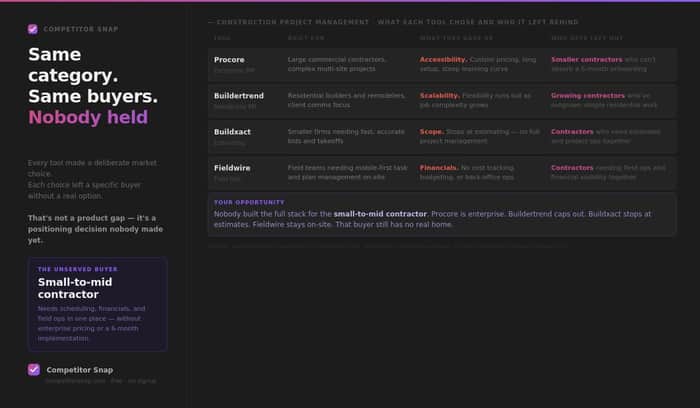
the most useful thing competitor research ever surfaced for me wasn't a feature gap. it was a trade-off.
procore handles complex commercial builds - but the implementation is enterprise-grade and the price follows. buildertrend works for residential and small-to-mid contractors but flexibility runs out as jobs get bigger. buildxact is sharp on estimating and stops there. fieldwire owns field coordination, leaves financials to something else.
same category. same buyers. nobody held all three for the small-to-mid contractor.
the founders who moved on that gap weren't running better spreadsheets. they noticed which trade-off every competitor had quietly agreed to make.
when competitive research actually changed a decision for you - positioning, product, pricing - what made it land?
(competitor snap is built to surface exactly this: competitorsnap.com, free, no signup for now, testing phase) (https://www.competitorsnap.com).

Good way to frame competitive research, the trade-off everyone quietly agreed to rather than a missing feature. The example that always lands for me is pricing model, it reveals who the builder had in mind more than the number does. What pattern do you see most when you run this, pricing structure or scope creep like the contractor example?
This is a useful way to think about competitor research. The most valuable insight is often not “what feature is missing,” but “what tradeoff every existing player has accepted.”
That can reveal a much clearer positioning opportunity than a simple feature comparison table.