40 days in, $5k/28-day revenue, 75 subscribers. Here's what I learned building an AI book-writing tool
Hey IH. I'm Mykyta, software engineer from Paradox Builders (paradoxbuilders.com). I've been on a weird journey with AI and writing over the last 3 years, and I want to share what that taught me about building products.
Quick backstory. In 2023 I published The Rational Software Engineer, written mostly by hand. In 2024, Full-Stack Web Development with TypeScript 5, where AI helped a lot more. In 2025 I built NanoReads, a romance reading platform running entirely on AI-generated books. And in 2026 I launched AIWriteBook (aiwritebook.com), an AI copilot for writing fiction and non-fiction.
So I went from writing by hand to building the AI writing tool itself. That progression changed how I think about this whole space.
Why this market
Amazon KDP is a $40B+ marketplace. There are people making $2k-20k/month self-publishing. Romance authors putting out 12+ books a year. Side-hustlers writing nonfiction around their day job.
Their workflows are broken. The average self-published author uses 5-7 tools for one book. ChatGPT for outlining, Claude for drafting, Gemini for editing, Grammarly for grammar, Publisher Rocket ($97) for keywords, Vellum ($250) or Atticus ($147) for formatting, Canva for the cover.
Seven tools. Seven months per book. Copy-pasting between apps, losing context every time.
One author told me: "I want to write chapters in MY voice. I've tried ChatGPT, Claude, Gemini, type.ai. I'm looking for ONE tool that does everything."
Voice, not speed. That's the real problem.
I thought speed would be the main thing. Write a book in days, not months. Makes sense right?
Nope. The number one pain across every user interview, from first-timers to people with 30+ books, is voice preservation.
They call generic AI output "AI slop." Repetitive phrases, passive voice, a tone that sounds like it was written by nobody in particular. One romance author who puts out 12 books a year told me: "With AI I do 3000 words per hour instead of 800. But I WANT THE CHAPTERS WRITTEN IN MY VOICE." Her readers notice when the voice changes. They come back because of how the last book felt.
That's a completely different problem than "make AI faster." And nobody in this space is solving it well.
What we built
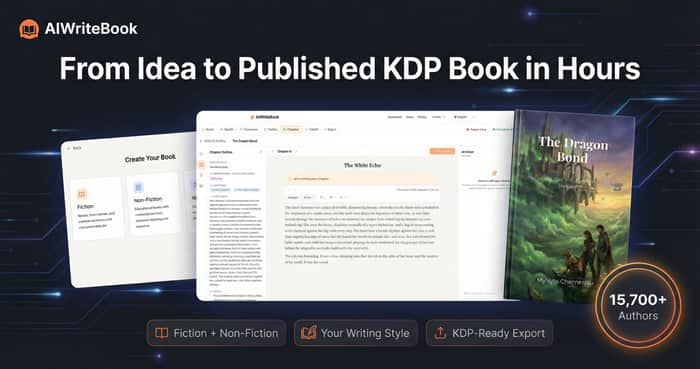
Not another AI text generator. The market has plenty. What's missing is the full pipeline: idea to outline to characters to chapters to cover to formatting to KDP-ready export.
Some specifics:
- Import existing manuscripts (.doc, .pdf, .epub). Authors have half-finished drafts sitting in folders. Users who import their own work convert way better. They already have skin in the game.
- Outline that actually drives content. Edit the outline, chapters follow. Sounds basic. Nobody does it right.
- AI cover generation with a full builder. Not templates.
- KDP-ready export. EPUB, print PDF with correct trim sizes, DOCX.
- Separate fiction and non-fiction flows because the structure is fundamentally different.
9 user interviews yesterday
This is the part I care about most.
Everyone can ship AI slop now. Wrap an API, put up a landing page, call it a product. The barrier to building is gone. Which means building is not the advantage anymore.
The advantage is being obsessed with the product. With user problems. With getting it right, not just shipped.
I did 9 user interviews yesterday. Not because someone told me to. Because every conversation shows me something I could never figure out staring at a screen. One author last week showed me how she tracks character details across a 12-book romance series using spreadsheets. That's worth more than any market research report.
We tried to be perfect from day 1. Not polished. Perfect in terms of solving the actual job the user hired us for. AI made that possible. What used to take a team of 10 six months, a small team can do in weeks now. So the bar moved. "Good enough" is table stakes. If your AI tool produces the same generic output as every other one, you're competing on price and you'll lose.
The numbers (40 days in)
- 75 active subscribers
- $5k 28-day revenue
- Launched 40 days ago
- Built at Paradox Builders (paradoxbuilders.com)
Not huge numbers. But for 40 days, limited paid acquisition, in a competitive space, it tells me the hypothesis works. Authors will pay for a tool that respects their craft. And now we've got more than a dozen people saying to us "I've tried 5 other competitors, they suck, but the quality your tool produced made me buy it"
What I'd tell other founders building AI products
-
Distribution is the moat, not the AI. Anyone can call the same APIs. Your edge is finding users, reaching them, keeping them. For us, Facebook writing communities are number one for experienced authors. YouTube and TikTok for beginners.
-
"AI-powered" is not a value prop. Nobody cares about the AI. They care about the finished book that sounds like them. The AI is infrastructure, not the product.
-
Let people bring their existing work. People have months of effort in half-finished manuscripts. If you can meet them where they are instead of asking them to start over, they convert. This was our biggest insight.
-
Perfection is achievable now, so aim for it. AI compresses build time. Use that to raise your quality bar, not to ship faster and sloppier. The market is full of AI slop. Stand out by being the one that's actually good.
Question for the community
How do you balance speed vs quality obsession in your product? I see a lot of "ship fast, iterate" advice. But in creative tools where output quality IS the product, I've found that backfires. Users leave the moment the output disappoints them. Curious if others feel this tension too.
