400+ reviews said the same thing. Every brand ignored it.
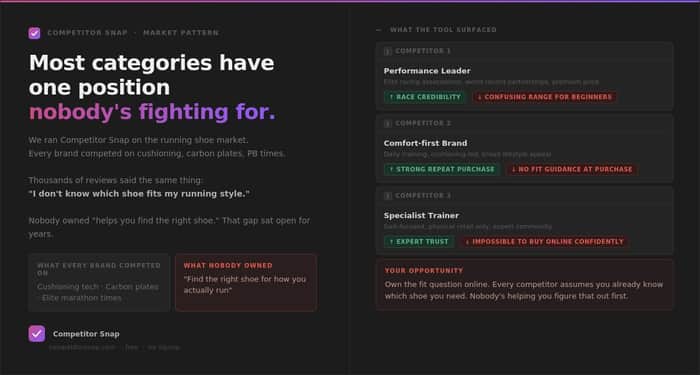
we ran competitor snap on the running shoe market this week.
every brand was competing on cushioning, carbon plates, and elite marathon times.
thousands of reviews said the same thing: "i don't know which shoe fits how i actually run."
nobody owned that question. not one brand had built a real answer to it. the gap sat open while every competitor kept outspending each other on the same three claims.
that's the pattern we keep seeing across categories - one position that should exist, doesn't. and nobody notices because everyone's benchmarking against the same three brands they already know.
what's the clearest gap you've spotted in a category you're in or studying?
curious what others are finding.
(we built competitorsnap.com to surface these gaps automatically - testing phase right now, no signup, describe your product and see what comes back)

One thing I'd be careful with:
A gap that appears repeatedly in reviews and a gap that can support a business are not always the same thing.
Those can look identical early on while leading to very different decisions.
that's the distinction worth making.
a complaint in reviews and an unowned position aren't the same thing. what the tool looks for is what frustrates people that no competitor has claimed. if 3 brands all ignore the same thing, that's not an oversight - that's a collective decision.
finding that pattern is the first question. whether it holds a business is the second. unit economics, distribution, how fast the category leader responds; none of that is in the research layer. most founders collapse both questions into one and either chase a complaint someone already owns, or miss the gap because they're benchmarking the wrong 3 brands to begin with.
the tool answers the first question. the second is still on the founder.
one honest caveat: it can't tell you why a gap is unowned. some gaps are open because nobody's figured it out yet. others are open because people tried and stopped. the research layer looks identical in both cases. that's the part that still needs a human judgment call.
That last part is what I found most interesting.
Two situations can look almost identical at the research layer and still imply very different decisions afterward.
Probably more than I'd try to unpack properly in a thread.
Happy to continue over email if useful.