5 No-Code AI Agent Builders That Actually Work — Ranked After Real Testing
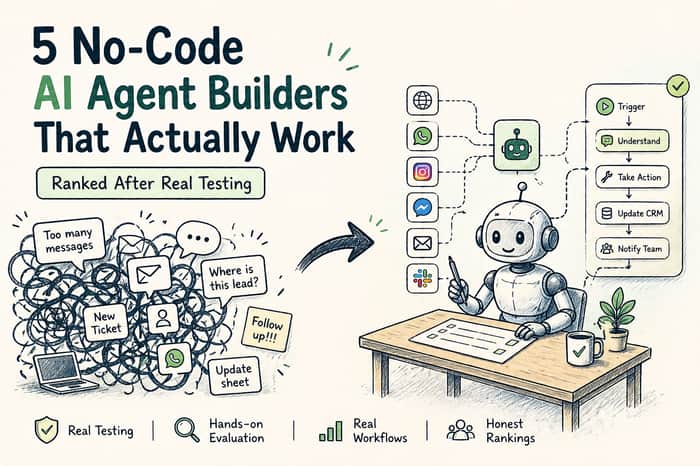
AI agents are running real business processes right now. I spent weeks testing the top platforms against actual use cases: customer support, lead qualification, internal automation. Here's what I found, ranked honestly.
My support inbox was drowning me.
I was spending 3 to 4 hours a day answering the same 15 questions. I knew AI agents were supposed to fix this, but every time I tried to evaluate platforms I ended up lost in a sea of "enterprise pricing" pages and feature comparison tables that all looked the same.
So I just tested them myself.
I ran each platform through three real scenarios: customer support automation, lead qualification, and multi-step internal workflows. Here's the honest ranking.
What separates an AI agent from a chatbot (quick version)
Before the list, this distinction matters for choosing the right tool.
A chatbot follows a script. Step outside the script and it breaks. It also forgets everything between conversations.
An AI agent reasons. Give it a goal and it figures out the steps, uses tools, takes action, and remembers context across sessions. It can check your CRM, send an email, update a database, and book a meeting, all in one flow, without you designing every step manually.
The no-code builders on this list make that accessible without writing a single line of code. Some do it better than others.
The Rankings
- Relevance AI
If you're building something complex, with multiple agents collaborating on the same process, Relevance AI is in a category of its own.
Most platforms give you one agent. Relevance AI gives you an orchestrated team of agents: one handling data analysis, one doing CRM updates, one generating content, all coordinated through a visual canvas that shows exactly how information flows between them.
The built-in vector database is genuinely impressive for anyone working with large knowledge bases. Semantic search across documents, databases, and past conversations. Not keyword matching but actual contextual retrieval.
Honest caveat: It's overkill if you just want a bot that answers FAQs. The learning curve is real and you need to understand at least the basics of how AI pipelines work to get full value.
Who should use it: Founders building internal AI systems, agencies building client automation, or anyone whose workflow is genuinely complex enough to need multiple specialised agents working together.
Best for: Multi-agent systems and data-heavy workflows
- YourGPT
YourGPT isn't a chatbot builder with a few AI features bolted on. It's built from the ground up to run multi-step actions in real time, not just respond to questions, but actually do things: query your CRM, update records, trigger workflows, escalate to humans with full context intact.
What stood out most was the omnichannel deployment. You build your agent once and it goes live on your website, WhatsApp, Instagram, Messenger, Slack, Discord, Telegram, email, and voice, simultaneously. Update the agent and it reflects everywhere instantly. For a solo founder managing customer touchpoints across multiple channels, this is a huge deal.
There are two building environments: a drag-and-drop builder for standard support and lead flows, and an AI Studio for anything involving API calls, code execution, or custom logic. I built a working support agent in under two hours on the no-code side, then used AI Studio to connect it to my internal database.
Live handoff works cleanly too. When a conversation needs a human, the agent passes full context over so the customer doesn't have to repeat themselves.
Honest caveat: If you just need a simple FAQ bot, this might feel like more than you need. The feature set is broad and it takes a bit of upfront thinking to plan your flows well.
Who should use it: Any indie hacker or small team that needs a serious AI agent handling real customer interactions across multiple channels without hiring a developer. Also solid for teams that eventually need to scale. It's SOC 2 and GDPR compliant out of the box.
Best for: Customer support, sales, and ops across every channel
- Voiceflow
Voiceflow carved out a specific lane and owns it: conversation design.
If the way your agent communicates, the flow of dialogue, how it handles unexpected questions, how it sounds, matters as much as what it can technically do, Voiceflow is the most purpose-built platform for that.
It started as a tool for building Alexa skills and that DNA shows. The design canvas is the most intuitive I've used for mapping out conversation flows visually. In 2026 they added proper LLM-powered responses alongside the structured flows, so agents can now handle genuinely unexpected inputs without falling back to canned answers.
The collaboration features are strong. If you have a designer and a developer who both need to work on the same agent, this is the platform that won't create friction between them.
Honest caveat: Weaker on the backend task execution side compared to YourGPT or Relevance AI. If your agent needs to do a lot, update systems, trigger external actions, integrate deeply, you'll hit limits. Integrations also require more manual setup than competitors.
Who should use it: Teams where brand voice and conversation quality are top priorities. Agencies building client-facing chat or voice experiences. Product teams with designers and developers collaborating on agent design.
Best for: Conversation quality and brand voice consistency
- Botpress
Botpress sits at an interesting intersection: accessible enough that non-technical founders can build functional agents, but deep enough that developers can go under the hood when needed.
It's built on an open-source core, which means you can inspect the logic, extend it with custom code, and maintain full transparency over how your agent makes decisions. For anyone in a regulated space or with genuinely unique requirements that templates can't cover, that matters.
The analytics are the real differentiator here. Most platforms give you basic usage stats. Botpress gives you a detailed view of where conversations succeed, where they drop off, which intents are being missed, and how resolution rates trend over time. That feedback loop is what separates agents that keep improving from ones that plateau.
Honest caveat: Some of the best enterprise features are locked behind higher pricing tiers. And getting the most out of it does require some technical comfort. It's not quite as beginner-friendly as it looks in demos.
Who should use it: Founders who want to optimise agents based on real data, or anyone with specific requirements that go beyond what standard templates cover.
Best for: Customisable agents with strong performance analytics
- Make (ex-Integromat)
Make takes a fundamentally different approach from the others. It puts your entire automation in front of you as a flowchart. Every connection, every condition, every data transformation is visible at a glance.
That visual transparency is genuinely valuable for complex scenarios. When you need to understand exactly how data is moving through a workflow, or audit it later, Make is cleaner than anything else on this list.
With 3,000+ app integrations and solid data transformation tools including parsing, filtering, and manipulation, it handles multi-path workflows and error logic well. AI steps through OpenAI and Claude add intelligence at specific nodes.
Honest caveat: The AI capabilities feel like additions to an automation platform rather than native agent intelligence. For workflows where you're primarily moving and transforming data between apps, with AI enhancing specific steps, Make is excellent. For use cases requiring genuine agent reasoning, memory, or autonomy, the dedicated agent platforms above are more appropriate.
Who should use it: Indie hackers building complex automations that touch many apps and need conditional logic they can actually understand and debug. Strong value for money at lower task volumes.
Best for: Complex, conditional workflows with lots of branching logic
How to choose
The decision is simpler than it looks:
Need agents that actually do things across multiple channels? Go with YourGPT
Building complex, multi-agent systems with lots of data? Go with Relevance AI
Care deeply about how your agent communicates and sounds? Go with Voiceflow
Want strong analytics and open-source flexibility? Go with Botpress
Primarily automating data flows between apps? Go with Make
My honest recommendation for most indie hackers starting out: try YourGPT first. It covers the widest range of real use cases, support, sales, ops, with the least technical overhead. You can be live in a day and expand from there.
The worst move is spending two weeks evaluating platforms. Every platform on this list has a free tier. Pick the one that fits your first use case and build something real. Start small, measure what happens, and scale what works.
What's your current stack for customer support or automation? Drop it in the comments. Happy to share what worked and what didn't for my specific setup.
Tags: AI · Automation · No-Code · Tools · Customer Support · Productivity · SaaS · Startups

The 'actually works' bar shifts at week six. Most builders shine on setup and early runs. The gap that tends to surface later: no monitoring layer. Agent produces wrong output, nobody notices, you find out three weeks later when something downstream breaks. The builders that hold up in production are the ones that make failure visible — clear error messages, logs, alerts when nothing ran. Worth adding to any review: what does it look like when the agent makes a mistake?
Most of these comparisons test for building one agent, not running 20 clients' worth of agents.
The gap: no-code builders are designed for builders, not for operators running agencies. You can build a solid agent in Make, Retell, or VAPI. But once you have 15 clients, you need client isolation so they can't see each other, white-labeled access so clients log into your portal rather than the platform's, and per-client billing so you know what each one actually costs you to run.
VAPI, Retell, n8n, Voiceflow are all strong for building individual agents. None of them are built for running a multi-client agency. That's a different product category, and it's the gap I'm working on at buildwithhermes.com.
Hey! Saw your comment about needing client isolation + per-client billing once agencies hit 15+ clients — really specific point, most guides skip straight past that.
I'm researching this exact gap (what happens to the API key/billing once an agency hands a bot off to a client). Since you built Hermes around it — quick text questions if you don't mind:
When one of your users' clients' bots goes live, does the LLM billing usually stay on the agency's account long-term, or have you seen it actually transfer to the client at some point?
In your experience, are most agencies trying to fully hand projects off and walk away, or do they want to keep billing/control on purpose (recurring revenue)?
No worries if you're busy — even a one-line answer would help a lot.