6 months of analytics told us nothing. One cancel page chat told us everything.
we were doing everything right on paper.
tracking cohorts. monitoring feature usage. watching
session recordings. we had dashboards for our dashboards.
and users kept leaving. quietly. every week. no pattern
we could find. no obvious reason.
then we did something embarrassingly simple.
we put a small chat on our cancel page. not a survey.
not a form. just a real question asked at the right
moment — when someone actually decided to leave.
first week broke us a little.
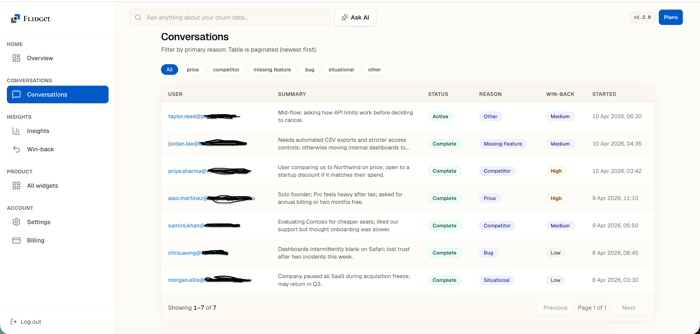
a user had been dealing with a safari bug for three
weeks and never reported it because they assumed we
knew. we had no idea it existed.
a solo founder loved the product but could not justify
the price after taxes. never said anything. just left.
two users were already halfway moved to a competitor
not because we were worse but because nobody had ever
shown them why staying made sense.
none of that was in our analytics.
none of it came from surveys.
it only came out because we were there at the right moment.
six months of data told us churn was happening.
one week of conversations told us why.
if you are watching users leave and have no idea why
the answer is probably sitting in the conversations
you are never having.
we built flidget.com out of this experience if anyone
wants to try the same thing.
what are you currently doing to understand why users cancel?

The 'Safari bug' story is the perfect example of why dashboards lie. Data tells you that someone left, but only a conversation tells you they left because of a bug they assumed you already knew about.
Since you've built Flidget to help founders catch these 'invisible' reasons for leaving, you should put the tool to work in the Validation Arena (tokyolore.com).
It’s a 30-day $19 entry sprint where founders compete on real traction.
It would be a fascinating 'meta' move to see you use Flidget to stop churn in a high-pressure race.
The prize pool is at $0 right now, and the winner takes a trip to Tokyo 🏆
The Safari bug example is exactly why we built Flidget. Dashboards show you the what but never the why. Someone churned. Great. Now what? You're left guessing between pricing, a competitor, a bug they never reported, or a feature they assumed was coming. The conversation is the only place the real story lives.
The meta angle here is genuinely interesting. Using an exit chat tool inside a churn pressure sprint where every cancellation is a public signal would be a live stress test of the exact thing Flidget is supposed to solve. Hard to say no to that kind of real world validation.
Checking out tokyolore.com now. Tokyo's a decent enough reason to ship fast. 🏆
You’re exactly the kind of person this is built for — real churn pressure, real signals, not dashboards.
If you’re already curious enough to check it out, I’d honestly not overthink it. Prize pool is still at $0 right now, which means your odds are literally the best they’ll ever be.
Round 01 hard caps at 100 entries and then it closes permanently — so this window doesn’t stay open.
If Tokyo + real validation sounds worth $19, I can get you set up in 2 minutes.
This matches what we found in e-commerce research. We went through 530+ Shopify app reviews and the quantitative data (ratings, install numbers) told us almost nothing useful. The qualitative data in the 1-star reviews told us everything. The exact complaints, the exact pain points, the exact words merchants use to describe their frustration.
The cancel page conversation is the equivalent of a 1-star review. It's where people stop being polite and tell you the real reason. Every SaaS should treat churn conversations as the most valuable data source in the company. Not a metric to minimize, but a feedback channel to maximize.
The 1-star review comparison is spot on. And honestly it's a better way to explain Flidget than how we explain it ourselves.
The reason 1-star reviews are so valuable is the same reason cancel conversations are valuable. The filter is off. People stop trying to be nice and just tell you what actually happened. That emotional honesty is where the real signal lives.
The difference is timing. A 1-star review comes weeks or months later when the frustration has cooled and the context is half forgotten. A cancel page conversation catches them in the exact moment they made the decision. The wound is fresh. The reason is specific. And you still have a chance to do something about it.
530 reviews to find the pattern is a lot of work. Flidget is basically trying to automate that same insight in real time, every time someone leaves.
Would love to see that Shopify research if you ever write it up. That kind of qualitative analysis is exactly what most SaaS teams are too busy to do manually.
You nailed the timing difference. The 1-star review gives you the pattern after the fact, the cancel page catches the decision in real time. Both are gold, just different windows.
The 530+ review research is essentially what became StoreMD. We mapped every complaint by category and found the same 5 problems across every major Shopify app. That qualitative layer is what told us what to build. The quantitative data (ratings, install counts) was noise.
Your angle with Flidget makes a lot of sense. Catching the "why" at the exact moment of the decision is something most SaaS teams skip because they're focused on the "how many" dashboard. Different problem, same philosophy: qualitative beats quantitative for product decisions.
You nailed the timing difference really well.
1-star reviews show you the pattern after the fact, while cancel-page conversations capture the decision in real time — when the emotion and context are still fresh. Both are powerful, just different lenses of the same truth.
What stood out in your 530+ review research is how the qualitative layer completely outweighed the metrics. Ratings and install counts are just surface-level noise; the real insights are in the complaints and themes repeating underneath.
Flidget’s approach fits that same philosophy perfectly — instead of waiting for hindsight signals, you’re capturing the “why” at the exact moment it happens. That’s where the highest-quality product signal lives.
Most teams optimize dashboards. Very few optimize for understanding decisions.
Exactly. Dashboards tell you what happened. Decision capture tells you why. The gap between those two layers is where most product teams lose the signal. Good luck with Flidget, curious to see how it evolves.
okay so i have been using flidget for a few days and i genuinely did not think it would make this much difference.
the voice feature is the thing that got me. users actually talk through why they are leaving instead of just picking a checkbox. the feedback we get now is so much more real than anything we had before.
setup was honestly two minutes. i was expecting a whole integration nightmare and it was just drop the script, add the key, done.
if you are on saas, d2c or ecommerce and still sending exit surveys after someone cancels, just try this. hearing from customers at the exact moment they decide to leave is a completely different thing. highly recommend.
this is exactly why we built the voice feature. checkboxes tell you what category someone falls into. voice tells you the actual story behind it.
two minutes was always the goal so really glad that held up in practice.
appreciate you sharing this. if you ever want to give feedback on anything or see something added just reach out directly.