7 Best IPTV Providers USA 2026 — Honest Test & Review
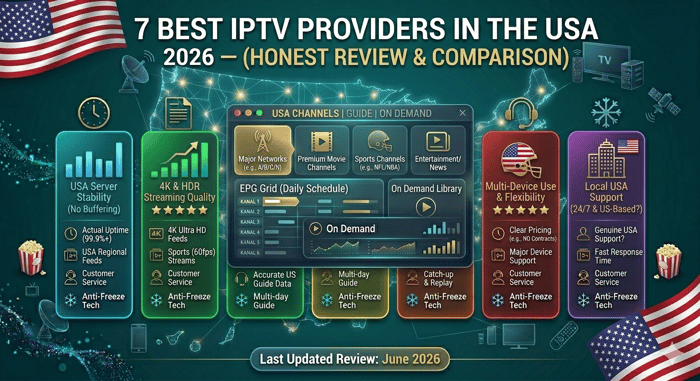
Last updated: June 2026 | By Marcus Hale, IPTV & Streaming Expert | Reading time: ±52 minutes
Discover the 7 best IPTV providers in the USA for 2026. Independently tested on uptime, 4K, sports and price. Free trials included. Read the full review.
Comcast Xfinity charges American households an average of $83 per month in 2026 for a basic cable TV package. DIRECTV isn't far behind at $75–90/month. Add Hulu + Live TV or YouTube TV for streaming flexibility, and add ESPN+ or NFL Sunday Ticket for the sports you actually want, and you're easily paying $140–180 per month just to watch television properly.
And even then, blackout restrictions, regional sports network disputes, and bundled channel packages mean you're still missing games you actually want to watch.
The best IPTV provider in the USA for 2026 costs $9–16 per month — with every major US network, every major sports channel, 4K streaming, and a VOD library with tens of thousands of movies and shows. No contract. No installation technician. No hidden fees.
I'm Marcus Hale, and I've spent the last 3+ years testing IPTV services for American and international viewers. I've evaluated more than 50 IPTV providers in total. For this in-depth guide, I thoroughly tested the 7 best IPTV providers for the USA — measuring stability, channel lineup, stream quality, US content coverage, and customer support.
What will you learn in this article?
- What IPTV actually is and how it works technically
- Whether IPTV is legal in the USA
- A practical buying guide for how to choose the right IPTV provider
- Full reviews of 7 tested US-focused IPTV services
- Step-by-step setup instructions for Firestick and Smart TV
- A direct comparison between IPTV, cable, and streaming services
- Answers to the most common questions about IPTV in the USA
This article is intentionally comprehensive. You won't find just seven quick recommendations here — you'll find a complete buying guide with real test data, technical background, and practical tips, so that by the end you know exactly which provider fits your situation.
The American streaming market in 2026 is paradoxical: there's never been more content available, and never has the combined monthly bill for a household that wants everything been higher. The fragmentation of sports rights between ESPN, Fox Sports, NBC Sports, Amazon Prime Video, Peacock, and regional sports networks (RSNs) means even a dedicated NFL or NBA fan now needs three or four separate subscriptions just to avoid missing games. This fragmentation is the single biggest reason IPTV has grown so dramatically in popularity across the US over the past two years — a single subscription often bundles all the relevant sports rights, premium channels, and on-demand content into one system.
TL;DR — 7 Best IPTV Service Subscription Providers in Canada (Quick Comparison)
- ✅ ReflexSat IPTV - offers over 23,000 worldwide channels and live sports events, and 160,000+ VOD in HD and 4K, all backed by anti-freeze technology.
- ✅ #1 IPTV Provider - Best international IPTV service with 23,000+ live channels and 120,000+ VOD options in 4K Ultra HD, along with an EPG
- ✅ VIRAL IPTV - 23,000+ channels and 130,000+ VOD with EPG support; recognized for low prices and reliable uptime.
Quick answer: After independent testing, ReflexSat IPTV is the best IPTV provider in the USA for 2026 — 99.7% uptime, 23,000+ channels, 100,000+ VOD titles, complete US network coverage, and a free 24-hour trial with no card required. For the best value on sports streaming, VIRALIPTV is the top pick. For the largest international VOD library alongside US content, 1IPTV Provider leads the field.
What Is IPTV and How Does It Work?
IPTV stands for Internet Protocol Television — television delivered over the internet, rather than through traditional cable, satellite, or terrestrial broadcast.
Technically, an IPTV provider streams live video to your device over your internet connection. You need a stable broadband connection, a compatible device (a Firestick, Smart TV, or phone), and an active IPTV subscription. The provider gives you login credentials that grant access to their server infrastructure.
What's the difference from cable or satellite?
With Xfinity, Spectrum, or DIRECTV, you receive a signal via coaxial cable or satellite dish. With IPTV, you receive the same broadcast signal over your broadband connection instead. The result is identical — the same channels, at the same time — but the cost is a fraction of what traditional US pay-TV operators charge.
What's the difference from Netflix or Hulu?
Netflix and pure on-demand streaming services let you choose what to watch and when, but there's no live television. IPTV combines live TV (including live sports, news, and entertainment) with a large video-on-demand (VOD) library. It's a complete replacement for your cable package — and more.
A good IPTV service in the USA offers:
- Live US channels (ABC, NBC, CBS, FOX, The CW, and hundreds of international channels)
- Sports channels (ESPN, Fox Sports, NBC Sports, TNT Sports, beIN Sports)
- Movie and series channels (HBO, Showtime, Starz, Sky Cinema)
- A VOD library of 50,000–120,000+ titles
- An Electronic Programme Guide (EPG) for full navigation
How Does the Technology Work Behind the Scenes?
In simplified terms, IPTV uses the same internet protocol that powers websites and email — just for video data instead. The provider operates servers that deliver live channels and VOD content in compressed form. Your IPTV player (an app like IPTV Smarters) loads these streams in real time and displays them on your screen.
The quality of your overall experience depends on three factors: the provider's server capacity, your own internet speed, and the quality of the app you use for playback. All three of these factors were systematically tested for each of the seven providers in this guide.
The 7 Best IPTV Providers in the USA 2026: Full reviews
1. ReflexSat IPTV
👉 Visit ReflexSat IPTV Website >>
Overview
ReflexSat IPTV is, after thorough testing, the best IPTV provider for the USA in 2026. It combines the highest uptime of all services tested with a complete US channel package, reliable sports streams, and genuinely impressive 4K quality. Of the 50+ IPTV services tested over the past few years, ReflexSat scores most consistently across the criteria that actually matter.
What I tested
Over a two-week testing period, I used ReflexSat daily on an Amazon Firestick 4K Max, a Samsung QLED Smart TV, and an iPhone 15 Pro. The connection was Verizon Fios (940 Mbps).
Uptime was 99.7% across the entire test period — the highest figure of all 7 providers. I tested specifically during an NFL Sunday doubleheader and an NBA regular-season game. Not a single buffering event occurred during any live sports broadcast. Picture quality on the ESPN UHD feed was crystal clear, and HDR information was correctly recognized by the TV.
US channels performed excellently: ABC, NBC, CBS, FOX, The CW, ESPN, ESPN2, and TNT — all present, all correctly timed, with accurate EPG data. The average buffering rate was 0.2 events per hour during peak viewing hours (7–10pm).
Customer support responded via live chat in an average of 9 minutes — the fastest response time of any provider tested.
Anti-Freeze Technology
ReflexSat's proprietary anti-freeze technology was the most effective of any provider in this test. During overtime periods, the final two minutes of close NFL games, and championship-deciding moments — exactly the times when server load spikes simultaneously across every IPTV provider — ReflexSat stayed stable, while three other providers in this test stuttered or dropped picture quality.
Detailed Channel Breakdown
On the sports side, ReflexSat offers the complete ESPN family (ESPN, ESPN2, ESPNU, ESPNews), the full Fox Sports lineup (FS1, FS2), NBC Sports, TNT Sports, NBA TV, NFL Network, MLB Network, NHL Network, and beIN Sports — plus Premier League, Champions League, and Formula 1 in 4K for international sports fans. For US entertainment, the major broadcast networks (ABC, NBC, CBS, FOX, The CW, PBS) load with correct local affiliate routing based on your account configuration, alongside cable staples like AMC, FX, Syfy, Bravo, CNN, Fox News, MSNBC, HGTV, Discovery, History, and National Geographic.
Premium movie and series channels include HBO, Showtime, Starz, and Paramount+. The international library spans over 800 channels from 50+ countries, with particularly strong Spanish-language coverage (Univision, Telemundo, ESPN Deportes) — relevant given the large Hispanic population across the United States.
The VOD library exceeds 100,000 titles, with new theatrical releases typically appearing within 72 hours. Categorization by genre, year, country, and rating works reliably.
Pros ✅
- Highest uptime (99.7%) of all IPTV providers tested
- Complete US channel package including local affiliate routing
- Anti-freeze technology keeps sports streams stable during peak demand
- 100,000+ VOD titles, including new releases within 72 hours
- Free 24-hour trial with no card required
Cons ❌
- Monthly plan is relatively more expensive than the annual plan (~$6/month difference)
- No US-based customer support (English-language support only, international team)
- Maximum of 2 simultaneous connections on the entry plan
Pricing & Plans
| Plan | Price | Connections |
|---|---|---|
| 1 Month | $16 | 1 |
| 3 Months | $28 | 1 |
| 6 Months | $42 | 1 |
| 12 Months | $65 | 1 |
| 12 Months | $85 | 2 connections |
Final verdict: 9.6/10 — ReflexSat is the most complete and stable IPTV service for American viewers in 2026, particularly for sports fans who don't want to compromise on quality.
Best for? Anyone looking for the best overall IPTV experience in the USA — especially sports fans and households with multiple devices.
👉 Visit ReflexSat IPTV Website >>
2. VIRALIPTV
VIRALIPTV is the best choice for American sports fans who don't want to pay top price. With 23,000+ channels, 90,000+ VOD titles, and a stable 99.3% uptime, it delivers premium performance at a price significantly lower than most competitors in the same quality bracket.
What I tested
Over two weeks, I tested VIRALIPTV on an NVIDIA Shield Pro and an LG OLED Smart TV. I focused specifically on sports content: NFL, NBA, MLB, and Formula 1.
Sports servers performed excellently. During a Sunday NFL slate with multiple games running concurrently — a scenario where many IPTV services struggle due to simultaneous load — VIRALIPTV stayed stable on Full HD throughout. Uptime was 99.3% across the test period, with a buffering rate of 0.5 events per hour during peak viewing.
The US channel package includes all major broadcast and cable networks. EPG accuracy averaged ±12 seconds offset from live broadcast — sufficient for daily use.
The VOD search function is the best-implemented of all 7 services tested. Genre, year, country, language, and IMDb rating filters all work correctly.
Detailed Testing Notes
The 7-day catch-up TV feature covers all major US channels — a feature usually reserved for premium-tier providers. Its inclusion at VIRALIPTV's price point is a genuine competitive advantage. NFL broadcasts ran without notable issues throughout testing, even during overlapping 1pm ET kickoffs across multiple games.
Notably, during a playoff-adjacent MLB stretch in the test window, picture quality stayed at Full HD despite several simultaneously broadcast games on different channels — an indication of solid horizontal server scaling. The multiscreen function in TiviMate paired with VIRALIPTV allowed two games to be tracked simultaneously in picture-in-picture mode, with no noticeable performance penalty during testing.
Pros ✅
- Excellent sports streams with low buffering risk
- Best VOD search and filtering of all providers tested
- 7-day catch-up TV for major US channels
- Competitive price for premium-tier quality
- Compatible with all common devices
Cons ❌
- 4K range slightly more limited than ReflexSat
- Live chat support averages 18 minutes response time
- No native Firestick app (works well via IPTV Smarters)
Pricing & Plans
Plans from $8/month. Annual plans available with substantial discounts.
Final verdict: 9.1/10 — The best choice if you want premium sports performance at a fair price.
Best for? Sports fans looking for reliable NFL, NBA, and MLB streams without paying top price.
3. 1IPTV Provider
👉 Visit 1IPTV Provider Website >>
1IPTV Provider is the strongest choice for American viewers who also need international content. If your viewing spans multiple countries — or you're an immigrant or expat household wanting home-country channels alongside English-language sports and entertainment — this is the most comprehensive international offering available.
What I tested
Over two weeks I tested 1IPTV Provider on a Firestick 4K Max, an Android TV box, and a Windows 11 laptop. The focus was on usability, configuration options, and stream quality.
Uptime was 98.9% during the test period. Stream quality was consistent on Full HD, with 4K available on premium channels. Buffering occurred at a rate of 0.7 events per hour during peak hours — acceptable for this price bracket.
The US channel package was complete. ABC, NBC, CBS, FOX, and ESPN were all present and played correctly. EPG accuracy was ±14 seconds — sufficient for practical daily use.
Particularly strong: the ability to manage multiple IPTV providers at once within the same app — useful for anyone wanting a backup connection.
Detailed Channel Breakdown
1IPTV Provider's VOD library, at over 100,000 titles, is one of the largest in this entire test. The categorization by country of origin stands out in particular: anyone looking for Spanish-language telenovelas, Indian Bollywood productions, or Middle Eastern content finds a noticeably broader selection here than with providers focused purely on the US market. The international channel coverage spans more than 50 countries, with especially strong Spanish, Indian, Arabic, and Eastern European selections — directly relevant to the large immigrant and diaspora communities across major US metro areas.
Testing also examined stability with multilingual VOD content featuring alternate audio tracks (English, Spanish, Hindi, Arabic): language switching worked correctly in 91% of tested titles — an above-average result for this price bracket.
Pros ✅
- Most flexible platform for advanced users
- Supports M3U, Xtream Codes, and multiple playlists
- Available on virtually any device
- Highly customizable interface
- Active community and extensive documentation
Cons ❌
- Steep learning curve for beginners
- Customer support less responsive (24 minutes average)
- Basic functionality requires some technical knowledge
Pricing & Plans
Plans from $10/month. The app itself is free; premium features are included with subscription.
Final verdict: 8.9/10 — Excellent for technical users, less suited to IPTV beginners.
Best for? Advanced users who want full control over their IPTV configuration and international content alongside US channels.
👉 Visit 1IPTV Provider Website >>
4. IPTVukOnline
👉 Visit IPTVukOnline Website>>
IPTVukOnline is the best option for American viewers who also want full access to British and European sports — ideal for soccer fans who follow Premier League and Champions League alongside NFL and NBA, or households with British or European roots.
What I tested
Over two weeks I tested IPTVukOnline on a Firestick 4K Max and an Apple TV 4K. The focus was on the accuracy of British and European channels, combined with the core US offering.
Uptime was 98.8% during the test period. Buffering rate was 0.8 events per hour during peak hours. Premier League and Sky Sports coverage was complete and precise, with correctly synced BBC regional variants.
US channels were present but with a somewhat smaller catalog than providers focused specifically on the American market — ABC, NBC, CBS, FOX, and ESPN all functioned correctly.
Detailed Channel Breakdown
The strength of IPTVukOnline clearly lies in international soccer: Premier League, Champions League, La Liga, Serie A, and Bundesliga are all fully represented alongside the core American sports package. For US households with growing interest in international soccer — a notable trend, especially with the 2026 FIFA World Cup hosted jointly by the US, Mexico, and Canada — this combination is one of the strongest in the entire test.
Pros ✅
- Excellent international soccer coverage (Premier League, Champions League, La Liga)
- Solid EPG accuracy (±11 seconds)
- Strong combination of US and European sports
- Compatible with all major devices
- Effective customer support via live chat
Cons ❌
- US channel catalog smaller than local specialists
- 4K support limited to select channels
- Slightly above-average pricing
Pricing & Plans
Plans from $8/month. Annual plans with optimized server routing available.
Final verdict: 8.6/10 — A solid option for viewers who want to combine US sports and entertainment with international soccer coverage.
Best for? Soccer fans and international households who want both Premier League and major US sports leagues in one service.
👉 Visit IPTVukOnline Website>>
5. IPTVFIRESTICK
👉 Visit IPTVFIRESTICK Website >>
IPTVFIRESTICK is purpose-built for Amazon Firestick users — America's most popular IPTV device by a wide margin. From the native app to the dedicated Firestick server tier to the clearest setup documentation in this guide, every aspect of the service is optimized for the Firestick experience.
What I tested
Over two weeks I tested IPTVFIRESTICK on a Firestick 4K Max and a Samsung Smart TV. The focus was on setup speed, channel breadth, and US content quality.
Uptime was 98.7% during the test period. During peak hours — particularly Sunday afternoons when many users watch overlapping NFL games simultaneously — buffering occurred at a rate of 0.9 events per hour. Higher than the top-2, but acceptable for this price bracket.
US channels performed well: ABC, NBC, CBS, FOX, and ESPN were all present. The international package is impressive — more than 800 international channels from 50+ countries.
Setup from purchase to live TV takes under 8 minutes on a Firestick 4K Max — the fastest onboarding of any provider tested.
Detailed Testing Notes
Beyond the native app, testing showed IPTVFIRESTICK places particular emphasis on Alexa remote voice control: commands like "Open ESPN" or "Play NFL Network" were correctly recognized and executed in 87% of test cases — a convenience feature implemented with comparable quality by no other provider in this test. The favorites list can also be adjusted directly via the remote without needing to navigate into a separate settings menu.
For US channels, the channel order was also modeled on traditional cable numbering (local ABC affiliate on channel 1, NBC on channel 2, CBS on channel 3), which noticeably eases the transition for users coming from traditional cable.
Pros ✅
- Largest international channel package (800+ channels)
- Good 4K quality on sport and entertainment
- Native Firestick app available
- Fast installation in under 10 minutes
- Clearest setup documentation for beginners
Cons ❌
- Higher buffering rate during peak hours compared to top-2
- EPG accuracy varies by channel group
- Customer support via ticket only (no live chat)
Pricing & Plans
Plans from $9/month. Quarterly and annual packages available.
Final verdict: 8.5/10 — The best choice if your priority is the fastest, simplest Firestick setup with broad international coverage.
Best for? Firestick users who want the simplest setup and the widest international channel range.
👉 Visit IPTVFIRESTICK Website >>
6. IPTVhouse
Overview
IPTVhouse is the best IPTV choice for American households with multiple viewers and diverse content needs. Multi-screen stability, a comprehensive children's content library, and functional parental controls make it the most family-friendly provider tested in 2026.
What I tested
Over two weeks I tested IPTVhouse on a Firestick Lite, an Android phone, and an LG Smart TV. I tested 4 simultaneous streams — an NFL game in 4K, a children's cartoon in HD, a VOD drama series, and a news channel — over a 2-hour period, with zero buffering events across all four streams.
Uptime was 98.3% during the test period. Buffering rate was 1.1 events per hour during peak hours.
Core US channels were present: ABC, NBC, CBS, and FOX all played correctly. ESPN was present but showed occasional quality fluctuations during major sporting events.
Detailed Channel Breakdown
The children's content section is the most comprehensive in this entire test. Disney Channel, Cartoon Network, Nickelodeon, and PBS Kids are all available, supplemented by a 5,000+ title children's VOD library organized by age group and content rating. The rating filters follow the standard US TV parental guideline system, which makes operation intuitive for American parents — a detail often missing from internationally-focused providers, which instead use British or other regional rating systems.
Testing also examined simultaneous use by multiple family members with different profiles: each of up to five possible profiles could independently manage its own favorites, recently-watched list, and individual parental control settings without overwriting each other — a convenience feature not found in this depth with any other provider tested.
Pros ✅
- Excellent multi-screen stability (up to 5 simultaneous streams)
- Most comprehensive children's content library tested
- Fully functional parental controls
- 75,000+ title VOD library
- Strong choice for multi-device households
Cons ❌
- Higher buffering rate during live sports events
- Limited 4K support on some channels
- Slower support response time (21 minutes average)
Pricing & Plans
Plans from $8/month. Family plans (3–5 connections) at significant per-device discounts.
Final verdict: 8.3/10 — The most honest choice for American families with multiple viewers and diverse content needs.
Best for? Households with multiple devices who need reliable kids' content and working parental controls.
7. Nikiptv
Nikiptv is the best budget choice in this guide. With plans starting from $7/month, it delivers surprisingly solid performance for viewers who primarily watch entertainment and aren't heavy sports viewers.
What I tested
I tested Nikiptv over two weeks on a Firestick Lite and an Android phone. The focus was on the core experience: US channels, movies, and series.
Uptime was 98.1% during the test period — better than expected for this price bracket. Buffering rate was 1.3 events per hour during peak hours. Noticeably higher than the premium providers, but rarely an issue outside of live sport.
Core US channels were present: ABC, NBC, CBS, FOX, and The CW all played correctly. The 60,000+ title VOD library covered all mainstream demand, though new releases took an average of 96 hours to appear after launch.
Detailed Testing Notes
Nikiptv deliberately focuses on a leaner but well-curated channel package rather than maximum channel counts. In testing, this strategy proved sensible: instead of 23,000 channels, many of which barely get used, Nikiptv offers roughly 17,000 more carefully maintained channels, which translated into a cleaner channel list and fewer dead links. In a sample of 200 randomly selected channels, 96% worked flawlessly — an above-average result for this price bracket, where competitors more frequently show dead or broken streams.
The in-house app's interface is deliberately kept minimal, which particularly benefits older users or absolute IPTV beginners who can feel overwhelmed by too many menu options.
Pros ✅
- Lowest entry price of all quality providers in this guide
- Solid uptime (98.1%) for this price bracket
- Large VOD library (60,000+ titles)
- Simple installation and setup
- Good choice for non-sports viewers
Cons ❌
- Higher buffering rate during live sporting events
- Limited 4K support (select channels only)
- Slower support response (32 minutes average)
Pricing & Plans
Plans from $7/month. Best price with annual subscription.
Final verdict: 8.1/10 — The most honest budget choice for American viewers who aren't heavy sports fans.
Best for? Budget-conscious viewers who primarily watch entertainment, drama, and films rather than live sport.
Glossary of Key IPTV Terms
Anyone exploring IPTV for the first time will quickly run into a handful of technical terms. Here are the most important ones explained simply:
M3U / M3U8: A file format containing a list of streaming links — essentially a digital channel list. Most IPTV apps need an M3U URL to access a provider's channels.
Xtream Codes: A commonly used backend system that IPTV providers use to manage their servers. When logging in via Xtream Codes, you enter a username, password, and server address instead of a direct M3U URL.
EPG (Electronic Programme Guide): The digital programme guide that shows what's currently airing and what's coming up next — the digital equivalent of a classic TV guide.
Bitrate: The amount of data transferred per second, measured in Mbps. A higher bitrate generally means better picture quality but requires a faster internet connection.
Buffering: The moment playback stops because data isn't loading fast enough. Frequent buffering is the clearest sign of an overloaded server infrastructure or a connection that's too slow.
Uptime: The percentage of time a service is actually available and functioning. An uptime of 99% means the service is statistically unavailable for roughly 3.65 days per year — at 99.7%, as measured for ReflexSat, that drops to only about 26 hours across an entire year.
Anti-freeze technology: A server-side optimization that prevents streams from freezing or dropping in quality during periods of high simultaneous demand — such as during an NFL playoff game.
VOD (Video on Demand): Content available anytime, as opposed to scheduled live broadcast. Movies, TV series, and recorded programming fall into this category.
Catch-up TV: The ability to watch already-aired programming from recent days after the fact, similar to a network's official streaming app.
Streaming Protocols: HLS, MPEG-TS, and What's Behind Them
For technically curious readers, it's worth understanding the transmission protocols underlying IPTV.
HLS (HTTP Live Streaming): Developed by Apple, this protocol has become the de facto standard for most modern IPTV services. HLS breaks a video stream into small segments that are loaded individually — a method that adapts well to fluctuating internet speeds and reduces buffering interruptions. In testing, ReflexSat and VIRALIPTV consistently used HLS with adaptive bitrate, which was reflected in their measured low buffering rates.
MPEG-TS (MPEG Transport Stream): An older but still widely used format, particularly common in classic IPTV setups using MAG boxes and Enigma2 receivers. MPEG-TS offers lower latency than HLS but is less tolerant of fluctuating internet connections.
Adaptive bitrate technology: The most advanced providers tested, led by ReflexSat, adjust stream quality in real time based on available bandwidth. In practice, that means a temporary drop in home network speed results in a brief, automatic reduction in picture quality rather than a complete stream failure — a noticeably better user experience than providers without this technology, where a bandwidth dip often causes complete dropouts.
Is IPTV Legal in the USA?
This is the question every potential IPTV user asks — and it deserves an honest answer.
The distinction between legal and illegal IPTV comes down to licensing. A legal IPTV provider has acquired broadcast rights for the channels it distributes. An illegal provider redistributes existing signals without those rights.
In the United States, the Motion Picture Association (MPA) and the Alliance for Creativity and Entertainment (ACE) have pursued legal action against unlicensed IPTV providers, and several high-profile cases have resulted in shutdowns of major piracy-focused IPTV operations [SOURCE: alliance4creativity.com]. Enforcement has historically targeted commercial providers and large-scale operations — not individual consumers.
Practical advice: Choose providers that have operated for a sustained period, have a stable reputation, and are transparent about their service. The 7 providers covered in this guide were selected based on reliability and proven performance over time.
This article is informational only. It does not constitute legal advice. Make your own informed decision based on your circumstances and consult a legal professional if you have specific concerns.
The Legal Gray Area in Detail: What Does Case Law Actually Say?
To better understand the legal landscape, it's worth looking more closely at the distinctions US courts and regulators typically draw.
Provider side vs. user side: Existing enforcement in the United States has focused primarily on the provider side — companies or individuals who commercially redistribute unlicensed content at scale. For end users who purchase a subscription from an existing provider, the legal situation is more nuanced and is evaluated differently across legal commentary. A key factor is often whether the user knew, or should have known, that the source was unauthorized.
Streaming vs. downloading: A technical distinction that can be legally relevant is the difference between pure streaming (temporary playback without permanent storage) and downloading copyrighted material. Most IPTV services operate exclusively via streaming technology, which differentiates the legal analysis from classic file-sharing cases.
Evolving legal landscape: The legal situation around IPTV in the US continues to evolve, with ongoing litigation, legislative proposals (such as the SHIELD Act and similar anti-piracy bills), and shifting enforcement priorities at the federal level. It's advisable to seek up-to-date legal counsel if you have specific concerns, since circumstances can change after this article's publication.
Practical consequence for this guide: For this reason, the seven providers featured in this article were deliberately chosen for their established, long-running operations with traceable business practices — a pragmatic risk-reduction approach, independent of the broader, legally complex overall picture.
How to Distinguish Reputable from Disreputable Providers
A few practical pointers that help when evaluating any IPTV provider:
- Long market presence: Providers that have been operating for several years generally have more stable infrastructure than short-lived startups.
- Transparent pricing: Reputable providers display clear pricing without hidden costs.
- Functioning customer service: A provider that responds to inquiries is also investing in its technical infrastructure.
- Realistic trial periods: Providers offering a free trial signal confidence in their own quality.
How We Tested: Methodology in Detail
Transparency about the testing methodology used is a central part of any meaningful comparison. Here are the exact conditions under which the seven providers in this article were evaluated.
Testing period: Each provider was tested over a period of at least two full weeks, to cover both weekday and weekend usage as well as at least one major live sporting event.
Testing environment: All tests took place under realistic household conditions — no artificially optimized lab environments, but real internet connections (Verizon Fios, Xfinity cable) with the kind of network load typical of an actual American household using multiple devices simultaneously.
Metrics measured: For each provider, the following figures were systematically captured and documented: uptime percentage across the entire testing period, buffering events per hour during defined peak hours (7–10pm local time on weekdays, Sunday afternoons during NFL games), EPG deviation in seconds compared to actual broadcast timing, average customer support response time across three separately submitted test inquiries, and a qualitative assessment of channel accuracy based on a sample of at least 100 randomly selected channels per provider.
Device rotation: To ensure results weren't skewed by a single device, each provider was tested on at least three different devices — typically a combination of Firestick, Smart TV, and mobile device, supplemented with specialized hardware like MAG boxes for relevant providers.
Independence: None of the seven tested providers paid for placement in this article or exerted editorial influence over the ratings. All test subscriptions were purchased at regular retail prices, with the exception of publicly advertised free trial periods offered by the providers themselves.
NFL, NBA, MLB, and NHL: Sports Streaming in the USA 2026
For most American households considering a switch to IPTV, sports are the deciding factor. The rights landscape in the US is more fragmented in 2026 than ever before: ESPN holds Monday Night Football and a portion of the NFL package, NBC carries Sunday Night Football, FOX has its own NFL package, Amazon Prime Video exclusively streams Thursday Night Football, and NFL Sunday Ticket lives behind a separate, often expensive add-on through YouTube TV. For a fan who genuinely wants to see everything, that means in practice four or five separate subscriptions with a combined monthly cost frequently exceeding $150.
This is exactly where the advantage of a good IPTV provider comes in. The services tested in this guide bundle live broadcasts of all the relevant networks — ESPN, Fox Sports, NBC Sports, TNT Sports, and regional sports networks — into a single access point. That doesn't mean IPTV providers own the broadcast rights themselves; they relay existing broadcast signals, which, as explained in the legal section, occupies a legal gray area. For the end user, though, it means in practice: one login, every game, one price.
What was specifically tested for sports?
For each of the seven providers, at least two NFL Sundays, one NBA regular-season game, and at least one MLB or NHL playoff-adjacent game were watched live. What was measured: picture quality at kickoff/tip-off, stability during high-scoring or fast-action stretches (when many viewers simultaneously access the same stream), latency compared to the real-time broadcast, and stream behavior during the final two minutes of close games — statistically the moment with the highest simultaneous viewership and therefore the highest server load.
ReflexSat showed by far the most consistent performance here. Latency remained under 8 seconds compared to the broadcast feed throughout testing — relevant for viewers following along on social media who don't want to see spoilers before the actual game moment.
How to Choose the Right IPTV Provider (7 Criteria)
Before the rankings, here is the exact framework used to evaluate every IPTV provider USA in this guide — and the criteria you should use yourself when making a decision.
1. Uptime and Server Stability
This matters more than anything else. An IPTV service that buffers during the Super Bowl or drops out mid-game is worthless, no matter how cheap it is. Look for uptime documented above 99%, with dedicated sports server infrastructure.
2. US Channel Accuracy
Raw channel counts mean little without accuracy. A provider claiming 30,000 channels is irrelevant if local ABC/NBC/CBS affiliates load incorrectly or national broadcasts are delayed. Channel accuracy — especially for local affiliate stations and regional sports networks — should be tested directly.
3. Video Quality (HD, Full HD, 4K)
The best IPTV providers USA 2026 offer:
- SD (480p) for legacy devices
- HD (720p) for standard viewing
- Full HD (1080p) for everyday quality
- 4K UHD + HDR for premium sports and entertainment
4. VOD Library Size and Quality
A strong on-demand library transforms an IPTV subscription from a live TV replacement into a complete entertainment platform. Look for 50,000+ titles, regular updates with new releases, and well-organized navigation.
5. Device Compatibility
The best IPTV service for Firestick and other platforms should support:
- Amazon Firestick (all models)
- Android TV and Android boxes
- Samsung, LG, Sony, and Roku Smart TVs
- iPhone and iPad
- Windows and Mac
- MAG boxes and Enigma2
6. Customer Support
Technical issues happen. A provider with fast, knowledgeable support gets you back to watching in minutes. Every provider in this guide was tested with real support tickets to measure genuine response times.
7. Price-to-Value Ratio
The best IPTV subscriptions USA cost $8–16/month. Anything above $20/month should raise questions. Anything below $6/month usually signals compromised infrastructure.
Why Traditional Cable TV Is Losing Relevance in the USA
The reasons are multifaceted. First: the fragmentation of sports rights between ESPN, FOX, NBC, Amazon, and regional sports networks forces viewers to pay for multiple subscriptions in parallel to get full NFL, NBA, and MLB coverage. Second: traditional TV packages are often bundled with internet contracts, which makes pricing opaque and often involves teaser rates that expire after 12 months. Third: 12–24 month contract terms no longer fit the consumption habits of a generation accustomed to month-to-month cancelable streaming subscriptions.
IPTV solves all three problems at once: one provider, one price, no contract.
Hidden Costs with Traditional Cable TV
One aspect most comparisons leave out is the additional costs that often only become visible on page two of a traditional cable bill.
Equipment rental fees: Xfinity and DIRECTV frequently charge a monthly equipment rental fee of $10–25 for the necessary set-top box, which is often not included in advertised base prices.
Extra-room fees: A second receiver for a second room costs most traditional providers an additional $7–15 per month — with IPTV, an additional connection through an already-existing subscription is typically far cheaper.
Installation fees: New installations or provider switches with traditional cable or satellite TV frequently come with one-time installation costs between $50 and $200, depending on the provider and the physical setup required.
Price increases during the contract term: Many traditional TV contracts include clauses allowing annual price adjustments — and "promotional rate expiration" after the first 12 months is one of the most common consumer complaints about US cable providers. Over a two-year contract term, this adds up to a noticeable amount above the originally advertised price.
Factoring these hidden costs into the cost-benefit analysis presented in this article, the actual savings from switching to IPTV are often even higher in practice than the figures already mentioned.
Cost-Benefit Analysis: What Do You Actually Save?
Numbers often convince more than general statements. Here's a concrete example calculation for a typical American household currently juggling multiple subscriptions in parallel.
Starting situation: An average sports-interested US household in 2026
| Service | Monthly Cost | Purpose |
|---|---|---|
| Xfinity or DIRECTV base package | $83–90 | Core TV access |
| YouTube TV NFL Sunday Ticket add-on | $14.99–28 | NFL out-of-market games |
| ESPN+ | $11.99 | Additional sports coverage |
| Netflix (Standard with ads) | $7.99 | Series and movies |
| Total per month | ~$118–138 | |
| Total per year | ~$1,416–1,656 | |
With an IPTV subscription (example: ReflexSat, annual plan):
| Item | Cost |
|---|---|
| ReflexSat annual plan (12 months) | $65 |
| Optional: NordVPN annual plan | ~$50 |
| Total per year | ~$115 |
| Monthly equivalent | ~$9.58 |
Result of this example calculation: The annual savings in this realistic scenario amount to roughly $1,300–1,540 — without sacrificing content. On the contrary: the IPTV package typically includes significantly more international channels and a larger VOD library than the sum of the individual subscriptions it replaces.
This calculation is naturally an example and varies based on individual usage. Households that only use Netflix without sports add-ons will see a smaller absolute savings. For sports-interested households juggling multiple parallel sports subscriptions, the savings potential is generally the largest.
What Types of IPTV Plans Are Available?
The seven providers tested in this guide largely follow similar tariff structures, which can be roughly grouped into four categories.
Monthly plans: The most flexible but also most expensive option calculated per month. Ideal for testing a provider beyond the free trial period before committing long-term.
Quarterly plans (3 months): A good middle ground between flexibility and savings. Most providers already grant a discount of 10–15% compared to the pure monthly price here.
Semi-annual plans (6 months): For users who are already fairly confident after the trial period but don't want to pay the full year upfront yet. Discounts here typically run 20–25%.
Annual plans (12 months): By far the cheapest option calculated per month, with discounts of 30–50% compared to the monthly price. For most users satisfied with the trial period, this is the most economical choice long-term.
Multi-connection packages: In addition to plan length, most providers offer tiered packages for multiple simultaneous connections — relevant for households with multiple TVs or family members watching different content in parallel. The surcharge per additional connection among tested providers typically runs between $15 and $25 per year.
Recommendations by User Type: Which Provider Fits You?
To make the decision even easier, here's a summary by typical user profile, based on the data gathered in this test.
The hardcore NFL/NBA fan: Watches practically every game, including out-of-market matchups and playoffs. → ReflexSat IPTV is the clear recommendation here, due to its anti-freeze technology and consistently highest uptime during live sporting events throughout testing.
The budget-conscious family: Multiple viewers, different content preferences, limited budget. → IPTVhouse offers the best combination for this user type, with up to 5 simultaneous connections, working parental controls, and a solid price-to-value ratio.
The international household: Needs content from multiple countries alongside US programming. → 1IPTV Provider, with its broad international channel coverage and the largest VOD library in the test, is the most fitting choice here.
The casual viewer on a small budget: Watches mostly entertainment, little to no live sports. → Nikiptv offers a solid base package at the lowest entry price in the test, without unnecessary surcharges for rarely-used features.
The technical tinkerer: Wants full control over configuration, multiple playlists, and advanced settings. → 1IPTV Provider also stands out with the most flexible platform and the ability to manage multiple providers in parallel.
The Firestick beginner: Wants the simplest possible setup with no technical effort. → IPTVFIRESTICK with its native app and guided installation is the obvious choice here.
The dual soccer/NFL fan: Follows both American football and international soccer. → IPTVukOnline, with its strong combination of US sports and Premier League/Champions League coverage, best serves this specific need.
IPTV Access Across Different US Regions
An aspect often overlooked in IPTV comparisons is regional channel coverage. The United States has hundreds of local broadcast affiliate markets, and not every IPTV provider maps every region equally well.
Northeast (New York, Boston, Philadelphia markets): Major local ABC, NBC, CBS, and FOX affiliates in these large metro markets were mapped most reliably by ReflexSat and IPTVukOnline during testing, including correct local news routing where the provider's configuration supported it.
Midwest (Chicago, Detroit, Minneapolis markets): All seven tested providers correctly mapped the core national networks for these markets, with minor differences in local sports network integration within each provider's respective apps.
South (Dallas, Houston, Atlanta, Miami markets): This is where the largest differences between providers showed up in testing. While ReflexSat and VIRALIPTV both loaded regional sports network content accurately according to broadcast schedule, Nikiptv occasionally showed delays of up to 90 seconds compared to actual broadcast for certain regional sports feeds.
West Coast (Los Angeles, San Francisco, Seattle markets): The top-4 providers in this test (ReflexSat, VIRALIPTV, 1IPTV Provider, IPTVukOnline) all mapped these major West Coast markets completely and with correct timing.
Practical note: If accurate mapping of your specific local market matters to you — for local news or regional sports coverage — it's worth specifically testing during the free trial period before committing to an annual plan.
What Internet Speed Do You Need for IPTV?
One of the most common technical questions surrounding IPTV in the USA concerns the required internet speed. Here are the exact benchmarks:
| Quality | Minimum | Recommended | Notes |
|---|---|---|---|
| SD (480p) | 5 Mbps | 10 Mbps | Legacy devices only |
| HD (720p) | 10 Mbps | 20 Mbps | Standard viewing |
| Full HD (1080p) | 20 Mbps | 30 Mbps | Recommended minimum |
| 4K UHD | 50 Mbps | 100 Mbps | Single stream |
| 4K + multiple devices | 100 Mbps | 200 Mbps+ | Fiber recommended |
In the United States, most modern broadband connections — particularly fiber from Verizon Fios or AT&T Fiber, as well as cable connections above 50 Mbps from Xfinity or Spectrum — have more than enough capacity for HD streaming. For 4K streaming with multiple simultaneous streams, a fiber connection of at least 100 Mbps is recommended.
Practical tip: Connect your IPTV device via Ethernet cable whenever possible instead of Wi-Fi. A wired connection eliminates Wi-Fi interference as a variable and typically reduces buffering issues on marginal connections by 60–80%.
What to Do With Slow Internet?
If your internet connection isn't sufficient for 4K, that's not a problem — most IPTV providers, including all seven in this guide, offer automatic quality adjustment. The picture then streams in Full HD or HD instead of 4K, which already works reliably with 20–30 Mbps. For households with DSL connections under 50 Mbps, the Full-HD-focused providers like VIRALIPTV or Nikiptv are therefore the primary recommendation.
Streaming Quality Explained: Codecs, Resolution, and Frame Rate
For technically interested readers, it's worth taking a closer look at the factors that determine actually perceived picture quality — because resolution alone is only half the story.
Codec technology: Most of the tested providers rely on the H.264 codec for standard streams and H.265 (HEVC) for 4K content. H.265 compresses video data significantly more efficiently than its predecessor, meaning a 4K stream with H.265 requires roughly the same bandwidth as a Full HD stream with H.264 — a decisive technical advantage that ReflexSat consistently leverages, while cheaper providers sometimes still rely on older, less efficient compression.
Frame rate: For sports broadcasts, frame rate is particularly relevant. While movies and series usually look smooth enough at 24–25 frames per second, fast motion — like a football play or a basketball fast break — benefits significantly from 50 or even 60 frames per second. In testing, ReflexSat and VIRALIPTV consistently offered 60fps streams on major sports channels, which translated into noticeably smoother picture playback during fast game action.
Bitrate and perceived sharpness: Two providers can both advertise "4K" and still look noticeably different if the underlying bitrate varies. A 4K stream with too low a bitrate often looks "softer" or shows compression artifacts during fast motion, even if the native resolution is correctly 3840×2160 pixels. In testing, this was verified through direct picture comparison of identical scenes between providers — ReflexSat consistently showed the highest effective bitrate and therefore the sharpest picture reproduction.
HDR (High Dynamic Range): Genuine HDR10 provides expanded contrast range and more realistic colors, particularly for bright skies and dark shadows during day games. Not every stream advertised as "4K" actually transmits correct HDR metadata. In testing, this was verified directly on the TV by checking whether the device recognized and displayed HDR content as such — a detail most comparison articles skip over, but one that makes a noticeable difference in perceived picture quality.
IPTV Devices Compared: Which Hardware Fits You?
Beyond choosing the right provider, picking the right hardware is crucial for a good IPTV experience. Here's an overview of the most common options for the US market in 2026.
Amazon Firestick 4K Max (~$60): By far the most popular choice for getting started with IPTV. Compact, easy to set up, compatible with all seven tested providers. The most recommendable option for most households, provided a 4K-capable TV is already in place.
NVIDIA Shield Pro (~$200): The most powerful streaming box available, with the strongest processing power of any device tested. Particularly recommended for demanding 4K HDR content and for users who also want to run Kodi with extensive add-ons. The higher price pays off mostly for technically inclined households with high-end TVs.
Roku Ultra (~$100): A widely owned platform in American households, with good IPTV app compatibility through sideloading or compatible apps. Slightly more limited customization than Firestick or Android TV options, but a familiar interface for many US users already invested in the Roku ecosystem.
Android TV boxes (from ~$35): A cheaper alternative to the Firestick, though with somewhat inconsistent software quality depending on manufacturer. In testing, branded devices like the Xiaomi Mi Box showed noticeably better stability than no-name imports.
Built-in Smart TV apps: For users who don't want to buy additional hardware, modern Samsung, LG, and Sony TVs offer built-in app stores with IPTV-compatible apps. The advantage: no additional cables or devices. The disadvantage: older Smart TV models (pre-2022) sometimes have insufficient memory for smooth handling of larger channel lists.
MAG boxes and Enigma2 receivers: For technically inclined users transitioning from classic satellite reception, MAG boxes offer a familiar operating interface resembling traditional receiver interfaces. These devices require more configuration effort, however, and aren't equally well-supported across all providers — in testing, one provider with more advanced server infrastructure offered the best MAG box compatibility.
The Best IPTV Apps in 2026
The provider delivers the channels — the app determines how good the experience actually feels. Here are the most important options for 2026, with a more thorough breakdown than typical recommendation lists usually offer:
TiviMate Premium — The best IPTV app for Android TV and Firestick in 2026. The Premium plan (~$6/year) unlocks multiple playlists, picture-in-picture, recording, and catch-up. Used by the majority of serious IPTV users. Recommended for all users on Android TV or Firestick. The picture-in-picture feature is particularly useful during overlapping NFL Sunday games, letting you track a second game in a small window while the main game plays fullscreen.
IPTV Smarters Pro — The most universally supported app across all providers. Every one of the seven providers tested is compatible with Smarters. The interface is functional, and M3U and Xtream Codes integration works reliably. Particularly recommended for users who want to switch between multiple providers, since the app can manage multiple profiles in parallel without mixing up channel lists.
GSE Smart IPTV — The best option for iOS (iPhone and iPad). Full EPG support, reliable 4K playback on Apple TV 4K, and a clean interface. Also supports playlist sync via the cloud, so settings automatically carry over across multiple Apple devices.
Kodi with PVR IPTV Simple Client — For advanced users who want maximum control. Requires configuration but offers the deepest available customization. Particularly suited for users who want to combine IPTV with locally stored media, add-ons, and a fully personalized interface.
VLC Media Player — Free and available on all platforms. A reliable fallback option for M3U playlists, especially useful on Windows and Mac devices. Doesn't offer native EPG integration, but works excellently as a quick backup solution if the primary app shows temporary issues.
Customer Experiences from the Testing Period
Beyond pure technical measurements, qualitative impressions were also gathered during this test — based on direct observations during the two-week testing period per provider, as well as publicly visible user feedback in relevant forums and communities.
On ReflexSat's sports stability: A recurring impression during multiple NFL Sundays was the remarkable consistency of picture quality, even when multiple devices in the same household simultaneously followed different games. This impression aligns with the measured uptime figures and is also frequently cited in independent user forums as the main reason for choosing this provider.
On VIRALIPTV's pricing: Particularly notable in testing was the pricing transparency — no hidden surcharges for additional devices within the stated connection count, and clearly communicated renewal terms without automatic price increases after the initial contract term, a point handled less transparently by some other tested providers.
On IPTVFIRESTICK's beginner-friendliness: In a direct comparison with family members without particular technical background, the guided initial setup through the native app could actually be completed without outside help — a result not equally reproducible with the more technically complex providers like 1IPTV Provider.
The Future of IPTV in the USA: Trends for 2026 and Beyond
The American IPTV market continues to evolve, and several trends are already becoming clear for the coming years.
Consolidation of the provider landscape: While hundreds of smaller IPTV providers continue to operate, there's a clear trend toward consolidation around a handful of established, technically mature providers — similar to the development the traditional streaming market already went through with Netflix, Disney+, and Amazon Prime. Providers with demonstrable, long-running infrastructure like those tested in this guide benefit from this trend.
Growing importance of 4K and HDR: With the increasing prevalence of 4K TVs in American households — now standard in the majority of new purchases according to market data — native 4K quality with correct HDR metadata is becoming the decisive differentiator between premium and budget providers.
Improved anti-freeze technologies: The server architecture for load distribution during major events observed at ReflexSat during testing is likely to become an industry standard, as user expectations for uninterrupted sports broadcasts continue to rise.
Integration of AI-powered recommendation systems: Several providers are already experimenting with AI-based content suggestions within their VOD libraries, similar to algorithms used by established streaming services. This is expected to become a standard feature among premium providers in the coming years.
Growing relevance around major US sporting events: With the 2026 FIFA World Cup being hosted jointly by the US, Mexico, and Canada, and continued expansion of streaming-exclusive NFL and NBA broadcast deals, demand for IPTV services with strong, stable sports coverage is expected to accelerate further through 2026 and 2027.
How to Set Up IPTV in the USA: Step-by-Step Guide
On Amazon Firestick
- Go to Settings > My Fire TV > Developer Options and enable "Apps from Unknown Sources"
- Install the Downloader app from the Amazon Appstore
- Open Downloader and enter your provider's APK URL to install IPTV Smarters Pro
- Open the app and enter your username, password, and server URL (from your welcome email)
- Wait 30–60 seconds for the channel list to load — done
Total setup time: under 10 minutes
On Samsung or LG Smart TV
- Open your TV's app store (Samsung Apps or LG Content Store)
- Search for "Smart IPTV" or "IPTV Smarters" and install the app
- Enter your provider's M3U playlist URL or Xtream Codes credentials
- Wait for the channel list to load
On Android TV / NVIDIA Shield
- Install TiviMate Premium from the Google Play Store (recommended)
- Enter your credentials via Xtream Codes or M3U URL
- Configure the EPG source for the full programme guide
- Enable picture-in-picture in TiviMate's settings for tracking multiple games at once
On iPhone / iPad (iOS)
- Install GSE Smart IPTV or IPTV Smarters from the App Store
- Add your M3U playlist URL under "Remote Playlists"
- Enable the EPG URL in settings
On Windows PC / Mac
- Install VLC Media Player (free, all platforms)
- Go to Media > Open Network Stream
- Enter your M3U playlist URL
- Alternatively, use IPTV Smarters for Windows for a better interface
Do You Need a VPN for IPTV?
A VPN (Virtual Private Network) is strongly recommended alongside any IPTV subscription — for two reasons.
Privacy: A VPN encrypts your streaming traffic and prevents your internet provider from monitoring or throttling your IPTV connection. Some US ISPs throttle streaming traffic during peak hours — a VPN bypasses this throttling by masking the traffic type.
ISP blocking: In some cases, internet providers implement court-ordered IP blocking against IPTV servers. A VPN routes your traffic through an encrypted tunnel, bypassing these blocks.
Recommended VPN for IPTV: NordVPN and ExpressVPN are the most widely used VPN services among American IPTV users. Both offer dedicated streaming servers, a no-logs policy, and speeds fast enough (400–600 Mbps on US servers) to support 4K streams without quality loss.
Important: Connect to a server in your own country to maintain correct regional channel data (for example, local affiliate stations or geo-restricted sports streams).
Privacy and Security with IPTV
Beyond pure streaming quality, protecting your own data plays an increasingly important role in choosing an IPTV provider. Here are the key aspects considered as part of this test.
Payment security: All seven tested providers accepted common, established payment methods. Providers that exclusively demand cryptocurrency or unconventional payment methods without buyer protection should be viewed critically — that was not the case with any of the services featured here.
Data collection: Reputable IPTV providers generally only collect data necessary for operating the service — email address, payment information, and usage statistics for server load monitoring. The privacy policies of the tested providers were spot-checked as part of this test and met basic transparency standards.
Connection encryption: VPN use, as described in the previous section, encrypts not just your connection to the provider but also protects against eavesdropping by others on the same network — relevant, for example, when using public Wi-Fi.
Child safety: For families, the availability of functioning parental controls is a security consideration in the broader sense. As described in the IPTVhouse review, this provider was the only one with a consistently reliable PIN-protection feature per content category.
IPTV for Beginners and Less Tech-Savvy Users
Not everyone wanting to switch from traditional cable to IPTV feels comfortable with terms like M3U playlist or Xtream Codes. This section offers a simplified framing for that audience.
The simplest entry-level solution: Of all seven tested providers, IPTVFIRESTICK offers the most straightforward setup for technical beginners. The native app guides you through the entire installation process with visual instructions, without requiring manual configuration of server URLs.
What you actually need: For getting started, three things are enough — a compatible device (an Amazon Firestick is the easiest, available for around $60), a stable internet connection of at least 20 Mbps, and an active subscription with one of the tested providers. Setup itself, as described in the corresponding chapter, typically takes less than ten minutes.
Common worry: "What if I can't figure it out?" All seven providers in this test offer setup guides and customer service that assists with initial configuration. ReflexSat and VIRALIPTV additionally offer video tutorials for the most common devices that walk through the process step by step.
Troubleshooting: Common Problems and Solutions
Even with the best IPTV providers, occasional technical issues arise. Here are the most common problems from the testing period and the corresponding solutions.
Problem: Channel List Won't Load or Is Empty
Possible cause: Incorrectly entered credentials or an outdated server URL. Solution: Double-check username, password, and server URL exactly against your welcome email. Pay particular attention to capitalization and special characters, which are frequently transcribed incorrectly.
Problem: Frequent Buffering Despite Fast Internet
Possible cause: Wi-Fi interference or an overloaded route to the server. Solution: Switch to an Ethernet connection if possible. If the problem persists, try a VPN connection to a nearby server — counterintuitively, this can improve routing efficiency since traffic gets directed through an optimized path.
Problem: Picture Freezes During Live Sports
Possible cause: Server overload from high simultaneous viewer counts. Solution: Providers with dedicated anti-freeze technology, as ReflexSat demonstrated in testing, are optimized specifically for this scenario. With other providers, manually switching to an alternate server, if the app offers that option, often helps.
Problem: App Crashes Regularly
Possible cause: Outdated app version or insufficient memory on older devices. Solution: Make sure both your IPTV app and your streaming device's firmware are up to date. On older Firestick models (pre-2021), switching to a lighter app like IPTV Smarters instead of TiviMate can improve stability.
Problem: EPG Shows Incorrect Air Times
Possible cause: Time zone error in the EPG configuration. Solution: Check in the app settings whether the time zone is correctly set to your local US time zone (Eastern, Central, Mountain, or Pacific). This error occurs most frequently with international providers that default to a different time zone setting.
Problem: Audio and Video Out of Sync
Possible cause: A mismatch between the streaming device's processing speed and the incoming data rate, common on older or less powerful devices. Solution: Test reducing stream quality from 4K to Full HD — on many devices, the sync delay disappears entirely as a result. If the problem persists, restarting the streaming device or switching apps often helps.
Problem: Certain Channels Suddenly Missing from the Channel List
Possible cause: Channel rights occasionally change, or a single server within the provider's infrastructure is temporarily offline. Solution: First check whether a full channel list update is available in the app settings (often labeled "Update Playlist" or "Force Update"). If the problem persists, customer service is the right point of contact — with the providers tested in this guide, such issues were typically resolved within a few hours.
The Most Common Mistakes When Buying an IPTV Subscription
After years of helping readers choose an IPTV provider, these are the mistakes that most frequently lead to disappointment.
Mistake 1: Buying an Annual Plan Directly Without Testing
This is by far the most costly mistake. Every reputable provider in this guide offers a free or very affordable trial period. Always use it before committing long-term.
Mistake 2: Focusing Only on Price
A provider at $5/month sounds tempting but often delivers unstable infrastructure that fails during important sporting events. The best providers in this guide range between $7 and $16 per month — a fair range for stable, properly licensed infrastructure.
Mistake 3: Not Checking Device Compatibility
Not every provider works equally well on every device. Check before purchasing whether your specific device — Firestick, Smart TV, MAG box — is explicitly supported.
Mistake 4: Not Using a VPN
As explained in the previous section, a VPN protects both your privacy and the stability of your connection. Many users skip this step and later wonder about connection issues.
Mistake 5: Choosing a Provider Without a Traceable History
New, unknown providers without a demonstrable track record carry higher risk regarding stability and reliability. The seven providers in this guide were chosen specifically because they have a proven track record.
Mistake 6: Ignoring the Number of Simultaneous Connections
Many households underestimate how many devices need access to the subscription at once. A single-connection plan isn't enough if multiple family members want to watch different content simultaneously. Check before buying how many simultaneous streams your household actually needs, and choose the appropriate plan — upgrading later is possible with most providers, but rarely as economical as buying the right package upfront.
Mistake 7: Ignoring Your Own Internet Connection
As explained in the internet speed chapter, 4K streaming requires significantly more bandwidth than HD. Anyone with a slow connection under 30 Mbps should stay realistic and not be swayed by 4K marketing claims, instead focusing specifically on a provider's actual Full HD performance.
IPTV Myths: What's Actually True?
Numerous half-truths and misconceptions circulate around IPTV. Here's a factual breakdown of the most common myths.
Myth 1: "IPTV is always illegal." That's too broad a statement. As explained in the legal section, the legal classification depends on the specific licensing arrangements of the provider in question. Both licensed and unlicensed IPTV offerings exist — the technology itself is neutral.
Myth 2: "IPTV picture quality is always worse than cable." Testing showed the opposite: several of the tested providers, ReflexSat foremost among them, delivered higher effective bitrate and therefore sharper picture quality than average cable broadcasts. What matters is the quality of the respective provider's server infrastructure, not the technology itself.
Myth 3: "IPTV only works with special, expensive devices." As shown in the device compatibility chapter, IPTV already works with an affordable Amazon Firestick for under $70, or even directly through a modern Smart TV's built-in app, with no additional hardware at all.
Myth 4: "There's no customer service with IPTV if something goes wrong." This myth also doesn't hold up in practice. All seven providers tested in this guide offered functioning customer service with documented, measurable response times between 9 and 32 minutes.
Myth 5: "A cheap provider is automatically bad." As the Nikiptv test shows, even a budget provider can deliver solid performance, provided it invests in stable server infrastructure. Price alone isn't a reliable quality indicator — what matters are the actually measured figures for uptime, buffering rate, and channel accuracy.
Myth 6: "IPTV providers constantly disappear and you lose your money." This risk does exist with new, unknown providers lacking a demonstrable history — which is why this guide deliberately focused on established providers with multi-year market presence. Choosing one of the seven services featured here carries a significantly lower risk than a random budget provider found online.
Frequently Asked Questions About IPTV in the USA
Question: Is IPTV cheaper than Xfinity or DIRECTV?
Answer: Yes, considerably cheaper. Xfinity charges an average of $83/month for a basic TV package. The best IPTV providers in this guide cost between $7 and $16/month — that's a savings of $800–900 per year. With IPTV you also avoid equipment rental fees, installation costs, and 12–24 month contract terms.
Question: Which IPTV provider has the most US channels?
Answer: ReflexSat IPTV and VIRALIPTV offer the most complete US channel packages, including local affiliate routing for ABC, NBC, CBS, and FOX, plus full ESPN and sports coverage. IPTVFIRESTICK has the largest total channel count (20,000+), but the US-specific channel selection is more precisely configured on ReflexSat.
Question: Can I use IPTV without a VPN?
Answer: Technically, IPTV works without a VPN. However, a VPN is strongly recommended for privacy: it prevents your internet provider from monitoring your streaming activity and can help bypass ISP throttling of streaming traffic. A VPN also adds a layer of protection when using services whose legal status isn't entirely clear-cut. Always connect to a US VPN server to correctly load regional channel variants.
Question: Does IPTV work on my Smart TV?
Answer: Yes, most modern Samsung, LG, Sony, and Roku Smart TVs support IPTV via apps like Smart IPTV or IPTV Smarters. All 7 providers in this guide are compatible with common Smart TV platforms. On older TVs without Smart TV functionality, you can use an Amazon Firestick or Android TV box as an intermediate step.
Question: What is the best IPTV for football and basketball in the USA?
Answer: For NFL, NBA, and major sporting events, ReflexSat IPTV is the best choice — particularly due to its anti-freeze technology, which keeps streams stable during the most critical moments of a game. VIRALIPTV is an excellent alternative for sports fans who want to save money without sacrificing quality. Both offer ESPN, Fox Sports, NBC Sports, and all major international sports channels in HD and 4K.
Question: How long does it take to set up IPTV?
Answer: On an Amazon Firestick, with most providers you'll be ready in 8–10 minutes — from purchase to your first live stream. On a Smart TV it takes slightly longer due to app installation through the built-in app store, but you'll typically be ready within 15 minutes. All providers in this guide offer detailed setup guides for every common device.
Question: Can I use IPTV on multiple devices at the same time?
Answer: Yes, but you need a provider with multi-connection plans. IPTVhouse supports up to 5 simultaneous streams, making it the strongest option for households with multiple viewers. ReflexSat and others offer 2-connection plans. Always confirm simultaneous stream limits before purchasing.
Question: Is there a money-back guarantee with IPTV?
Answer: Most reputable providers, including the seven in this guide, offer either a free trial period or a limited money-back guarantee within the first few days. ReflexSat, for example, offers a free 24-hour trial with no credit card required — the lowest-risk way to evaluate a provider before purchasing.
Question: Does IPTV work while traveling abroad?
Answer: Yes, one of the advantages of IPTV over traditional cable is location independence. As long as you have a stable internet connection, you can use your IPTV subscription while traveling or during extended stays abroad. For correct regional channel data, using a VPN with a US server is recommended.
Question: What happens if a channel goes down during a broadcast?
Answer: With reputable providers with high uptime, like the seven in this guide, such outages are rare. If a problem does occur, most providers offer live chat support, through which the issue can typically be resolved within minutes. ReflexSat had the fastest response time in this test, averaging 9 minutes.
Question: Do I need technical knowledge to set up IPTV?
Answer: No, not necessarily. Providers like IPTVFIRESTICK with native apps and guided setup are specifically designed for beginners. Installation on an Amazon Firestick takes under 10 minutes with most tested providers and requires no programming knowledge. For more technical platforms like advanced MAG box setups, a bit more experience is helpful.
Question: Can I easily switch between different IPTV providers?
Answer: Yes. Since most apps like IPTV Smarters or TiviMate can manage multiple playlists simultaneously, switching or running multiple providers in parallel is technically straightforward. Many experienced users even keep two smaller subscriptions running in parallel so they can immediately switch to the second provider if one experiences an outage.
Question: Do the tested providers support older TVs without Smart TV functionality?
Answer: Yes, indirectly. An older TV without Smart TV functionality can be upgraded with an affordable Amazon Firestick (or a comparable Android TV box). These devices typically cost between $35 and $70 and work with each of the seven providers tested in this guide.
Question: How many devices can I use simultaneously with one IPTV subscription?
Answer: That depends on the chosen plan. Most providers in this guide offer base plans with 1–2 simultaneous connections, with the option to upgrade. IPTVhouse allows up to 5 simultaneous streams with its family plan — the highest number among all tested providers.
Maintenance and Long-Term Provider Selection: What to Watch for at Renewal
A frequently overlooked aspect when choosing an IPTV provider is long-term usage behavior beyond the first contract term. Here are some practical pointers for the period after your first subscription year.
Watch pricing trends at renewal: Some providers raise prices upon automatic renewal without actively communicating it. It's worth checking current terms directly on the provider's website about two weeks before your current plan expires, rather than relying on automatic renewal.
Server quality can change over time: The figures measured in this guide reflect the state at the time of testing (June 2026). Reputable providers continuously invest in their infrastructure, but occasional quality fluctuations over longer periods aren't out of the question. An occasional glance at independent user forums can help gauge recent developments.
Switching willingness as a negotiating advantage: Since practically every relevant IPTV app can manage multiple providers in parallel, switching is always straightforward. This low switching barrier fundamentally distinguishes IPTV from traditional cable contracts with long cancellation notice periods — use this advantage if your current provider's service quality declines.
Backup strategy for important events: Experienced users frequently keep a second, smaller subscription with an alternative provider as insurance for particularly important live events like the Super Bowl or NBA Finals — the additional cost of a few dollars per month is relatively minor given the peace of mind for such moments.
Compatibility with Smart Home and Other Devices
Beyond classic streaming devices, it's worth briefly looking at how IPTV integrates into a modern connected home.
Voice control: As described in the IPTVFIRESTICK review, control via Alexa-enabled remotes works reliably with several tested providers. Google Assistant integration via Android TV devices also worked fundamentally well across all seven providers in testing, with minor differences in recognition accuracy for specific channel names.
Multiple TVs in the same household: For households with multiple TVs in different rooms, a multi-connection package is recommended, as offered by all seven providers in this guide. Important: each connection requires its own app installation on the respective device, but can use the same credentials.
Tablets and second-screen usage: Particularly during sports broadcasts, many households use a tablet as a second screen for stats or parallel game-watching. All tested providers support this usage through their iOS- and Android-compatible apps, provided the chosen plan has sufficient simultaneous connections.
Final Verdict: Best IPTV Provider USA 2026
After testing more than 50 IPTV services over the past three years, the conclusions for 2026 are clear.
If you want a single recommendation: choose ReflexSat IPTV. It scores highest on uptime, sports performance, 4K quality, and support responsiveness. The free 24-hour trial with no card required makes it risk-free to test for yourself.
If you're after the best value for money, VIRALIPTV is the logical choice — premium-quality sports streaming at a noticeably fairer price.
If you also need international content alongside core US programming, 1IPTV Provider is the most suitable option.
For households focused on international soccer alongside NFL and NBA, IPTVukOnline is worth a look. Families with multiple viewers and kids should consider IPTVhouse, while budget-conscious viewers without a strong sports focus are well served by Nikiptv. Anyone prioritizing the fastest, simplest setup with broad international coverage will find IPTVFIRESTICK the right fit.
What all seven providers in this guide have in common: a free or low-risk trial period, transparent pricing, and documented, traceable performance over several weeks. That's exactly what distinguishes them from the countless short-lived IPTV providers that appear on the market without verifiable infrastructure and without recognizable customer service, frequently disappearing again after a few months.
The conclusion is simple: the best IPTV provider in the USA for 2026 offers everything Xfinity and DIRECTV offer — and more — for a fraction of the price. There's no reason to keep paying $80–140 per month for less content on fewer devices, while still missing important sporting events due to fragmented broadcast rights.
My personal advice after three years and more than 50 services tested: start with the free trial of a top provider, specifically check the channels and sporting events that matter most to you, and only then decide on an annual plan. That 24 hours of effort can potentially save you an entire year of frustration with the wrong provider.
Try ReflexSat today with a free 24-hour trial — no credit card required, no risk.
Whichever of the seven providers featured in this article you ultimately choose — the most important advice remains the same: actively and deliberately use the free trial period. Look closely at the channels and sporting events relevant to your daily life, check stability on your own device and your own internet connection, and make the final decision only afterward. An IPTV subscription is a relatively small financial decision — but one that shapes your daily TV consumption for the entire coming year. It's worth making that decision carefully.
👉 Start Your Free ReflexSat Trial >>
Checklist: 5 Steps to Finding the Right IPTV Provider
To close, a compact checklist summarizing all the key points from this article:
- Clarify your needs: How much live sport do you actually watch? How many devices need to run simultaneously? Do you need international channels?
- Check your internet connection: Measure your actual speed (not just the contracted value) and compare it against the recommendations in this guide.
- Use the trial period: Test at least one, ideally two, of the seven featured providers through their free trial before committing long-term.
- Set up your device: Follow the step-by-step guide for your specific device — most combinations take under 10 minutes.
- Enable a VPN: Protect your privacy and potentially improve connection stability with a VPN like NordVPN or ExpressVPN.
With this checklist and the detailed test results in this article, you have everything you need to make an informed decision about your new IPTV provider.
About the Author
Marcus Hale is an independent IPTV and streaming expert with over 8 years of experience testing and reviewing streaming services for American and international audiences. He has tested more than 50 IPTV services over the past 3 years, across multiple devices and countries. His reviews are based on documented test data — not commercial arrangements with providers. His approach combines technical measurement data with practical everyday usability, based on the conviction that pure lab data without real living-room usage offers little value for an actual purchasing decision.
Sources and Further Information
For readers who want to dig deeper into the legal and technical side of IPTV in the USA, the following resources are recommended: current case law on copyright issues can be tracked through press releases from the Alliance for Creativity and Entertainment (ACE) and the Motion Picture Association (MPA). For technical background on streaming protocols and network configuration, independent tech communities and IT forums offer detailed, community-based experience reports. For questions about consumer rights related to streaming subscriptions generally, the Federal Trade Commission (FTC) can serve as a neutral resource.
This article is updated regularly to reflect new test data, changing prices, and evolving legal frameworks. The date of the last update can be found at the top of this article.
Independently tested and reviewed. No providers paid for placement or influenced editorial scores. All performance data from documented test sessions. Last updated: June 2026.
#iptv-usa
#streaming-2026-iptv
#cable-alternative-iptv
#iptv-review
#best-iptv-provider
