700 downloads and stuck — five months later...
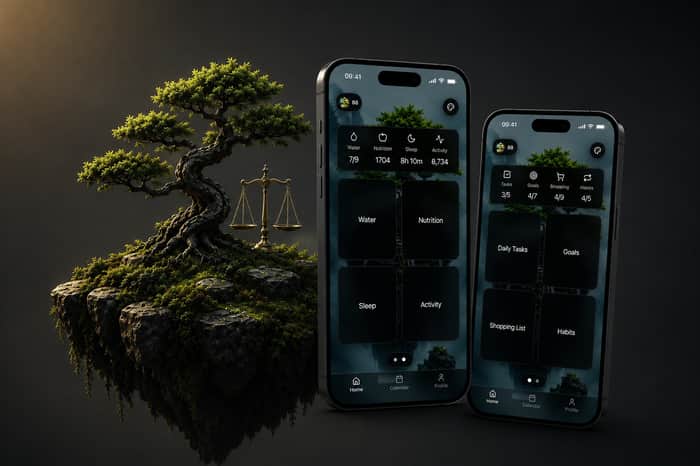
Five months ago I posted here about being stuck. The numbers were: 700 downloads, ~20 paying users, $150 total revenue. The feeling was worse than the numbers — that classic solo loop where you need users to know what to build, features to attract users, and marketing time you don't have because you're building features. About thirty of you answered, and I've reread those comments more times than I'll admit. They've been the co-founder I don't have.
Why I kept building anyway
The most common advice in that thread was blunt: stop building, start selling. You already have something worth marketing.
I half-listened — and I want to explain the half I ignored, because it was a real decision, not procrastination-by-coding.
SelfOS was never meant to be another to-do list. I started it for myself, and the idea from day one was bigger: one calm place for your whole life — what you need to do, what you're trying to become, and how you actually feel while doing it. The line in my Instagram bio says it best: for the days you're thriving, and the days you're just surviving. Tasks and habits were only half of that vision. When my little marketing spikes worked and people arrived, they were landing on half an app.
And there was a pettier reason, which I suspect some of you will recognize. To live my own vision I'd have to subscribe to a calorie counter, a water reminder, a sleep tracker — three more subscriptions on top of the planner I'd already built to avoid other subscriptions. At some point I looked at the price of a popular calorie-counting app and thought: absolutely not. I'll build my own. So I did :)
What shipped: SelfOS 2.0, the health update
It went live on August 5. Water, nutrition (with a barcode scanner), sleep and activity joined tasks, goals, habits and shopping lists — 8 modules total now, and every single one is optional. You turn on what you need; the app is exactly as big as you want it to be. Someone who only tracks water and someone running their entire life in it are both using SelfOS "correctly."
The emotional core stayed the same: the bonsai. It's a little tree that grows with your streak — and after 2.0 it grows from everything: a glass of water and a completed task feed the same living thing. 60 achievements shipped along with it, plus full statistics and data export — you can pull every byte of your data out anytime. Everything lives on your phone: no account, no ads.
The other big move was invisible in the changelog: a new name and a new category. SelfOS: Self-Care Tracker (App Store / Google Play) now lives in Health & Fitness instead of the planner shelf.
Then something new happened: users started writing to me
I didn't expect this part. After 2.0 went live, emails began arriving. People praising the app. People reporting bugs — politely, with screenshots! People suggesting features. My favorite review so far: "Replaced 3 different apps with this one."
If you've never shipped solo: strangers taking time to write to you about your app is rocket fuel of a purity you can't buy. One request kept repeating in different words — "let my phone's calendar feed my day." So 2.0.1 shipped just ten days after 2.0, with calendar import: events from your phone's calendar become daily tasks, and your edits always win over the sync. It's the fastest feature turnaround I've ever done, and it exists purely because someone asked.
The selling half
Through all these months I kept showing up on socials — Threads, Instagram, Pinterest, TikTok. Threads is where I actually live: a few advice-style comments a day in the niches where my users already talk. Not "check out my app" — just being a useful person in rooms where planners and self-care apps get discussed. It costs $0 and ten minutes a day, and it has produced every single growth spike this app has ever had. And one of those little daily comments recently set off a wave big enough that it deserves its own post — coming soon.
An honest confession though: reels and video are brutally hard for me. Some people talk to a camera like it's a friend; I talk to it like it's a tax inspector. I've decided to stop fighting that and build around it instead — the app now has bonsai share cards, so my users can post their trees to their stories even if I can't post mine 😄 We'll see if the bet pays off.
Questions for you
- The big one: how do you actually market a multi-functional app? Users love all-in-one — but only after install. Selling it is another story: every keyword, every screenshot, every comment forces me to pick ONE pain to lead with, and the stores think in single-purpose shelves. Renaming to "Self-Care Tracker" was me picking a door — but the house behind it is much bigger. Do you sell one module as the door and let the rest be the surprise? Rotate doors seasonally? Is all-in-one an indie superpower (retention, LTV, no direct competitor on the full bundle) — or a structural trap where you can never win any single shelf?
- Instagram people: has anyone actually grown an app through IG — organically or with paid promotion? I'd love to develop my page (Instagram), it feels like the right shopwindow for a visual app like mine, but I have no idea whether IG promotion actually pays back for a consumer app or whether it's all vanity reach. Real numbers welcome, good or bad.
- And still open from March: if your MRR was flat for months and then finally moved — what moved it?
I'll be back soon with the wave story, and after that with the retention verdict. Thank you for those thirty comments — they steered all of this. 🌱

Really interesting update, especially the point about your growth spikes coming from simply being useful in communities where your users already hang out. I’m building a consumer app too and distribution has definitely been the harder part compared to building the product.
Also like the idea of picking one clear “door” to market an all-in-one product rather than trying to explain everything upfront. Have you noticed whether people who come in for one specific feature end up adopting the other modules over time?
I think that having no-one to compete with full stack can be read 2 ways. Quiet straightforward assesment is that they have not thought about it and hence it makes sense to pursue to tap an unexplored market. However, this could also mean that they thought about it and rejected developing the full stack due to its value and more importantly investment-to-profitability ratio.
Nevertheless, having more features is not necesarily a bad thing as long as you deliver and diffrentiate with competitors on the features that really matter to the users. So, my honest suggestion is to get more user feedback or run a POLL to check which of your unique features resonate with the users top sought features. This could help you reposition in the market to the exact demographics. Best of luck!
The shift from 700 downloads/$150 to users actively writing in after 2.0 is a meaningful change in the signal. The multi-functional positioning question becomes especially interesting at this stage.
Thank you - "a meaningful change in the signal" is exactly what it feels like from the inside. Installs can be bought; emails can't.
That’s the important distinction. The emails are a much stronger signal because someone had to care enough to initiate contact. Curious what those users are actually asking for now that they’re reaching out.
The email that started the calendar import tells it better than any roadmap. A few days after 2.0 launched, a medical student from Ukraine wrote to me - sixth year, working three jobs alongside university, her parents living in a border town that's been under shelling for years. She found the app on a morning walk home from a bomb shelter, and asked two things: could SelfOS pull tasks from her calendar, and was there any way to afford it on a student stipend.
Calendar import shipped ten days later - her request went straight into 2.0.1. And she got a lifetime code from me, free; some emails you don't answer with a pricing table.
I'll be honest about why this one matters so much to me: I'm Ukrainian too. I know what it's like to live through war and try to gather your thoughts after a sleepless night. That my app can be one calm place for someone carrying all of that - that's deeply valuable to me.
The other emails are smaller but just as useful: one user has sent me three UI bugs with careful screenshots (all fixed in 2.0.1), another asked for recurring tasks — "don't make me retype 'take out the trash' every Tuesday" - now on the roadmap. This inbox has quietly become my product team.
That’s a much more meaningful signal than the install numbers. I’d be interested in continuing the conversation beyond the thread — what’s the best email to reach you at?
The moment your measurement signal shifted - from "700 downloads" to "users writing me emails with specific requests" - that's the signal that matters, and it only appears after product-market alignment. You shipped 2.0 and suddenly the silent metric (downloads) became transparent (direct feedback).
On the multi-functional positioning trap: the issue is that your single-shelf problem changes depending on the person. For someone drowning in subscriptions, your door is "consolidation." For someone in crisis, it's "one calm place." For someone optimizing, it's "holistic tracking." Those are three different people arriving through three different doors - and each one needs to see a different first-impression.
The all-in-one curse isn't the feature count, it's that you have to pick which door gets the storefront real estate. But your 2.0.1 calendar feature shipped in ten days because someone actually asked - that's the feedback loop other single-purpose apps never get. The people who love what you built love it precisely because you built everything they need in one place. Maybe the measurement to track is retention and LTV (your superpower), not acquisition CPA (their superpower).
Thank you! The three doors metaphor is a keeper. It matches what I see in reviews: the "replaced 3 apps" person and the "one calm place" person are clearly not the same buyer.
Funny enough, I almost built a version of "different first impressions": letting people pick their modules during onboarding. I backed off for one reason - I was afraid nobody would ever open a module they didn't pick on day one, while removing one takes a single tap anytime. So for now everyone sees the whole house first and trims it down, not the other way around.
And yes - retention is exactly where my focus already lives. Your framing is a good reminder that it's the right way:)
700 downloads and stuck is a distribution problem, not a product problem — and the fix is usually unglamorous.
The pattern that works when growth is flat: stop optimizing the product for a month and go sell one unit manually, every week. Not "post more" — actually identify one person with the problem, reach out directly, and get them using the thing while you watch.
I work in the course/creator space (I run iLoquio) and the parallel I see constantly: creators with "nobody is buying" are almost always waiting for inbound that has no reason to exist yet. The first 10-20 customers in any knowledge or app business come from outbound conversations, not discovery. The manual phase isn't a failure state — it's the phase where you learn which words make people pay, and those words later become the marketing that does scale.
One question worth answering honestly: of the 700 downloads, how many did you personally talk to? If the answer is near zero, that's the cheapest growth lever you have left untouched.
This is very close to what actually works for me - I just run it in public threads instead of DMs. My Threads playbook isn't "post more": I search for specific people asking specific questions - "where do you track your water?", "which calorie tracker do you use?", "what app for tasks + long-term planning?" - and answer each one personally, suggesting SelfOS where it genuinely fits. One person, one conversation, one install at a time. That's what produced every growth spike this app has had, and it's exactly your "learn which words make people pay" phase: by now I know which phrasings convert, because I've typed them hundreds of times at real humans, not into a keyword tool.
I ran the identical playbook on Reddit and got banned within two weeks 😄 Same behavior, different immune system.
But where you've got me is "watch them use it": with a no-account, on-device app I literally can't see anyone's usage, and live 1:1 conversations with existing users have been rare - mostly whoever emails me first.
Local-only + data export is a strong selling point, more apps should do this. One thing I wonder - shopping lists almost beg for sharing with a partner. Any plans for that, or would it break the “no account” philosophy?
Thank you! And good news - shopping lists can already be shared, there's a share option that sends the list through the system share sheet, so you can drop it straight into whatever messenger your partner actually uses.
Real-time sync between two phones is the honest gap though - that one genuinely needs a backend, and it's on the long-term radar. But whenever it comes, the rule stays the same: accounts optional, the app fully useful without one. That part of the philosophy isn't negotiable.