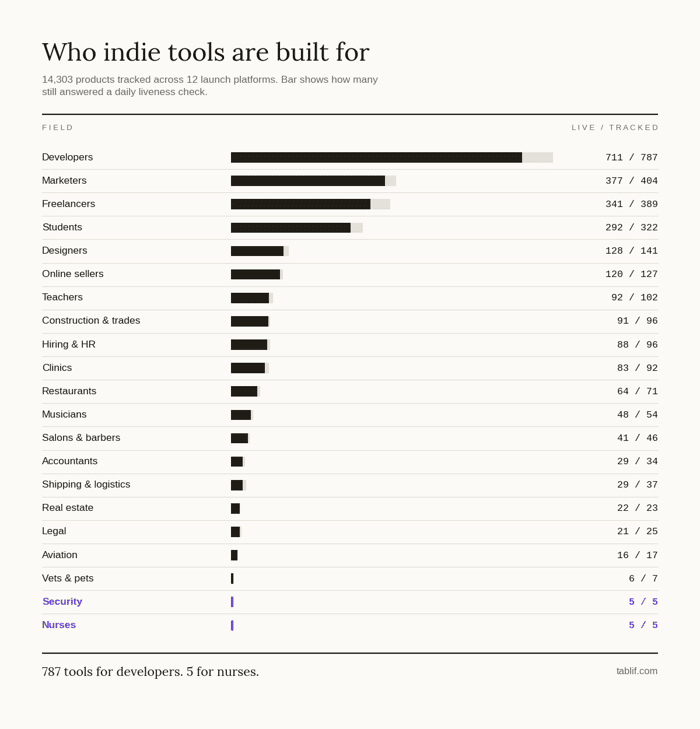
787 tools for developers. 5 for nurses. Two weeks of tracking 14,000 indie launches.
I'm building a thing that watches products from 12 launch platforms and checks every one of them daily to see if it's still running. 14,303 in there right now. Over a thousand new ones come in every day and get analyzed with AI to work out what they are and who would need them.
That last part is where the interesting data lives, so here it is.
Every product gets filed under who does the work. Live over tracked:
Developers 711/787
Marketers 377/404
Freelancers 341/389
Students 292/322
Designers 128/141
Online sellers 120/127
Teachers 92/102
Construction & trades 91/96
Hiring & HR 88/96
Clinics 83/92
Restaurants 64/71
Musicians 48/54
Salons & barbers 41/46
Accountants 29/34
Shipping & logistics 29/37
Real estate 22/23
Legal 21/25
Aviation 16/17
Vets 6/7
Security 5/5
Nurses 5/5
787 tools for developers. 5 for nurses. There are something like 28 million nurses working right now. That list isn't a map of where the problems are, it's a map of who's building.
The second number worth sitting with. 4,859 products have no shipping streak and no Hacker News mention. Nothing has happened to them since the day they launched. That's about a third of everything tracked.
Some go fast. There are rows in the went-quiet list marked "watched for 1 days", which means we found them on launch day and by the next morning the site was already gone.
I don't think the lesson is "go build for nurses". Clinics have 92 tools and plenty of those will die too, because you don't reach a nurse from a launch post. The lesson is smaller. Where you have distribution and where the need is unmet are almost never the same place, and most of us pick the first one and call it validation.
There's already a page that shows all of this. It's rough and I'm still building it, but the shape is clear enough to talk about, because the same data answers three things a founder actually wants to know after launch day ends.
Who else is in my lane, and are they still moving. You pick a set of products and watch them. When they ship, when they go quiet, when someone outside the product brings them up somewhere public.
Which fields are actually moving. Not which are crowded. A field with 92 tools where nothing has shipped in a month is a completely different bet from a field with 30 where half of them shipped this week, and right now nobody can see the difference between those two.
And where to find people once the launch traffic is gone. That's the part nobody warns you about. Day one you get a few hundred visitors and day three you get eleven, and the people who were looking for exactly your thing show up in week six, on a day when nothing is pointing at you.
That last one is the business model, or the plan for one anyway. The site stays free for people looking for tools. Founders who want the view from the other side pay for it. Nothing is charged yet and I'd rather the data be worth paying for before I ask.
Caveat worth saying out loud. This is two weeks of data. Ask me in 90 days for a real survival curve.
Question for the room. If you've built for a field you don't work in, how did you get the first ten users?
tablif.com if you want to poke at the raw thing.

The salons, clinics, and restaurants rows are the interesting ones to me, not because those fields are technically underbuilt, but because the people running those businesses are not out there searching for tools. They post about being tired, about forgetting to follow up with someone, about running the whole thing from memory. You will not find them by searching tool related keywords, you find them by reading the burnout post first and working backward to what they actually need.
That has been the real answer to your question in my own experience. FounderFlow is your AI Executive Chief of Staff. It watches your business, identifies what matters, protects your revenue, and tells you exactly what to do next. It is built for exactly the overlooked group your data is pointing at, solo and small team operators running service businesses. The first users never came from a distribution channel built for developers, they came from showing up where people talk about the burnout part, not the tooling part.
If you want to dig into the full dataset behind this, every board, every tag, the survival numbers, all of it, I put last week's full report up here: https://tablif.com/report/launches-2026-07-20
On the prefill problem being something you cannot detect: I think you actually can, and cheaply, because prefilled copy has a fingerprint that founder-written copy does not.
A platform generating listings from a template produces text with recurring structure across unrelated products on that same platform. Same sentence count, same opening construction, same tag vocabulary drawn from a fixed set. Founder-written copy scatters. So rather than trying to classify a single listing, compare listings within one source: cluster on structural features instead of topic, and the prefilled cohort separates out as an unnaturally tight cluster. StartupBase gave ours four tags before I typed anything, and I would bet those four come from a small closed vocabulary you could recover just by counting tag frequencies across that source.
That also gives you a per-source confidence score rather than a binary. A source where 70 percent of listings fall in the tight cluster is one whose categorization you should trust less, and you can surface that as a caveat instead of silently averaging it into the totals.
The cheap version needs no model at all: for each source, count how many listings share a near-identical description length and tag count. If that distribution has a spike rather than a spread, the spike is the template.
And on stretching launch day past 24 hours, that is the part of what you are building I find most interesting, because the queue lag we were both describing is really the same problem from the other end. A product sitting four weeks in a free queue is already living in the post-launch-day world before it has had a launch day at all.
ha iontersting facts but at the same time who is looking for new products devs we want it fast now and in future code so as not to0 have to replace int 3 weeks . the report says it all and .as far as built and not shipped i can say this i built entire buisness ready to go and shipped 0 not becuasei cant sell it or products nto good im 20 year sales vet .... i despise that side of things so i built it shelved it and now im going to sell it is how inded up here btu im only sellgin so i can go back to creating but opend my eyes to the litllt guys so thank you
Haha, love this, total opposite problem from what I usually see. My data's full of people who can build but can't sell a single unit, and you're sitting on something that sells fine but can't stand doing the selling part yourself. What was it, out of curiosity? What does a 20 year sales guy build when nobody's watching?
Two data-quality notes from the other side of this, since I have spent the last stretch actually submitting a product across about a dozen of these platforms. Disclosure: I work on growth at Ojin, so I am one of the rows feeding datasets like yours.
First, on several of those platforms the launch date is not the launch date. StartupBase told me there were roughly 1,334 startups ahead of us in the free queue, about four to five weeks, or $39 to skip it. BetaList, Uneed and others each have their own version of this. So a product surfacing on day X may have been finished six weeks earlier, and some of your "watched for 1 days, site already gone" rows could be products that died during the queue wait rather than after launch.
The sharper version: paid queue-skipping is a systematic bias rather than noise. Founders who pay to skip enter your dataset sooner and are on average the better funded and more committed ones. Free-queue founders arrive weeks later, and some fraction never arrive at all because they gave up while waiting. So sitting underneath "a map of who is building" there is a quieter layer of "a map of who paid to be seen sooner."
Second, and this one genuinely surprised me: several of these platforms now prefill the listing with their own AI. StartupBase generated our tagline, description and four category tags before I had typed anything, and I overwrote all of it. Which means when you run AI categorization across scraped listings, you are sometimes classifying another AI model’s guess about a product rather than anything the founder actually wrote. For the 787-versus-5 count that matters, because the platform’s own AI carries its own priors about what reads as a developer tool.
Neither of these breaks the thesis. The who-builds-versus-where-the-pain-is point stands and I think it is the right read. But if you are heading for a real survival curve at 90 days, queue lag is a confound you can partly correct for, since queue length is usually visible at submission time.
Yeah, this maps onto something I've been chewing on already, so glad you brought it up.
On the AI prefill thing, you're onto something bigger than just StartupBase. My pipeline reads whatever text is sitting in the listing when I pull it, and I have no way to tell if that text is what the founder actually typed or something the platform filled in first. So if a founder never touches the prefilled copy, I'm basically categorizing the platform's own guess and calling it the founder's intent. That's a real gap, not something I can wave away.
On the queue lag side, you're right that it hits me directly too, a couple of my sources run queues, so launch day in my data isn't always the day the thing was actually ready.
This whole thread is close to home for me too, because it's basically the whole point of what I'm building. A project launches, fine, but then what, who actually finds it after that and where. What I'm trying to put together is a front end where someone with an actual need can land on the right tool, not just scroll through whatever launched yesterday. So in a way I'm trying to stretch launch day out instead of letting it die after 24 hours, since being launched really just comes down to who you got shown to in the first place. I want to sit in a different spot than the usual directories and launch boards, and eventually show people how much a project actually delivers versus what it just promises, not just that it exists.
Glad the number turned out to be buildable from data you already log. Two implementation traps worth dodging before it becomes a baseline, both learned by getting this wrong on our own arena's numbers.
Self-seeded mentions. A founder posting their own tool on Reddit is builder motion wearing a demand costume. If those count as a first external mention, the baseline inherits exactly the confound you are removing from shipping streak. Splitting founder-initiated from organic fixes it, and your founder-claim layer might double as the labeling mechanism: a claim is also a disclosure of which mentions are self-authored.
Censoring. At two weeks most lanes are right-censored, so an average time-to-mention reads falsely fast because only the quick ones have resolved. A survival view per lane, median plus the share still unmentioned at N weeks, keeps the young categories honest. You already framed the 90-day caveat in survival terms, so this is just carrying that frame into the metric itself.
Handle those two and the number stays trustworthy as the dataset ages.
Both of these are real, and honestly I'd have shipped the naive version and found out the hard way. The self-seeded one especially, a founder posting their own launch on Reddit and me quietly counting that as "demand found this" would've made the whole metric worthless within a month.
Tying it to the claim layer is smart. Once someone claims a product they're basically disclosing their own footprint, so that mention gets flagged as founder-initiated by definition instead of me guessing intent from a post.
On censoring, you're right that a flat average right now would just measure which lane got one lucky fast case, not the lane itself. Median plus percent-still-unmentioned at N weeks is the honest version, and it's really the same "ask me in 90 days" thing I already said for the whole post, just carried one level deeper.
Thanks for bringing actual math instead of just the idea.
Machine Arena team here again. One more second-order trap on the claim layer, since you are building it anyway.
The claim layer will bias the baseline it feeds. Founders who claim a product are the engaged ones, and engaged founders get mentioned sooner, so any lane with a higher claim rate will show a faster time-to-first-mention for reasons that have nothing to do with the lane. A founder in a low-claim category then checks their own silence against a number built mostly from the most active builders in a more-claimed one, and reads it as a verdict on demand.
Cheap guard: compute the baseline on unclaimed products only, or report claimed and unclaimed separately and show the gap. The gap is the interesting number on its own, since it puts a figure on how much of "discovery" is just the founder showing up.
Related, and it compounds with the censoring point: keep the baseline cut by launch cohort rather than pooled. If a lane's discovery surfaces get louder or quieter over a few months, a pooled baseline quietly averages two different worlds, and someone launching today gets measured against a channel that no longer behaves that way.
Good catch, and this one's sneakier than the first two because it hides inside the fix you just handed me.
You're right that claim rate isn't random, engaged founders claim faster and get mentioned faster, so any lane with a high claim rate will look like faster-moving demand purely because the people in it show up more, not because the lane itself is louder. Comparing someone in a quiet-claim category against a baseline built mostly off engaged builders in a loud one is basically making them compete against a different game than they're playing.
Reporting claimed and unclaimed separately and showing the gap is the right call. The gap on its own might end up being the more interesting number, it's basically a measure of how much of "getting found" is the founder doing the finding themselves.
And cutting by cohort instead of pooling makes sense too, a channel doesn't behave the same in month one as it does in month six, pooling would just blend two different eras of the same lane and blame the founder for the drift.
Appreciate you working through the second-order stuff, most people stop at the first trap.
The velocity insight is gold here. Most founders look at "crowded vs underserved" and pick underserved, but miss that a field with 0 shipped in a month is dead regardless of the market size. You're basically saying the real decision tree is: where do people actively search for solutions, not where do solutions theoretically fit. That week-6 organic discovery window you mentioned is the real tell - if your field has shipping momentum, those qualified users actually exist and are looking. The "distribution mismatch" problem explains so many failed launches in unsexy verticals.
Appreciate you coming back for a third round on this one. We've covered the velocity and week-6 points pretty thoroughly already, so I won't repeat myself, but the distribution-mismatch framing is a good way to tie it together. Thanks for engaging with the post this much, means a lot.
this is a map of who builds, not where the problems are, and thats the whole opportunity. developers get 787 tools because developers build tools, they are scratching their own itch. nurses get 5 because almost no nurse is also a solo saas founder, not because they have no problems. so the underserved verticals arent underserved because the market is bad, theyre underserved because the people with the pain and the people who can build have basically zero overlap. the catch, and the reason it stays that way: those markets are hard to REACH as an outsider. a dev can launch to devs on here in an afternoon; selling to nurses or trades means you dont speak the language, dont know the watering holes, and cant get distribution from your existing network. so the real edge in a "5 tools" vertical isnt building, its having a genuine way in (you worked in it, or you partner with someone who did). the whitespace is real but it rewards domain access, not code. would love to see this same list weighted by market size per tool, that ratio is the actual opportunity heatmap.
The "who builds vs where the pain is" framing is right, and the market-size-weighted ratio is the natural next question. The catch I keep running into though: total headcount is a bad denominator. 28 million nurses doesn't mean 28 million people who'd want a SaaS tool, most of that number would never touch one regardless of who builds it. The real addressable slice is much narrower and way harder to pin down than the raw profession count.
That's actually part of why the site filters by more than profession, what you do, what you work on, what you already use, what you won't compromise on, stacked together. A ratio built on job-title population looks clean but probably misleads more than it reveals.
Where I'd rather put the energy is the other side of this. I'm building alerts off those same filters, so someone with a real need can save their exact combination and get pinged the moment something matching it clears its first "still alive" checkpoint, not on launch day noise, after it's actually held up. Same mechanism solves the founder side too, that's the audience showing up in week six instead of never.
This comment was deleted a month ago
Answering your question: I built for businesses I didn't work in by giving the work away first. After 9/11 I did free IT migrations for displaced NYC companies, and my first ten paying customers were those same companies once they got back on their feet; trust came before the invoice. Your developer-to-nurse gap is really a trust-channel gap, and the fastest bridge into a field you don't work in is the vendor, association, or reseller that field already buys from.
Trust-channel is honestly a better name for it than whatever I was calling it in my head. I'd been treating the gap as a distribution problem this whole time, like the fix is just showing up in the right feed, but you're right, showing up wouldn't even fix it. Put an ad in front of a nurse and she still has zero reason to believe the thing works. There's no track record, nobody she trusts has vouched for it.
The 9/11 thing kind of proves the point too. You didn't earn that trust by pitching, you earned it by doing the work for free and letting it speak for itself until it was obvious. That's just slow, and I don't think there's a way to skip it.
Finding the vendor or association a field already trusts is probably closer to the real unlock than finding where people post online. Changes how I'd think about the founder side of this too, tbh, less "what subreddit" and more "who already has their ear."
The founder-market-fit framing here is the right one, so instead of repeating it I'll add an axis nobody's mentioned: the same 787-vs-5 gap runs across languages and regions, not just professions — and it's even more lopsided there.
I'm building for non-technical people who own a server but aren't sysadmins, and "find where they hang out" broke for me twice over: once because they're not on HN or Product Hunt (the point everyone's making), and again because the moment you leave English there's often no community, no newsletter, no creator covering the problem in that language at all. "5 tools for nurses" quietly becomes "0 tools and 0 discoverable audience" once you say "German-speaking nurses." The underserved-ness compounds.
So my question runs a different direction than the others: could the survival and velocity signals ever be cut by language or region, not just category? A field that looks saturated in English — 50 tools, all shipping — might be a wide-open lane in Italian or German with zero coverage, and that gap is invisible if everything's measured on English-first launch platforms. Is there even enough non-English launch signal in your data to see it?
Honestly, no, not really. Almost everything I track lives on English-first platforms, so the non-English side isn't something I can filter for, it's just missing from the source data to begin with. Kind of the same shape as the developer-vs-nurse thing, except here you don't even get the "5 tools" step, there's no launch signal at all to be lopsided in.
The thing that actually gets around it is the founder side I'm building, letting people connect their own MRR or Google Analytics once they've claimed their product. That stuff doesn't care what language you're building in. A German or Italian tool could go its whole life without a single English mention and still show up as alive through its own numbers. Probably matters even more for a field like yours, honestly, since the audience was never going to be sitting on an English launch board anyway.
That's the honest catch, and I think the founder-claim layer inherits the same blind spot one level up: the tools hardest to see are built by founders who were never on an English platform to claim them in the first place. Self-reported MRR fixes the "no mention" problem — but only for founders who already found their way to your tool, which skews right back toward the English-plugged-in crowd.
I'm actually the reachable slice, not the invisible one: Italian, building for a non-English-friendly audience, but sitting here writing this on IndieHackers in English. The ones you'll never capture are building in Italian, for Italians, discovered entirely through Italian channels, and never touch an English board or a claim form.
The only cross-language signal I can think of that doesn't need the founder to show up is demand-side — search volume for "X in language Y" exists whether or not anyone's built or claimed the tool. Harder to source, but it'd tell you which non-English lanes are empty and wanted, which might be the more useful half anyway. Cool problem — I'll be following the founder layer.
You're right, and honestly that's a sharper version of the point than I'd landed on. Self-reported MRR just moves the wall up a level, it still needs someone to have found the door in the first place.
The search-volume idea is the first thing here that doesn't route through a founder or a launch platform at all, that's probably why it's the more useful half like you said.
I poked around for an Italian-language Product Hunt out of curiosity and came up basically empty, a small LinkedIn group here, a mostly dead IH group there, nothing that functions like an actual platform. Matches what you're describing almost too well. Curious if that's really the whole picture from where you sit, or if there's something smaller and more local that just doesn't show up from the outside.
Yeah, empty is about right from the outside, but it's less that there's no community and more that it moved somewhere you can't scrape. The Italian stuff that's actually alive is mostly closed Facebook groups and Telegram, plus a couple of subreddits like r/ItalyInformatica and some LinkedIn groups. None of it works like a launch platform though, no feed, no public API, nothing you could point a tracker at. It's real activity sitting inside walled gardens.
Which is kind of your measurement problem in its purest form, honestly. The signal exists, it's just structurally invisible from outside because it lives in places that don't publish anything. I'd bet a German or French founder tells you the same shape, different rooms. It also makes the "go where they hang out" advice harder, since where they hang out is often a Telegram group you can only find if someone drops you the invite.
Good reframe honestly, walled-garden vs published is probably the real axis here, not language. Telegram, Discord, private FB groups, doesn't matter what language they're in, none of it's scrapeable. Appreciate you sticking with this thread, it's one of the better ones I got. Good luck with the server project.
Walled vs published is the right axis, language just happens to be one of the walls. Same reason a German founder and an Italian one would tell you the same story in different rooms.
And I'm about the most on-the-nose example of it you could ask for, Italian, building for people who'd never touch an English board, but reachable only because I ended up over here on IH in English anyway. So if you ever push the founder-claim layer toward the non-English side, ping me, happy to be an early one to plug a real product in and see whether it reads as alive the way you're betting it will. Good luck with tablif, I'll be watching where it goes.
That means a lot, and yeah, if the founder-claim layer ever pushes toward non-English, you're on the list, no question. This whole thread's honestly one of the better arguments I've gotten for building it that way instead of English-only from the start. Good luck with the server tool too, hope Italy ends up being the easy part of it.
Walls, not languages, that's the line I'm keeping from this whole thread. It actually changed what the founder layer is for in my head, less "catch non-English tools" and more "let any tool prove it's alive without routing through a published platform at all." You handed me back a bigger version of my own feature, which is a strange thing to have happen in a comment thread.
And it's not a maybe. When the claim side is real enough to point at, you're the first non-English founder I'm bringing in, the real ping, not the polite one. I'll take the last word so we don't good-luck each other into next week. Best thread I've had on here in ages, go build tablif.
This nails something founders consistently get wrong: they optimize for product-market fit when they should optimize for founder-market fit. The 787 vs 5 gap isn't about opportunity - it's about discoverability. Developers read Hacker News and Product Hunt. Nurses don't.
The week-6 window you mentioned is the real insight. Most founders chase day-1 launch traffic and quit by day 3 when it drops. They don't realize their actual customers show up in week 6 when search engines crawl, Twitter threads bubble up, or someone mentions them in an unrelated Slack channel. The velocity metric (which products shipped this week in my category) is probably worth more than market size when evaluating where to build.
Founder-market fit is a good way to put it actually, better than how I framed it in the post. Developers get lucky by accident there, they're building for people exactly like them, so distribution and need collapse into the same thing without anyone trying. Everyone else has to go find that overlap on purpose.
We already went a round on the shipping velocity point so I won't repeat myself there. The one new thing worth saying: the harder version of founder-market fit isn't picking a field you understand, it's admitting when you don't and building the distribution muscle for that anyway. That's the actual gap between the 787 and the 5, nobody's unwilling to help nurses, they're just not launching products on Product Hunt, so almost nobody building for them has ever had to learn how to reach one.
The 787-versus-5 gap is a useful reminder that launch platforms show where builders gather, not necessarily where potential buyers are. For the paid founder view, will you show the actual communities or creators where a non-developer audience already discusses a problem, or mainly category-level activity?
Right now it's closer to category-level, and I'd rather just say that than sell the roadmap like it's already shipped.
What's live is two signals per product, did it ship anything since launch, and did anyone outside the team bring it up somewhere public. Add those up by field and you get which lanes are actually moving. That's the category view, and it's real today.
The "somewhere public" part is exactly where your question lands. Right now that side is thin, a couple of sources I actually trust enough to show, and honestly it's the earliest thing I've built here. I can tell you a product got picked up off its own launch, but I can't hand you "your non-dev audience is arguing about this exact problem in this specific community or newsletter." Not yet, that's the direction I'm pushing next.
Category-level is real, the creator side is what I actually want to get to, and that's part of why nothing's priced. Ask me again in 90 days, I'd rather be showing you than promising it.
That’s a fair distinction, and I appreciate you being clear about what exists now and what doesn’t. For someone with limited outreach time, category-level movement is useful, but named communities would be the part that changes what they do next. I’ll be interested to see where that layer is in 90 days.
The 787-vs-5 split perfectly illustrates why GTM matters more than market fit. Nurses and clinics have massive unmet needs, but you can't reach them through Product Hunt or HN. The real opportunity isn't "build for nurses" - it's recognizing that niche markets require totally different distribution playbooks.
Your point about the week-six discovery window is critical. Most founders panic in week 3 when they see zero traction, then ghost. But for non-typical audiences, weeks 2-4 are when organic search rankings solidify, Reddit threads age into Google results, and the people actually searching for solutions start finding you.
One thing I'd add: the shipping velocity metric you mentioned is gold. A field with 12 tools shipping weekly is way more competitive than one with 50 where nothing shipped in a month - but most founders would see the second field and think "too crowded." The survival data you're building could flip how people think about market selection entirely.
Appreciate this, especially the shipping velocity point because that's the one I keep coming back to myself. 12 tools shipping weekly beats 50 that are all dead, kind of the whole thesis in one line.
I want to be a little careful about the week 2-4 part though. It's a pattern I believe in too, I've heard other founders describe it the same way, but two weeks of data isn't really enough for me to say I've confirmed it. Feels more like something I expect to hold up than something I've actually measured yet. Didn't want to just nod along like it's already proven.
If the shipping velocity number holds up past 90 days though, I think you're right that it's the more useful signal than raw tool count. A crowded field that's still shipping is a different animal than a crowded field that's a graveyard, and right now nobody's separating the two.
Same product, and I'd say the split runs inside the distribution itself rather than across fields.
Flyout started as a developer tool, built by a developer, for developers, and the launch channel that worked first, Product Hunt, was developer-heavy for exactly that reason. The bet paid off fast there because the audience already existed on the platform.
But the actual need, a quick note you can pull up without breaking flow, isn't developer-specific. Once that became obvious, the marketing copy moved toward everyday scenarios instead of dev jargon, and a separate set of pages went up for the searches non-developers actually type: sticky notes, quick notes, floating notes. None of that traffic comes from a launch platform. It's slow, organic, and a completely different acquisition motion running in parallel with the fast one.
Matches your point about distribution and unmet need rarely overlapping, just visible within one product instead of across two.
Yeah, this is exactly the gap. Right now something growing quietly looks identical to something dead on my end, no shipping streak, no mention, nothing separating the two.
There's already a founder layer for this, still a few pieces missing, opening it up soon. Revenue isn't the only definition of alive either though. A project can be gaining users with zero money changing hands, maybe it's free by design, maybe monetization just hasn't started. Most of the MRR-tracking sites I've looked at kind of assume no revenue means no growth, and I think that's wrong about as often as it's right.
MRR is live now, Google Analytics too, a few more sources still on the table. Revenue ends up being one signal among several, not the whole verdict.
Where I'm honestly still stuck is this: all of that needs the founder to show up and connect something. If they don't, I don't have proof of life, but no proof isn't the same as dead, and I don't want the system to quietly act like it is. Still figuring out how to show that difference instead of just defaulting to silence looks like death.
Machine Arena team here. The week six line is the realest thing in this post, and it matches our logs almost exactly. We publish daily across several channels and went through week after week of windows where attributed signups were zero. When the first real signups finally landed, they all came through one surface, traceable to one creator's post, weeks into the grind. From the aggregate view we looked exactly like a row in your went-quiet list the whole time.
Which is the caveat I'd flag for the survival data: your quiet cohort at two weeks will include products sitting in that week six trough, alive but not yet discoverable by any signal you track. Shipping streak measures whether the builder is moving. It says nothing about whether demand ever got a chance to arrive. A product that shipped nothing for a month but got its first outside mention in week six is a better bet than one shipping daily to nobody, and right now those two would sort the same or even backwards.
So a metric suggestion, since you asked what founders would actually want: time to first external mention, by category. You already track outside mentions for the lane view. The distribution of how long that takes per field would tell a founder whether their silence is normal for their lane or a verdict. We would have paid for that during the zero weeks, because the thing we lacked was not traffic advice, it was a base rate to compare our silence against.
On your direct question about first ten users in a field you don't work in: what worked for us was not finding where the audience hangs out in general, but finding the handful of people already publishing to that audience and earning our way into their threads before ever mentioning the product. Slower than a launch. Compounds better.
This is the best kind of comment because it comes with a number I can actually go build.
You're right that shipping streak only measures whether the builder's still moving, it says nothing about whether demand had a chance to show up yet. That's a real blind spot in how I'm currently sorting the quiet cohort, and your week six story is a clean example of exactly the gap.
Time to first external mention, by category, is something I can pull from data I already log, I just haven't cut it that way yet. Turning it into a baseline per lane so a founder can check their own silence against it feels like the actual missing piece, not more traffic advice, like you said, just a number to measure against. Adding it to the list of what I'm building toward.
There's also a founder-claim layer taking shape on my end for cases like this, still a few pieces missing before I open it up, but it's aimed at the same problem from a different angle, letting a founder show what the aggregate view can't see yet.
And yeah, the ten users answer matches what I've heard from a few other people in this thread too. Slower, but it compounds, versus the launch spike that mostly doesn't.
I'm curious what convinced you the core problem is camera avoidance rather than the effort of consistently turning ideas into publishable content.
From the people who've tried Voclip, do they keep using it because they dislike being on camera, or because recording a voice note becomes the fastest path from an idea to something they're actually willing to post?
Think this landed on the wrong post, not my project. But good question either way.