A denied insurance claim sent me searching for answers. That’s why I built Clayem.
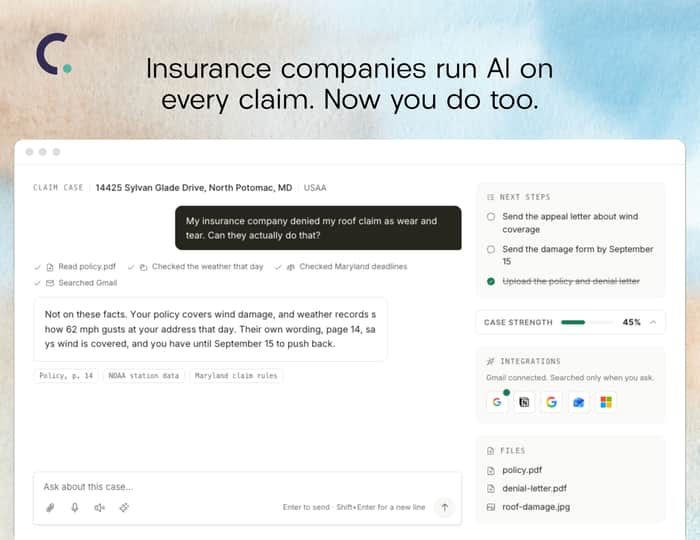
Clayem, insurance companies use AI for every claim, and now policyholders can too.
Not long ago, I had an insurance claim denied that I thought should have been approved. I hired a public adjuster to help me with the appeal, and it struck me how the adjuster understood the process well. In contrast, the policyholder experience relies on phone calls, PDFs, and manual back-and-forth. Meanwhile, the insurance company has teams, data, and all the motivation to pay as little as they can. You feel outmatched right from the start.
That realization led to the creation of Clayem.
Clayem is an AI that reads your policy and explains what is actually covered, citing the page for each answer. It organizes your documents, highlights deadlines that could quietly close a claim, and suggests your next move, so you can understand your claim just as well as the people on the other side. It works for both residential and commercial policyholders, and public adjusting firms are using it for their cases as well. The first week is free, and if you continue, it costs a flat $149 for the entire case, with no percentage taken from your settlement.
The most interesting and challenging part to develop is this: it operates in a regulated, high-stakes environment. When a family’s claim is at risk, an agent incorrectly estimating a number or misreading a policy can lead to serious consequences. So from the beginning, we focused on accuracy and integrity. The agents must be correct, provide their sources, and follow the deadlines and rules that govern a claim, instead of just performing well in a demo. This requirement influenced everything, from the model we selected to ensuring a source is available for every finding, allowing people to verify the work.
Here are a few things I’ve learned so far:
- In a trust-based, regulated field, “move fast and break things” poses a risk. Consistent, dependable reliability is the actual feature.
- A sharp focus is better than a broad one. “Denied and underpaid property claims” is a real, ongoing issue and much more specific than “AI for insurance.”
- Marketing a product like this is a product in itself. People don’t seek help until a disaster strikes, so being easy to find and trustworthy at that moment is half the challenge.
I’d welcome feedback from this community, especially from those who have worked in regulated or trust-heavy areas: how did you manage to balance speed of delivery with the reliability your users needed?

What stood out to me wasn't the AI or the compliance layer.
It was the possibility that reliability and trust might not be the same thing.
A policyholder can trust a service because it's accurate.
They can also trust it because it helps them feel less outmatched.
Those can overlap.
But they don't necessarily point toward the same product decisions over time.
That's the part I'd be most curious about.
That distinction resonates with me. It's precisely why we see AI as a tool to support a licensed public adjuster, not to take their place. The additional perspective on a claim is essential. A licensed human brings judgment, accountability, and relationship. The financial and emotional weight of a claim is significant. The tool can help organize and evaluate the file, but a person remains responsible for it. That's a boundary we intend to keep clear.
Yeah, that’s exactly the tension I was pointing at.
Because once those definitions feel cleanly separated, they often start quietly shaping what gets optimized — even before anyone explicitly chooses a direction.
That’s usually where I’ve seen the biggest downstream divergence happen: not in the definition itself, but in what it causes the team to start prioritizing next.