A single Reddit question exposed 3 blind spots in my analytics product
Almost every store owner I talked to checks revenue first thing in the morning. Almost every one also told me it's the wrong number to check.
I'm building briefpeak — a tool that connects to your online store and sends you a morning email explaining what happened yesterday in plain English. I shared milestone #1 here a few weeks ago.
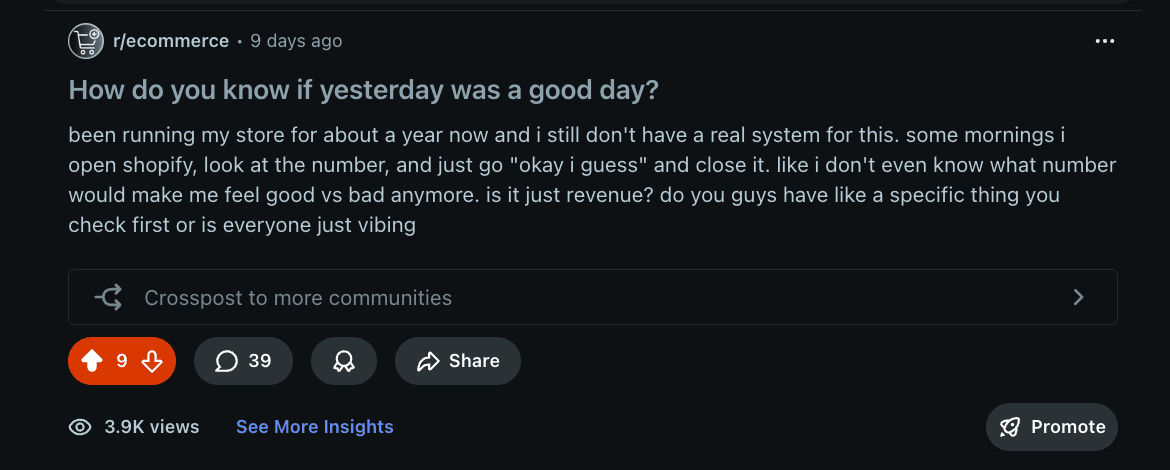
After 8 years of building analytics for e-commerce brands, I had strong opinions about what that email should say. But opinions aren't data — and a few of you in the comments challenged my assumptions. So I went to Reddit and put my thesis to the test with the simplest question I could think of: "how do you know if yesterday was a good day."
39 comments. 3,900 views. Some of it confirmed what I expected. Some of it changed the product.
1. I knew revenue was misleading — but I underestimated how much.
Almost every response started with "I check revenue." But then they immediately followed up with why that's misleading.
"Shopify dashboard just lies to you. Had an $8K day last Q4, felt like a massive win — pulled my spreadsheet next morning, Meta CPA had spiked to $65, actually lost $400." — store owner, daily spreadsheet tracker
"Revenue is a vanity metric dressed up as a KPI. The number you should be opening first is contribution margin per order." — experienced seller
One owner described setting a margin floor percentage and checking every morning whether it cleared or not. Pass/fail. That's it. No doom-scrolling dashboards.
2. Daily checking is a comfort habit, not analysis — this one I didn't expect.
I built the brief around the assumption that store owners actively use their morning dashboard check. Multiple people described the opposite: open dashboard, look at the number, feel good or bad, close it, change nothing.
"The daily revenue scrolling is just you pretending to work." — Shopify store owner (replied in two separate threads)
The store owners who broke out of this pattern all did the same thing — they picked ONE metric beyond revenue and tied it to ONE action. Add-to-cart vs checkout completed. Weekly rolling margin. Conversion rate against a baseline. The specific metric varied but the pattern was identical.
3. Returns as a daily signal — this one genuinely surprised me.
"Refunds and returns from the previous day tell you if those sales were clean or if problems are coming." — store owner who checks conversion rate, AOV, and support volume together
A spike in orders that creates a flood of support tickets the next day isn't actually a good day. It just looked like one. In 8 years of building analytics, I'd always treated returns as a monthly metric. This reframed it as a daily quality check — and it changed the product.
What this changed in the product:
When I wrote milestone #1, I thought I knew what the brief should say. I was partially right — but the thread pressure-tested my assumptions and changed several key decisions:
The daily email now leads with net revenue (not Shopify's inflated top-line number) compared against the same day of week, not just yesterday. A 4-year store owner pointed out he compares against the last 2 years of the same weekday — "Friday-Monday strongest, Tues-Thurs less." Without that, every Tuesday looks like a crisis.
There's now a "What Came Back" section that flags return activity as a next-day quality check on revenue — something I'd never thought to build before this thread.
The verdict cross-references margin, AOV, and order count to explain WHY a number moved, not just that it moved. And anomaly detection calibrates to each store's own baseline instead of arbitrary thresholds — confirmed by multiple owners who already do this manually.
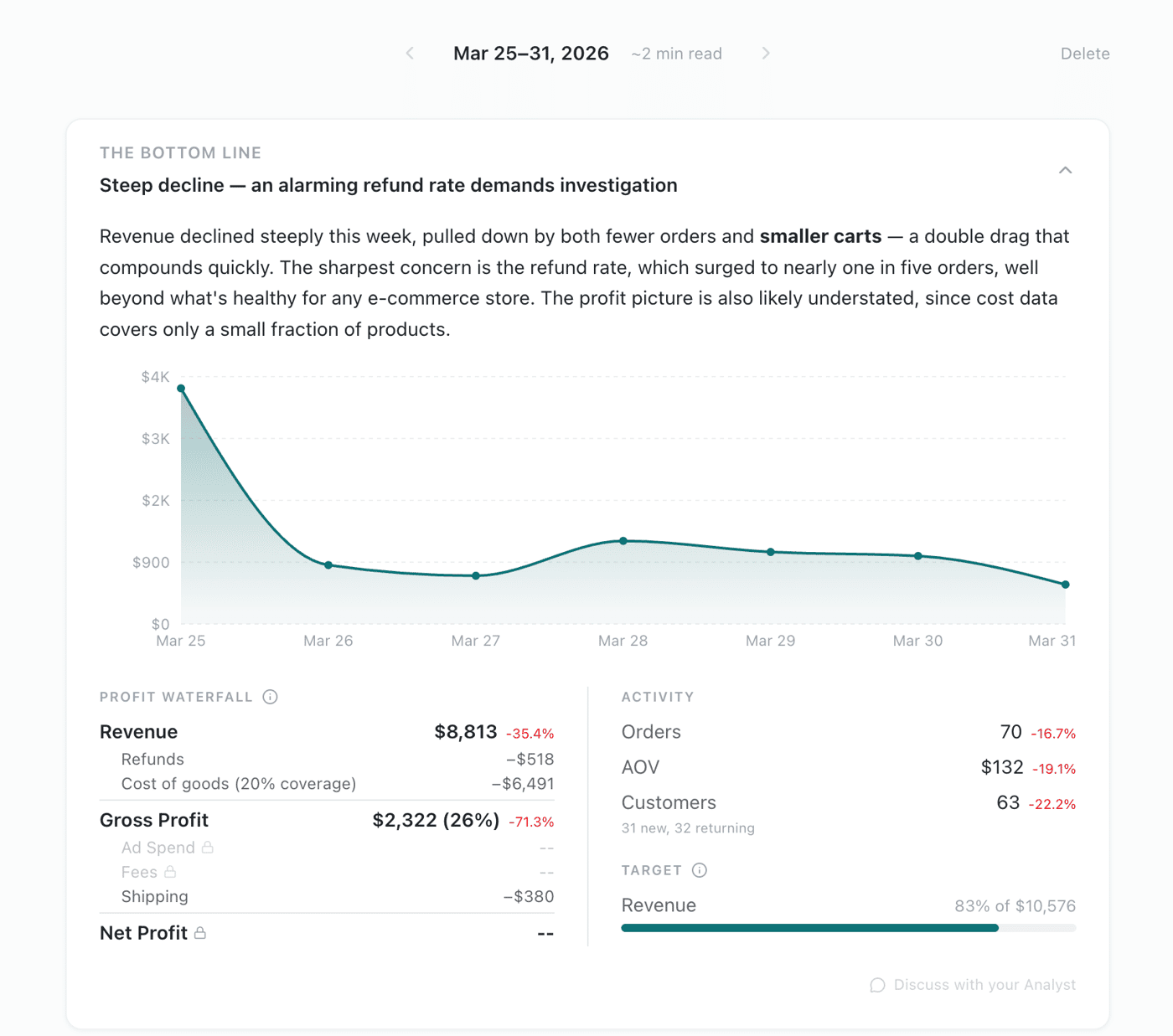
Still $0 MRR. Still solo. Still bootstrapped. The thing I'm testing next is whether email delivery actually changes behavior compared to a dashboard — or whether people ignore the email the same way they ignore dashboards.
The "one metric, one action, move on" pattern came up over and over from the most experienced owners. If you had to pick ONE thing you'd want a morning email to tell you about your business — not just the number, but what it means and what to do about it — what would it be?

