A tiny retention signal that meant more than my first sale
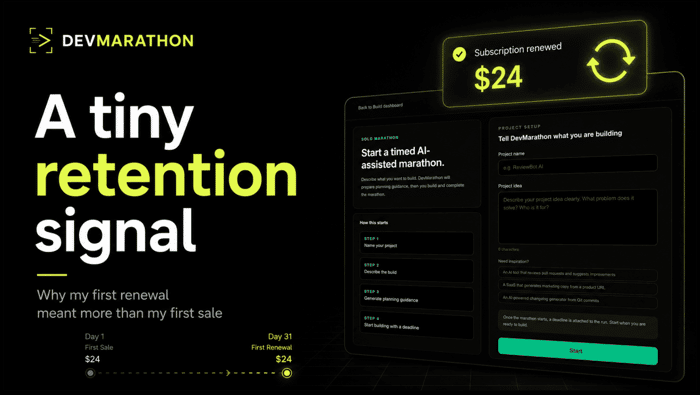
About a month ago, DevMarathon got its first paying subscriber on the $24/month plan.
At the time, I was happy about it. Getting someone to pay for something you built feels different from getting another signup or another page view.
But I also knew that one payment doesn't prove much.
Maybe they were curious.
Maybe they wanted to try the product once.
Maybe they would cancel before the next billing cycle.
So I tried not to overinterpret it.
Today, the subscription renewed.
Another $24 payment came in.
It's a very small amount of revenue, and I'm not pretending otherwise.
But this second payment felt more meaningful than the first one.
The first payment and the second payment mean different things
The first payment told me:
Someone is willing to try this.
The renewal tells me something slightly different:
Someone may see enough value to keep this around.
Of course, one renewal is not product-market fit.
It's not statistically meaningful.
It's not a growth story yet.
But when you're building something this early, small signals matter because there isn't much noise around them.
You can actually stop and ask what they might be telling you.
Where DevMarathon is today
DevMarathon is still very early.
I'm building it around the idea that developers should be able to prove their abilities through real project work, while companies should be able to evaluate candidates based on actual execution instead of relying only on CVs, interviews, and take-home assignments.
Both the developer and B2B hiring sides are live, and I'm continuing to refine the experience as I learn from real usage.
I wrote about the original idea behind DevMarathon here, back when the product was at an earlier stage.
There are no impressive revenue charts to share yet.
No huge customer numbers.
Just a product that is starting to meet the real world.
And right now, one of the most useful things I can do is pay attention to the difference between people who try it and people who decide to stay.
Retention feels more interesting than acquisition
As founders, it's easy to get excited about acquisition.
A new signup.
A new customer.
A new payment notification.
Those moments are visible and immediate.
Retention is quieter.
It happens later.
And I think that's why this renewal felt different.
The first sale answers:
"Is someone willing to pay for this?"
Retention begins to answer:
"Was there enough value after the purchase?"
That second question is much harder.
And much more important.
What I'm thinking about next
This renewal doesn't make me want to celebrate the extra $24.
It makes me want to understand the reason behind it.
What part of the product is valuable enough to keep paying for?
What problem is DevMarathon solving well today?
What would make that value clearer for the next user?
And eventually, can I turn one renewed subscription into a repeatable pattern?
That's the real milestone I'm interested in.
Not $24 becoming $48.
But one signal becoming something I can understand, reproduce, and build on.
Still very early.
Still a lot to figure out.
But today, DevMarathon felt a little less like an idea I'm trying to validate and a little more like a product beginning to earn its place.
For other founders building at this stage:
Did your first renewal feel more meaningful than your first sale?

The renewal gives you something more valuable than a data point: access to one customer’s timeline. Before asking why they renewed, I’d reconstruct what they actually did—projects completed, feedback viewed, company interactions, and return frequency before billing—then ask, “What would you use if DevMarathon disappeared tomorrow?” That avoids leading them toward a feature you hope is valuable. I’d also watch the third cycle, since a second payment can still be inertia or a forgotten cancellation. The repeatable signal is probably a behavior pattern that consistently appears before renewal, not renewal by itself.
This is a really useful way to look at it. I especially like the distinction between the renewal itself and the behavior that happens before it.
And you’re right about the third cycle too. One renewal is interesting, but not enough to draw conclusions yet.
The non-leading question is a great idea as well. Thanks for this.