A tweet about my AI dev tool hit 250K views. I didn't even have a product yet.
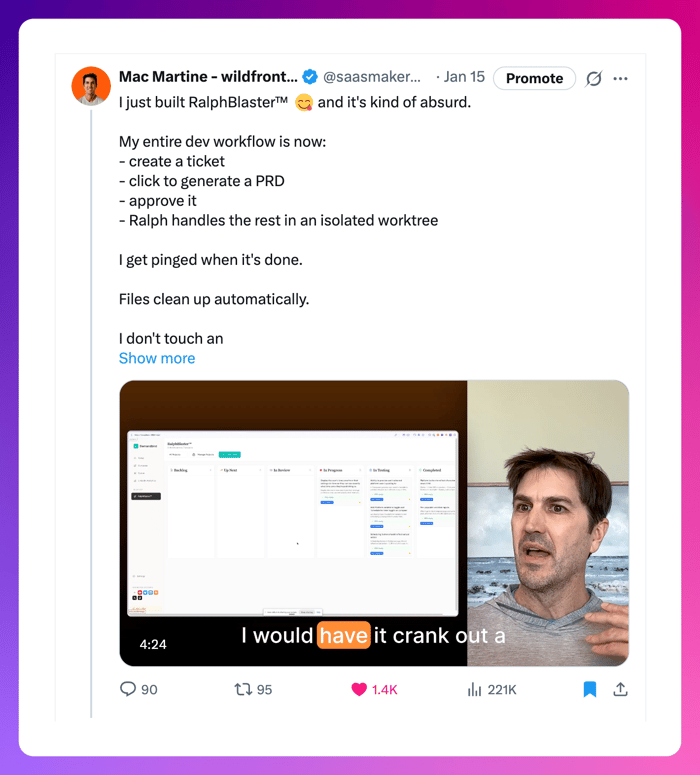
A few weeks ago I tweeted a demo of a tool I'd been building for myself, an autonomous coding agent that runs while you sleep. Describe a feature, walk away, come back to a PR with passing tests.
I posted it mostly for my existing audience (I'm a bootstrapped SaaS founder, been building and selling software businesses since 2011). Figured maybe a few hundred people would see it.
It hit 221K views (300k across a couple tweets). 1,400 likes. 2,500 bookmarks.
Here's the thing — I didn't have a product. I had a tool I built for myself and my co-founder to use internally across our portfolio of products at Wildfront. No name, no website, no waitlist.
Once I saw the tweet taking off (the morning after I posted it) I scrambled. Within hours I had a name (RalphBlaster), threw up a landing page, and added a waitlist. 750 people signed up.
Then I actually had to build it. Went from internal tool to real product in about three weeks.
What I think worked:
-
The demo was real. Not a mockup, not a pitch deck. An actual screen recording of the tool doing its thing. People could see it working.
-
Timing. AI coding tools are a hot topic and people are curious about what actually works vs. what's hype.
-
I didn't try to sell anything. The tweet was just "look at this thing I built." No CTA, no link, no pitch. The demand came to me.
-
I moved fast when it mattered. Could've sat on it and let the moment pass. Instead I got a waitlist up same day.
What I'd do differently:
-
Have the landing page ready before posting. I left signups on the table in those first few hours.
-
Better capture on the tweet itself — I added the waitlist link in a reply, but a lot of people never saw it.
Takeaway for other founders: If you're building tools for yourself, show them to people. The stuff you build to scratch your own itch is often exactly what others need. And if something starts getting traction, move fast — that window doesn't stay open long.
But the bigger lesson is:
I've been doing this for many many years and I've tried nearly every approach — from spending two years on a product before launch (huge mistake early on) to launching things within 24 hours, to things like this where I seriously had zero intention of turning this into a product. Instead I accidentally ran into the demand.
You really never know what's going to hit. Even the things we feel most passionate about or most convinced will do well often don't, and vice versa. So the lesson is truly to make a lot of small bets.
Happy to answer questions about the build, the launch, or what autonomous coding agents actually look like in practice. You can check out RalphBlaster — it's live and taking new users.
I also co-run Wildfront, and we have an amazing community and portfolio of bootstrapped SaaS products. If you're a founder building in this space, come join us.

750 signups before even building RalphBlaster is wild—I wish I had that kinda traction before launching
spent 8 months building a SaaS with 0 customers and 6 months on a marketplace with just 12 users, so I know how brutal it is when the demand isn't there
Definitely get a landing page up before sharing, even a simple one can catch those early signups
show real demos as you did, that kinda authenticity hits way better than mockups
move fast when momentum hits, don't let that initial interest slip away
How did you decide what to prioritize in those first three weeks of actually building the product?
Appreciate this. The 8 months → 0 customers story is painfully familiar — I've been there too. We're putting up a simple early-access form this week (Tally) just to stop overthinking it. Your point about real demos is spot on. Right now prioritization is: 1) finish the growth agent stub so it can actually draft content, 2) dogfood it to write about dogfooding it. Very meta, very indie hacker.
The "make a lot of small bets" takeaway is the part I think most people will skim past, but it's worth highlighting. And your point about building for yourself is spot on — if you built it to solve your own problem, at least you know the problem is real.
Curious about the three-week sprint from internal tool to real product — what was the biggest gap between "works for me" and "works for strangers"?
750 signups and the challenge now is figuring out which ones to prioritize. One thing that helped me a lot at that stage - enriching signups automatically so you can see job title and company right in Slack the moment someone comes in. You can quickly spot the "Head of Eng at a 200-person startup" in the noise without any manual research. Trial Hook does this for free. Check it out: https://www.trialhook.com/
keep it up
The "move fast — that window doesn't stay open long" point is backed up by a lot of failure data.
I've gone through postmortems of 127 failed startups, and timing failure is one of the 8 consistent patterns — but it cuts both ways. The more common version isn't launching too late. It's having a timing signal and not acting on it.
Color.com raised $41M for photo sharing in 2011. Instagram launched the same week. Color had more money, more people, more press. Instagram had a team that moved faster on what the market was signaling.
Your "accidental demand" discovery is actually the cleanest possible validation signal — the market revealed itself without you having to interpret survey data or beta user feedback. The only question after that moment is: how fast can you move?
750 signups from a no-product landing page is remarkable. The 3-week build-from-internal-tool-to-product timeline is the right call — most founders would have spent 3 months planning first.
The "make a lot of small bets" lesson is the one that doesn't get written about enough because it looks like luck from the outside.
Thank you, this is useful. validate and then build.
Thanks for sharing this. Having a wait list landing page ready before posting about it is worth a trial. I will implement this.
This is such a solid example of “build it for yourself, then show it.” The real demo + no pitch combo is powerful, and the way you moved fast once demand showed up is textbook. Big takeaway on making lots of small bets, thanks for sharing this so honestly
Really appreciate you sharing this honestly - both the wins and the "what I'd do differently." This is one of the most useful posts I've read here.
I'm in the exact same spot right now. Building an AI workflow for myself as a solo founder — not just coding but growth, ops, pipeline, the whole context-switching problem. No product yet, just started writing about what the setup looks like day-to-day and trying to see if the idea resonates.
Your point about having the landing page ready before posting is exactly the kind of mistake I'm about to make. And the "I didn't try to sell anything" lesson — that's what I'm trying to do too. Just show the work, see if people care.
The part I'm stuck on: you had an existing audience from years of building in public. For someone starting from zero, "just tweet it" doesn't quite work. Curious how you'd approach the early traction problem without the built-in following.
Give a try to my Reddit Extension. It's a Chrome extension called Pulse of Reddit that basically acts like my own alert system for Reddit.
Anytime someone posts something with keywords I care about like 'looking for a designer' or 'best SEO tool' it pings me right away. It’s saved me so much time and helped me hop into threads while they’re still fresh.
If you’re tired of manual digging and want to catch those conversations early, I’d really recommend giving it a look.
It’s free to start and super simple to set up.
Website:
pulseofreddit.com
I’m doing a 14-day experiment building income from $0 using only free AI tools.
No ads or client work — just structured execution.
Still early, but it’s been interesting seeing what’s actually viable vs hype.
Give a try to my Reddit Extension. It's a Chrome extension called Pulse of Reddit that basically acts like my own alert system for Reddit.
Anytime someone posts something with keywords I care about like 'looking for a designer' or 'best SEO tool' it pings me right away. It’s saved me so much time and helped me hop into threads while they’re still fresh.
If you’re tired of manual digging and want to catch those conversations early, I’d really recommend giving it a look.
It’s free to start and super simple to set up.
Website:
pulseofreddit.com
I enjoyed reading this because it didn’t feel like a tale of a launch. ~
Instead, it felt like a person getting surprised by their own acceleration.
The part that jumped out at me was that the demo was literally a screen recording of a tool you already used. No pitch.
No landing page. No positioning. Just, “Here’s what I built for myself, and it works.” That is probably more convincing than most of the described launches.
I can also understand that the tweet outpaced the product.
It sounds a bit crazy, but I can totally understand the scramble to name it, put up a page, and create a waitlist.
It made me think that I should probably show more of the tools I build instead of waiting until they are all done.
Give a try to my Reddit Extension. It's a Chrome extension called Pulse of Reddit that basically acts like my own alert system for Reddit.
Anytime someone posts something with keywords I care about like 'looking for a designer' or 'best SEO tool' it pings me right away. It’s saved me so much time and helped me hop into threads while they’re still fresh.
If you’re tired of manual digging and want to catch those conversations early, I’d really recommend giving it a look.
It’s free to start and super simple to set up.
Website:
pulseofreddit.com
“Make a lot of small bets” is such a solid takeaway. Love how this went from internal tool to product just because you showed it.
Give a try to my Reddit Extension. It's a Chrome extension called Pulse of Reddit that basically acts like my own alert system for Reddit.
Anytime someone posts something with keywords I care about like 'looking for a designer' or 'best SEO tool' it pings me right away. It’s saved me so much time and helped me hop into threads while they’re still fresh.
If you’re tired of manual digging and want to catch those conversations early, I’d really recommend giving it a look.
It’s free to start and super simple to set up.
Website:
pulseofreddit.com
The "always have a landing page ready" lesson is one I keep learning the hard way. We've had similar moments where an offhand demo got more traction than anything we deliberately promoted.
The question nobody's asked yet: how do you handle trust and audit when an autonomous coding agent moves from internal dogfooding to external customers? Internally you can spot-check PRs and know the codebase. External users running this against their own repos need to know what the agent touched, what it skipped, and why. "Tests pass" is a proxy for correctness, not proof of it. That governance layer could be a real differentiator rather than just overhead. How are you thinking about that as you go from 750 waitlist signups to actual production usage?
Give a try to my Reddit Extension. It's a Chrome extension called Pulse of Reddit that basically acts like my own alert system for Reddit.
Anytime someone posts something with keywords I care about like 'looking for a designer' or 'best SEO tool' it pings me right away. It’s saved me so much time and helped me hop into threads while they’re still fresh.
If you’re tired of manual digging and want to catch those conversations early, I’d really recommend giving it a look.
It’s free to start and super simple to set up.
Website:
pulseofreddit.com
@mac — congrats on the progress. I really like that you validated the idea by building it for your own use first. That’s often the strongest foundation for real product-market fit.
Your landing page is well done — it clearly communicates the problem, target audience, and value proposition. The $1 first-month offer is smart risk removal and creates a strong incentive to try the product. Overall, it’s a very solid early offer.
With development cycles and costs coming down so much, you’ve positioned this well, especially given your experience in SaaS.
At this stage, I’d say the biggest lever is continuing to focus on deep customer feedback and refining the strategy around it to truly lock in PMF.
I’d love to learn from your journey and share insights as well. Let’s keep the dialogue going.
Give a try to my Reddit Extension. It's a Chrome extension called Pulse of Reddit that basically acts like my own alert system for Reddit.
Anytime someone posts something with keywords I care about like 'looking for a designer' or 'best SEO tool' it pings me right away. It’s saved me so much time and helped me hop into threads while they’re still fresh.
If you’re tired of manual digging and want to catch those conversations early, I’d really recommend giving it a look.
It’s free to start and super simple to set up.
Website:
pulseofreddit.com
Appreciate the transparent post-mortem. Three things resonate:
Real demo over polish — in regulated fields like compliance, seeing actual working logic builds trust faster than any pitch deck.
Timing & trend alignment — you caught the AI coding wave. For compliance tools, the shift toward automated governance feels like a similar momentum building.
Speed over perfection — launching the waitlist same day is a mindset shift many builders (myself included) need to embrace.
The landing page lesson is one I'm taking with me as I build. Thanks for sharing the real takeaways.
Give a try to my Reddit Extension. It's a Chrome extension called Pulse of Reddit that basically acts like my own alert system for Reddit.
Anytime someone posts something with keywords I care about like 'looking for a designer' or 'best SEO tool' it pings me right away. It’s saved me so much time and helped me hop into threads while they’re still fresh.
If you’re tired of manual digging and want to catch those conversations early, I’d really recommend giving it a look.
It’s free to start and super simple to set up.
Website:
pulseofreddit.com
750 signups from zero intent to launch is honestly the best kind of validation. You weren't trying to prove anything, you were just showing what you built — and that's exactly why it worked.
I've been building dev tools myself and the "scratch your own itch" approach keeps proving out. The stuff I build because I actually need it always resonates more than things I build because I think there's a market.
One thing I keep coming back to from your post: having the landing page ready BEFORE going viral. I've had smaller moments like that where something gets traction and I'm scrambling to capture it. Now I always have at least a basic page up for anything I'm working on, even if it's half-baked. The cost of a landing page is nothing compared to losing that window.
Thanks! Keep going! You sound like you might be a good fit for our community https://substack.com/chat/5899761
Give a try to my Reddit Extension. It's a Chrome extension called Pulse of Reddit that basically acts like my own alert system for Reddit.
Anytime someone posts something with keywords I care about like 'looking for a designer' or 'best SEO tool' it pings me right away. It’s saved me so much time and helped me hop into threads while they’re still fresh.
If you’re tired of manual digging and want to catch those conversations early, I’d really recommend giving it a look.
It’s free to start and super simple to set up.
Website:
pulseofreddit.com
The "accidental demand" thing hits home. I'm juggling 4 side projects and honestly it's partly because you just can't know which one catches. My "strongest" idea has barely any traction while something I almost didn't ship is getting organic signups.
What I'm curious about - the demo being a screen recording of an actual tool doing its thing, not a pitch deck. I've been building with AI coding tools myself and keep wondering if I should share more of the process publicly. Did showing the agent writing code feel risky before you knew it worked as a demo? Like were you worried people would pick apart edge cases or was that never a concern?
Also 3 weeks from waitlist to live product is wild. How much of what shipped was the original internal tool vs rebuilt for paying users?
Give a try to my Reddit Extension. It's a Chrome extension called Pulse of Reddit that basically acts like my own alert system for Reddit.
Anytime someone posts something with keywords I care about like 'looking for a designer' or 'best SEO tool' it pings me right away. It’s saved me so much time and helped me hop into threads while they’re still fresh.
If you’re tired of manual digging and want to catch those conversations early, I’d really recommend giving it a look.
It’s free to start and super simple to set up.
Website:
pulseofreddit.com
mice
Give a try to my Reddit Extension. It's a Chrome extension called Pulse of Reddit that basically acts like my own alert system for Reddit.
Anytime someone posts something with keywords I care about like 'looking for a designer' or 'best SEO tool' it pings me right away. It’s saved me so much time and helped me hop into threads while they’re still fresh.
If you’re tired of manual digging and want to catch those conversations early, I’d really recommend giving it a look.
It’s free to start and super simple to set up.
Website:
pulseofreddit.com
Wow, this is inspiring for a new developer like me. I just launched my first project with a $0 budget. Built on a broken phone, it's a habit tracker web app that tracks habits with an AI coaching system.
That's exciting! You sounds like you might be a good fit our our private SaaS founder community https://substack.com/chat/5899761
Give a try to my Reddit Extension. It's a Chrome extension called Pulse of Reddit that basically acts like my own alert system for Reddit.
Anytime someone posts something with keywords I care about like 'looking for a designer' or 'best SEO tool' it pings me right away. It’s saved me so much time and helped me hop into threads while they’re still fresh.
If you’re tired of manual digging and want to catch those conversations early, I’d really recommend giving it a look.
It’s free to start and super simple to set up.
Website:
pulseofreddit.com
This resonates a lot. The “real demo, no pitch” part is such an underrated lesson. I’ve seen the same thing — when you show something you actually built for yourself, people trust it instantly. Also +1 on moving fast once traction appears. That window is real and it closes quickly. Great reminder to make more small bets instead of over-planning.
Give a try to my Reddit Extension. It's a Chrome extension called Pulse of Reddit that basically acts like my own alert system for Reddit.
Anytime someone posts something with keywords I care about like 'looking for a designer' or 'best SEO tool' it pings me right away. It’s saved me so much time and helped me hop into threads while they’re still fresh.
If you’re tired of manual digging and want to catch those conversations early, I’d really recommend giving it a look.
It’s free to start and super simple to set up.
Website:
pulseofreddit.com
Great execution on the pivot from attention → waitlist. 750 signups from a viral tweet is solid.
Now the harder part: converting waitlist to paying customers.
A few things I've seen work at this stage:
Segment the 750 aggressively
Pre-sell before building more
Mine those tweet replies for positioning language
Curious: What's the next step for KnowItUp? Are you building based on feature requests or going back to those 750 to validate willingness to pay?
Give a try to my Reddit Extension. It's a Chrome extension called Pulse of Reddit that basically acts like my own alert system for Reddit.
Anytime someone posts something with keywords I care about like 'looking for a designer' or 'best SEO tool' it pings me right away. It’s saved me so much time and helped me hop into threads while they’re still fresh.
If you’re tired of manual digging and want to catch those conversations early, I’d really recommend giving it a look.
It’s free to start and super simple to set up.
Website:
pulseofreddit.com
Great execution on the pivot from attention → waitlist. 750 signups from a viral tweet is solid.
Now the harder part: converting waitlist to paying customers.
A few things I've seen work at this stage:
Segment the 750 aggressively
Pre-sell before building more
Mine those tweet replies for positioning language
Curious: What's the next step for KnowItUp? Are you building based on feature requests or going back to those 750 to validate willingness to pay?
yamamoto7's question about the 750 → launch path is exactly where most founders lose momentum.
The pattern I've seen work: you don't need to talk to all 750. Talk to the 15-20 who signed up and then emailed you unprompted asking when it's ready. That self-selection signal is gold.
Mac's internal usage gave him the thesis. The waitlist validated demand existed. But the people who couldn't wait? Those are the ones who'll tell you what actually needs to work on day one vs what can ship later.
The real insight here is what Mac mentioned about "small bets" — most founders get this backwards. They think viral validation means "build everything now." It actually means "ship the absolute minimum that delivers on what made the demo resonate, then iterate fast with the people who are most impatient."
The demo showed autonomous overnight coding. That's the promise. Everything else can be rough edges.
Give a try to my Reddit Extension. It's a Chrome extension called Pulse of Reddit that basically acts like my own alert system for Reddit.
Anytime someone posts something with keywords I care about like 'looking for a designer' or 'best SEO tool' it pings me right away. It’s saved me so much time and helped me hop into threads while they’re still fresh.
If you’re tired of manual digging and want to catch those conversations early, I’d really recommend giving it a look.
It’s free to start and super simple to set up.
Website:
pulseofreddit.com
"I didn't try to sell anything" — this is the part most founders get wrong. The moment something feels like a pitch, engagement drops.
I've noticed the same pattern: showing what you're actually building (even if rough) generates more genuine interest than polished marketing. People can smell authenticity.
The "small bets" framing is spot on too. After 14+ years you've internalized something that takes most founders too long to learn: you can't predict what will resonate, so optimize for volume of attempts, not perfection of any single one.
Curious about one thing: with 750 waitlist signups, how did you decide what to prioritize for the initial launch? Did you talk to any of them before building, or did you already have a strong thesis from your own usage?
Give a try to my Reddit Extension. It's a Chrome extension called Pulse of Reddit that basically acts like my own alert system for Reddit.
Anytime someone posts something with keywords I care about like 'looking for a designer' or 'best SEO tool' it pings me right away. It’s saved me so much time and helped me hop into threads while they’re still fresh.
If you’re tired of manual digging and want to catch those conversations early, I’d really recommend giving it a look.
It’s free to start and super simple to set up.
Website:
pulseofreddit.com
Funniest part was you were saying, "Should I even post a video about this?"
And we were like "heck yeah dude what's the downside"
Then it blew up.
Give a try to my Reddit Extension. It's a Chrome extension called Pulse of Reddit that basically acts like my own alert system for Reddit.
Anytime someone posts something with keywords I care about like 'looking for a designer' or 'best SEO tool' it pings me right away. It’s saved me so much time and helped me hop into threads while they’re still fresh.
If you’re tired of manual digging and want to catch those conversations early, I’d really recommend giving it a look.
It’s free to start and super simple to set up.
Website:
pulseofreddit.com
Spam^
This comment was deleted 7 months ago