Abacus AI Deep Agent Review: The AI Super Assistant That Builds Apps Fast
If you’ve been looking into Abacus AI there’s a good chance you’re asking a very practical question:
Can this thing actually help you build a real app, or is it just another flashy AI demo?
That’s exactly where Deep Agent stands out. Inside the Abacus AI ecosystem, it’s positioned as an AI Super Assistant that goes beyond answering prompts. It can plan, build, debug, and help deploy software with far less manual effort than traditional app development. And for people who want an AI App builder that feels closer to an actual product team than a chatbot, that promise is hard to ignore.
For founders, operators, marketers, creators, and even developers, Deep Agent opens a new lane: build apps without coding, or at least without getting buried in the technical setup that usually slows everything down.
In this review, I’ll break down what Deep Agent does well, where it still needs human judgment, and how it compares to both classic no-code platforms and hiring developers.
What Is Abacus AI Deep Agent?
Abacus AI is both a Gen AI company and an AI Super Assistant platform built for creation, research, automation, and productivity. Deep Agent is the product layer that takes that intelligence and turns it into action.
Instead of only giving answers, Deep Agent can complete connected tasks such as:
planning app architecture
generating code
building frontend and backend systems
connecting a database
adding authentication
supporting payments
debugging issues
helping with deployment
powering AI workflow automation
That’s what makes it different from a normal chatbot. It’s not just waiting for your next prompt. It’s designed to operate more like agentic AI - an active system that can move through a sequence of tasks with context.
In plain English, it behaves like an AI App builder with enough autonomy to be useful for real work.
Why Deep Agent Feels More Useful Than a Typical AI Chatbot
There’s a real difference between an AI that writes snippets and one that helps ship products.
A standard chatbot can absolutely help with code. But it still tends to leave you holding the bag on everything else:
wiring pieces together
choosing the stack
setting up auth
handling storage
deploying the app
figuring out bugs when something breaks
Deep Agent is trying to reduce that load.
That matters because most app ideas are not blocked by a lack of imagination. They’re blocked by friction. Technical friction. Time friction. Hiring friction. Budget friction.
Deep Agent’s appeal is that it cuts through a lot of that early-stage drag. You describe the product, and it starts acting like a builder rather than a tutor.
That shift sounds small on paper. In reality, it changes the entire pace of work.
Can You Really Build Apps Without Coding?
Yes, in many cases, you can.
That’s one of the strongest arguments for Deep Agent. If your goal is to launch an MVP, internal tool, portal, dashboard, lightweight SaaS, booking system, or AI-powered utility, it can help you build apps without coding in the traditional sense.
You’re not manually writing routes, designing database tables from scratch, or piecing together a basic auth system one article at a time. Instead, you’re describing what the product should do and refining the output.
That makes Deep Agent especially attractive for:
founders without a technical background
consultants who want to launch digital products
agencies producing client tools
businesses building internal systems
creators testing product ideas
developers who want speed, not ceremony
The honest answer, though, is this: you may still need iteration.
The first version of an app may not be perfect. Some bugs may need fixing. Some flows may need refining. But that’s still very different from starting with a blank screen.
And that’s the real advantage of no code app development with AI. You don’t need perfection on day one. You need momentum.
What Deep Agent Does Best
1. It accelerates MVP creation
This is where Deep Agent really earns attention.
If you’ve ever spent weeks trying to turn an idea into something testable, you already know the hardest part is usually not the idea itself. It’s getting to a version that other people can click, use, and react to.
Deep Agent shortens that path.
That alone makes it valuable for early-stage app development, where speed of validation matters more than pixel-perfect polish.
2. It supports full-stack builds, not just pretty mockups
A lot of AI products generate a nice UI and call it a day.
Deep Agent appears far more useful because it can support the actual moving parts of a working app, including:
backend logic
persistent storage
authentication
payments
deployment-ready structure
That makes it feel much closer to a full-stack app builder than a glorified design generator.
3. It helps with debugging
This is a bigger deal than many people realize.
Generating an app is exciting. Fixing it is where the real work begins. Tools that can’t handle that step quickly become frustrating. Deep Agent’s ability to identify issues, revise code, and keep moving makes it more practical than many AI builders that stop at output generation.
4. It connects well with broader automation use cases
Deep Agent isn’t only useful for apps. It also fits into the world of AI automation tools.
That matters because businesses don’t just need products; they need systems. They need things like:
report generation
document analysis
research workflows
recurring business processes
connected task flows
smarter internal operations
That overlap between AI App builder and AI workflow automation is one of Deep Agent’s underrated strengths.
Abacus AI vs No-Code Tools
This is where the comparison gets interesting.
Traditional no-code platforms helped open the door for non-technical builders. Tools like Bubble, Glide, Softr, and others made it possible to launch apps without learning to code from scratch. That was a huge leap.
But they still come with a learning curve.
You may not be writing JavaScript, but you’re often still learning:
platform-specific logic
database setup
visual workflows
conditional rules
connectors and plugins
page structure and states
So while they’re called no-code, many of them still require “builder logic.” It’s just a different kind of technical work.
Where Abacus AI has an advantage over no-code tools
With Abacus AI especially Deep Agent, the experience starts with language instead of interface configuration.
You tell it what you want. It interprets the product goal, plans the architecture, and begins building. That makes it more natural for people who think in business outcomes rather than workflow diagrams.
Abacus AI vs no-code tools: key differences
Abacus AI Deep Agent
prompt-based building
stronger autonomous planning
more natural for non-technical users
can help with code, debugging, and deployment
useful for both apps and automation
Traditional no-code tools
visual builders
more manual setup
better if you like drag-and-drop control
often require learning platform logic
can become rigid as projects grow
When no-code tools may still be better
To be fair, no-code tools still have strengths.
They can be better if:
you want tight manual control over layout and workflow
your team already knows the platform well
you prefer visual logic over prompt-based iteration
you’re building within a very specific ecosystem
So this is not a case of “Abacus AI kills no-code.”
It’s more accurate to say this: Deep Agent lowers the barrier even further. It removes a lot of the builder complexity that no-code platforms still expect users to manage.
If classic no-code helped people skip coding, Deep Agent helps people skip a chunk of the setup thinking too.
Abacus AI vs Developers
This comparison needs nuance, because it’s easy to oversimplify.
No, Deep Agent does not magically eliminate the need for developers in every situation.
But yes, it absolutely changes when, why, and how you need them.
Where Abacus AI can replace developer work
For many early-stage use cases, Deep Agent can reduce or replace the need to hire a developer immediately, especially for:
MVPs
internal business tools
landing-page-style web apps
client portals
educational sites
lightweight SaaS products
proof-of-concept tools
If you’re a founder trying to test an idea, this is huge. Instead of spending thousands upfront, you can get to a working version first and validate demand before bringing in a dev team.
Where developers still win
Professional developers still matter for:
complex architecture decisions
security-heavy applications
performance optimization
compliance requirements
custom integrations at scale
long-term maintainability
advanced product strategy
There’s also a practical reality: a generated app may still need human review before it’s production-grade.
So the better framing is not “Abacus AI vs developers” as if one must completely defeat the other.
It’s this:
Abacus AI vs developers: the real answer
Deep Agent can replace a lot of repetitive, early-stage, and boilerplate-heavy work.
Developers still provide critical judgment, refinement, and production-level engineering.
The smartest teams will often use both.
That’s why I see Deep Agent less as a total replacement and more as a force multiplier.
For non-technical users, it can remove the need to hire developers too early.
For developers, it can remove tedious work and speed up execution.
For businesses, it can lower the cost of experimentation.
That’s a meaningful shift.
Real-World Scenarios Where Deep Agent Makes Sense
To understand the value, it helps to think in scenarios.
A startup founder
You have an idea for a niche SaaS tool. Normally, you’d need a wireframe, a dev estimate, and probably a budget you don’t want to spend yet. Deep Agent helps you get a working version first.
A consultant
You want to offer clients a branded portal or a lightweight tool as part of your service. Instead of outsourcing the entire build, you can use Deep Agent to create a solid first version.
A small business owner
You need a booking flow, customer dashboard, or internal reporting tool. Hiring a full team would be overkill. Deep Agent gets you there faster.
A developer
You already know how to build the app, but you don’t want to waste hours on setup, boilerplate, auth, and repetitive scaffolding. Deep Agent helps you move faster.
This is where the time and cost advantages become obvious.
Pricing Value and ROI
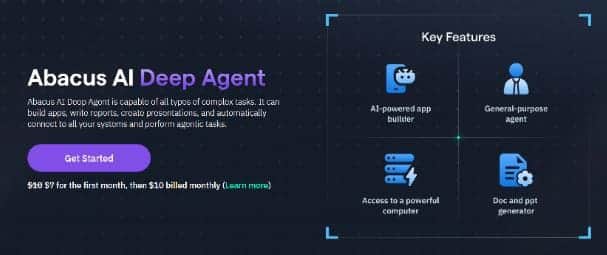
When people evaluate AI automation tools, they often focus only on the subscription cost.
That’s the wrong lens.
The real question is: what does the tool save you?
If Deep Agent helps you:
avoid hiring too early
shorten time to launch
reduce development cycles
test ideas faster
build internal tools cheaply
then the value is not in the monthly fee alone. It’s in the time saved and the decisions accelerated.
For many users, the biggest return is not just cheaper building. It’s faster learning.
And in business, faster learning is often more valuable than cheaper labor.
Limitations You Should Expect
No serious review should pretend this is flawless.
Here are the tradeoffs:
1. You still need clear prompts
If your idea is messy, the output may be messy.
2. Iteration is part of the process
You may need to refine features, fix bugs, and improve flows.
3. Credits or usage constraints matter
Larger builds and repeated debugging can increase usage.
4. Complex products still need human oversight
For serious production environments, you’ll still want technical review.
None of that weakens the core value. It just sets realistic expectations.
Who Should Use Deep Agent?
Deep Agent is a strong choice for:
entrepreneurs
solopreneurs
agencies
freelancers
product managers
creators
businesses building internal tools
developers who want faster output
If your goal is build apps without coding, or at least without doing all the coding yourself, it’s one of the more compelling options currently available.
Final Verdict: Is Abacus AI Deep Agent Worth It?
Yes, especially if you care about speed, experimentation, and reducing the friction between idea and execution.
As part of Abacus AI Deep Agent feels like more than a trendy builder. It’s a practical AI Super Assistant for people who want to create products, automate work, and move faster. It combines elements of agentic AI, no code app development, and AI workflow automation in a way that feels genuinely useful.
Deep Agent won’t eliminate the need for every no-code tool or every developer, but it can absolutely reduce how much time, money, and manual effort you need to get an app off the ground. And honestly, that’s enough to make it important.

