After 200+ sign ups, I decided to completely rebuild my product, BetaBloom. Here's why.
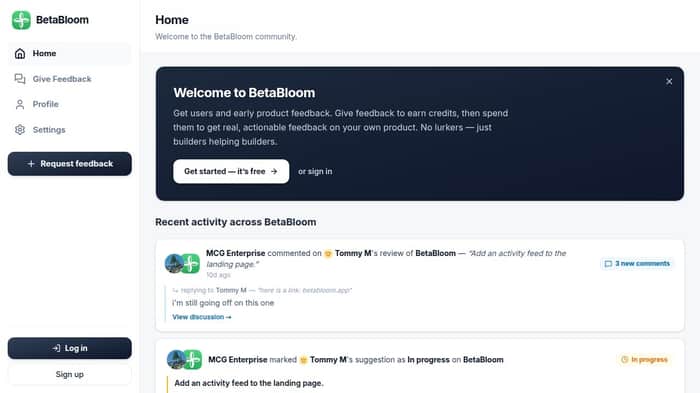
I started BetaBloom with the goal of helping indie founders get early product feedback. I found an organic user acquisition strategy that was working well. The platform grew to 200+ products published, 230+ sign ups, 630+ pieces of feedback shared. No money spent on traffic.
However, I realized some fundamental issues that would hinder long term retention and monetization. I made the decision to halt my marketing efforts so I could focus entirely on a ground up rebuild. Here are the problems I identified and how they've been addressed in the re-launch of BetaBloom.
- Paywall Repelant
In the old model, my monetization plan was to require paid membership in order for founders to view >N pieces of feedback. For example, they could view their first 5 pieces of feedback for free but would need to be a paid member to view 6th and beyond. The critical problem with this model is that any founder who decided not to upgrade at that point would then have no incentive to continue participating. Therefore they would no longer be potential providers of feedback to other products.
In the new model, founders spend credits to request feedback from the network. Credits can be paid for – or earned by giving feedback to other products. Founders who rather not pay can instead leverage their time to earn credits and receive more feedback.
- No Reciprocity Guarantee
In the old model, the network was a feed of products that wanted feedback. You could boost your product higher in the feed and get more visibility by providing feedback to other products. The critical problem is that this did not guarantee you would receive feedback in return. You might appear high in the feed momentarily, only to be superseded by a different product and not necessarily receive any feedback.
In the new model, you spend credits to request feedback. Feedback requests sit in a queue and do not disappear until someone provides actionable feedback. Your feedback request will have to be fulfilled before newer requests can appear in the queue.
- Activity Silos
In the old model, community activity was only visible when you received feedback on your own product or in regard to feedback you had given to other products. The community was active but new users coming to BetaBloom could easily get the impression that it was an inactive community because they couldn't see what was going on across other products.
In the new model, anonymous and signed-in users first land on a home activity feed. They can immediately see feedback and lively discussions taking place across the network of products. They get a sense of a lively community from which they can derive value and actionable feedback.
All new users can create their first feedback request for free. Give it a try and let me know what you think. https://betabloom.app/

Credits solve liquidity only if they are earned for accepted feedback, not submitted feedback. I would track acceptance rate and median fulfillment time per contributor, then weight future earning by accepted quality. Otherwise a founder can farm credits with fast generic notes while careful reviewers wait longer, and the activity feed will look healthier as trust gets worse.
Yep that's right. Credits are held in escrow until the feedback is "accepted". Founder can "decline" feedback but must also provide a reason.
That closes the obvious credit-farming loop. The next metric is decline rate by requester, because the requester controls acceptance and can reject useful feedback to recover credits. If one founder declines far above peers, route those cases to lightweight review instead of refunding automatically; otherwise quality control becomes a free-feedback exploit.
Exactly! Thanks for the input.
200+ signups then a rebuild is a gutsy call — respect it. Curious: when you relaunch BetaBloom, how are you planning to find the first users who actually feel the pain? Are you hunting Reddit/niche communities for people describing the problem, or leaning on your existing signups? Asking because I built a small tool around exactly that hunt and want to see if it maps to how you're thinking about relaunch distribution.
There is a vast supply of people building software solo or with small teams and looking for their first users and feedback. Many of them are posting on X or Reddit and the vast majority are not getting engagement. They're desperate for feedback.
One strategy that has worked super well is I just go give these founders feedback directly. The feedback lives on a page within BetaBloom so that I can easily convert and onboard them. A major issue I've run into though is that Reddit will flag my account as spam because I'm sharing a lot of links - despite the fact that all recipients are super grateful.
That spam-flag loop is brutal — especially when the founders who get the feedback actually appreciate it. Reddit usually punishes link volume + newish accounts, not the intent.
Two things that help in that workflow:
I built a scored digest for #1 (discovery of those pain/feedback threads). If useful, I can map a sample for “solo founders asking for feedback on X/Reddit” on a 10-min call — or send a feed if you drop 3–5 subs + phrases you already hunt.
What stood out to me is that you stopped optimizing for feedback volume and started optimizing for reciprocity. I'd keep validating whether founders are ultimately buying feedback or confidence that contributing to the network reliably creates value in return.
You're right. This is crucial. Without that, the network will fail.
One thing I'd keep watching is whether people eventually describe the product as a place to receive feedback or as a place where contributing reliably improves the quality of feedback they receive.
Those sound similar, but the second creates much stronger network effects over time.
Great insight. Thank you.
The credit change feels right because it keeps non-paying founders in the liquidity loop instead of turning them into churned spectators. One thing I'd watch closely: separate “I earned credits” from “I got useful feedback” in analytics. If credits move but request fulfillment quality drops, the marketplace can look active while trust is leaking.
Will need to watch closely for sure. Right now, the feedback can be declined if you provide a reason. Your credits would be refunded. The community can see when you decline feedback to encourage honesty and integrity.